 Muns
MunsProject Trishul not Shelved : DRDO
The Defence Ministry clarified that research and development work on the indigenous ship defence missile Trishul has not been stopped.
Additional PIO, Defence Ministry, Sitanshu Kar said, “Trishul missile system was taken back in the R&D mode during 2002 for addressing certain technical problems. Having overcome these, 20 flight tests were carried out between June 2003 and mid-2006. The last three trials have been conducted in July 2006.”
With this, Trishul’s development stands completed, he added. He said decision on induction is yet to be taken.
The clarifications came after media reports on Saturday quoted officials as saying that R&D work on Trishul will be stopped in December. The reports said instead, the Defence Research and Development Organisation will focus on developing an advanced version of the Israeli Barak missile.
MunsOld news…Trishul has now been in the tech demonstrator stage for the better of 2 years now. Recent reports point towards a revival with foreign collaboration mainly the Israeli’s but the main thrust is being given towards Barak 2 as a joint venture with tests to begin in 2008.
MunsAir Force personnel to be trained for Phalcon AWACs in Israel
The first batch of IAF personnel including pilots have been sent to Israel to get trained on operational and maintenance of the Air Early Warning and Control aircraft ahead of India receiving the first three AWACS late next year.
“A batch of IAF personnel have been sent to Israel for basic training in operating the AWACS,” a top IAF officer told PTI here during the ongoing Indo-UK joint air combat exercises.
Israel under a 1.1 billion US dollar deal is mounting three Phalcon airborne radars on a Russian IL-76 platform for delivery to India by December 2007.
In a run up to induction of the AWACS technology, IAF in the course of a number of bilateral air exercises is trying to get familiar with the technology. IAF was first exposed to operating under AWACS condition when the air warriors went to France, two years back to exercise with the French Air Force.
Last year at Kalaikunda in West Bengal, the US Air Force for the first time brought the AWACS (Airborne Warning and Control System) over the Indian skies.
In the just concluded Indo-UK air exercises codenamed Indradhanush-06, the Royal Air Force fielded their E-3D sentry AWACS.
“The Royal Air Force allowed four IAF fighter controllers everyday as observers to familiarise the IAF personnel with the complexities of AWACS operations,” Air Marshal K D Singh, Senior Air Staff operations, told newsmen.
Air Chief S P Tyagi had recently said that the force was in the process of setting up special laboratories for processing voice and data links downlinked by these advanced airborne surveillance aircraft.
He said that AIF expected all the sub systems for the AWACS to be in place before their induction in December next year.
MunsIndia, Britain conclude joint air exercises with promise of more
Gwalior (Madhya Pradesh), Oct 13 (IANS) Combat jets that were once ranged against each other during the Cold War flew in tandem as the Indian Air Force (IAF) Friday concluded its first joint exercise with its British counterpart with honours even and the promise of many such more exercises.
The IAF’s Russian-built SU-30 MKI might have been technologically superior to the British Tornado but the US-built E3D Sentry Airborne Warning and Control System (AWACS) the Royal Air Force (RAF) fielded ensured its aircraft had that extra edge – and thus there were no winners or losers in Exercise Indradhanush that began here Oct 2 at this sprawling airbase in central India.
“This was a marvellous opportunity to learn each other’s procedures, very educative and I hope the start of a burgeoning friendship,” Air Vice Marshal Christopher N. Harper, Chief Of Staff (Operations), Strategic Forces of the RAF said at a media interaction here.
“Some would judge this exercise by the number of kills each side achieved but that’s not the way to judge this exercise. We flew combined missions because the intention was to test our interoperability,” he explained.
“The idea was to familiarise and learn from each other in the air on the ground. It was a great learning experience for both sides, added Air Marshal K.D. Singh, senior air staff officer of the IAF central command that hosted the exercise.
The effort was unique in more ways than one. Not only were mid-air refuelling tankers deployed by both sides for the first time to enable the exercise envelop to a huge 120 km by 60 km, but it was only the second time that an AWACS was seen in operation in Indian airspace.
This was significant as the IAF will begin receiving the first of its three AWACS – an Israeli Phalcon radar mounted on a Russian IL-78 platform – from next year. To this end, the RAF AWACS carried four observers every day of the exercise to familiarise them with the highly sophisticated system.
A total of 24 aircraft participated in the exercise. The IAF fielded four each Sukhoi SU-30 MKIs, Mirage-2000s, MiG-27s and MiG-21 Bisons, and the IL-78 refueller. Six Tornados, the AWACS and a VC-10 refueller represented the IAF.
Asked why the IAF had not fielded its frontline Typhoon jet, Air Commodore Julian Shilton, said this was because it was just being inducted into squadron service.
“It’s at a very early stage. We have one formed squadron that is to be declared operational next year. The next time around, it would be useful to operate it along the SU-30,” he added.
On his part, Harper was lavish in his praise for the Su-30.
“It’s far superior to the Tornado and those of my pilots who flew it came back with rather silly smiles,” he stated amid much mirth.
The exercises were divided into two parts, with the combat jets operating from here and the AWACS and refullers from the Taj Mahal city of Agra. This was because the runway here was not catered to operating the heavy aircraft.
“Both the forces flew with each other in various missions involving up to four aircraft. The missions were planned keeping in view a building block approach,” explained Air Marshal Singh.
“Less complex missions were conducted in the first week, with the more difficult ones coming up in the second week, which saw a large force engagement being flown and the number of aircraft increasing to 12,” he added.
Operation Indradhanush grew out of an initiative between Indian Prime Minister Manmohan Singh and his British counterpart Tony Blair, to improve defence cooperation between the two countries.
As part of this, the two armies and navies conducted exercises last year and early this year respectively. The next IAF-RAF joint exercise is scheduled for 2007 in Britain.
–By Vishnu Makhijani
MunsNow, IAF mesmerises Royal Air Force
GWALIOR: A year after proving their mettle against the US Air Force, Indian fighter pilots have now won acclaim from the Royal Air Force after 10 days of intense joint air combat exercises over central India.
“Your fighter pilots are extremely skilled and quick on the button. They can be rated among the best in the world,” visiting Air-Vice Marshal Christopher N Harper, chief of RAF’s strike operations, said at the conclusion of the first Indo-British air force exercise held after a gap of 43 years.
Not only the men, but their flying machines too came in for awe from pilots and commanders of the RAF.
“It’s a super fighter and a mean machine,” was how one RAF pilot labelled the IAF’s frontline Sukhoi-30MKI combat jet, which along with Mirage 2000s, MiG-27s and upgraded MiG-21 Bisons participated in the exercise with the RAF’s mainstay Tornado F-3 air defence aircraft over the skies here.
Forseeing the contours of the emerging cooperation between armed forces of not only Britain and India, but other NATO allies, Harper said, “We live in an uncertain world where the antagonist is not known. A coordinated operation by like thinking nations is a must.” Following fighter exercise with the US Air Force last year, reports had suggested that IAF pilots had out-performed their American counterparts despite flying ageing jets like the MiG-21.
“We don’t know where the next conflict will erupt and we are looking for allies all over the world,” Harper said, adding that the focus in cooperation among major countries was on evolving “ways and means” to combat the meance of terrorism.
He said during the joint exercise, the RAF had been keen on learning from the IAF’s experience in the Kargil conflict of 1999, particulary the use of air power in combating armed militants holed up in mountain hideouts. “We also shared our experiences of the ongoing fighting in Afghanistan and in Iraq,” Harper said.
Avoiding giving out information on the kill and miss ratio during the air combat manoeuvres, both RAF and IAF officers said the aim of the exercise was to get familar with each other’s operating procedures and to indentify areas of commonality.
Though the RAF brought its upgraded Tornados for the joint exercise, Harper said that during the next exercise planned to be held in Britain in September next year, his force might field the new generation Typhoon Eurofighters.
But the machine that had the RAF in awe was the Su-30, with Air Commodore Julian Stinton saying the jet was “absolutely masterful in dog fights”.
Four RAF pilots flew the Su-30s while Indian pilots flew the RAF’s Tornados. The high point for the IAF was when the British allowed four fighter controllers to witness operations in the E3D Sentry Air Warning and Control System aircraft during a combat operational flight.
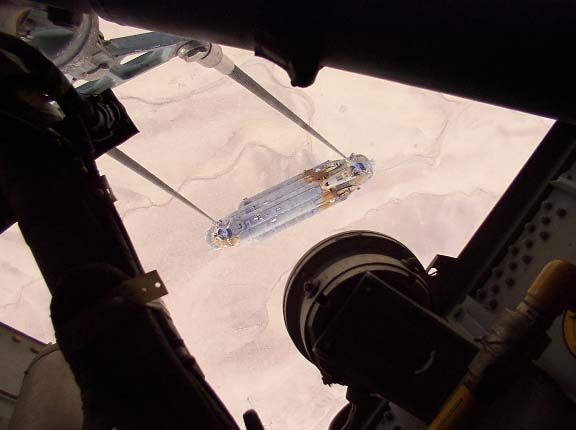
MunsHere’s a top view of the Chinook from the Mi – 26. Whatta beast!
MunsIndian Air Force takes off on inventory control
Tata Consultancy Services addresses computerization needs of inventory control and logistics management of the IAF
Monday, October 09, 2006
MUMBAI: Tata Consultancy Services Ltd (TCS) announced the go-live of IMMOLS (Integrated Materials Management Online Services), a nation-wide systems integration project addressing the computerization needs of inventory control and logistics management of the Indian Air Force.
The project was unveiled at a press conference by the Union Minister for Defense, Pranab Mukherjee.
Inaugurating the project, Mukherjee, said, “I’m proud to dedicate this project to the nation today, which holds the potential of setting new benchmarks on how computerization can re-define the efficiencies for various defense applications – making us more equipped, agile and robust to effectively handle any contingencies, as well as benefiting from better cost management. I congratulate the teams from IAF and TCS for successfully taking on this mammoth challenge and emerging victorious.”
Speaking on the occasion, S Ramadorai, CEO and managing director of TCS, said, ” TCS is excited about this project, which is set to revolutionize the way the Indian Air Force manages their logistics and materials. This project exemplifies synergy between public and private partnership in a true sense and results from IAF’s vision to adopt technologies to bring in greater administrative efficiencies.”
Providing further details on the project, Tanmoy Chakrabarty, vice-president and head, Global Government Industry Group, of TCS, said, “TCS IMMOLS took a concrete shape in 2003, wherein we carried out pilot implementation for around 22 sites of the Indian Air Force. After extensive testing of the application, which included software development, acceptance testing, training, analysis and several other initiatives, the project has now been successfully rolled out across all 108 sites of Indian Air Force nationally. I would like to thank the IAF for the complete assistance extended at every level right from creating a dedicated project office for IMMOLS to the support extended by the top officials of the IAF. This played a crucial role in ensuring the success of this project.”
TCS IMMOLS has broadly two key components. First, being custom designed application software, it caters to all facets of materials management at various levels of hierarchy in Indian Air Force. The second component includes IT infrastructure, which covers nationwide installation of computing platforms, campus LANs and other hardware equipment.
Replacing the earlier paper-based processes, TCS IMMOLS will obviate all problems earlier faced by IAF, including stock outs, delays, dependencies on individuals and inaccurate communications.
Along with this, IMMOLS provides assets visibility for better utilization of available resources; Provide information triggers for mid course correction in various materials management processes;Reduction in inventory levels (leading to huge savings); Improved fleet serviceability, etc.
Involving an investment outlay of around Rs 55 crore, TCS IMMOLS has been implemented in a distributed manner at various depots of IAF and replaces the current manual system of materials management in IAF at all levels of hierarchy and at all its headquarters and units across the country. In all, around 130 sites of IAF are today being networked by TCS IMMOLS. All personnel of IAF – both users as well as supply chain managers – will now be shifting to TCS IMMOLS, as the application will encompass all materials management tasks, which were till now done manually.
Some of the challenges faced by implementing teams included countering complexity of functionality, geographical spread, distributed data processing, training, large amount of inter base information transfers and most importantly, facing the psychological barriers for change from manual to fully automated systems.
TCS develops Advanced Material Management System to Air Force
Munsxpost
Sigh!
I mean for all the claims we still see on the net, can we still not tell massively overmatched when we see it.? I have nothing but respect for what the PAF has managed to do, being withing the boundaries of budget restraints and active aid from the US, lets be serious.
From recent news reports (of the top of my head) :
IAF inducting 190 SU 30 MKi’s at an average of 14 – 16 per year.
Additional Mki’s to beef up no’s 40
Confirmed LCA production of 40 with possibly 20 more, with energised operation towards production on the way.
37 new Jaguars, with 17 being twin and all Litening capable , starting now.
Addtional acquisition of Mirages (possible 20), and upgrades on progress.
Upgrades of Mig 29’s to SMT and upgrades of Mig 27’s on the way, mostly inhouse.
Induction fo 66 Hawk AJT’s with a possible new role for CAS
Delivery of Phalcons 3 AWACS next year and more to be ordered (2 more)
Induction of DRDO AWACS in the same time period for which Embraer Jets have already been signed for. possible 4 by 2010.
Additonal IL 76’s MKI to be signed for, 6 no’s reported.
Massive Helo upgradation with weaponised ALH’s, LCH’s and the recently upgraded Mi 25’s. ALh’s and LCH’s are to even fire aam’s. Not much news yet tho if the new 197 heli order will be weaponised and aam capable. 80 medium lift heli’s on order…possible MI 17 IV’s
Speedy resolution of the 126 MRCA project.
Huge upgrades to the missile fleet from Pythons, to R 77’s, Tunguska’s, Astra Akash, Spyder, Buk, KS172 etc
Radar production with inhouse Ragendra, imported Greenpine and Aerostats.
Upgrades to the transport fleet IL76’s and AN 32’s with the MTA to begin production from 2008. (personally i love the IL-76’s and wish to (*&&^ that they’d gain the rights to build up these in house)
Aerospace assets with glonass and improved spy sats to be launched soon…cartosat and beyond.
Network centring and C4i command system on progress.
EW on the increase with Tarang, SHiv etc.
Induction of additonal Heron UAV’s and Nishant
IJT orders to complete of 200 -250
Kh-31, Kh-59, KAB-250s
Nd even forgetting about the naval arm which is to start inducting 16+ Mig 29k’s from next year.
Personally i think it’s mind boggling and i know i’ve left things out. In the holistic view of things….ouch.
MunsSigh!
I mean for all the claims we still see on the net, can we still not tell massively overmatched when we see it.? I have nothing but respect for what the PAF has managed to do, being withing the boundaries of budget restraints and active aid from the US, lets be serious.
From recent news reports (of the top of my head) :
IAF inducting 190 SU 30 MKi’s at an average of 14 – 16 per year.
Additional Mki’s to beef up no’s 40
Confirmed LCA production of 40 with possibly 20 more, with energised operation towards production on the way.
37 new Jaguars, with 17 being twin and all Litening capable , starting now.
Addtional acquisition of Mirages (possible 20), and upgrades on progress.
Upgrades of Mig 29’s to SMT and upgrades of Mig 27’s on the way, mostly inhouse.
Induction fo 66 Hawk AJT’s with a possible new role for CAS
Delivery of Phalcons 3 AWACS next year and more to be ordered (2 more)
Induction of DRDO AWACS in the same time period for which Embraer Jets have already been signed for. possible 4 by 2010.
Additonal IL 76’s MKI to be signed for, 6 no’s reported.
Massive Helo upgradation with weaponised ALH’s, LCH’s and the recently upgraded Mi 25’s. ALh’s and LCH’s are to even fire aam’s. Not much news yet tho if the new 197 heli order will be weaponised and aam capable. 80 medium lift heli’s on order…possible MI 17 IV’s
Speedy resolution of the 126 MRCA project.
Huge upgrades to the missile fleet from Pythons, to R 77’s, Tunguska’s, Astra Akash, Spyder, Buk, KS172 etc
Radar production with inhouse Ragendra, imported Greenpine and Aerostats.
Upgrades to the transport fleet IL76’s and AN 32’s with the MTA to begin production from 2008. (personally i love the IL-76’s and wish to (*&&^ that they’d gain the rights to build up these in house)
Aerospace assets with glonass and improved spy sats to be launched soon…cartosat and beyond.
Network centring and C4i command system on progress.
EW on the increase with Tarang, SHiv etc.
Induction of additonal Heron UAV’s and Nishant
IJT orders to complete of 200 -250
Kh-31, Kh-59, KAB-250s
Nd even forgetting about the naval arm which is to start inducting 16+ Mig 29k’s from next year.
Personally i think it’s mind boggling and i know i’ve left things out. In the holistic view of things….ouch.
MunsAs Pakistan buys 18 US made F-16 fighter jets, the Indian Air Force enters its platinum jubilee year with a huge shopping list – of over Rs 60,000 crore in just major deals alone. After the Hawk trainer, the Sukhoi fighter and the air-to-air refueller, the Air Force is now looking at another major modernisation drive.
There will be no shortage of firepower, either. The Defence Ministry is negotiating on a number of major deals, not just for new fighters. The shopping list includes helicopters and missiles as well.
Acquisitions on the cards
A Sukhoi-30 swap is on the cards. India gives back Russia 18 used fighters, and gets back new ones for a price. The MiG-29 is also ready for an upgrade. For just over Rs 3,000 crore, 66 MiG 29s will be upgraded.
Additionally the Air Force has committed to buying 40 indigenous light combat aircraft called ‘Tejas’, at a price tag of Rs 6,000 crore.
Hundred and seventy two helicopters will also get a new life, and the advanced light helicopter will be weaponised.
Another big buy would be 18 new surface-to-air missile batteries, at the cost of nearly Rs 6,000 crore
Why is India investing heavily in air power?
“No matter which way you look at it, air power would remain the main stay for any threat that is posed to you, or you wish to pose on an enemy. If in the Kargil war air power was used more extensively from day one, then the number of casualties would have been far less,” opines former air chief marshal S K Sareen.
“If India wants to be counted in the same league as China, accordingly its defence acquisitions will aim to be at the same level as China,” says Lieutenant General Asad Durani.
Added to all of the above, is the biggest deal of them all – the plan to buy 126 fighter aircraft costing Rs 42,000 crore. The Government is yet to make a decision on what these fighter aircraft will be, with the US F-16 being just one of the probables. The deal is evidently far from complete.
(By Srinjoy Chowdhury)
MunsYou dont think that IAF may just adopt limited numbers like the Army did with Arjun? and what we might see is that LCA will turn into a tech demonstrator and stepping stone for a MCA project? Afterall, it seems that any aircraft that will form part of teh MRCA deal will be superior to the LCA?
3rd October 2006 11:46
I definetly don’t think so, the Army has its own ideals. Not apt to talk in an air force thread, but basically the Army has decided where it needs to spends its bilions and the Tank fromations only add to a small part of its own massive upgradation.
124 + 16 pre production Arjun MK1 variants in the heavy tank class is hardly a small number….and its numerous offspins are being applied to upgrading the whole T-72 tank fleet as well. This apart from the 1000 T-90’s that avadi is also producing.
So its basically COST….the army has more bigger priorities….the 4000 sp guns…helicopter gunships and upgrading the missile fleet to name a few.
I personally think the Arjun Mk2 will come later provided a tot takes place for the engine.
Again as before discussed the IAF’s priority right now in numbers and bulking up numbers of squadrons. Its taking a dual induction policy with the MRCA and the LCA while numbers of the Mig series are currently being phased out. The Tejas has already shown to have numerous benefits with regard to manufacturing and spinoffs which are being used in upgrades throughout the whole fleet including the MKI.
Im pretty sure that even the MRCA when inducted will be customised to Indian standards and even that may have tech derived from the Tejas. It’s technologies will still be releveant far into the future.
Numerous testimonies from engineers to combat pilots have shown their praise for it even throughout this thread.
I’m pretty sure that with dual induction of the MKI’s, MRCA, we will also see hundreds of LCA Tejas being flown to bulk up squadron strength to the 45+ level. Pity its not fast enough, but then the IAF has changed dramatically over the last 6 years…
MunsA quick view through the previous pages of the thread shows ample reports for the the initial 8 LSP joining next year in 2007. Orders have been placed for the initial 20 batch 1 Tejas to start deliveries from 2008.
Ongoing trials are on now for weaponisation of PV2 with PV3 to take to the air soon. 2 seater PV4 should take to the air middle of next year along with the naval LCA.
I expect a much larger order will be made for the Tejas early next year at Aero India 2007.
MunsOf the top of my head, i’m thinking about 2 deals that were signed, before the US decided to intervene and block delivery.
1st is with the sale of Israeli Phalcon to China, reportedly the planes we’re halfway complete before delivery was cancelled due to US pressure and some US equipment in the planes.
2nd is with the prior sale of F-16’s to pakistan. pakistan reportedly paid for surplus F-16’s but delivery was cancelled with some of the offsets being paid back to pakistan in the form of soy bean oil.
MunsAll i’ve seen is possible options available for western avionics from this thread for the JF 17. No Concrete evidence if they WILL be installed and for what they will be.
The Claim reading through the thread seems to be if Indian Naval aviation can take on PAF assets based at Masroor and not the bulk of the PAF fleet.
You still haven’t posted stats for the Magic 2 vs the Aim 9 L/M
I still don’t see any credible evidence in the RECENT past for Grifo S 7 being integrated with SD 10
F-16 Block 52s with AMRAAM C5
Have these been signed for yet and are they degraded as per the recent reports?
J10 with SD 10
Have these been signed for yet?
JF-17s with unspecified avionics and missiles
Is this a joke? What of the SD 10?
The fact is with the upgrades of the sea harriers and the induction of the Mig 29k’s the PAF will have stiff competition establishing air superiority of the sea just from Masroor.
So Far Greenday yet again seems to be selectively reading and posting IGNORING the arguments based above, making baseless claims of taking on the entire PAF Fleet.
MunsI’d like to see a follow on order for the new jags being delivered to the IAF presently…..but with a stick it to principle applied to the aircraft.
Radar? Choose between ‘western’ and russian israeli. Who know’s with recent bonhommie with the US we might be able to stick on a US radar on there as well.
BVR? Too early to say but could be between ‘western’ and ‘Northern’ and who knows maybe middle eastern as well. India’s got good realtions with france, US and UK right now. Everything from AMRAAMS to KS172 and Python 5’s.
Engine? Well most likely Northern, with western engines being a possibility.
Avionics and ECM? I’d personally like to see some western one’s on there. But budget constraints might make us have to choose Eastern ones for the first batch. EW? We might be able to do that inhouse with some middle Eastern help.
Such an aircraft would be formidable indeed. Think Jag armed with AESA radar from west, AMRAAMS and Pythons from West and middle east, TVC engine from North and EW from West, North, East.
But of course we’d have to wait for an actual deal for F-16’s to be actually signed, who know if AMRAAMS might be coming without critical EW systems.
Too Bad for the LCA for not applying a stick it principle….or any aircraft in the IAF. With any number of combinations available for the super JAG…..its too early to say if even the MKI might and will face difficulty.


 Sign In







