 Jai
JaiAn Absolute Devil
The Su-27SM’s radical expansion of the functional capabilities and the increase of combat survivability in the multirole fighter variant is provided by improvement of the air-to-air weapons control system (the SUV-V), the introduction of the airplane’s additional air-to-surface weapons control system (the SUV-P) in the avionics suite and the build-up of the avionics capabilities owing to new componentry and algorithms.
The effectiveness of the airman’s operation is assured owing to the creation of new cockpit instrumentation, the increase of the targeting and navigational system’s precision and the use of servicing regimens which are resolved via the use of two additional SUV-P computerized weapons control systems, and the installation of the A-737 satellite navigation system (SNS) which works with the GLONASS and NAVSTAR systems.
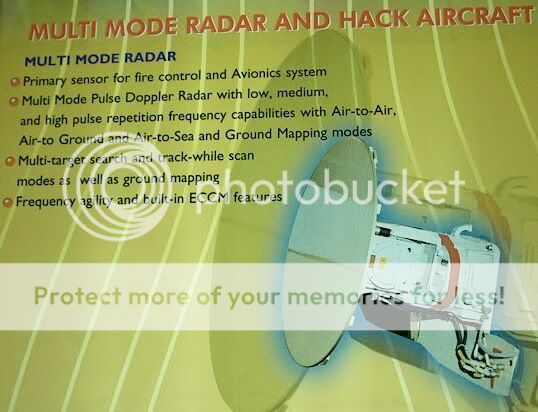
The aircraft radar has obtained a mapping capability in real beam and synthetic aperture mode with medium and high resolution. A selection mode of moving target also has been realized, and a “sea” mode which provides for a decrease in the influence of the sea state in the search and detection mode. ?? The radar detects radar contrasting ground targets at a distance up to 100 kilometers, huge surface targets at a distance up to 350 kilometers and small sizes up to 120 kilometers.
The cockpit’s new instrumentation has color liquid crystal multifunctional displays in the 6×8 inch format. Information from specific systems can be highlighted as the airman wishes on any of the displays. Duplicate functions are set aside for traditional pointer instruments. The optimal construction of the cockpit instrumentation allows operationally taking quickly changing information about the surrounding situation and minimizing the airman’s actions for adequate reaction to these changes. This allows effectively controlling the airplane, systems and weapons in combination with the new control elements ((ORGAN)).
Use of the Kh-29L missiles with laser guidance is provided by the installation of a new 52Sh optical sighting station with expanded functional capabilities owing to the realization of the air-to-surface mode with the use of a laser target designator and range finder with a range of effective illumination of a ground target up to 10 kilometers. At the same time, the operational range of the range finder has been increased in the air-to-air mode from 3 kilometers to 8 kilometers, which essentially improves the precision parameters of aiming in a dog fight.
Telecode ((TELEKODOVAYA)) communications apparatus provides communications with controllers and between airplanes in the air, the exchange of information between airplanes of a group, assessment of targets and target designation in combat and even control of the relative position of a group’s airplanes is realized in “group actions” mode.
Source : 24.01.05, Krasnaya Zvezda, Correspondent: Anatoliy Antipov
JaiIAF Helicopters showering rose petals during the Republic Day Parade-2005, in New Delhi on January 26, 2005

JaiA few photos from yesterday’s Republic Day Parade.
Photo Credits : Indian MoD
BrahMos – Command Post :

BrahMos- TEL :

JaiIndian Airforce jetfighters fly in formation during India’s annual Republic Day parade in New Delhi, 26 January 2005.
Image Credit : RAVEENDRAN/AFP/Getty Images
JaiRe: Republic Day photos
Photos from today’s Republic Day Parade.
Mi-25
Searcher MK-II

JaiRafael to unveil innovative helmet for combat pilots
The Rafael Armaments Development Authority announced yesterday that it has developed a helmet for combat pilots allowing the operation of weapons and armaments without the need to coordinate position sensing signals between the helmet and the signal processor box.
The company will unveil the helmet, nicknamed “mind reader”, at the upcoming Aero India Exhibition in Bangalore, which opens on February 9. The helmet, whose commercial name is Eyeball, is equipped with mounted sights.
A tiny camera follows the pilot’s pupil and locks on-board weapons onto the pilot’s line of sight. The helmet, developed the company’s missile division, provides displays to the pilot regardless of where he is looking.
Missile division manager David Shtamer said that the helmet has passed all development stages and was successfully tested by Israeli F-16 pilots. The Rafael helmet has several advantages over the Elbit helmet, he said. Rafael’s helmet, at 1.3 kilograms, is half the weight of Elbit’s and it does not require integration between the helmet and the cockpit, in contrast to the Elbit model. Shtamer added that the Rafael helmet will be between one-third and one-half cheaper than the Elbit’s.
In Bangalore, Rafael will also present an innovative air defense system it is offering to the Indian Air Force, based on the conversion of Python 5 and Derby air-to-air missiles into anti-aircraft missiles. The operational range of the Spider system is 15 kilometers. The system includes a control cabin and radar system. Israel Aircraft Industries participated in developing the radar system.
Rafael said that the system had passed the early stage of the Indian air force’s $350 million air defense system tender, beating companies from Russia and South Africa. It will now compete against France’s MBDA Missile Systems.
The Indian air force will send a delegation next month to assess the system in operation.
Jaifft, can this thread be used for sharing information about Ground and Naval LPI radars ?
JaiIL-76MD : K-3014 lies parked at Phnom Penh International Airport on 07 November 2002.
Image Credits : Florent de Warren

JaiCan somebody ID the country ?
JaiMission ‘Sea Waves’ was like a war-time operation
It was as good as a war-time operation. We had to fight against heavy odds and we believe we did succeed largely,” IAF officers who led ‘the operation Sea Waves’ to Andaman and Nicobar Islands, Sri Lanka and Maldives in the wake of the tsunami strike on December 26 said.
In one of the biggest peace time operations, Air Force had flown 678 sorties to the Andamans and Car Nicobar and Sri Lanka, evacuating hundreds of people and delivering mounds of relief supplies to these worst-hit places, said the officers during an interaction with mediapersons at the headquarters of the Southern Air Command (SAC) here.
JaiImage Credits : Hindustan Times
JaiRe: Miscellanous MMR and Avionics pictures

JaiRe: 26th Jan Republic Day parade rehearsals
IAF planes carrying out refilling midair, during Republic Day parade rehearsals on Rajpath in New Delhi
Image Credits : Hindustan Times
JaiOperation near over, Navy starts pulling back ships
NEW DELHI: Just under a month after the tsunami struck the Indian coast, the Navy on Friday began pulling back from what has proved to be an enormous operation.
The Navy’s effort, at its peak, saw 32 ships, 21 helicopters and eight aircraft, accompanied by about 5,500 personnel in the disaster zone. In total, the Navy shipped 730 tonnes of relief material, including 450 tonnes of food and 20 tonnes of medicine to the Andaman & Nicobar Islands, Sri Lanka, the Maldives and Indonesia.
The day the tsunami struck the Andaman Islands and coastal India, Naval chief Admiral Arun Prakash was the first to order all Eastern Command ships to be on call within minutes. And by evening, 19 ships had left shore for the tsunami-ravaged zones, accompanied by four aircraft and 14 helicopters.
Admiral Prakash even ordered an aerial survey of the islands by a Navy Tupolev-142 maritime surveillance plane, a sortie that was able to immediately chart out the damage on the islands, making deployment logistics more streamlined.
Preoccupations now continue to include evacuations, and hydrographic surveys of the coasts of Sri Lanka and India, to open up damaged channels and chart out repair plans for getting damaged harbours operational.
JaiWhat does this mean?
It means that the MMR has a terrain following mode.


 Sign In







