 Jai
JaiMilitary sets sights on tsunami-proof bases
Port Blair, Jan. 8: After getting emergency relief work off the ground in Andaman and Nicobar, the military has begun to plan ahead to reconstruct its tsunami-destroyed facilities and create new ones.
A six-member team from the three components of the armed forces is here, visiting all affected areas with the objective of rebuilding the bases in a manner that can stand up to tsunamis.
“We will be looking at Japanese technology because they are used to tsunamis and their installations are strong enough to withstand tsunamis, which can also be triggered by a small earthquake (6.6 on the Richter scale) in the ocean bed. Our reconstruction work will be stronger than before,” Commodore V.K. Bhansali, part of the elite team, said.
The armed forces plan to set up new bases in Port Blair and Diglipur, both in the northern part of the islands, to thwart possible military incursions and conduct major defence reconstruction work.
To start with, at the air base in Diglipur, the length of the runaway will be increased to 6,000 feet from 3,500. Two new defence installations are likely to come up at Pahargaon and Calicut near Port Blair.
“We have chosen about 20 acres of land in Pahargaon and 45 acres in Calicut. Once the land is ready, the armed forces will be in a better situation to deal with any eventuality, be it war with the enemy or the present war we are waging against nature,” Kumar said.
Plans are also afoot to build a strategic “operation readiness platform” in Port Blair, where a pilot will take only three minutes to get on the aircraft and be airborne once the bell rings.
About 3,000 feet of the 9,000-ft runaway on Car Nicobar island has been destroyed by the tsunami.
Land is being acquired on the west coast of Car Nicobar and a complete overhauling will be undertaken in Campbell Bay to strengthen the forward operating posts (military supplies depot) on the only inhabited island in the south.
“In terms of strategic defence installations, the Car Nicobar air base assumes great significance. So does the forward operating base in Campbell Bay, which has been badly affected. We will rebuild them shortly,” Kumar said.
For possible box Planned expansions Diglipur air base runaway from 3,500 to 6,000 ft. Car Nicobar air base on higher west coast landProtect Campbell Bay base with Japanese technology.
Date set for India tsunami system
Science and Technology Minister, Kapil Sibal said today, India’s tsunami warning system will be operational in two to three years’ time.
The 27 million dollars system will give the speed of a tsunami and the regions most at risk, reports the BBC.
Speaking here, Sibal said the warning system would involve installing Deep Ocean Assessment Reporting Technology at a depth of six kilometres.
JaiHi,
Could somebody tell me the status of the Su-30MKI ?
There are currently 32 ( IAPO with s/n from SB-018 to SB-050 ) + 2 ( HAL – assembled with s/n SB-101 and SB-102 ) of Su-30MKIs in India.
I mean, how many of them have already been delivered, and to what specifications ( already with TVC, fully developed radar, etc).
The aircrafts were delivered in three batches, with each batch containing updated software for the Bars radar. Each batch has the TVC.
Batch-1 / Su-30 MKI Mk.1 : Cleared for air-to-air engagements. 10 in number.
Batch-2 / Su-30 MKI Mk.2 : Above item included plus cleared for Anti Shipping duties with Kh-31A. 12 in number.
Batch-3 / Su-30 MKI Mk.3 : Above items included plus a range of Air to Ground armament including LGB delivery via integration with Litening-II LDPs. 10 in number.
The HAL delivered MKIs probably belong to the Mk.3 standard though I am not sure.
The MKI Mk.1 and MKI Mk.2 will be upgraded to the MKI Mk.3 standard this year.
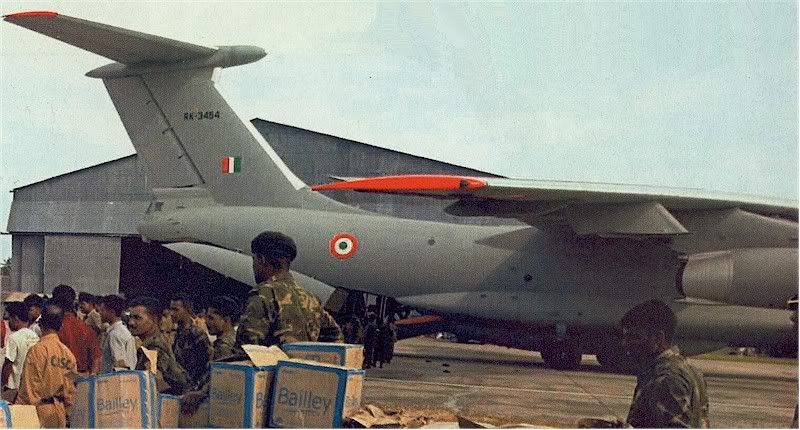
JaiIL-78 MKI at Car Nicobar.
Image Credits : India Today via Jagan
Some information regarding serial numbers of various planes in the Indian contingent deployed for Cooperative Cope Thunder 2004 can be found here.
JaiFrench firm bids for maritime surveillance aircraft order
Avions de Transport Regional (ATR), the Toulouse-based regional aircraft maker, is in the race for selling two maritime surveillance aircraft to the Indian Coast Guard.
ATR chief executive officer Filippo Bagnato told IANS that the company had submitted the quotation for the military version of the aircraft in response to a global tender floated by the Indian government in September 2004.
“The two surveillance aircraft will be used by the Coast Guard for patrolling the territorial waters surrounding the Indian coastline,” Bagnato said.
“We will deliver the airframe to Alenia Aeronautica of the Italian Finmeccanica group, which will transform it into a patrol version for maritime and reconnaissance operations.”
According to Indian military sources, besides ATR, Dassault Aviation of France, CASA of Spain, SAAB of Sweden, Embraer of Brazil, Antonov of Ukraine, Ilyushin Aviation of Russia, Dornier of Germany, Bombardier of Canada and Lockheed Martin of the US have submitted their quotations for the $27.7 million order.
The proposals are under the consideration of the defence ministry and a decision is expected this year.
JaiELLSWORTH AFB — The Air Force’s B-1B Lancer bombers are flying again after being grounded Dec. 30 because of a landing-gear problem on one airplane.
Air Force officials put most of its 67 bombers on the ground after the landing gear collapsed Dec. 13 on an Ellsworth Air Force Base bomber at an undisclosed overseas location. The airplanes were allowed to fly again last Thursday.
Staff Sgt. Brian Jones of the public affairs office at Ellsworth said that during the six-day grounding, Air Force officials checked the nose gear on all of the long-range bombers.
“The inspectors didn’t find any other problems with the rest of the fleet, and the cause of the collapse is still under investigation,” Jones said.
JaiNew Delhi, Jan. 7: The Indian Air Force has thrown open the competition for a bulk order of 125 multi-role fighter aircraft that will form the cutting edge of its fighting fleet in the medium term.
The chief of air staff, Air Chief Marshal S.P. Tyagi, said four companies have been asked to send details on their multi-role fighters that would be considered for the order.
But what the IAF’s decision to approach at least four companies means is that France’s Dassault Aviation, with its offer of the Mirage 2000-V, is not necessarily the most preferred choice at the air headquarters.
The Mirage 2000 is already in service with the IAF and the air headquarters was so far understood to have voiced a preference for it. The decision to approach a number of companies is also in line with an acquisition policy of the defence establishment to avoid a single-vendor situation.
Air Chief Marshal Tyagi said requests for information have been sent to companies — the US, Sweden and Russia, apart from France. Air headquarters sources said the aircraft on which information has been requested are the F-16 Fighting Falcon (Lockheed Martin, US), Grippen (Saab, Sweden), Mirage 2000-V (Dassault Aviation, France) and the Russians for Sukhois and the MiG 29 MCR.
JaiINDIAN naval Captain T K Ashokan was at sea during exercises on December 26. On that fatal day he noticed a sudden swell in the sea but days later he experienced first hand the full devastation caused by the tsunami. The INS Sarvekshak dropped anchor outside Sri Lanka’s debris-strewn Galle harbour five days later.
Captain Ashokan and his crew had an urgent mission: to clean up the harbour, allowing relief to reach the survivors of the country’s worst-ever natural disaster. “Before we even reached here, we saw a few sunken boats right out in the middle of the sea,” Captain Ashokan said of the damage wrought by the killer tsunami.
The Sarvekshak, a ship that specialises in hydrography or the mapping of the ocean floor, drew into Galle in the dead of night, but lighthouses usually ablaze with light along the ravaged coast were snuffed out.
The immediate mission of the 218 officers and sailors on board, along with 82 army personnel, was to clear the harbour to allow the ships carrying a flood of international aid arriving here to safely dock, the captain said.
An emblem of the monumental effort this took over the following three days sits right on the pier where Ashokan’s ship is now docked: a massive dredger that the tsunami wave heaved up and gently placed down, undamaged.
Using its cutting-edge surveying equipment, the three-year-old Sarvekshak’s first task was to map out where boats, buses and other sizeable objects had been hurled into the harbour by the powerful waves. A team of 25 specialist divers then worked on clearing the harbour of the debris, wrapping up work on January 3. “There were so many sunken boats, we lost count of them,” he said.
While Galle harbour is an important commercial port for Sri Lanka, a port worker who did not want to be identified said that no commercial ships were damaged, with the fishing fleet instead bearing the brunt of the catastrophe. Scores of boats belonging to local fishermen, painted in incongruously cheerful hues of blue and yellow, red and green, still litter the side of the coastal road winding along the harbour.
Another crucial job the crew carried out was replacing the buoys that marked out a safe passage for ships into the harbour, which were torn from their anchors by the force of the tsunami. Captain Ashokan said the scale of the devastation and clean-up did not compare to other natural disasters he has seen, including a major cyclone, both physically and emotionally.
Captain Ashokan hailed the Sri Lankans for their bravery and energy in starting to swing back to normal life. “The Sri Lankans have risen to the occasion most admirably. Life is getting back to normal. People are not just sitting around, and that’s a welcome sign.”
Indian warship returns after completing relief work in Sri Lanka
PT, yes.
JaiPT, all those six hovercrafts were inducted between 2000 and 2002. A few images from BR.


JaiNaval aircraft provide relief to tsunami victims
Kochi, Jan 06 – A Dornier and an Islander aircraft of the INAS 550 named ‘the flying fish’ squadron of INS Garuda have been deployed in Sri Lanka and is operating from Ratmalana air base, a navy press release said here on Wednesday.
Black Sunday brings tri-services command to life, in a war-room
NEW DELHI, JANUARY 5: Tucked away in a corner of South Block, hums a high-security room 24 hours a day. It can accommodate almost 100 people, its row of cubicles house all Ministries. Entry to this room is through biometric identification although that’s being waived for some VIPs. It’s linked, real-time, to all military posts across the country via elaborate satellite hook-ups and to the operational rooms of all three services, the Navy, the Army and the Air Force. Even to the 31 Naval ships out at sea.
This room has existed since 2002, as the tri-services Integrated National Command Post—but only on paper, as an idea. Black Sunday brought it to life and today it’s the nerve centre of the Government’s biggest relief and rescue operation in recent history.
Equipped with state-of-the-art communication and control systems designed to meet the pressing demands of contemporary warfare, INCP was operationalised at the instance of the Navy which had to play the lead role in the disaster management on Sunday evening.
Each naval ship is a command post in itself and is in direct touch with the INCP. As of now there are 31 ships posted at various points along the affected areas. Further, the Army’s Southern Command has set up tactical headquarters at Chennai, which again, is in direct touch with this post and so will be the relief command being set up in the Andamans. There are nearly 8300 Army troops on the field along with Air Force and Navy personnel.
Within hours of the disaster, aircraft of the Aviation Research Centre were sent out to obtain the first aerial pictures. These have been pouring in since then along with satellite imageries. What the INCP has done is that it has drastically cut down the time for decision making.
And now orders have been passed for three unmanned aerial vehicles to carry out reconnaissance in the tsunami-affected areas as part of an accurate damage-assessment exercise.
JaiIndia Plans to Expend Nine Billion Dollars to Obtain Foreign Fighters
The Indian government has disseminated among the leading world aircraft building companies a request for information with the intention of obtaining 126 tactical fighters for the national air force at a total of more than 9 billion dollars.
As India’s ministry of defense specified, the request was aimed at the Russian Airplane Building Corporation MiG about a provision of data on the improved MiG-29SMT fighter, the Swedish SAAB company (the JAS-39C) and the French Dassault (the Mirage-2000-9.) According to a defense ministry representative, the request was not sent to the American Lockheed-Martin company for a provision of data about the F-16 fighter. He refused to comment on this fact, however, he noted that the possibility of the Indian defense ministry’s addressing other aircraft building firms and companies has not been excluded.
According to the defense ministry’s information, it is intended to hold the tender in the next 4 months, and a technical appraisal of the aircraft – in the coming 6 – 8 months of 2005.
The Indian air force plans to replace part of the Mig-21 fighters in the inventory with the new foreign airplanes. Moreover, it is intended to obtain the fundamental manufacturing of the aircraft for the possible equipment of them with future radars and weapons systems.
According to a statement of India’s air force representatives, the French Mirage-2000-9 fighter is being looked at as the main aspirant for victory in the tender.
Source: 06.01.05, ARMS-TASS
Jai’cause i’d love that radar for “my Migs” 🙂 (9-13).
MiG is definitely working on putting the Bars-29 into the MiG-29. This was confirmed by Valery Toryanin.
VALERIY TORYANIN – DIRECTOR GENERAL AND DESIGNER GENERAL, RUSSIAN AIRCRAFT CORPORATION MIG
Piotr Butowski JDW Correspondent
MoscowJANE’S DEFENCE WEEKLY – JUNE 16, 2004
“At India’s request, we are working on a modernised version of the MiG-29 with a smaller variant of the N-011M Bars multimode radar [used by Indian Su-30MKI fighters] to provide compatibility, which is very important for the Indian Air Force. Moreover, the phased-array antenna increases the radar capability.”
Paul/Overscan had mentioned on BR that the Bars-29 is designated with the unofficial title of “Barsik”.
Some more information regarding Bars-29.
“Bars” RLSU Is Next Step on Way to Creation of Fifth Generation Fighter
The technologies in the “Bars” radar control system make possible the creation of its modifications for various types of airplanes. Thus, the “Bars-29” radar control system for the MiG-29 airplane is 80 – 90 percent apparatus standardized with the “Bars” radar control system of the Su-30MKI, in which connection three non-standardized blocs (the antenna bloc, SHF receiver, and the master generator) are being manufactured on a common technology with analogous “Bars” radar control system blocs. Standardization of the “Bars-29” radar control system and the “Bars” radar control system in the area of software is greater than 90 percent. The small software difference is governed by the difference in the aircraft equipment interface of the airplanes. Such standardization allows essentially standardizing the training of flight crews, radar control system servicing and composition of ground training facilities.
The “Bars” aircraft radar allows the use of a combined mode, that is, to operate simultaneously both against aerial and against ground targets (whereas this was practically impossible in the aircraft radars of the previous generation.) In which connection, this mode is realized in two variants: the ground target tracking mode with maintenance of spatial scan of aerial targets and the single ground target tracking mode with simultaneous firing at an aerial target in long-range combat.
Beside the modes listed above, the “Bars” radar control system provides:
In the operational mode against aerial targets:
search of targets by speed;
search of targets by measuring and changing range;
scan of the air space in a zone of +70 degrees in azimuth and +40 degrees in elevation;
illumination of targets and transfer of update commands ((KOMANDA RADIOKORREKTSII)) for control of missile armament;
tracking of a jamming platform;
determination of type of airborne targets. On switching on of this mode, the “Bars” radar control system determines the type of aerial target detected through the parameters of the signal reflected from the target: “large target,” “medium-sized target,” “small target,” “group target,” transport airplane, helicopter, and jet airplane. Upon introduction into the data base of the spectral characteristics of specific airplane this mode will allow determining the type of airplane, for example, F-14, F-18 and so on;
determination of the characteristics of a group target in the tracking mode while maintaining scan. This mode allow more effectively using guided missile armament upon attacking a group target;
search, lock-on and tracking of a visually spotted aerial target in close-in maneuvering combat.
In the operational mode against ground targets:
ground ((POVERKHNOST’)) mapping in real beam mode;
ground mapping in narrow-beam Doppler mode ((REZHIM DOPLEROVSKOGO OBUZHENIYA LUCHA));
ground mapping in synthetic aperture mode;
selection of moving ground targets;
coordinate measuring and tracking of up to two ground targets;
resolution of tasks of group actions upon attacking ground targets.
In the operational mode against naval targets:
further detection of huge sized naval targets;
scan of the sea surface and detection of naval targets;
selection of moving naval targets;
coordinate measuring and tracking of up to two naval targets, moving or stationary.Source: 24.03.04, VPK
JaiLCA naval variant under development
Jan 4: Enthused by the successful test flights of the indigenously developed light combat aircraft (LCA) Tejas, the Aeronautical Development Agency (ADA) today made public the development of the naval variant of the LCA.
“Over 320 test flights of the LCA have been conducted till October, 2004, with absolutely no failures,” said LCA project deputy director, Mr Rajeev Srivastava, at the 92nd Indian Science Congress being held here.
Delivering a lecture on ‘Design and Development of Tejas’, Mr Srivastava said: “Encouraged by LCA’s success we are now developing it’s naval variant to address to the needs of Indian Navy.”
JaiJaiIndia continues flow of relief goods, medical teams
Several Indian medical teams have been deployed in Sri Lanka to treat tsunami victims, the Indian High Commission said.
One medical officer, two medical assistants and one hygiene/ sanitation specialist who arrived last week are at the Hambantota District hospital.
The INS Sutlej and Sarveekhak Indian naval ships operated two medical camps in Galle and treated about 300 patients.
Two Medical officers and medical Assistants from INS Kirch at Trincomalee have been deployed at Kinniya in Trincomalee District.
Six Medical Officers and 12 medical assistants from INS Aditya, an Indian naval tanker have been deployed in Batticaloa with the army bridge HQ and will be working at the refugee camps located eight miles north of the bridge HQ. India, which was also heavily affected by the tsunami disaster, is also continuing its relief supplies to Sri Lanka. India was the first country to rush relief goods to Sri Lanka, on December 26, the day of the disaster. It rushed 600 Kg of medical supplies by air.
This was followed by 30 tons of relief goods to Trincomalee by INS Sukanya and Sandayak on December 27, 22 tons of relief supplies by INS Sutlej and Sharda to Galle on the same day, 700 Kg of emergency medical supplies to Colombo by air, 750 Kg of emergency medical supplies to Colombo and Trincomalee by air on December 28, 22 tons of relief supplies (dry rations) by IL-76 aircraft to Colombo on December 29, 700 Kg of emergency medical supplies by air to Colombo on December 30, 20 tons to relief supplies to Trincomalee by INS Kirch on December 31, 50 gen sets to Trincomalee on December 31, 1000kg of relief goods to Colombo on December 31 by INS Aditya, 82 tons of relief goods and rations to Trincomalee by INS Ghorpad on January 1 and 1500 kgs of relief goods by CGS Samar to Colombo on Jan.2.
JaiIsraeli co offers free tsunami alert system
Jerusalem, January 4: An Israeli company said on Monday it planned to distribute free to Asian countries hit by last week’s tsunami a device it says could save lives by warning holiday-makers directly that a tidal wave is coming.
The system developed by Israeli inventor Meir Gitelis uses land and water sensors, smaller than a shoe box and each costing $170, to measure seismic activity and wave motion.
Like other systems already in operation, the sensors can send alerts in seconds by satellite to governments anywhere in the world. Unlike others, this system can also relay warnings directly to private subscribers over cellphones, pagers or dedicated receivers, spreading the message more widely.


 Sign In







