 Jai
JaiIndia, Russia to build navigational satellite project
India News, New Delhi: India and Russia are putting together their space technology skills to build an ambitious navigational satellite project that would have both civilian and military applications.
A milestone agreement on Indian participation in the proposed Global Navigational Satellite System (Glonass) as an “equal and sole partner” of Russia is to be signed during Russian President Vladimir Putin’s three-day visit to India from Thursday, a senior official said.
Russia had revived the project recently as an alternative to the US Global Positioning Satellite System (GPS) and invited India to join it.
New Delhi’s positive response comes in the wake of delay in finalising India’s participation in the Galileo satellite navigation system that European Union (EU) is developing.
India, which had pledged 300 million euros for the Galileo project, was willing to take part only as an “equal partner” with access to the satellite codes during times of peace and war that the Russians are more than willing to agree.
However, the official said the Russian and EU projects are not “mutually exclusive,” indicating that New Delhi is keeping its option open on joining the Galileo project.
JaiSome information regarding the Gorshkov from Sevmash site.
With the unofficial visit Sevmash visited the delegation of the embassy of India. Our partners it interested, as go the matters on the aircraft-carrying cruiser “Admiral Gorshkov”, to what extent social base is ready for reception of Indian specialists and seamen.
The main object of visit the heavy aircraft-carrying cruiser “Admiral Gorshkov” assumed delegation to wardroom. Deputy of director general Sevmash on Military Technical Co-operation described the history of aircraft carrier, presented to the guests of the schedule of the already executed and forthcoming operations:
– in 1999 we accomplished scale preparatory work for the stage of ship from Murmansk into Severodvinsk. Without waiting until the signing of contract, Sevmash together with VMF ensured vitality of ship, removal of fuel remainders from holds, it approached the flaw detection of systems. The works in the shops began from the moment of the signing of contract. New sections for repairing the equipment of cruiser are created, rigging is prepared, warehouse accomodations are prepared, documentation is developed. All this made it possible immediately to approach the first stage of execution of the contract. First of all, concluded the agreements with the planning organizations: PKB “Nevskiy”, 51- m by institute VMF, by St. Petersburg technological institute. During June the report about the fulfillment of the first stage of works is signed, we await inspectors for the presentation of the second stage. Entire cycle of repair and re-equipment of ship is calculated for 52 months.
Specially for the coordination of project on Sevmashe is opened the representation of state company “rosoboroneksport”. V.Yu. Komarov, the chief of the administration of the department VMF of this company, noting the importance of contract in the development of military technical collaboration between Russia and India, he said:
– the primary task together with the plant qualitatively satisfying all conditions of contract documents thus to show that we are ready to work on other projects. Contract according to “Gorshkov” – the very critical program, in which are begun to operate hundreds of enterprises. And it is necessary to give credit to the management of plant in the integral approach to resolution of all questions. Training Indian crew is coordinated with the Defense Ministry of Russia. Takeing into account deficiencies in the instruction of the crew of frigate, built in Saint Petersburg for India, Sevmash seriously studied the study of this question. Indeed it is necessary to organize transportation, stay and nourishment of one-and-a-half thousand people. Furthermore, for us one must organize the maintenance of cruiser in India.
– Mikhail Starozhilov
JaiPhoto taken on 1st September 2004 by M. Vorkunkova from Sevmash site.
Indian Delegation on “Admiral Gorshkov”
JaiKUROYEDOV: RUSSIA DOES NOT INTEND TO LEASE APL-971 SUB TO INDIA
NEW DELHI, December 1 (RIA Novosti) – At present, Russia is not considering any opportunity to sign a contract on leasing or selling the APL-971 (Akula) submarine to India, Commander-in-Chief of the Russian Navy Vladimir Kuroyedov reported.
“The sub is being built for Russian needs, for the Navy,” Kuroyedov said during his visit to the Indian capital along with the Russian Defence Ministry’s delegation.
On the Gorshkov :
Touching upon the issues of contracts signed earlier, Kuroyedov pointed out that the process of equipping the aircraft-carrying cruiser Admiral Gorshkov under the purchase contract was going on ahead of time.
Concerning the aviation component, specifically the supplies of the MiG-29K wing, the official assured the Indian side that the order will be carried out in accordance with the schedule.
“Our Indian partners denied that there were any problems with the project, including the aviation aspect,” he remarked.
The project Admiral Gorshkov will be accomplished in 2007, the Russian Ministry of Defence stated.
“The cruiser is being currently modernised in Severodvinsk. The aviation component of the project envisages the modernisation of the landing deck,” the Ministry of Defence reported.
JaiAs stated in previous articles there was supposed to be a test of the surface to surface variant of BrahMos during this month.
India to test advanced version of BrahMos
December 01, 2004
India is planning to test an advanced version of supersonic cruise missile BrahMos at the Integrated Test Range (ITR) in Chandipur, Orissa.
Preparations are underway to test the missile, developed jointly by India and Russia, using a land platform, ITR sources said Wednesday.
JaiIndia, Russia to hold joint paratroopers exercise: Ivanov
Moscow, Nov 30 (PTI) India and Russia will hold joint military exercises involving their elite paratroopers next year, Defence Minister Sergei Ivanov has said, underscoring Moscow’s intention to actively develop relations between armed forces of the two countries.
“The Indian paratroopers and Russian airborne troops are cent-per cent compatible and are equipped with same types of planes and weapons,” Ivanov told PTI here ahead of his trip to New Delhi to prepare the ground work for President Vladimir Putin’s three-day visit this week.
Unlike the Soviet-era, when contacts between the armed forces of the two countries were limited to training Indian personnel by Soviet military instructors and visits by the naval ships, Russia intends to actively develop inter-services relations, he said.
Senior defence officials from both the countries had yesterday began deliberations in New Delhi to iron out differences on the supply of major weapon systems.
Ivanov recalled that the Navies of the two countries had In May 2003 conducted massive joint wargames in the Indian Ocean involving mock hunt for the ‘enemy’ submarines and use of strategic bombers and cruise missiles.
JaiVympel, what is the current developmental status of “Region” developed GPS bombs ?
JaiFirst home-built Sukhoi-30 MKI handed over to Air Force
NASIK, NOV. 28. The first home-built Sukhoi-30 MKI multi-role fighter aircraft was handed over to the Indian Air Force today. It took off from the air strip of the Nasik Division of its makers, Hindustan Aeronautics Ltd (HAL), and performed breath-taking aerobatics amidst cheers from the Defence Minister, Pranab Mukherjee, the Chief of the Air Staff, Air Chief Marshal S. Krishnaswamy, and HAL Chairman, N.R. Mohanti.
Though assembled mainly from the Russian-supplied knocked-down kit, the Su-30 MKI is fitted with major Indian avionics such as mission computer, radar computer and radar warning system developed by the Defence Avionics Research Establishment (DARE).
Its communication system and Identify Friend or Foe (IFF) are from the HAL’s Hyderabad Division. Mr. Mohanti told reporters later that HAL was to produce 140 Su-30 MKIs for the Indian Air Force in four phases. While the aircraft building during the first three phases would be primarily out of the Russian kits, the indigenous component would progressively increase and the fourth phase would be out of raw material.
Of the 140 aircraft 114 would be built in the fourth phase. That would not only reduce the cost but also maximise production in various HAL plants. The peak production would be 12 aircraft a year and all the planes delivered by 2017-18.
JaiNo, but it doesn’t guarantee it either. The proof is in the eating. Besides, it remains to be seen if my homecooked tikka masala is just as tasty as the one i can order in 😉
I had posted a report in a thread related to the LCA, in which the IAF pilots had given high marks to the locally prepared tandoori chicken and this was when it was not even cooked completely. I understand your point though, and hope that a solid order is placed in the future, but the evaluation by the user agency has been positive so far.
JaiTrials of anti-submarine version of ALH in progress
Trials for the anti-submarine version of the indigenously built Advanced Light Helicopter (ALH) are in progress here, Flag officer commanding-in-chief, Southern Naval Command, Vice Admiral S C S Bangara, said today.
The Navy expects to operate these helicopters from frontline ships soon, the Vice Admiral told a press conference on board the INS Krishna.
The ALH, built at HAL, was inducted into the Indian Navy in 2003. These helicopters are based at INS Garuda, Kochi, for training and trials before their operational deployment. Their utility version had already been proven in various roles, including as ambulance and commando carrier, he said.
Three more ALHs will be brought to Kochi. At present there are two ALHs here.
JaiIndia to Partake in U.S.-Russia Project
India will invest US$100 million (euro75.49 million) in a U.S.-Russian joint venture to build short-haul passenger aircraft, a top official said Tuesday.
“Joining international aviation as a partner is our new priority,” said N.R. Mohanty, chairman of the state-owned Hindustan Aeronautics Ltd., which manufactures aircraft and related equipment for India’s armed forces.
The investment, which will give India a 10 percent stake, will be in a consortium led by Boeing Co. and Russia’s Sukhoi Design Bureau, Mohanty told reporters.
Snecma Aerospace and Thales of France and Lyulka Saturn of Russia also are part of the consortium, which plans to build 60-, 75- and 95-seat aircraft. The first prototype is expected in 2008.
JaiThe title of the previous image must be Zond-1 and not Zond-2.
bring_it_on, the Zond-1 features a phased array radar for survellaince. It also carries equipment to act as a communication relaying platform.
Payload : 1500 kg
MTOW : 12000 kg
Endurance : 18 hours
Wing span : 35 m
Length : 13 m
Height : 5.5 m
All information from Sukhoi site.
JaiYakhont-M photos from MAKS-2003.
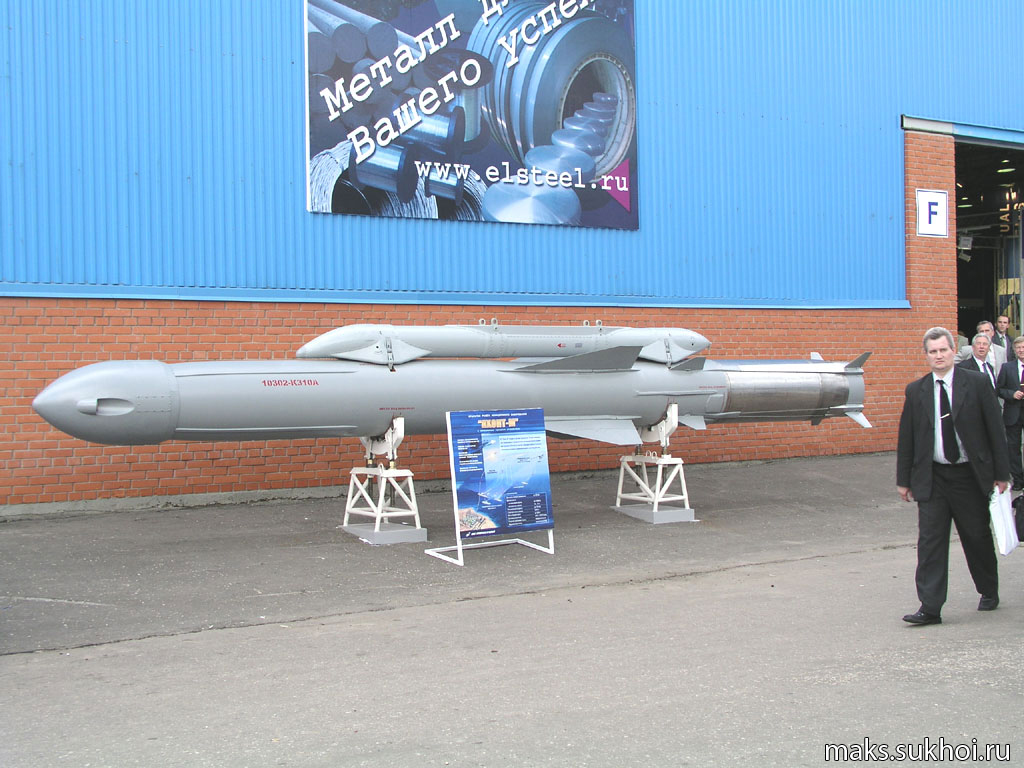
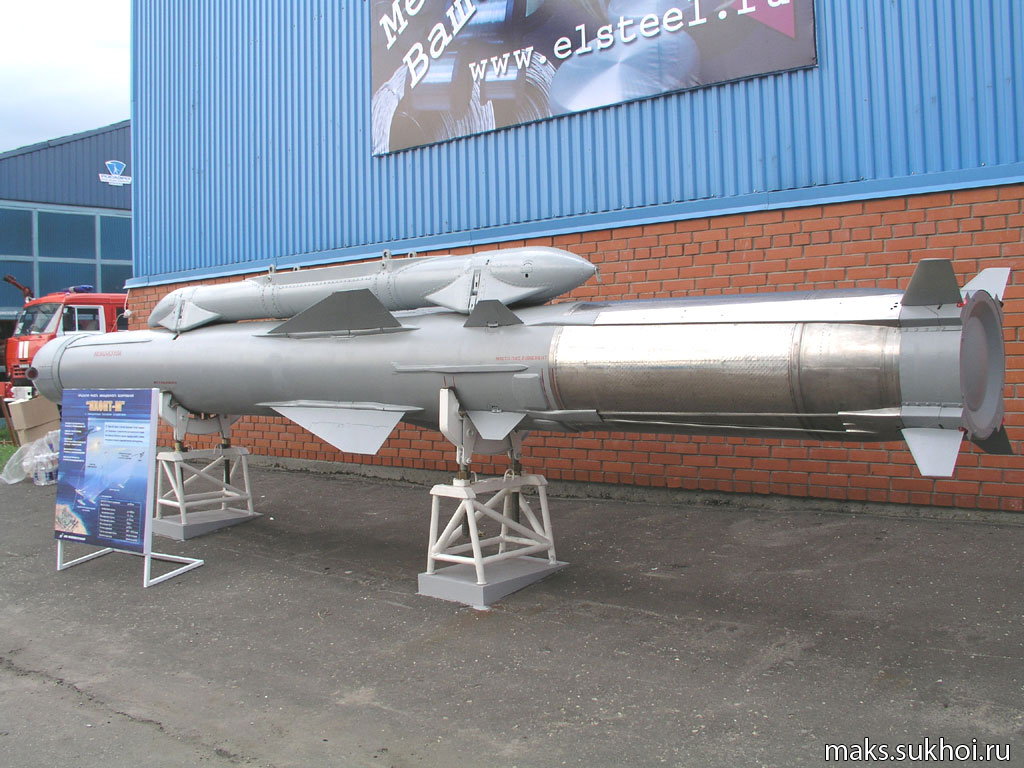
JaiZOND-2 from MAKS-2003.
JaiThanks to mnkumar from BRF. Times of India, print edition 19th Nov.
Desi ( local ) Sukhoi to roll out on Nov. 28
Bangalore: Hindustan Aeronautics Ltd (HAL) will roll out the first indigenously manufactured Sukhoi (Su-30 MKI) from its Nashik unit on November 28. This will mark yet another milestone in the Indo-Russian defence and strategic relationship.
Outgoing HAL chairman N.R. Mohanty told The Times of India on Thursday that one more Su-30 MKI will be handed over to the Indian Air Force this year, while another six will join the force next year.
For deadline man Mohanty, Sunday’s event will be a farewell gift from HAL as he is retiring on November 30. “It was a tough ask but I wanted to land happily in my career after seeing that the first Su-30MKI made in our stables rolled out,” Mohanty, also known as t he MiG Man of aviation, said.
He said the indigenous production of Sukhois will end by 2016. The fresh piece of Sukhois will have desi components like the mission computer, communications systems and navigational aids.
Defence minister Pranab Mukherjee will be chief guest for the Nashik event. The Su-30 MKI that will be rolled out will perform a flying display. Top IAF officials will also attend the event.


 Sign In







