Jai
JaiYep.
JaiSaras : first official flight
An order for six such aircrafts has been placed by the IAF.
JaiAny more sources on the total costs?
You can use FAS’s ASMP.
The Arms Sales Monitoring Project
http://www.fas.org/asmp/
On the MKI’s price you may use this as a source.
Nikolai Novichkov’s ( JDW Moscow correspondent ) article on Russian Arms Export in 2002
http://armstass.su/data/Files/File/4.pdf
Execution of the delivery contract on the Su-
30MKI fighters is a unique phenomenon in the
Russian aircraft industry’s record. Under its
terms, Sukhoi has developed an aircraft featuring
the best airframe in the world for the time being
and an international avionics suite.It is planned to perform an upgrade of the
Indian Su-30K to the Su-30MKI version at
IAPO, prime Russian enterprise responsible for
execution of the Indian contract. However, it is
not ruled out that the work will be carried out in
India at a plant of the corporation Hindustan
Aeronautics Limited (HAL), which in 2004 will
start mastering production of 140 Su-30MKIs
under a license contractUnder the license contract, India will receive an
‘in-depth’ license for production of 140 fighters at
Indian plants. HAL’s plants in Sunabed (state
Orissa) will build the fighters in four phases through
2017. The Russian side has already been delivering
appropriate technical documentation and some
specific manufacturing equipment. HAL plans to
roll off the first aircraft in 2004. The price of the
fighter is expected to be around US$ 31 million.
JaiRe: MiG financial situation
23rd August
MOSCOW (Reuters) — State-owned jet maker MiG has paid off $180 million of debt this year and expects the strength of its exports to wipe out its remaining debts, the head of the firm told Interfax Saturday.
“The financial situation has undergone a substantial change for the better,” MiG’s general director Valery Toryanin was quoted as saying by the news agency, which said MiG’s debts stood at $500 million to $600 million at the start of the year.
MiG has lagged its rival Sukhoi, but said last month it was gaining ground, with current contracts valued at $1.4 billion just shy of Sukhoi’s annual sales of $1.5 billion.
Toryanin said MiG’s booming order-book meant it would outstrip its export target for 2004 and export sales were likely to rise to up to $600 million to $800 million per year.
“That kind of figure will make it possible to pay off all the company’s debts,” he said.
JaiOne more photo of Knights’ Su-35. The gent below the flanker is really happy.

JaiSwedish Erieye Photos.
JaiHere are some more peace and war stories of the new champion workhorse of the air. Bates Lynden passed on a picture of a C-130 on Fletcher Ice Island T3 in the Arctic Ocean.
It is sitting on its belly, wings drooping to touch the ice, after a landing accident. Lynden was there for 16 days on the 7-by 3-mile floating island while the plane was being repaired with the help of a center wing section borrowed from the Marine Corps. It flew off the island nine months after it had crashed in February 1973.
Peter Rourke reports flying in the 1980s in Navy EC-130s. These aerial communications relay stations “maintained 24/7 airborne coverage to deter the Soviets from a surprise nuclear attack.” Mike Archer was a C-130 crew chief in my old photo mapping outfit; he recalls flying on projects in Ethiopia, Ecuador, Colombia and Brazil. “Landing on dirt strips in Sudan and the Galapagos Islands was adventurous, to say the least.”
Ed Rice says that when the C-130s were supporting ground electronics sites on a mapping project in Africa, one site’s crew complained that baboons had overrun their mountaintop ground station. The C-130 made low-level passes over the station to scare them away until a helicopter could evacuate them.
A former ALC commander at Robins, Bob Hails, recalls checking out in the C-130 when he arrived at the base. Unlike any of the other 43 types of aircraft he had already flown. “It was the only aircraft I ever flew that the pilot could actually back into a parking spot by reversing the propellers.”
JaiEh? The ARROW is effectively a SAM system, albeit designed to shoot down ballistic missiles. Are they worried the Indians might turn the ARROW into an SSM? The Indians already has long range SSM programs. What is this MTCR concern with the ARROW?
Hi Glenn, some information regarding Arrow and MTCR.
U.S.-Israeli Policy for Exporting Arrow Missile Undecided
Appearing before a subcommittee hearing of the Senate Governmental Affairs Committee July 29, Deputy Assistant Secretary of State Vann Van Diepen and Deputy Assistant Secretary of Defense Marshall Billingslea broadened Rumsfeld’s statement, explaining that Washington had no position on Arrow exports in general.
Van Diepen informed senators that Arrow is classified as a Category I system under the Missile Technology Control Regime (MTCR), which is a voluntary arrangement of 33 countries, including the United States, aimed at preventing the spread of missiles and related technologies capable of carrying a 500-kilogram payload at least 300 kilometers. MTCR members are expected to maintain a strong presumption of denial on exports of Category I items, which include whole missiles or major subsystems such as rocket engines.
The presumption of denial, however, is not a ban. Members are to weigh five criteria set out in the MTCR guidelines when considering a Category I export. Those criteria include, among other things, evaluating the importer’s intentions for using the export and whether it poses a potential proliferation risk. The United States has made past Category I exports, shipping Tomahawk and Trident missiles to the United Kingdom and transferring items to European and Japanese space launch programs. 😉
Not all theater missile defense systems would necessarily be classified as a Category I item. The U.S. Patriot system is not, and Washington has exported different versions of that missile system to several countries.
Now for the details regarding Category-I items.
CATEGORY I
ITEM 1 COMPLETE DELIVERY SYSTEMS
1.A. EQUIPMENT, ASSEMBLIES AND COMPONENTS
1.A.1. Complete rocket systems (including ballistic missile systems, space launch vehicles, and sounding rockets) capable of delivering at least a 500 kg “payload” to a “range” of at least 300 km.
2.A. EQUIPMENT, ASSEMBLIES AND COMPONENTS
2.A.1. Complete subsystems usable in the systems specified in 1.A., as follows:
a. Individual rocket stages usable in the systems specified in 1.A.;
b. Re-entry vehicles, and equipment designed or modified therefor, usable in the systems specified in 1.A., as follows, except as provided in the Note below 2.A.1. for those designed for non-weapon payloads:
1. Heat shields, and components thereof, fabricated of ceramic or ablative materials;
2. Heat sinks and components thereof fabricated of light-weight, high heat capacity materials;
3. Electronic equipment specially designed for re-entry vehicles;c. Solid propellant rocket motors or liquid propellant rocket engines, usable in the systems specified in 1.A., having a total impulse capacity of 1.1 x 10⁶ Ns (2.5 x 10⁵ lb.s) or greater;
HTH.
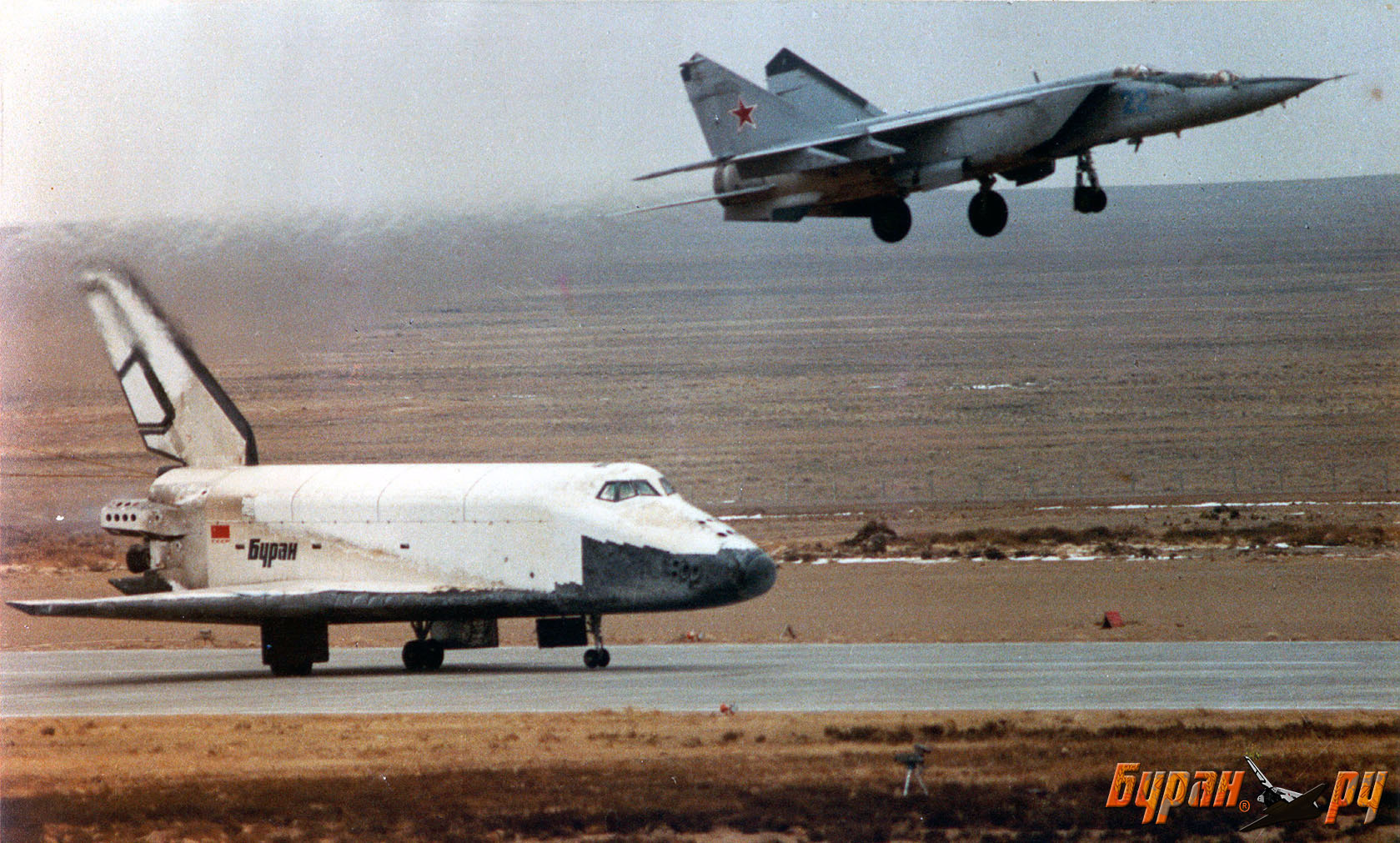
JaiFor the foxbat fans.
The post-touchdown landing run of Buran on the landing strip of spaceport Baikonur, 15 November 1988, 09.24 MOSCOW STANDARD TIME. In the foreground – escort fighter MiG-25, which met Buran in the stratosphere, piloted by Magomedom Tolboyevym.
For other photos.
http://www.buran.ru/htm/foto5.htm
JaiA star is born
Sukhoi Is the Star of a New Action Flick
ZHUKOVSKY AIRFIELD, Moscow Region — Standing on the tarmac of an idle airfield outside Moscow, a disillusioned ex-CIA agent orders a Russian Air Force pilot to attack an unidentified target with his stealth Sukhoi fighter.
The $10 million budget for the movie, with the working title “Su-XX,” is being bankrolled by Sukhoi and several Russian commercial banks. “Su-XX” will premiere in Russian theaters on May 9, 2005, to coincide with the 60th anniversary of the Soviet Union’s victory over Nazi Germany.
Fans of the Sukhoi will notice fiction in the film’s depiction of the jet. The stealth capabilities assigned to the plane will only be a reality when Sukhoi rolls out its fifth-generation fighter in 2010. Two planes were used on the film set, an Su-27UB and an Su-35.
“Su-XX” director Vasily Chiginsky promised more eye-dazzling action than audiences are used to seeing in Russian films.
“There will be a lot of computer graphics, but there will be a lot of shooting in the air as well when the plane performs stunts,” Chiginsky said.
Still, Kapanets, who previously produced the 2002 film “Red Serpent,” starring Roy Scheider, is confident that “Su-XX” will be a hit.
“We will rip the Russian box office, and we will show it in every country where people have TV sets,” he said.
JaiDoes anyone have a picture of the upgraded Mig-21 Bison cockpit?
1 cockpit photo + 1 bonus photo.
JaiRAF birds on their way to Alaska.
http://homepage.mac.com/aviationphoto/pages/page7.html

JaiJaiPictures of Osa radar.
Hyperwarp, guess who JaiS is ? 😀
JaiRe: Official or Not
A deal of such proportions will take time. The report consolidates the fact that the acquisition is not simply a rumor but it is being discussed officially. The fact is that this acquisition has been proposed in the Indian Parliament. Take the report in the context of this quoted comment :
Where did this Sayan Majumdar come up with that India will be buying Mirage 2000-5 MK2? I don’t think India has the stomach to bill this much amount and this article is basically some fantasy cocked by BR people.
A recent (enough ?) article.
09 August 2004, 12:00
The Defence Ministry is expected to request bids later this year or in early 2005 for a contract that could be worth more than $5 billion, ministry sources say.
The Defence Ministry is in talks with aircraft manufacturers from France, Sweden and the United States for the purchase of around 125 fighter aircraft, the ministry official said.
The official said France’s Dassault Aviation is a front runner with its
upgraded Mirage-2000-5 aircraft.


 Sign In