 Jai
JaiAgreement on Joint Development of Fifth Generation Fighter to Be Signed This Week
Between Russia and India, who probably needs a minimum of 100 aircraft, modified to her specific needs.
Source: 15.10.07, ARMS-TASS
JaiCan a Russian speaker please translate this ?
http://arms-tass.su/?page=article&aid=46285&cid=24
Thanks.
JaiIndia, Pakistan to work on combat flying
NEW DELHI, Oct. 11 (UPI) — India and Pakistan have agreed to cooperate in combat flying and flight safety.
The two countries exchanged views on issues ranging from pilot fatigue to stress levels faced by pilots of their respective air forces at an International Flight Safety Conference in New Delhi.
Pakistani Air Attache Group Captain Shahid Akhtar Alvi, while addressing the conference, said the gesture was likely to be reciprocated when his country holds a similar event in Pakistan next year. Alvi was one of the participants from 26 countries who were invited for the conference.
The conference, which discussed issues like safety management and human factors in accidents, was the second of its kind organized by the Indian air force and marks the culmination of the platinum jubilee celebrations of the IAF.
“Pakistan air force has for the first time been invited to this conference. Flight safety is everyone’s concern,” said Indian Air Chief Marshal F.H. Major.
Indian Defense Minister A.K. Antony said it was vital for countries to come together and share best practices to keep pace with the changing technologies and newer challenges in flight safety.
JaiSingapore and India sign agreement on joint military exercises
SINGAPORE : Singapore and India have signed an agreement to conduct joint military exercises.
The agreement was signed by Singapore’s Permanent Secretary for Defence, Mr Chiang Chie Foo, and India’s Defence Secretary, Mr Vijay Singh, in New Delhi on Tuesday.
Mr Chiang and Mr Singh are co-chairing the Fourth Singapore-India Defence Policy Dialogue.
The dialogue was established under the Defence Cooperation Agreement signed in October 2003 to oversee and drive forward the bilateral defence relationship.
The Republic of Singapore Air Force (RSAF) and the Indian Air Force (IAF) have already conducted four bilateral exercises since the inaugural exercise in Gwalior in October 2004.
The most recent exercise was in December 2006, which was held in Singapore for the first time.
Besides bilateral exercises between the RSAF and the IAF, the two armies have already conducted three joint exercises.
The fourth exercise is scheduled to begin next week.
Deal inked, Singapore to use Bengal airbase for F-16 training
NEW DELHI, OCTOBER 9: In a move that is likely to raise hackles of the Left parties, the Government on Tuesday signed a crucial defence agreement with Singapore allowing it to use the Kalaikunda airbase and nearby firing ranges to train its pilots.
The Republic of Singapore Air Force (RSAF), plagued with a shortage of air space and training assets, has been visiting the West Bengal airbase regularly for joint exercises, but this is the first time that a “long term arrangement” to use Indian facilities for training has been formalised.
While Singapore has one of the most potent air forces in the region, its biggest constraint is a lack of space to train its personnel. The prosperous island nation, with a total area of just 700 sq km, currently uses the Pearce Airbase in Australia for basic flying training and the Cazaux Airbase in France for fighter pilot training. It also uses facilities in the US for advanced training.
Singapore will be paying the Defence Ministry for using training facilities and possibly upgrading them in the future, but the Indian Air Force (IAF) is more excited about getting to train with the city state’s F-16 Fighting Falcon aircraft that are also the mainstay fighters of the Pakistani Air Force (PAF). “We will get to practice with the latest F-16 fighters used by Singapore, which is very crucial, as the same type of aircraft are in service with one of our potential adversaries,” the officer said.
JaiVideo capture of IAF’s 75th Anniversary parade. Credits to gogna @ BRF.
http://video.google.co.uk/videoplay?docid=-7763505164647245052
Flying display begins from the 1:07:10 mark. Featuring Mi-26, ALH, Chetak, Mi-35, Avro HS.748 , An-32, Do-228, IL-78 MKI, Mirage-2000, Jaguars, MiG-29, MiG-21 among others. Video taken from overhead, have been taken by an unnamed UAV flying at 15,000 feet.
JaiStupid !
How about this one ? X-post from BRF.
BRUSSELS (AFP) — Internet auction website eBay on Monday withdrew an unusual second-hand sale item, the country of Belgium, which had attracted an offer of 10 million euros (13.9 million dollars).
“Belgium, a kingdom in three parts” was posted on the Belgian ebay site as offering “plenty of choice” despite the caveat that it comes with “300 billion of National Debt.”
Offered in three parts — Flanders, Brussels and Wallonia — the accompanying blurb said the kingdom “can be bought as a whole (not recommended).”
The vendor also included as added extras “the king and his court (costs not included).”
Ebay spokesman Peter Burin said the site could not host the sale of anything virtual or “unrealistic,” the Belga news agency reported.
The ‘vendor’ was named as a former journalist, Gerrit Six. Offering his lot at an initial price of one euro, he saw 26 subsequent bids culminating in the 10 million euro offer on Monday before the auction was halted.
According to the ebay spokesman, it wasn’t the first time Belgium had been put up for sale.
“But the last time it wasn’t a Belgian who made the announcement and it wasn’t as well done or as amusing,” said Burin.
🙂
JaiGuys,,, please post something related to topic:mad:
Sure. 😀
Foreign Bidders Seek Deadline Extension for India’s MMRCA
The deadline for submitting bids for India’s $10 billion Medium Multi-Range Combat Aircraft (MMRCA) is likely to be extended by another six months.
Foreign vendors have made repeated requests for the Ministry of Defence to extend the acceptance of bids beyond the current March 8, 2008, deadline, ministry sources said.
The foreign vendors say they need extra time to submit their technical bids, especially in view of the conditions India has attached to the contract, including requirements for 50 percent in offsets and the transfer of several critical technologies.
A senior executive for one foreign vendor invited to bid on the program said privately that his company is finding the Indian request for proposals (RfP) vague and unclear on several points, so compiling the technical bids could require extra time.
JaiU.S. develops 14-ton super bomb, bigger than Russian vacuum bomb
WASHINGTON, September 13 (RIA Novosti) – The U.S. has a 14-ton super bomb more destructive than the vacuum bomb just tested by Russia, a U.S. general said Wednesday.
The statement was made by retired Lt. General McInerney, chairman of the Iran Policy Committee, and former Assistant Vice Chief of Staff of the Air Force.
McInerney said the U.S. has “a new massive ordnance penetrator that’s 30,000 pounds, that really penetrates … Ahmadinejad has nothing in Iran that we can’t penetrate.”
He also said the new Russian bomb was not a “penetrator.”

Jai*****Fair Use*****
Crossposting from BRF, originally poste by NRao.
AWST:
Moscow Air Show
War on Two Fronts for Russia’s Missile Builders
Aviation Week & Space Technology
09/10/2007, page 68Douglas Barrie and Alexey Komarov
Zhukovsky, RussiaFunding tap turned back on for Russia’s guided-weapons sector, but hurdles remain
Printed headline: Family Affair
Russia’s guided-weapons manufacturers face a war on two fronts—a battle to sustain and expand their position in the export market, and a fight to retain and attract specialist staff at home.
Future success in the export arena will hang on the air-launched weapons now in (sometimes prolonged) development for the Russian air force. The Moscow air show, held here Aug. 21-26, provided an insight into major programs, including a key tactical air-to-surface weapon for a modular missile family.
The Tactical Missiles Corp. revealed the basic configuration of its Kh-38M, a modular guided-weapon design to succeed its Kh-25 (AS-10 Karen/AS-12 Kegler) type of tactical air-to-surface missiles. A mockup was unveiled at the air show, though the Kh-38M program has been in development for more than a decade, with the requirement for a successor to the Kh-25 family likely originating no later than the early 1990s.
“The Kh-38M is a multirole medium-range missile that will replace a number of different missiles we have in our corporation,” says Boris Obnosov, the company’s director. “The main characteristics of this missile have been tested,” he adds.
Established in 2002, Tactical Missiles incorporates the bulk of Russia’s tactical guided-weapons design and manufacturing industry. Its formation and operation, however, have been challenging.
The Russian defense ministry late last year atypically highlighted the guided-weapons sector for public criticism. Then Defense Minister Sergei Ivanov cautioned that “development of aircraft weapon systems is unsatisfactory.”
A contributory cause, however, was the lack of adequate government funding. While this situation has improved, the sector still faces challenges. Obnosov suggests the sector needs state support for the training of specialist engineers. He suggests that within five years the company will face a serious shortfall in specific areas of expertise if nothing is done.
The Kh-38M has been designed for internal carriage, with the missile’s mid-body wings and rear control surfaces folding. The missile is earmarked for inclusion on the Russian air force’s fifth-generation fighter program, known as the PAK FA, for which the Sukhoi T-50 design has been selected. The missile also would conceivably fit within the internal carriage bay of MiG’s Skat unmanned combat air vehicle (UCAV).
No performance figures or dimensions were released by the company for the Kh-38M. The mockup appeared to be slightly longer than the Kh-25MSE, giving it a length of around 4.4 meters (14.4 ft.). Obnosov confirms that the Kh-38M airframe is designed to be fitted with various seekers. The mockup appeared to represent a version fitted for an electro-optical sensor. The Kh-25 family includes television, imaging infrared, semiactive laser, millimeter-wave radar and passive radar-homing guidance options. The Kh-38M family will also likely offer these features.
The Kh-38M (middle) design is a key development for Tactical Missiles Corp., replacing the Kh-25 family of weapons.Credit: DOUGLAS BARRIE/AW&ST PHOTOS[b]Some of the more recent seeker options proposed as upgrades for the Kh-25 may be related to the overall Kh-38M development program, including the imaging infrared seeker and the broad-band passive seeker.
The Kh-38M is potentially the most important of the company’s tactical air-to-surface missile projects, not least of all since it will provide a replacement offering for the Kh-25 in the export market. Various models of the Kh-25 have been sold to about 20 countries since the basic type was introduced into service in the mid-1970s.
Besides the PAK FA, the Kh-38M will likely be integrated on derivatives of the Sukhoi Su-27 Flanker and MiG-29 Fulcrum aircraft, as well as the Su-34 (Su-27IB) strike variant of the Flanker.
The Tactical Missiles Corp. also unveiled two considerably modified versions of missiles already in production—the Kh-31AD (AS-17 Krypton) antiship missile and the Kh-58UShK antiradiation weapon.
The Kh-31AD is an extended-range version of the Kh-31. Like the Kh-38M, the extended-range variant has been in development for a prolonged period. The mockup also appeared notably longer than the basic Kh-31, also displayed. Previous brochure material has given the Kh-31AD as being 4.8 meters in length. Beyond the Kh-31AD, a significantly lengthened variant of the Kh-31 has also been in development since at least the 1990s, with a body length of 5.2 meters.
The Kh-31AM/PM program was, in effect, a midlife upgrade for the missile, with improvements to the guidance and control system and additional fuel.
The company did not provide any performance information on the Kh-31AD; however, the modification was previously described as giving a modest range increase. The more extensive Kh-31AM/PM program is aimed at improving the missile’s maximum engagement range to more than 170 km. (105 mi.) from 110 km.
The mockup shown at the air show had a notably larger gap between the short-chord wings and the four rear control surfaces compared with the basic version of the weapon. The missile’s solid propellant booster motor also appears to have been extended.[b]
The Kh-58 (AS-11 Kilter) may see an extended life with the latest iteration, the Kh-58UShK, intended for carriage in an internal weapons bay.Credit: DOUGLAS BARRIE/AW&ST PHOTOSWhile the Kh-31 was displayed alongside MiG’s Skat UCAV, the missile may well not fit the PAK FA internal bay dimensions. This would provide one explanation as to why Tactical Missiles is developing a further variant of its Kh-58 (AS-11 Kilter) antiradiation missile, originally designed in the mid-1970s.
The Kh-58UShK is intended for internal carriage, with the missile’s mid-body wings and rear control fins all folding to reduce the weapon’s diameter. The improved versions of the anti-radiation Kilter and Krypton will also have broadband passive seekers, rather than the waveband-specific seekers of the original missiles.
Although Tactical Missiles Corp. was able to display some of its ongoing air-to-surface developments at the show, it was not in a similar position in the air-to-air arena. The company had planned to display several improved systems, but the necessary government clearance was not forthcoming.
In the air-to-air missile (AAM) market, the company is confronting similar pressures as those it faces in the air-to-surface sector—the need to refresh its products, both for the air force and export. The R-73 (AA-11 Archer) infrared-guided short-range missile design is around 30 years old, with the weapon already in service for 20 years. The R-77 (AA-12 Adder) active radar-guided medium-range missile program began in the early 1980s.
Russian industry sources suggest the company was planning to display an improved version of the R-73, likely the K-74M. This program was first revealed at the Moscow air show in 1997; but in recent years, the company has not been able to discuss the development. This improved variant of the Archer is now believed to be in flight tests. The missile has an improved IR seeker with a wider look-angle.
It’s likely that the R-77 upgrade the company had ambitions to display corresponds to the Izdeliye (Article) 170-1. This is a limited upgrade to the basic Adder, with an improved seeker and guidance laws that allow the missile to follow a lofted trajectory. A far more extensive modification, likely known as the Izdeliye 180 (K-77M), will introduce a dual-pulse motor, and probably see the missile’s present lattice fins replaced by conventional control surfaces.
While an upgraded MiG-31BM Foxhound was on view at the show, Tactical Missiles’ ambitions to display the aircraft’s long-range air-to-air armament was thwarted. The upgraded Foxhound is meant to carry an improved long-range missile rather than the R-33 (AA-9 Amos). This missile is likely the K-37M, a further development of the K-37 (AA-X-13). Again, this weapon is said to be in flight test.
While Tactical Missiles Corp. was unable to display its latest long-range AAM, a further iteration of Novator’s KS-172 was shown with the Sukhoi Su-35 prototype.
The status of this program remains far from clear. One Novator executive said little work had been done on the project for more than a decade, and the design of the missile “was never finalized.” Sukhoi, however, continues to display mockups of the missile, and India has previously been reported as showing interest in the program.
Mockups of Novator’s long-range air-to-air missile and air-launched versions of the Club air-to-surface weapons were on display at Zhukovsky.Credit: DOUGLAS BARRIE/AW&ST PHOTOSAlso on display were mockups of air-launched derivatives of Novator’s 3M-54 (SS-N-27 Sizzler) antiship missile family and the 3M-14 land-attack cruise missile. The weapons are containerized for aircraft carriage, says one company official, to maintain commonality with the naval variants. India and China are already export customers for naval versions of the missile. A customer for the air-launched system has yet to be secured.
An actual transporter-erector-launcher for another version of the Novator cruise missile family was also exhibited for the first time. The “Club-M” system is capable of using ether the 3M-54K antiship missile for coastal defense or the 3M-14K for land attack. Industry officials involved with the program say the system was tested recently using the Kapustin Yar range.
They were unwilling to discuss if the 3M-14K is related to the R-500 land-attack cruise missile, which was also tested earlier this year at Kapustin Yar. This weapon is intended for the Iskander-M system for the Russian army, and reportedly has a range of 490 km. Another air-launched missile debut at the show—albeit belated—was that of NPO Mashinostroenia’s 3M-25 Meteorit strategic cruise missile (AS-X-19 Koala). This program was canceled in the early 1990s following more than 50 test flights of the weapon. Surface- and submarine-launched versions of the missile were evaluated, along with the air-launched version.
The high-altitude 3M-25 was intended to be fitted with active countermeasures to improve its chances of penetrating air defenses. The missile has been associated with a plasma system, dubbed Marabou, intended to reduce its radar cross section.
——————————————————————
This site may contain copyrighted material the use of which may not always
have been specifically authorized by the copyright owner. this site is
making such material available in its effort to advance understanding of
defence, military, world strategic developments, anti-terrorism issues and
tactics, humanitarian, education, democracy, and social justice issues, etc.
We believe this constitutes a ‘fair use’ of any such copyrighted material as
provided for in section 107 of the US Copyright Law. In accordance with
Title 17 U.S.C. Section 107, and such (and all) material on this site is
distributed without profit to those who have expressed a prior interest in
receiving the included information for research and educational purposes.
For more information go to:
http://www.law.cornell.edu/uscode/17/107.shtml. If you wish to use any
copyrighted material from this site for purposes of your own that go beyond
‘fair use’, you must obtain permission from the copyright owner.
JaiIndia-China joint air exercise in November: Antony
India will conduct joint air exercise with China in November this year and the Air Force chief will visit Beijing prior to that, Defence Minister A K Antony said on Sunday.
JaiPersonally, I wouldn’t be surprised if India selects one of the American Types for its MMRCA. With a good likely hood that the F-35 will follow at a later date. As a matter of fact that is exactly what I believe is going on at this moment. With the Super Hornet being the likely winner………..really its been a done deal for along time. Remember, the public is always the last to know. At least that is what I’ve been hearing behind closed doors. (that’s all I can say)
If I may ask, which closed doors are you referring to ?
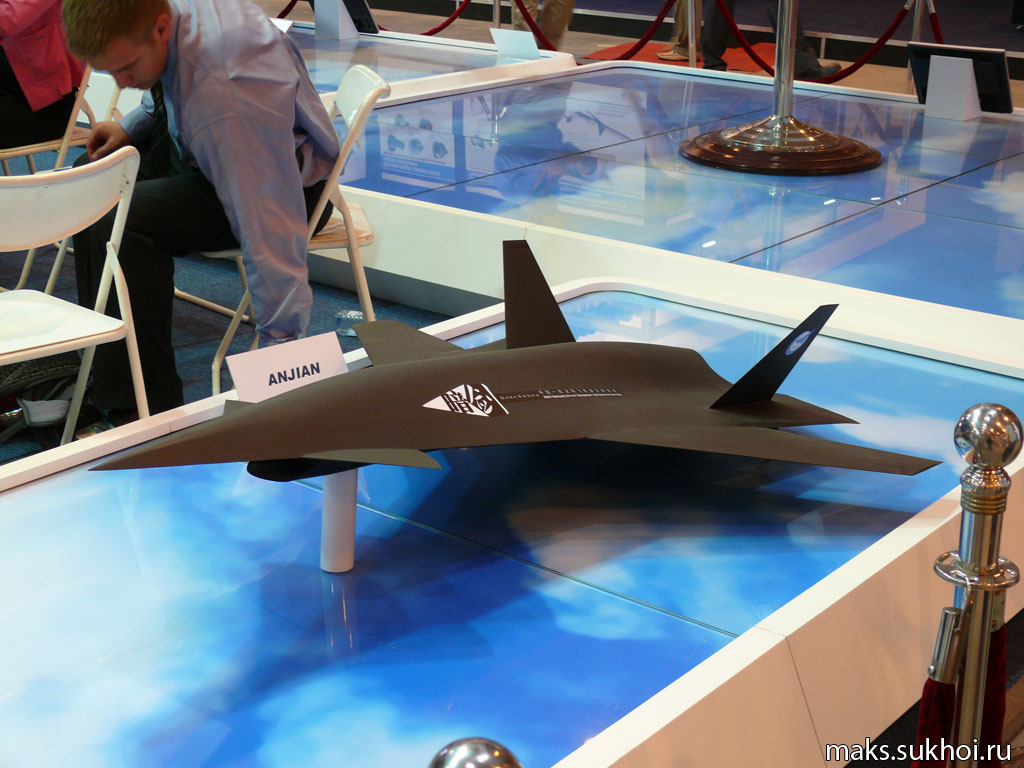
JaiA few photos here as well.
http://maks.sukhoi.ru/maks2007.htm
One question, what project do the following pics signify ?

JaiGPS Issue Latest In History Of JASSM Problems
At least eight components of the Lockheed Martin Joint Air-to-Surface Standoff Missile (JASSM) have caused problems during the stealthy cruise missile’s troubled past, contributing to the missile’s 42 percent failure rate in recent months.
All of the issues are being addressed and some of the involved systems are being fixed or replaced (see chart p. 2). The steady stream of issues, though, demonstrates a pattern of failures that traces back to the first lot of deliveries.
As part of a get-well plan for the $5.8 billion program, the U.S. Air Force is adding flight-tests at a cost of $68 million. Though Lockheed Martin earlier rejected shared funding for the plan, the company now has agreed to pay $38 million toward the testing. The company also has changed its management, bringing in Steve Barnoske, who led the tactical missiles branch of Lockheed Martin, as director of the JASSM program.
The problems, most recently with a Global Positioning System-dropout that caused missiles to impact more than 100 feet from their targets (DAILY, May 10), contributed to a decision by House appropriators to reject the Air Force’s plan to continue to ramp up funding in fiscal 2008, and the defense appropriations subcommittee proposes to trim $34 million from the USAF request of $201.1 million. Validation of the fix to the GPS dropout problem will come in November, with flight-tests to follow.
The Air Force also is planning to issue a request for information (RFI) to industry to explore alternatives by mid-September. The RFI will include stealthy cruise missile capabilities similar to the 200-mile range JASSM and 500-mile JASSM-extended range variant.
There is reluctance in Congress to abandon JASSM, according to one staffer there, combined with concern about turning to a European solution – either the MBDA Storm Shadow or Taurus KEPD 350 – and pulling money out of the U.S. industrial base. The system’s design is “sound,” the staffer says, and “it is largely suppliers” that are causing problems.
At least 16 flight-tests have been added to the program as well as up to 17 ground tests to demonstrate fixes for the GPS dropout problem. Production of the missile is expected to slow and stretch out as a result of the guidance issue, according to a briefing provided to Capitol Hill from USAF Maj. Gen. Mark Shackelford, the service’s director of global power program acquisition. The government plans to pick up the tab for the lengthened production run.
The Air Force reported a major JASSM cost overrun to Congress earlier this year, and the Pentagon has taken the unusual step of deferring a decision on whether to move ahead with the program or terminate it. That decision will come in spring 2008, a full year after the overrun was reported to Congress. At that time a new cost estimate will be formed, though the missile is expected to have doubled in unit cost from its original estimate of $400,000 per missile to more than $800,000.
Shoddy components have been a major factor in JASSM’s low reliability. According to a briefing Shackelford provided to lawmakers, the problems range from the missile’s electrical systems, warhead, and power system to its guidance kit and engine components. Seven of the issues are in various stages of repair or replacement. One industry expert says this is a “stunning list” of historical problems for the JASSM program (see chart below).
JaiLockheed Martin Explores Tie-Ups in India, Plans Bid With F-16
July 19 (Bloomberg) — Lockheed Martin Corp., the world’s largest military contractor by sales, is exploring long-term tie- ups with Indian companies for domestic and overseas markets as it prepares a bid to sell 126 fighter jets to the south Asian nation.
Lockheed, based in Bethesda, Maryland, will propose F-16 jets to the Indian Air Force in a contract that may be valued at about $9 billion, Royce Caplinger, managing director of Lockheed Martin’s India unit, said in an interview yesterday in New Delhi.
“We will work with the Indian government and the industry for the best possible offset package,” Caplinger said. “We will fight for this thing as hard as we know how.”
Boeing, GE ready to launch N-deal lobby
Major American companies like GE and Boeing as well as a prominent trade body are ready to launch a big lobbying campaign to persuade the Congress to bless the Indo-US civil nuclear deal as soon as any compromise between the two governments is nailed down, according to a media report.
“This deal is very very important to both countries,” Bill Begert, vice president at Pratt and Whitney, a unit of United Technologies, which hopes to supply engines for a fighter-jet deal, is quoted as saying. “If this falls apart, it will have real near-term consequences for everyone in the defence industry.”


 Sign In








