wow the factory is so very clean.
some factory in other country its crazy. you see grandmas working there!
Sir, you are truly a troll.
what a big bay…
Big as in roughly the same size as the one on F-22, right? It just doesn’t look deep enough to hold, say, an anti-ship missile in it. I half suspect the bays on PAK FA are actually bigger but that’s just my guesstimate.
Baltic interceptions 2013… 2 beautiful birds and a very Cold War setting!
Full picture set: http://www.facebook.com/media/set/?set=a.539737329405330.1073741894.290726467639752&type=3
I just realised that the Mirage was flying in the foreground. That size difference ;D. Interestingly, it seems that the Sukhoi is flying at a lower alpha than the Mirage, very telltale of their relative wing-loading.
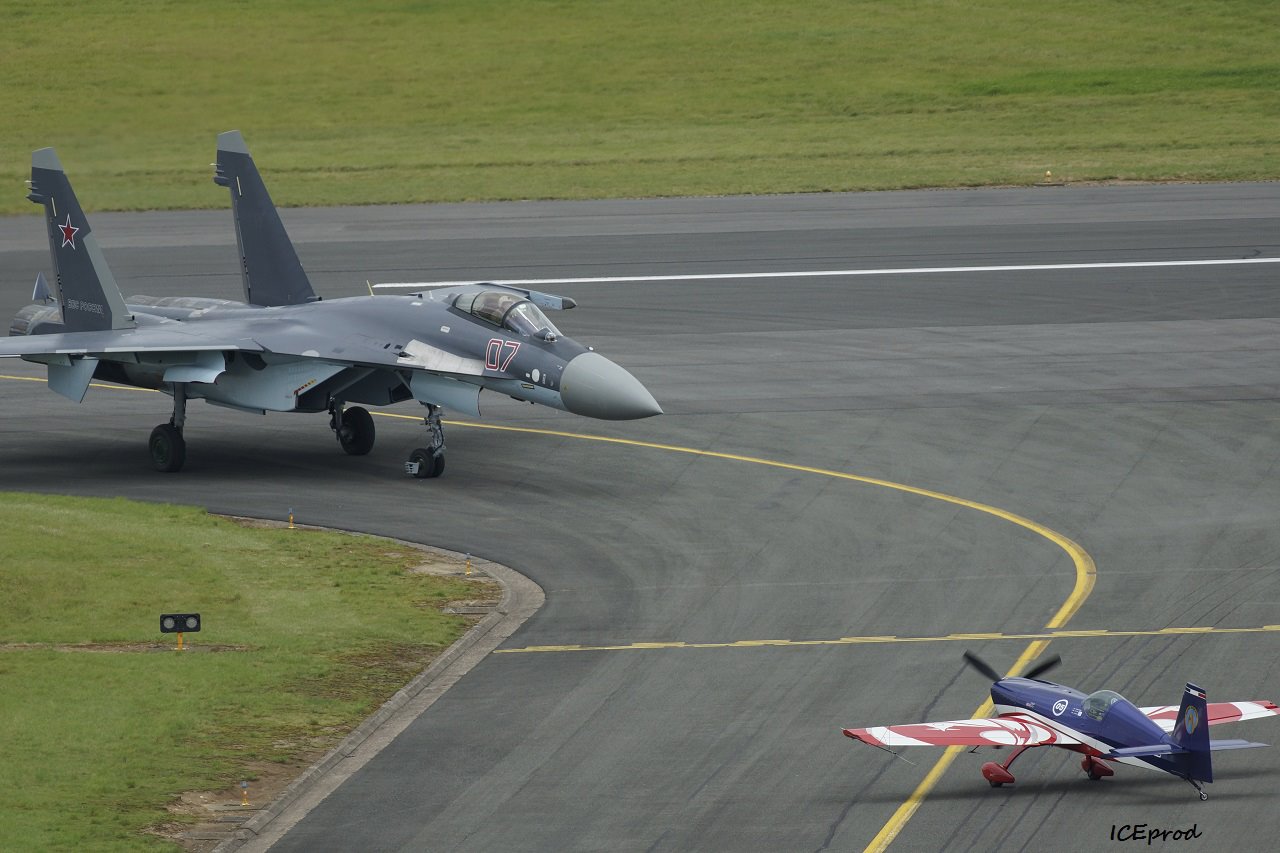
Extra 300: Well well Su-26, you sure look a hell of a lot bigger today…
An Army Apache (Army Air 301) had a blue laser pointed at it just after 11:15pm this evening.
While flying to the west of Rayleigh. Shame they couldn’t have “returned fire”.
Only one laser beam? Damn! If they did it the Egyptian way it would have been epic!
[ATTACH=CONFIG]218327[/ATTACH]
Credit: The Huffington Post (Link)
WS-15 is reporting targeting 180kN thrust…
…and exactly how does that, if and when it materialises, help lowering the wing loading?
Nice pic, doesn’t the wing area look somewhats small in relation to body ?
Ya this bird always gets me nervous. It looks like it’s got twice the wing loading as T-50 and not nearly as much T/W ratio…
clearly the fence is (and has been for many decades) an effective solution. Just not elegant (to me at least) and you can tell that, by seeing when the last fence was used prior to the hellduck.
You mean not as aesthetically pleasing as you wanted it to be by your standard, right? Engineering elegance is achieved when a hard problem is solved by a simple and low-cost solution. So the little fences solved wing buffeting on the Su-34? I call that a job well done.
The boys in Boeing seems to have done exactly the same to the Growler, too. Remember all those years of flight testing on the E/F to half-solve that transonic wing drop?
Really, you believe any of the aforementioned will be able to counter the PAK-FA, J-20, and/or J-31 in the next ten years?
With all due respect, PAK-FA, J-20/31 will not be operationally ready in the next ten years.
What is the POB??
I think he meant BOP.
no, don’t go to viscosity yet, they have gone too far, and already screwed up your mind.
It’s pure pressure difference, nothing else to think of now if you really want to understand it.
hold a piece of A4 size paper by a corner with 2 fingers of your left hand, hold another piece with your right hand, put them in parallel positions at about 10 centimeters from each other. Now blow some air to the gap between them, you will see both pieces of paper move towards each other.
the forces make them move is caused by air-fluid pressure differences!!
…except that still doesn’t explain how lift is generated. So the air pressue on the upper surface of the wing is lower than that on the lower surface, yes, but how? You still need to explain why anything flat can generate lift given the proper alpha angle.
The simplest (yet correct) answer is, as the aircraft moves through air, it pushes the air it moves through down, and by action-reaction, the air pushes the aircraft up.
Specifically lift is achieved by taking advantage of a property of air known as viscousity. That is, although you may not quite feel it, the air is a little sticky and not completely frictionless. As the airframe moves through air, the air particles that touches the surface of the airframe get “dragged along” and those in turn drag other air particles that are further away from the airframe. The lift-generating device such as the wing is designed to be flat and flat shapes with pointy trailing edge normally generate lift with a positive alpha angle. Lift increases as alpha increases up to a certain point when the “stickiness” is not enough for air to attach to the upper surface and the whole thing stalls.

If we compare the aerodynamic configuration and the location of the center of pressure, it appears that J-20 is closer to the S-37, not the MiG 1.42 😉
Red Line – Location of the main landing gear
I’d say J-20 and S-37 should have the AC ahead of the GC. There are photo images of each doing high alpha during which the canard drooped significantly to counter pitch up moment.
Speed is determined by thrust = drag. Drag increases with speed until it balances available thrust.
Just want to add that thrust is in turn a function of speed and altitude (and other things.) This function for a non-air-breathing engine looks very difference from that for an air-breathing engine.
I have a feeling that I’m the only one for…