moon_light
why not cut the b-52 but the b-1
moon_lightWhy don’t you plot that out on a graphical chart, add the air density in that chart (needed for drag) and look at what angles you end up with. The lofted profile is only good for the very long range and low Pk engagements.
You have propulsion for 11km.
It needs a vertical change in position of 3km minimum to have any form of useful range extension, preferably even more. But everything after the 11km is a glide flight where over 50% of the agility is lost already. And after something like 2-5 seconds of sharp turning it has lost nearly 50% of its velocity and even more of its turn performance (and thats the result of a target doing zig-zag or yo-yo).There are very good reasons why engagement envelopes look like this:
the aircraft in your graph fly 10 km lower than the enemy :p but i dont see any reason why the f-35 would do that
I expect it to drop further if the target decides to dive early on. 😉
if the the target dive down the different in potential energy will be even bigger => advantage to the missile 🙁 so what the point ?
You are wrong. German Typhoons were unable to get within 20 miles of an F-22, because Raptor did AIM-120 shoot at that time and turn away. The BVR exercises will have no sense, when you Can’t use your weapons in simulation.
Why Eurofighters couldn’t get within 20 miles especially in simulation – sth forced him to do so, and the only BVR F-22 weapon is AMRAAM – so conclusion is clear. I give you much more examples in recent post but you just ignore it. AIM-120C-5 has only 10% better range than AIM-120B (according RAF). In real life F-15C shoot AMRAAM from 25 km against poor equiped MiG-29 from 35k ft + 1,4 Mach. So please stop telling me that C-7 will destroy 4.5gen plane from 60km away.
And please give any sources.
f-35 is slower than f-22 but it can use Meteor while f-22 only use the aim-120C-5 , so it mean that typhoon can’t get within 20 miles of an F-35 too right
it will be even worst because:
This result reflects today’s level of technology, in which the within visual range (WVR) and beyond visual range (BVR) envelopes are separate. A BAE Systems paper from 1996 – reflecting the UK thinking that led to the adoption of the BAE Systems Meteor AAM for the Typhoon – points out that a target beyond 40km range “can feel free to maneuver without fear of engagement”. This is echoed by Robert Shaw, former US Navy fighter pilot and author of Fighter Combat Tactics. “There is virtually no missile that you can’t outmaneuver at maximum range.”
With today’s weapons, the BAE paper notes, most MRAAM engagements will take place between 15km and 40km-range. Older short-range AAMs “lack not only total energy but also missile speed” and are most lethal at ranges under 8km, according to BAE. Between 8km and 15km, therefore, there is a ‘commit’ zone where the target can still avoid a merge into close combat if the odds are unfavorable.
The key to the next generation of MRAAMs, such as Meteor, is greater range and (more importantly) greater energy at range. The result is a much larger “no-escape zone”. This zone surrounds a target and defines the maximum range at which the target cannot out-maneuver a missile shot. The missile’s kill probability may be almost constant from its minimum range out to 80km. (One issue here, observes Shaw, is that it may be difficult to confirm that the missile has found its target, particularly in poor visibility: this may be one reason why Meteor has a two-way datalink.)
http://www.stealthskater.com/Documents/Fighter_1.pdf
btw missiles have fly time too , they dont travel at speed of light , so it mean that the f-22 must have launched their missiles from distance > 20 miles , btw according to your assumption missles will be quite useless when their motor burn out no matter what their speed => effective range only 11 km so why the effective range of aim-120 from F-22 is 22 miles (we the rate of burning of AIM-120’s motor is constant as it solid rocket motor )
it will be even worst because
moon_lightRead the burn times, energy drop off over time, maximum G that can be pulled by the missiles after burnout, availability of decent sensors for the Eurocanards, especially for the latest versions.
Against modern adversaries with good pilots the AMRAAM is very short ranged. Your 40-50km are only viable against surplus Soviet aircrafts with rdars and rwrs that don’t work… and you also need a bad pilot in the target ac. If all of that is true then sure, you can get the 40-50km kills.
I used the lowest RCS number for the F35 and put it on the graph where the Irbis E would track that size of target. In real life the target size would be larger and there would be EW
not very sure how accurate your assumption is but you left out several things
1-f-35 can have Meteor
2- what stop the f-35 from accelerating to high speed , high altitude if it detect su-35 or EF-2000 long before the other aircraft see it 🙁
3- even in the example irbis-e only see F-35 from 40 km , in real life Irbis-e is unlikely to get these impress range ( due to single target track focus beam ) not to mention it may have to deal with clutter , jamming )
Why would I strap 3 drop tanks on the EF to make the F35 look good? I assume both ac are somewhat optimised for the engagment.
Already been acconted for and the assumption is that both at are somewhat optimised for AA engagements. Even vs stealth ac involved you tend to know when the enemy is near because you can track the AWACS and the radars ucurrently used.
without CFT or EFT the EF-2000 likely to run out of fuel long before it detect f-35 , f-35 can operate alone without AWACs
The fielded sensors of yesterday has a target acquisition range of 50km+, the AMRAAMs high Pk range is <15km. The F35 will have a really hard time coming up from behind any of the Eurocanards. (Based on one sided supercruise, enemy having datalinks and additional radar sources like AWACS etc supporting from behind)
what stop the AWACs from being shot down ?
btw even with low PK 2-3 AMRAAMs shot at the same time will have quite decent PK
So please explain me why F-15C shoot AMRAAM from 25 km (head on + high alt + high speed condition) in real war against poor equiped MiGs?
I give you a credible sources that AIM-120C-5 has 10% better range than AIM-120B ( RAF – use both of them).
I also give you sources that at least 2 long range shoot took by Shower was evade by MiGs.
This gives us a clue that AMRAAM (and any other BVRAAM) NEZ is rather smaller than 30km especially against modern fighters with good SA. This wasn’t an exercises – this was for real and against much worse equiped adversaries (much older equipement on 9.12 MiGs than on USAF F-15C, no AWACS support, and of course numerically disadvantageous).
But as always you know better,and without any sources you come up with strange conclusion.
Another interesting article:http://www.stealthskater.com/Documents/Fighter_1.pdf
About Meteor NEZ compared to current AMRAAM :
http://en.wikipedia.org/wiki/Meteor_%28missile%29
AMRAAM NEZ: 80km_3=26,7 km ( This explain us why Cpt.Rodriguez shoot AMRAAM from 25km :highly_amused:).
I give you BAE and fighter pilots knowledge in above examples.
The strike range of ASTRA 25-40km fits to above figures – US Navy pilot claim that BVR fight with current weapon won’t exceeds 40km, and will take place between 15-40km (depends on target maneuverability, alt, speed, etc – so higher number -40km are probably against non maneuvering targets)
🙁 you do know that f-35 can carry meteor right :confused: , and in your link they say meteor can have effective PK at 80 km same as 1 km , so in’t it so obvious that the first look , first shot of f-35 will give it great advantage ????
I thought we all agree on this.. When a missile runs out of fuel and Thrust, its pretty much become SPEAR rather than an ARROW. It loose 75% of its agility and it drops quickly Down to being a STONE as it try to follow a target…
This is pure physics and Logic, Why is this so hard to understand!?
missile often climb and dive down the target ( that give it alot of speed ), it dont just go on a straight line like sabot
What you win in range you lose in time,
lobbing can work vs a cooperative or slow target,
but in a dynamic supersonic air battle where a fighter may turn either way,
the kill box area at arrival is far too big
at higher altitude => lower drag => faster cruise speed => may be the the time take not that different
moon_lightThere is a reasonable amount of unclassified data on all these weapons, but much of it is not publicly available. For example, the Jane’s online stuff is behind a paywall, and few libraries stock the specialised books such as ‘Jane’s Air Launched Weapons’.
What sort of information were you specifically looking for?
just any info available , such as are they just for testing or in low rate production or have been used in conflict ..etc , why there so little info about them compared to other weapon
moon_lightA few touch-ups to the earlier calculator I posted.
Basic assumptions are:
– 50,000ft launch altitude for the purpose of air density and missile deceleration after coasting
– Aircraft starting, max speed and turn rate configurable. I use a clean F-15 turn rate chart (at 40,000 ft) to select turn rates for a A2A loaded typhoon at 50,000. In all likelihood this is overkill and the typhoon is not that capable.
– Typhoon acceleration is based off F-15 in clean config and with only 7000lb of fuel. I “could” tweak it a bit to simulate a slight dive.
– Missile acceleration is still not correct (anyone got sources on how to work out acceleration from specific impulse, mass and fuel? Also sources on fuel use during coasting for ramjet missiles?) so I assume 10 seconds burn, 15 second sustain.
– Missile deceleration is calculated each second based off speed and air density. Source was an old post on this forum.Still a bit missing. http://i.imgur.com/6V080gD.png
[ATTACH=CONFIG]217003[/ATTACH]
A couple interesting conclusions I’ve drawn from playing with the variables.
– Apart from a large detection range advantage, launch altitude is king. The decrease in drag and subsequently lower deceleration as altitude increases is enormous. Example. Missile peak deceleration is around 130km/hr/s at 40kft, 80km/hr/s at 50k, and around 40 at 60k.
– Launch speed doesn’t seem as important as people keep saying, especially at lower altitudes (this would probably be related to the missile acceleration calculation used). The benefit of an extra 500-600kmph launch speed is nullified within a few seconds of deceleration after burnout at 40,000ft and lower.
– Stealth aircraft have a much bigger advantage the higher they and their adversary fly. The combination of missile range increase and turn rate decrease for the target greatly enhances range. Missiles using ACM’s for turning will add to this advantage.
– At high altitude and against stealthy aircraft, the targeted pilot is better off flying at his best cornering speed, rather than high supersonic speeds when going into combat against known stealth fighters. When he need’s to manoeuvre, he can turn much faster (double the high speed turn rate) and decelerate away, giving him a better opportunity to escape. High speed just decreases his turn rate and increases the stealth fighters’ a-pole range because of the high closing speed.Summary:
If I haven’t missed too much with the calculations (really wish I could calculate missile acceleration and coasting times better, too much on my plate to learn rocket science this week. Will add vectoring later), stealth aircraft should do VERY well at high altitude regardless of kinematic performance. Detection advantage (a buffer between firing and being shot at) is all important so attention to detail with forward aspect RCS and emissions stealth are the most important factor for high altitude fighting.
very interesting dude
moon_light.
So yes, given suitable long-wavelength radar coverage, a fighter can “see” (to a sufficient resolution) the JSF from 200 miles away! If the F-35 were a Mach1.5 interdictor (like what the J-20 **might** be), then this may not be quite such an issue, as the intercept curve is challenging.
But, with JSF being relatively slow… enemy fighters do have time to formulate an effective response.
no fighter can do such a thing 🙁 unless it can carry something as big as an spy-1
moon_lightAnd I agree. The Vertical tail is a large reflector if… the enemy is coming in from a 90 degree angle to the side, in the case of the Gripen the bounce from vertical tail to wing to foe is much smaller than for jets like EF.
no what i mean is if you have 2 perpendicular surface it will result in very high rcs , even if enemy come only a few degree from front that why most stealth fighter have v tail
Modern systems are pretty good at distinguishing them from a signature library. Either way they get the direction to the jammer or radar.
depend on how modern the AESA is ,and algorithm
I have provided the data for circular motion and the G-forces experienced in those 10 sec turns. Im not talking about missiles gliding to the target (as that usually has meant a Pk that is almost non existant).
As i showed in the car example. You need thrust to make sharp turns. The missile has no thrust so turning will be worse and at every turn it lose even more speed.This is why it will hae a very hard time hitting a jet that makes evasive maneuvers after engine burnout (the missiles engine)
You dont need increased target acquisition range. 50km is good enough. The detection and identification range is longer and the missile will only have high Pk within 11-15km (Aim120) or up to 30km (speculative for Meteor).
i know what you mean but my point is that a small burn out missiles will be quite hard to detect , so may be the time pilot detect it they dont have enough time to maneuver , and yes missiles will lose speed by maneuver but they also gain some speed as they diving down , remember :eagerness: , btw we dont know the nez of aim-120 and meteor yet , why you assume they are 10 km and 30 km ???? , i think it much more at least for the case of meteor since it is ramjet the NEZ could be 60-70 km , about the high PK , i dont think you need very high pk even if the the pk is very low like 40 % then 2-3 missiles pretty much shot down target , it not an action movie so we dont need 1 f-35 to shot down 100 enemy aircraft right ?
Heard about triangulation? Two jets getting slightly different direction to the enemy and the intercept point is the location of the emitter. This has been around for quite some time but it is unknown if its good enough for missile engagement.
yeah and triangulation have very big problem gain low side lobe radar like an AESA :eagerness:
moon_lightbtw unlike f-35 these 4.5 gen fighter ef-2000 , rafale , gripen will have a really hard time if their opponent are mig-31 , su-35s , f-15c/e since nez range of missile quite short their reduced rcs design doesnot seem to offer lot of advantage
moon_lighti re up the file again , it have some problem:cool:
:mad::mad::mad::mad:
how to upload sth bigger than 2.5 mb :apologetic:
moon_lightFirst off I have to say thanks for an excellent post. It has everything from sources to a friendly tone.
But why make this into an apple vs oranges comparison? I go for the jets + weapons for a reason. Its the most comparable data you can get.
And btw, I agree that we dont know the true RCS figures. So I wont debate them. Sure, you can set the ‘un jammed’ range to 120km against the old Eurofighters if you want to. Shaping will always give you benifits in some aspects and disadvantages in others.
first , the EF-2000 in comparison using an AESA radar so i dont think it really old :p , and here where i got my infor about RCS , as they stated missiles and vertical tail are main contributor for RCS
http://www.orkut.com/Main#CommMsgs?tid=5363091547610857956&cmm=58541394&hl=en
6 pixels across is whats needed for a positive target identification according to FOI. As long as you got position of the enemy (approx) it is enough to fire the missile. The trajectory however wont be perfect but it will do the job.
oh i thought you was talking about calculate range by looking at the picture of target :p , if this was just for target Identify that the resolution is fine , however if you dont have information about range then the PK of missiles will be even more horrible since the best flight for BVR missiles is climb and then dive to target but without range information that impossible , not to mention that without velocity and aspect angle information you will have to constantly datalink to the missiles to update because your missiles willnot be able to predict where to fly to
Please enlighten me on how many clouds there are at 30’000 ft and above, or for that matter how often you see rain at those altitudes. Btw, that level of detail requires pretty short range between radar and target. If you have a target far away that isnt responing to IFF signals it is likely that its an enemy.
this what i can find 
btw there something bugging me : what will stop the F-35 from hiding in ground clutter and cloud and then sneak up from behind these 4.5 gen fighter 😎 F-35 is very low RCS fighter and also a meteor fire from short range will be really hard to evade
Thats not how jammers work today. For every advancement on the detection side you have an advantage using the same technique on the defensive side (at least when it comes to radars), ir is trickier.
i think the radar still have advantages , it always easier to hide and encrypted than to detect and understand ( i mean RWR can pick up the radar signal but dont even know it a radar signal let alone try to jam it )
Depends on how you count NEZ. In this case the best comparison would be an arrow from a longbow (usually starts at 300km/h) that had stron LED lights vs you in a car averaging ~100km/h. Pretty early on it will be very hard for a shooter to hit you in those speeds. And since you like comparing with cars I will ullustrate how to make the tightest possible turn with the highest possible exit speed.
The key here is having full throttle once you have begun the turn. This is impossible without propulsion. So once you lose propulsion maneuvering will suffer, and every turn costs a lot of energy.This is why the demonstrated Pk of missiles outside the 10nm range is almost laughable. If the enemy sees the missile coming, and the missile has no propulsion left, it is fairly easy to out maneuver it. That is why burn time is so important.
It is wuite possible that, say Aim120D or Meteor will have a Pk within the propelled range that is as high as 80%, but once propulsion is lost, a maneuvering target will make this go down all the way to 0% depending on the distance and maneuvers utilized.
well at high altitude like in your example missiles will decelerate very slow compared to a missiles fired at medium altitude or sea level , and BVR missiles dont go straight to target but climb and the dive down so they can have some speed from the potential energy the total speed at end game of missiles could be mach 2-3 depend on situation , missiles with burn out motor will be less lethal but also much harder to detect , not to mention missile dont follow the part that target take like in movie but will try to intercept at a prediction point , unless you run aways it not that easy to evade a missiles your maneuver need to be at right moment , and unlike in the car vs the bow the closing rate of aircraft and missiles will likely be much shorter :p ( and if you are flying supercruise the closing rate will be even higher :p + harder to turn at high speed )
Absolutely, but that requires afterburner which increases IRST detection range.
but it dont increase the track , lock range of IRST so you dont know how far is the target 10 km -40 km -100 km or 200 km ..etc
Thx. And that read confirms what I say. A rwr is pretty much the same as a passive radar. Lets say you have one that is 100 times smaller than a normal array, ie the rwr only has 14 antenna modules (receiver units). Now, is it likely that you get a reflection of 1% of the light you hit the target with at long distance?
Not really. The sensitivity is normally in the -50 to -60db range (1/100’000 to 1/1’000’000 range).
And thats the expected returns at maximum range. If you have antennas made for LPI intercept (as EWS39 has had for over a decade) it sort of doesnt matter. But these numbers show you what reflection is expected in return at max range so if you have just over 1/316 to 1/1000 the amount of listening ‘receive modules’ as the enemy has in their radar you will have a relatively better probability of detecting their emissions before they detect the reflections.
Some more read up here: http://www.phys.hawaii.edu/~anita/new/papers/militaryHandbook/rcvr_sen.pdf
well ELINT system will have to solve some problem when going again aesa radar : detection range , recognize that an enemy radar instead of spike , clutter ; since AESA can use multi frequency at same time and frequency hopping => extremely hard to jam by DRFM jammer ,using noise jamming make yourself an easy target , RWR can tell you that there is an enemy there but no information about range => not very useful
moon_lightThat modern jammers are using AESA antennas as well appears to be entirely ignored. A modern jammer isn’t not a broadcast style system that screams “here I’am, catch me if you can”. The other way round the radar transmissions of the opposing radar can be intercepted as well.
well unlike radar , a jammer need enemy to be able to receive it , otherwise there no point jamming , dont you think :p
moon_lightThere is a forum strictly for this sort of topic.
what forum :confused:
moon_lightI dont know the exact rcs-figures and I dont like debating what I dont know. But lets assume that the real RCS is 100-200% larger. It still only increases the range by 20-40%. Adding jamming we stay at the original number
well like in the link i have posted the f-35 can detect clean EF-2000 at 120 km , we dont know how much pylon , missiles will increase the RCS number , and since supercruise consume a lot of fuel , they may need to carry fuel tank too which increase RCS even further likely much more than 200 % , and the most important thing aircraft with vertical tail will have RCS rised significantly compared to aircraft with V tail like F-35 when the enemy is not completely head on
The IRST-range I give is “target acquisition range”. This means you have several pixels across so you can use basic trigonometry to get a good enough read on the range. It is not detection range.
you still dont have information like aspect angle and velocity , not to mention IRST affected by cloud , weather , and your triglometry will have big problem for example : how do you know the enemy is an F-35A not F-35 C , or how you know it an F-16 not an F-2 ..etc there alot of aircraft look alike but have different size
The reason I got into the RCS-numbers was begause I needed to illustrate the difference in detection range for the F35 meaning how large the advantage is. And depending on jammin etc the advantage is anywhere from 0-40km.
we dont know how good is jamming Vs AESA , and using jamming is more like saying hey iam here => F-35 can attack you by using ELINT system
Assuming the target is within the “killzone”, aka where the missile still has propulsion and the short range afterwards where the built upp kinetic energy is enough to keep it agile, it will have a fairly high Pk. Outside of this range it is a low Pk missile. The Aim120D will have a high Pk range of ~11-12km, possibly up to 14km. The Meteor will be in the 25-35km ballpark before kinetic energy is too low.
Aim-120 have NEZ bigger than that about 30-40 km , and meteor if i remember correctly have NEZ about 3 times of normal missiles , and btw just because missiles run out of fuel doesnot mean they are less lethal , for example if both F-35 and the enemy fly at high altitude the missiles will decelerate very slow , i dont think it easy to evade something at mach 4-5 while your aircraft is also moving toward it at speed of mach 1.5 ( think about it , it quite hard to evade a bullet when you are in your car , right 😉 )
Basically, If you have a good missile that performs exceptionally well WVR you are lucky if it is half as effective BVR. In this paper the definition of BVR begins at ~5nm or 9,3km.
But the shooter can come from the blind side of the enemy, the kinetic advantage is pretty huge (normal scenario back then was cruise speed @mach 0,8, if the attacking Viggen gets into the fight in mach 2,1 from the side and leaves target area then the relative engagement envelopes are pretty much in favor of the fast aircraft. This tactic (and variants) are good if you want to establish control of the engagement before it starts.
since F-35 detect these 4.5 much further than they detect F-35 , doesn’t that mean the F-35 will have time to accelerate to very high speed and also climb to higher altitude before launch missiles :p
But fine, just for the sake of arguing we can assume 0,3m�, it still is less than 110km range. As I said from the beginning, the early engagement forces the enemy into a defensive position where the engagement begins in a pretty bad way for the legacy jets. Pk is likely to be low but it will be higher than 0. We also have to take jamming into account. I would be optimistic to say that you only get a 30% range penalty if the enemy has heavy EW-support, white noise generators and so on. Another thing we need to take into account is rwr. Anyone using their radar gives away their position.
So its not as easy as “I can see you and you dont know it”. The Viggen example is a very good illustration of how it works. One rear ac gives away the position of itself and guides the others who are ahead of it. Unfortunately the enemy now have the approximate location of the enemy formation and will begin the defensive maneuvering as well as getting into a favourable formation.
about the RWR and AESA radar i think this a very good read
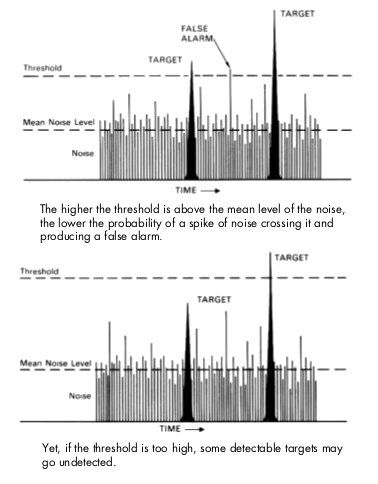
The issue for spread-frequency RWR to detect LPI radar is threshold….
The above illustration works both ways. For the seeking radar, if its threshold is set too low, it will end up chasing many targets. Against an LPI transmission, if the RWR threshold is set too low, whatever algorithms it uses to try to discern an LPI transmission will have it creating many false alarms. If its threshold is set too high, it will not discern any transmission patterns at all. The problem for any RWR system is not knowing what is ‘too high’ and what is ‘too low’ and that problem existed during the Cold War where LPI capability was a rarity.
Low Probability of Intercept (LPI) is a more a mode of operation than a distinct radar type, although there are some hardware involve. The word ‘intercept’ here mean that the signal is recognized by the radar warning receiver system (RWR) as a scanning transmitted signal and not as noise or a spike above the clutter region.
If we look at a typical spectrum analyzer scope there will be a constant background noise, or ‘hiss’ if this is converted to an audio signal. In LPI mode, and we will assume the LPI transmitter to be an ‘aggressor’ type, the aggressor transmitter will transmit a pulse that is either with the same signal strength as this background radiation (hiss) or just a spike above it. The victim usually does not know the specific frequency the aggressor will employ at any time. That is why RWR sets are usually broadband. Even if the aggressor signal spiked above background noise, unless there is a sequence of pulses with the same characteristics from pulse to pulse, the RWR set will dismiss this spike as nothing more than an anomaly, which by itself is nothing unusual. Spikes happens often.
For the aggressor, one pulse is not enough to acquire any significant information about the target. But if the aggressor transmit another pulse with the exact same pulse signature as before, then the RWR could recognize it as an attempt to acquire information, hence the word ‘intercept’. So instead of transmitting another pulse with the same pulse signature, the aggressor will transmit a pulse with slightly different characteristics, such as a different freq or amplitude or phase. As long as the aggressor remember what was employed when, it will be able to mislead the victim into believing that no one is attempting to scan it, hence the phrasing ‘low probability’.
The downside to this approach, for the aggressor, is that because the signal strength is so low, either within clutter region or just slightly above it, any target information require multiple attempts of verification. Pulse energy do get lost in transit, the longer the transit time, the less energy arrive at the target and even less energy that bounced off that target. This is called ‘atmospheric attenuation’. Most of the ‘stuff’ that sap the pulse’s energy is simple moisture, next is microscopic dust.
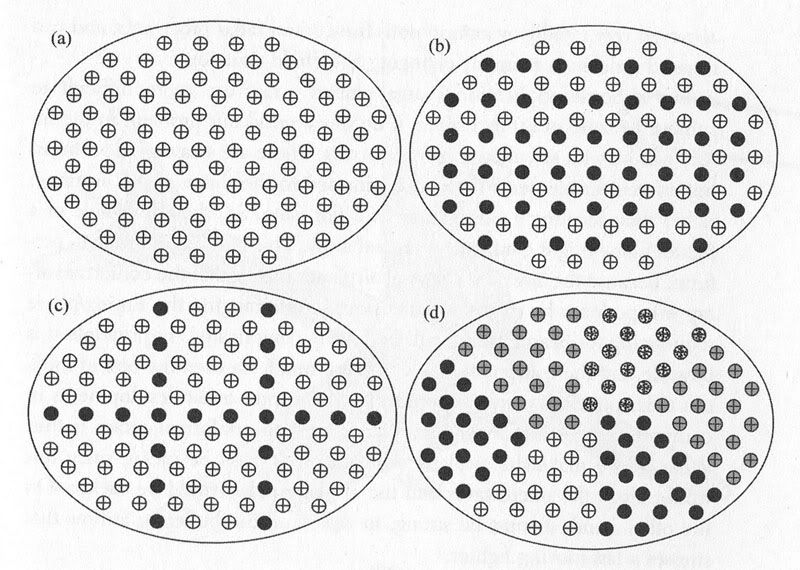
But there is a capability that is unique to the AESA system that no PESA can do — subarray partitioning.
Essentially, what subarray partitioning does is to create several smaller AESA beams from the main AESA antenna assembly. It is a software based feature. In the image above, ( a ) is one beam and ( c ) has nine distinct beams. See that? You can count the other two configurations for yourself.
This is what make an AESA so dangerous for the victim. In LPI mode, the aggressor can transmit nine simultaneous pulses with each pulse different in signature than the others. A couple or more pulses may spike above background noise level to provide the aggressor confirmation of target presence and basic characteristics. The rest will provide tracking information. Or instead of all nine subarrays against the victim, still in LPI mode, the aggressor may use only four subarrays against a victim, three in volume search just in case the victim has companions, one subarray standing by to act as a jammer, and the last subarray act as a secure data link.The victim may have ‘smart skin’ but all that does is to give him improved coverage over blade antennas that is typical of RWR systems today.
This is what an F-16 RWR antenna set look like…
http://www2.l-3com.com/randtron/f16cdant.htm
Install more blade antennas and it would accomplish the same thing as the ‘smart skin’ but at the expense of increased drag. So really the ‘smart skin’ benefits lies more in aerodynamics than from certainty of interception of aggressor radar signals. Even the classical concave dish or slotted planar array can perform LPI functions. All the aggressor has to do is fix the antenna in the direction of the target, assuming the victim’s presence is established, and transmit away. As long as the pulses are sufficiently different from one another and remains largely within the clutter region, it will be difficult for the victim to confirm attempts at detection and take defensive measures.
moon_lightWe also know that missile RCS shrinks by every upgrade and that stealth pods are reaching the market. So in a future engagement when the F35 is operational the 0,1sqm figure for a 4,5th gen fighter is fairly reasonable, or at least it should be because that’s where we are today with yesteryears RAM-coatings.
we dont know the RCS of stealth pod at the moment ,may be they have RCS = 0.1 m2 ? , pylon have RCS as well , and talking about RAM put a RAM coating on aircraft will make them heavier so perform not as good as they used to ..etc , btw since F-35 detect these 4.5 gen first , it will accelerate to fast speed before launching missiles so the different in missiles kinematic isnot that much , i know IRST can have detect stealth aircraft but they are unable to give information about aspect angle , velocity so they give missiles very limited information to make an optimum mission profile
last but not least , missiles will improve in performance as well so they make the super agility become less important
EX : missiles like R-27 , SAM-2 , AIM-7 have success rate in real war situation of just over 3-4 % , the AIM-120A/B improve that rate to 46 % ,i know you think these number are small and not very impressive but think about it it like playing Russian roulette but the cylinder have only 2 chambers so it is likely that AIM-120D , Meteor , CUDA will improve the rate even more
same for the range :AIM-7A have max range of only 10 km the NEZ will be even shorter , while missiles like AIM-120D may be able to achieve NEZ at 40-60 km , and for ramjet missiles like meteor that number may be 80-100 km …etc
moon_lightJust for the sake of adding validity I list all ingoing values below in a “F35 vs 4,5 gen eurocanard” table.
[INDENT]
RCS, frontal:
0,0015sqm vs 0,1sqm
Radar detection range:
85km/45nm vs short range (to get the +85% i assumed 92,5km) http://www.ausairpower.net/XIMG/FA-22A-Radar-2007-DT-1.png
IRST target acquisition range:
50km vs 50km, most likely it is “<50km vs >50km”.
Acceleration mach 0,8-1,2:
68 seconds vs <30 seconds.I would say all of these numbers are proven to be fairly accurate.[/INDENT]
well even for the future AESA on ef-2000
According to a calculation by a senior EADS radar expert, the Captor-E, which will use 1,426 T/R modules and is scheduled to be integrated onto the Eurofighter Typhoon in 2015, is capable of recognizing the F-35 at around 59 kilometers away.*
He acknowledged that the chance is high for the F-35 to detect and fire missiles first against fourth-generation jets, such as the Eurofighter or Boeing’s F-15, but claimed that the latter are capable of dodging missiles and successfully counterattacking at such a long range.*
His calculation shows that the F-35’s APG-81, which allegedly has 1,400 T/R modules, will be able to recognize the Eurofighter or semi-stealth fighter at 120 kilometers or farther based on the assumption both radars have the same capability.*
In this regard, Scott said that an advanced fighter might be able to lock on to the F-35 momentarily upon its launching of a missile, but will not be able to keep track of it due to the latter’s inherent low observable stealth design and as it would be busy dodging the missile for survival.*
“Once the F-35 opens its weapons bay and fires a weapon, the enemy may be able to see something for a moment, but it disappears again,” Scott said.*
“Being detected doesn’t mean that you are being tracked and targeted with weapons. Now they know you are out there. They don’t know where you are and will be busy avoiding the missile you just launched.”*
http://www.koreatimes.co.kr/www/news/nation/2011/10/205_97236.html
moreover
the RCS of Rafale , EF-2000 are unlikely to be 0.1 m2 in combat , may be 0.5 m2 at best as they have to carry missiles , pylon outside , not to mention targetting pod when mission required ,and supercruise will also consume alot of fuel so it likely that they may have to carry EFT which may increase RCS even further


 Sign In