 moon_light
a video on ARGUS, spotting a bird from 17,000 feet up, WTH? 😮
http://www.youtube.com/watch?v=13BahrdkMU8
:eek::eek::eek: OMG , this **** is incredible , seem quite small as well may be fit on f-35 external pod
moon_lightjust finish watching this
part 1 http://www.youtube.com/watch?v=-bOktdtk62k
part 2 http://www.youtube.com/watch?v=6uvBVIsksR4
part 3 http://www.youtube.com/watch?v=jbYUelX9voA
quite useful info 😀
it seem that some of you guy are right unlike stealth aircraft , stealth ship only try to look like fishing boat rather than be invisible , still have no idea how far a fighter can detected a fishing boat by radar :confused: 50 km ? , 100 km or 200 Km ?
BTW it seem that ship try to make slope to evade radar from other ship , but doesn’t it look like the more slope they are , the more their surface reflect radar from the air ?
i mean look at this
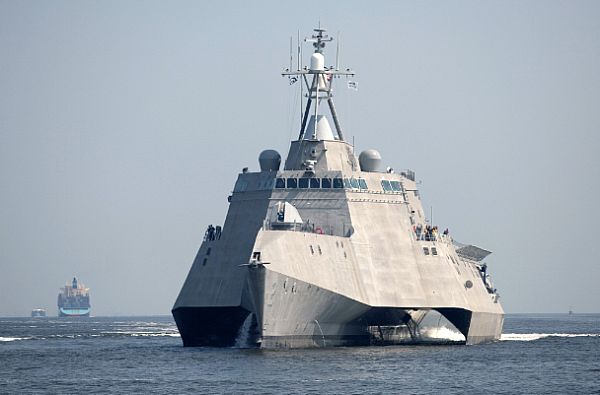
the first ship have surface more perpendicular to radar from other ship than the second ship , but if an aircraft radar fly at altitude look at the ship doesnt the situation reverse ?
moon_lighter… 500m?
should they try to go from italy to serbia at such low level and back, they’d probably run out of fuel long before returning home (not to speak about the mountains it would crash into on its way in or out)
besides, what would be the point in f-117 shaping if it flew at such low level?
talking about baghdad, I remember a report for the US congress stating that jamming over baghdad was so intense from the very begginning that a 747 could probably have overflown it without being seen… probably somewhat caricatural, but it illustrated the point that stealth doesn’t mean invisible…
no in Yugoslavia war the weather was so bad that most aircraft have to fly low in order to see target by FLIR , especially F-117
the jamming can be high intense at one point but you couldn’t keep it at the same level for the whole war period , and no one say stealth is invisible but it help aircraft to detect and attack enemy target before enemy can do the same to it
moon_lightThe F-117 only flew over Serbia at night, & IIRC high enough that it wouldn’t be exactly deafening people on the ground. It wouldn’t have been tracked by eye or noise. Detected, maybe – but that’s not the same thing.
f-117 actually often fly at altitude just over 500 meters and do like 3000-4000 routes so people know there is something fly over their place , as they didnot detect it on radar , they know that a stealth aircraft and prepare for ambush
moon_light1.Please sources? I thought that F-117 had RWR at that time and could use some evading maneuver, chaffs ?
Why LO failed against old defence system in dominated battlefield?
2. They hadn’t got any chance to do so, because NATO dominate and destroy most of air defence in first strike.
Imagine what could be happen if F-117 will fight against China at that time… against S-300 base SAM and Su-27?
You still think that if luckily they will shoot down 1 F-117? I don’t think so…
F-117 fly one route many time , dont have RWR , limited EO system , no weapon to fight back the SAM …etc
moon_lightBut you corrected me by being wrong. They engaged 2 F117, one crashed and one was taken out of service. You said only one.
Please show me those threads if they are relevant.
Ok. Give me a definition with an RCS-span that is acceptable. LO/RO usually implies an RCS <1m², something that the MQ1 lived up to in the simulation.If you have an official definition with exact numbers then please show me. APA uses the same scale as I do and thats the only one so far I have found with exact numbers. One occasion is here http://www.ausairpower.net/XIMG/Irbis-BARS.png
Thats not up to me to judge, materials and angles also play a large role.Still, its a small turret compared to the recce pods.
There is more to shaping than putting the wings in perfect alignment. Ground radars targets will have a very hard time getting any gain from those minimal extra returns of the 90 degree angles.Any source for that? It doesnt look like a shiny aluminum airplane.
Compared to a fully loaded F16 it looks stealthy, compared to an F117 not so much. But then again, I have never claimed it to be stealthy. Thats something out of your fantasy world.
See the attachement for a size comparison with the other targets.
Compared to a loaded F16 that is fairly small the RQ1 is a very very small target.
If you compare the shaping for an RQ1 on a scout mission to an F16 from below with drop tanks, JDAMS, recce pod etc you will see that is is pretty obvious that the RQ1 is a very small target. The simulation data places it @ LO or RO levels if we use the same way of measuring as APA.
If the data I have is wrong then its a different story. But all i hear from you is insults. Its easy to critizise without bringing anything of your own to the table. Have fun with that.
size doesnot say every thing , even the agm-84 have rcs = 0.1 m2 , without shaping , material and RAM it almost impossible to make an aircraft have RCS = 0.0001 m2 at 3 GHz like you claim which is incredibly low 😉
look at the Predator the EO turret is not stealth , the weapon carried out side , the wing is perpendicular head on and there is no source saying the Predator have been treated with RAM like Iron ball or anythings like that 😉 seriously you think that thing can achieved RCS = 0.0001 m2 ?? , i may believe the avenger or X-47 get that number but the Predator …..
and can you please quote exactly where in your link they say that Predator have RCS = 0.0001 m2 at 3 GHz
moon_lightOf course VLO design give some advantageous (especially against SAM), but is not panacea for a war. Stealth doesn’t mean: You can’t shoot me down – like some company said.
Reading some stuff from the forum I’m impressed that group of 4 VLO 5th gen. fighters can deeply penetrate over enemy territory ( with advanced SAMs , 4.5 gen fighters, ships) without suffering loses.
VLO aircraft is needed for a country which want ability to penetrate over enemy territory – so called super powers (China, USA, Russia) – in military “aggressors”* who want to play over enemy territory.
For self defense (DCA) over own country so called 4,5 gen + advanced SAM + link16 is more than enough. Together they can effectively defend own teritorry even against 5th gen. jet ( of course if the attacker hasn’t got numerical advantage ).
So decide what games You want to play and choose Your weapons. Remember that in the past “agressors” needs much more forces than defender to defeat enemy on his own (ex iraq , bosnia, and many many others ex from history …)* “Aggressors” – I don’t want to go any political discussion, ex – who is good guy and who is bad guy.
I only want to mark the rules of the war machines which operate over enemy territory.
the thing is VLO fighter will have advantages against gen 4.5 or gen 4
moon_lightThe RQ1 averaged around 0,06m^2 in RCS with a minimum RCS (same as the F22 and F35 figures) at <0,0001m^2 @ 3GHZ or <0,01m^2 in the X-band. http://www.efieldsolutions.com/example_rcs_predator.pdf
Numbers might be wrong but they are still interesting and I think they qualify the Predator as a LO/VLO platform.
:confused: that is even better than f-22 , even the f-22 only achieved rcs 0.0001 m2 at x band
not to mention predator wing shape , it’s EO camera and external weapon
and no official source declare Predator as LO or VLO , i think your link give wrong information
moon_lightand btw DRFM is not some thing new even the ALQ-184 and alq-165 have it
http://books.google.co.uk/books?id=4S3h8j_NEmkC&pg=PA411&lpg=PA411&dq=drfm+alq-165&source=bl&ots=hIWzKRZ2cY&sig=CwzJa846UVyktHmoFcJzVV-Cg9E&hl=en&sa=X&ei=L0cEUZGfLsOJ0AW9nIHoCA&ved=0CFQQ6AEwBw#v=onepage&q=drfm%20alq-165&f=false
http://www.f-16.net/index.php?name=PNphpBB2&file=viewtopic&p=204347
moon_lightEE :
Any new technique of jamming is sometimes undetectable and often undefeatable before it is understood by the opponent and until something is done like hardware or software change , or even building a new unit to counter it . During that time , the new EW technique is indeed … undefeatable .
For exemple , the vast majority of the actual GtoA , AtoA RF missiles use a monopulse radar as a seeker (Amraam , Mica , Meteor , etc) . Against the Cross Eye jamming technique , these missiles have a pk extremely low . To counter it with a good chance of success , you need an Aesa array .
I think the Japanese have an Aesa driven Air to Air missile , I read that somewhere …
To use the cross eye , one needs very advanced ECM arrayS and since you need at least 2 separated antennas , not a single pod on the actual market can do it . The Typhoon is said to use this technique and I bet that the Rafale too is using it .
Knowing rather well what Praetorian and Spectra are made off , I can say with pretty much assurance that I do not know of any similar systems fitted on any US aircraft . Someone prove me wrong and I will gently admit it .
Cheers .
jamming against monopulse is not really that impress , the falconedge EW on F-16 block 60 can do that too
http://www.f-16.net/f-16_forum_viewtopic-t-3538.html
and the problem of cross eye jamming or any other DFRM is that it have to recreate signal from enemy radar so it quite hard for them to jam more than 1 radar at a time 😀 imagine jam 4 different meteor and 1000 T/R modules on AESA radar at the same time 😀
more over most SAM on ground using SARH or command guide rather than just active seeker for missiles so it would be very hard for EF-2000 or rafale to survice S-300/400
moon_lightNot exactly, current IRST like EOTS, PIRATE, OLS-35 can scan a large volume of the sky like mechanically scan radar by repositioning itself.
See 6:45 video: http://www.youtube.com/watch?v=oKlQyPOiRuE
“IRST provides similar functionality to a radar without giving out electromagnetic radiation and can therefore provide full operational search and track functionality with a stealth capability.”
http://www.defaiya.com/defaiyaonline/index.php?option=com_content&view=article&id=518%3Aselex-galileos-irst-to-equip-gripens-next-generation-fighter&catid=66%3Aproducts&Itemid=50&lang=en“The OLS-35 provides a coverage of +/-90 in azimuth and +60/-15 in elevation with a target acquisition range for non-afterburning aerial targets of 50 km facing up to target’s front hemisphere and 90 km facing up to rear hemisphere.”
http://www.deagel.com/Navigation-and-Targeting-Systems/OLS-35_a001926001.aspx“A combined IRST/LR device for the Su-27, similar to the MiG-29’s KOLS but more sophisticated, using a cooled, broader waveband, sensor. Tracking rate is over 25deg/sec. 50km range in pursuit engagement, 15km head-on. The laser rangefinder operates between 300-3000m for air targets, 300-5000m for ground targets.
Search limits are ±60deg azimuth, +60/-15° in elevation. Three different FOVs are used, 60° by 10°, 20° by 5°, and 3° by 3°. Detection range is up to 50km, whilst the laser ranger is effective from 300-3000m. Azimuth tracking is accurate to 5 secs, whilst range data is accurate to 3-10m. Targets are displayed on the same CRT display as the radar. Weighs 174kg.”
http://aerospace.boopidoo.com/philez/Su-15TM%20PICTURES%20&%20DOCS/Overscan%27s%20guide%20to%20Russian%20Military%20Avionics.htmIt was a discussion about IRST :
http://forum.keypublishing.co.uk/showthread.php?t=38215&page=6
At maximum range then the FOV of IRST may be only 3° so with mechanically scan it may take about 20 seconds for the IRST to scan a sector of 60°
moon_lightExcellent thread and good points. One question, a lot of the discussion is on passive detection and ID technology using EO sensors. The ship will have a powerful radar – and current generation AShMs have long ranges … doesnt the fighter have a upper hand thanks to Anti Radiation homing?
And haven’t fighters had the upper hand since WW2 anyways? What does stealth technology on warships so drastically change to alter the equation?
not really because of LPI radar like AESA radar then anti radiation missiles and RWR will have a hard time , not to mention that to be able to measure range to launch missiles it require formation of at least 2 aircraft
in WW2 ship mostly use gun , missiles also not very agile , accurate so not very effective against aircraft by contrast ship can’t out manuever a boom or missiles
but now the ship defense is much much better able to shot down missiles and boom very easy , not to mention jamming , and now with stealth ship the aircrafts may not even know where the ship is , before they are shot down
moon_lightbtw what the different between DAS and EOTS , and why dont they use long wave IRST on F-35 ? , isn’t the technology already available in AAS-42
moon_lightNot on a fighter yet afaik. There are other applications for UV sensors in the work, which I would rather not talk about. But the combination of normal imaging and IR for example is quite common already.
And surely an IRST can search but any optical sensor is limited by resolution, so you always have a trade-off between Field of view and range at which a target can be detected. Look up this commercial system: http://www.infraredcamerasinc.com/images/Mirage_Pseries_2008.pdf
See the difference in FoV between the different lens options. So the longer your range (at which you get a useful picture from the sensor) the smaller your FoV is. So at maximum range, searching with an IRST is like watching the world through a straw.
The interesting point for this debate however is that using optical sensors in general giving an advantage to the ship, as it is able to carry more of those and heavier and larger and also has way more processing power (or should I say “should have”) to process the images. Giving the qualities of current sensors I dare say that the advantage of looking up into the sky instead of down on to the ground (sea) is not that much of an advantage any more, but still it makes processing easier.
how about the DAS , it have FoV of 360 degree so even at longest range the FOV may still be enough
moon_lightSanem,
As pointed out by Belethor:
http://www.is.northropgrumman.com/products/cni/assets/F35-CNI_datasht.pdf
…but with what field of view. As stated the Ikonos image was an 11km strip…this allowing for some semblance of area search…even then its not great. The point I’m making is that the stealth aircraft needs to search for the ship and it wont do so with the field of view even in the, relatively low res, ATFLIR image posted by moonlight.
We are presumably talking about today though.
3 words. False. Alarm. Rate.
Moonlight
The resolution isnt that spectacular there though…you’d likely distinguish a warship from a merchantman with that, I agree, but if thats 70km you’re certainly not getting an ID at 150…plus, as mentioned, whats the FoV there….looks to be about 6 or 7km across?. Going to take you a while sweeping a search pattern looking at that narrow an image and, if the ship can see the plane at 50km, getting a reliable detect and ID at 70km is cutting it a bit fine if you happen to be looking in the wrong place as you close on the surface contacts!.
Indeed. Hadnt seen the French system but its still the same thing IRST gives you a series of tracks within its FoV. Without the ability to tell from the IRST which one is the warship the pilot is obliged to look at each contact if doing so at extreme range i.e the 70km image you’ve shown thats time consuming. Go back to the AIS image and image how long its going to take to scrutinize a couple of hundred contacts…and THAT is in closed waters where its easier to contain your contacts…imagine how hard it gets in open water!.
quite good info 😀
btw i have just read sth quite the same here (but about irst against fighter )
http://www.network54.com/Forum/211833/thread/1181817479/1182872482/Raptor+demo.
btw i just think of an idea that may help aircraft detect the ship first EX: the aircraft may carry 1-2 decoys like MALD and launch it , then the aircraft itself fly down below radar horizon, as the MALD can fly for 920 km it can be program to fly around an area if there is any stealth ship detect the decoy and attack it by missiles ,their bearing will be detected when the missiles rised from horizon ( as the missile much hotter detect them must be much easier) and the aircraft only have to zoom it’s FLIR to that bearing to find the ship 😀
what do u think ?
( i think the fighter hunting Scud missiles launched did use the same tactic)


 Sign In







