 moon_light
And the B2 pic shows an IR image from an IR camera pointed at the B2 using the Mk.I eyeball. My point was that this image shows nothing. If it shows anything the lack of obvious hotspots is quite interesting.
the problem is the distance , weather , smoke , cloud ..etc at short range it may be easy , at long range not so easy ..etc , not to mention you not always look at the aircraft against a cold sky back ground
moon_lightSpeaking of the RCS, Lockheed has in mind the minimum value, paralay – average.
stealth aircraft is design to be minimum at frontal aspect while have very large rcs at some angle due to the shape of aircraft so i dont think it fair to measure the average RCS of them , because the frontal RCS is the most important when you tried to attack sth
EX : two aircraft may have the same average RCS but the one have lower frontal rcs obviously have great advantage
moon_lightRussian usually honest. USSR did not tell anything, but do not lie. Russia in the early nineties was much too frank. Today Russian understate characteristics of their aircraft.
For example, write a maximum combat load of the Su-34 – 8000 kg, actually more than 12,000 kg. 😉
well i think russian lie about their stuff as well
example :
plasma stealth ( still in theory )
invincible kirov with 700 km missiles ( say nothing about radar Horizon )
top speed of aircraft ( same for both sides as not very useful in real condition )
…etc
btw can you explain more the case of SU-34
moon_lightRegarding the IR signature. Does anybody believe that an object you can easily see with the naked eye could be masked from a semi-modern IR sensor against the sky… that is fantasy.
not really but i think they can reduce the detection range just like using camouflage to reduce visual detection
moon_lightUuumh.. So by your own logic, if US had invested twice as much funding, LM would somehow further reduce the F-22 RCS by half??
Yeah right, if you got a Klingon Coalking device..
It does not work this way. Every reduction in RCS are harder, much harder to reach. You come to a point where this stop.
Oh and lets not forget the steady improvments on Radar too.. which challange the RCS of any Stealth thingy(Ship, heli, jets. etc)
of course not but if it only improve that much then i dont think they will spent any money on stealth at all 😀
and the number are way too different from what public by US government :eek::eek: i mean seriously from 0.0001 m2 to 0.3 m2 :eek::eek: ( and both say that the minimum )
moon_light😎
what you mean ? i dont really understand 🙁
moon_lighthttp://en.wikipedia.org/wiki/McDonnell_Douglas_F-15E_Strike_Eagle
Empty weight: 31,700 lb (14,300 kg) – in fact, 16,550 kg, 14,650 kg – empty weight F-15E without CFT.
Maximum speed M = 2.5 + (2660 km / h) – in fact, the F-15E with CFT has a maximum speed of 1900 km / h CFT faster without the F-15C can accelerate only up to M = 2.3, the flight at that speed is not more than one minute. F-15E worse aerodynamics.
Weight of 10400 kg of payload, previously wrote all 11,110 kg – in fact the maximum combat load of the F-15E: 5124 kg
1x AN/AAQ-13 Navigation Pod, 204.6 kg
1x AN/AAQ-14 Targeting Pod, 240.7 kg
4x AIM-9L / M Sidewinder, 86 kg
5x GBU-10 Paveway II, 956 kg
2x 610gal Fuel Tank, ~ 2000 kgTotal: 204.6+240.7+86*4+956*5+2000*2=204.6+240.7+344+4780+4000=9569.3 кг
Weapons: 86*4+956*5 = 344 + 4780 = 5124 kg / 11 296,5 lbs
Many sources still write a maximum flight range of F-15E – 5680 km.
This is actually a range of F-15C: CFT + 3 fuel tanks (6105 kg + 4265 kg + 5396 kg = 15,766 kg)
The maximum range of the F-15E: CFT + 3 Fuel tank capacity (5952 kg + 4265 kg + 5396 kg = 15,613 kg) – 3900 kmAt MAKS-2011 on a poster about the F-15C was specified maximum speed – 3000 km / h. This has made my day 😀
that can be say the same about the russian stuff :confused:
top speed and max range are both not very usefull in real life btw how come the F-15E have much shorter range than F-15C :confused::confused:
moon_lightThey claim same frontal RCS as the export model F-35 for the Silent Hornet.
i thought that the claim of F-15 SE :confused:
moon_lightThe point is that I don’t have to.. LM have not included any groundbreaking IR suppression measures into the F-35, nor are they marketing these actively (in contrary to AESA, EODAS, (V)LO…).. It shows that we are likely not that far off in our opinion regarding their usefulness..
i think they did say something about Topcoat on both F-22 , F-35 recently http://www.boeing.com/news/releases/2000/news_release_000323n.htm
moon_lightIf you found yourself in a F-35 B/C getting into a knife fight is last thing you want as both do not have a gun fitted. when will this mistake stop being made history has proved time and time again the need for a gun its the last line and whilst a aircraft has rounds its still able to fight
Not fitting a gun to the B/C models will need sorting out at some point it always does and once again it will be a bolt on job but this time it will hurt the stealth side of the type as will all this hanging off it
the pod was design with stealth so we dont know how much it will affected the F-35 😉 even if the pod double the RCS of F-35 it still not affected much because increase RCS by 10 times only increase detection range of radar by 44 % )
moon_lightPracticing WVR fight has nothing to do with fun, because that kind of fight was in extreme % reality in real war conditions through history compared to BVR fight and I tend to believe that things are not going to change much.
The thing that pilots you worked with have fear of dog fight has nothing to do with what is going to happen in real A-A combat. To me they sound like MMA fighters that have fear to go to cage. From experience in Kosovo war I can tell you that our pilots wanted nothing but to fight “fur ball”. There are two reasons for that.
They know that they are strong in WVR fight and it is absolutely normal they want to put the fight in their advantage, it is nothing insane about that. And the second thing is something called courage!
When you have equally strong opponents there are great chances you will get in to a dog fight and that is the reason why pilots all over the world practice BFM.
WVR can help you kill the enemy but also help them to kill you , and it need not only skill but luck and number , that the reason why all fighter have standoff AA , AG missiles and most try to avoid WVR
That is correct but if you look at Iraqi Mig-25`s, these planes were able to shot down F-18 and were also able to evade many missiles fired at them and were also able to outrun F-15 using higher speed. And they are generation behind and were operating under unfavorable conditions ( worse situational awareness) 😉
F-35 is going to face planes such as J-20, Su-35S and PAK FA that are kinetically superior, as a matter of fact they are on totally another level compared to F-35 in supersonic arena and for things to get worse, they will probably have comparable electronic suite and superior WVR characteristic.
mig-25 have much greater speed than F-16 , F-15 but it was shot down by both due to limited situational awareness . That an example to show you how important situational awareness compared to kinematic ability of the aircraft :p
and you are assuming that T-50 and J-20 will have equal RCS to F-35 while India official website states 0.5m2 RCS for T-50/Pak-Fa:rolleyes: if that was true then T-50 will have alot of disadvantages in BVR ,not to mention until F-35 use all of it’s 3 Meteor , 2 Aim-132 and 4 CUDA and only after that T-50 superior agility can be useful ( when both of aircraft still have HOBS missiles left which one more agile doesnot really matter ) , about J-20 it doesn’t seem to be more agile than F-35 and still have problem with the engine so iam not going to talk about it here :p
moon_lightAmericans always overestimate / improve their equipment specifications for promotional purposes. Compare the figures in Wikipedia and in the flight manual 😉
RSC
Number of consoles 5 pieces (two wings and two stabilizers, one keel)
coating 50%
form 0
plasma 0
RCS min 10 square meters
RCS max 16 square meters
:confused: according to you then F-22 have RCS = 0.3 m2 , while F-16 have RCS =1.8 m2 :eek::eek: i mean seriously , you think they spent billions of dollars just for that much improment ??? (and 10 times reduce in RCS only reduce detection range by 44 % so if your information was right it would be so easy to detect any stealth fighter 😮 )
and while the US ‘s information be overestimate i really dont think they assume 0.3 m2 equal 0.0001 m2
moon_lightOK, that’s the theory and it is undoubtedly correct.. Just like that Russian plasma stealth invention. Now you need to put the effectiveness of that solution into an equation with cost, added complexity, weight, failure rate.. Don’t be surprised if you find out it does not pay off.
Nice Photoshops. And the paint jobs are just phenomenal for the given conditions..
Oh wait, they still paint all new aircraft dull grey, why is that?
because up until know radar still the most common method of detecting aircraft , grey color help reduce visual detection range ( if the sky is the back ground ) , and also reduce the temperature of the airframe because it reflex sun light quite good and not all aircraft paint grey


moon_lightI have first hand experience with the anti-IR suit. It is useful but works only for a limited time period. A video or a still shows you what the producer wants you to see – a relatively cold body dressed up in the suit in warm weather. Try to simulate the real conditions, a body heated up from a 20km long march in the cold desert night – after 30mins of wearing the temperature difference becomes quite disappointing.
to be honest i dont know alot about IR signature management :p however my point is instead of making the aircraft become completely invisible , they can make it less visible , mix with background when looker from higher altitude 😎
, reduce the detection range … bla bla
however for big thing like a tank or a destroyer ir stealth seem very potential as they can have sth like this
http://www.youtube.com/watch?v=Pftna34TbJU
http://www.youtube.com/watch?v=wkoFoaF_-R8
making invisible in ir become possible
for aircraft , at the moment stealth IR is impossible however in the future if they can some how put some thing to create smoke to cover most part of the air frame then it could be possible ( kind of the same concept with plasma stealth )
moon_lightInvalid argument. There is nothing like “those who design this must know much more than we do, that means whatever they do must be right”. Misconceptions, failures and troubles are common considering the people working in aerospace sector do pioneering work in many areas. The failure rate is quite high even with the most brilliant minds involved. There are concepts which don’t work, IR suppresion is one of them. Not because the basic idea is wrong but because IR sensors have gone through tremendous development in last three decades. Do you really want to hide a 1000C hot exhaust nozzle against a -40C cold sky using a drain system that pumps a 20C “cold” fuel through the leading edge? That can’t be done.. It might help reduce the head-on detection range by few miles at higher speeds but the trade-offs in terms of added complexity/cost/weight of such system are too big, especially for a fighter.
in head on the nozzle will simply be block by the aircraft air frame :p , and hotter air frame emit IR signature with different wave length , even if they can’t make the aircraft to have equal temperature with the environment they can make the air frame colder thus emit IR with shorter wave length => easier to be absorb by the air , cloud , smoke , rain …etc
It is not, at least not in the way you are presenting it. There are concepts which were deployed, from the most common techniques like application of ceramic layers to some more exotic stuff like spraying freons to the exhaust gases on the B-2A but these contribute roughly as much to the IR stealth level like camouflage pattern does to the visual stealth.
the point is not to be invisible but to get harder for enemy to detected it
BTW i saw some example of camouflage pattern 😀 if IR reduction can go this far then it quite useful actually :confused: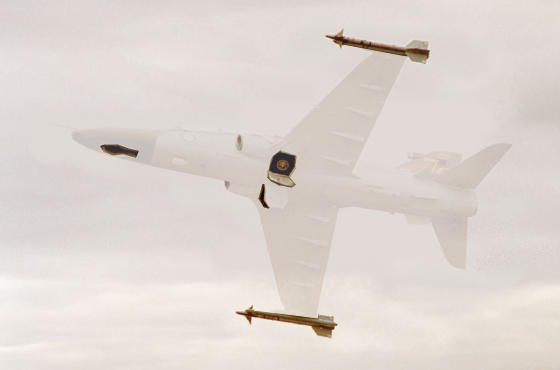



 Sign In








