Identifying a target is a much bigger and important challenge than “detecting” steath targets at long (meaningful) ranges.
In other words, you have to know if you are hitting planes or just wasting SAM’s on MALD π
Developers and operators of purpose-built stealth airplanes are not crying in their beers. RAM and RAS provides attenuation of RF scattering no matter where the emitter and receiver are located.
Would a radar using radio vorticity by constructive interference between two or more channels change anything?
Encoding many channels on the same frequency through radio vorticity


I must enfasise that I’m no radar expert, I’m just curious π
It was? just like the F-35C then (almost).;)
OK, let me correct myself π
PAK FA’s landing gear is designed to operate from short, unprepared runways.
@ Berkut
PAK FA’s landing gear was designed to operate from short, unprepared runways π
Cueing by VHF-band NEBO SVU helps provide some percentage increase in range by X or Ka band targeting radar. But probably not enough increase in range to prevent a purpose-built stealth airplane from launching weapons against it from outside its cued detection range.
Thank you for answering my question.
I guess the only way to “get them” is when they are parked on the ground or in this case CVF.
While the F-18s are considered to be “low observable” because they have RAM paint, their RCS is still several orders of magnitude greater than the purpose-built F-35C. Countering F-35C’s small RCS would require a substantial, expensive rebuild of a near peer’s air defenses.
I’m no expert but wouldn’t be enough to just add Nebo SVU to the mix? Using Nebo SVU for volume search and passing along info to other radars for cued search?
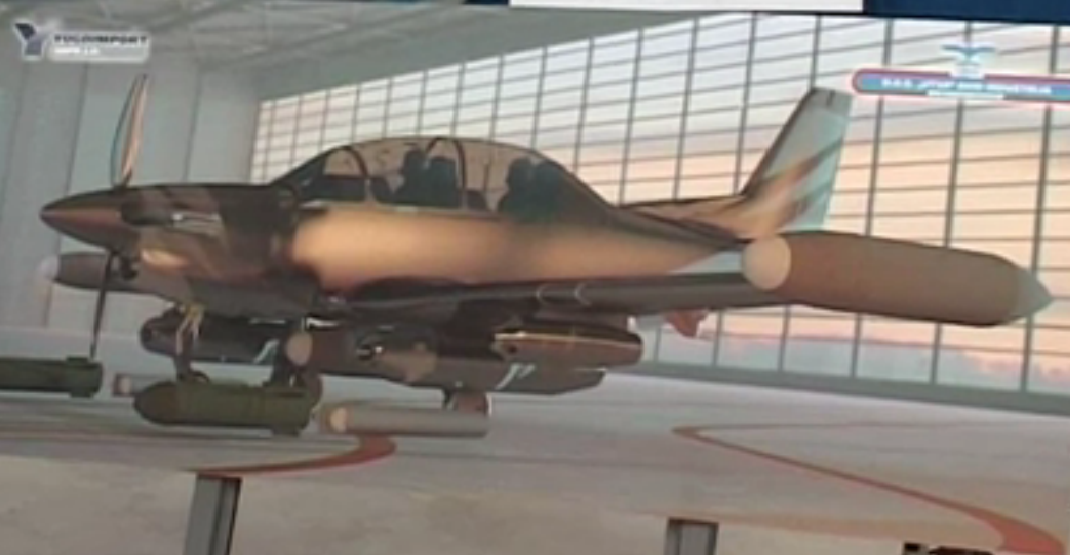
New turboprop version of Lasta called Kobac:

There was text next to that picture, it said:
Greetings A cockpit of those seen in MAKS … … image comes from Aviapanorama
Maybe it will help a bit π .
.
Interesting Acatomic. I am a bit stumbled myself. Not to be smartass, but there is no such thing as “Su-35BM”. There is however Su-35S. I am willing to bet this is Su-35S, but either it is some earlier configuration (looks to be taken in workshop) or maybe it is cockpit shot of one the serials. I am holding button for the later, as there is lack of “alarm clocks”. Also notice the huge screen on right side, i haven’t seen than in Su-35S, only in T-50…
Pak-Fa avionics testbed maybe?
As for Su-35S you are correct. I just keep forgetting that π
It’s from this site http://www.ejercitos.org/viewtopic.php?f=14&t=19&start=880
Can someone help me with this image of a cockpit? I would like to know which version of Su-27 it belongs to?

It looks like Su-35BM cockpit but it’s different: there are no buttons around the MFD and panels are painted black.
.
6. Non-flat underside – Well, even the F-22 and J-20 have protrusions from the plane of the wings, the difference is merely that it is one HUGE bump (the fuselage), rather than a few medium-sized ones. And then there is the F-35, which is *festooned* with bumps large and small! Non-issue.
Am I the only one who sees a huge flat underside with two big bumps/nacelles π ?
Alarm over UK-French drone document theft in Paris
The error involved is fairly small β that is why INS was useable for intercontinental flight long before GPS became available. A drift on 0.5nm per hour gives an error of only 5 nm after a ten-hour flight. Since the error is due to hardware limitations, there is no way that an electronic attacker can increase or alter it.
That is just one part of the whole picture i which GPS and INS work together to determine aircraft’s position (that’s why I quoted that csmonitor article). The way I see this is, that when GPS was updating INS to cancel its drift, it did so with a false signal which was fed by Iranians. For this to work they had to feed it with a false GPS signal which was only slightly different than original GPS signal and then gradually, step by step, they altered the course. They had to use small steps to get through Kalman filters (or whatever more advanced filter is in use today), but once they did then GPS was updating INS with “wrong data” and Sentinel was flying where they wanted it to fly. Of course, I’m not claiming that really happend… π
I hope Sentinel ends up where it belongs, in a museum, like U-2 in Russia and F/A-117 in Serbia.

But what is important is that combination of INS and GPS. If someone where to successfully jam the GPS, the difference between the positional data from the INS and the GPS would immediately become noticeable. Far from having βlost its brainβ, the onboard system would be aware that its GPS was probably being jammed.
Maybe they exploited a well known disadvantage all INS have? http://en.wikipedia.org/wiki/Inertial_navigation_system#Error
From csmonitor article:
βA more pernicious attack involves feeding the GPS receiver fake GPS signals so that it believes it is located somewhere in space and time that it is not,β reads the Los Alamos report. βIn a sophisticated spoofing attack, the adversary would send a false signal reporting the moving targetβs true position and then gradually walk the target to a false position.β