 talltower
Capt. Jeffrey Haney of the 525th FS, 3rd WG @ Joint Base Elmendorf-Richardson, AK, was the fallen Raptor pilot.
Memorial Monday for pilot killed in jet crash


RIP Capt. Jeffrey Haney. 🙁
talltowerIndonesia Looking for Trainer/Attack Aircraft
Article excerpt from Defense Industry Daily
Indonesia Looking for Trainer/Attack Aircraft
Indonesia is looking to replace its fleets of BAE Hawk Mk.53 trainer jets, and OV-10 Bronco forward air control/ counterinsurgency aircraft, as part of a more general modernization effort. That competition appears to be split in 2, and Brazil’s EMB-314 Super Tucano appears to be Indonesia’s choice to replace the OV-10s.
First, a bit of background. In 2007 the Indonesian Air Force purchased Russian SU-27SK and SU-30MKK fighters. The Flankers would supplement and/or replace fleets of F-16A/B and F-5E/F Tiger II fighters, whose condition was harmed by a long arms embargo imposed in response to widespread repression and genocide in East Timor. New fighters will need new trainers, and light attack/ forward air control/ surveillance aircraft are a high priority for a huge country with pockets of separatist unrest. First, however, the Air Force must secure the budgets to do so:


talltowerUS P-3 Recovery Plan Tries to Keep the Fleet in the Air
Article excerpt from Defense Industry Daily
US P-3 Recovery Plan Tries to Keep the Fleet in the Air
The USA’s aging aircraft problem spans a number of fleets, from aerial tankers, to fighters, to tactical transports. One may argue, however, that its most severe problem lies with its fleet of Lockheed Martin P-3 maritime patrol aircraft. Not only was the global P-3 fleet produced between 1962-1990, the aircraft have often been flown at low altitudes in a salt-spray environment. This is not a recipe for aircraft health.
Rear Adm. Holmes’ 2005 interview confirmed the seriousness of the situation. The US Navy keeps retiring aircraft, and is trying to hang on until its P-8A Poseidon/ BAMS UAV successors are fielded. That is proving to be difficult, to the point that Boeing is reportedly being asked to speed up P-8 production and fielding. Meanwhile, the P-3 Recovery Plan is part of a range of efforts designed to keep the P-3s in the air. Contracts continue, including outer wing replacements and other deep structural maintenance efforts…

talltowerThere is Shaanxi Y-8. But yes, the price will be much higher.
I may as well be looking for another alternative, like a C-130E.
Do you think you could persuade enough museums to sell you their A-1s? :diablo: I’m not even sure you could get enough A-37s to fill a squadron.
You should be able to get your hands on An-12s, but they’re all at least 37 years old.
If I could not get A-1s, I might use the AT-802U Air Truck.

To do this sort of thing you need a lot more of the background mythology!.
For instance the Kiwi’s, last I heard, still have a package of 17 well looked after A-4K’s and 17 Macchi MB-339CB’s that were available for around the US$150mn mark. Now there is every bit of the all-weather PGM-capable striking power you need bundled in with the necessary advanced training and secondary light strike capability. Thing is though you need the people and infrastructure to support fast jet, complex avionics, guided weaponry and all the rest of the toys to get the value out of the purchase. If your state doesnt have the core of skilled technicians in its services a bargain like the Skyhawks and Macchis is just a waste!.
Then you need to fill in terrain and infrastructure details. Are you a country the size of, say, Kenya with neighbours who are sponsoring the insurgency you are combatting or are you a country like the Phillipines with the logistical challenges of offshore island chains. Do you have a well developed infrastructure with a network of well established airbases, good quality and secure road, rail and comms links and a network of regional airfields or are you going to be limited to austere basing with poor comms and logistics?.
What kind of insurgency are you fighting and how are they supported?. Are they like the Hezbollah well financed, state sponsored and capable of fielding the odd piece of advanced kit or is it a more local-based religious insurgency with lower orders of organisation and weaponry?.
All of these things will change the equation as to what you need from your $2bn.
I would most likely be fighting a localized insurgency equipped with Cold War era weaponry and possibly with limited foreign backing.
talltowerDenel AH-2 Rooivalk of the 16th Squadron, SAAF

Burkina Faso MiG-17F

talltowerKorea’s F-X Multi-Role Fighter Buys: Phases 2 & 3
Article excerpt from Defense Industry Daily
Korea’s F-X Multi-Role Fighter Buys: Phases 2 & 3
The ROKAF originally planned to buy 120 advanced, high-end fighters as its next-generation platform in order to replace its existing fleet of F-4 Phantom IIs and other aircraft. So far, it has bought 60 fighters in 2 phases. Now the 3rd phase looms, and the question is whether it will be a variant of their existing fleet, or something new.
Back in 2002, the Republic of Korea Air Force (ROKAF) selected the F-15K advanced derivative of the F-15E Strike Eagle for its Next Generation Fighter Program, and bought 40. In 2008, a 2nd contract was signed for 20 more F-15ks, with slight modifications. While the DAPA procurement agency dreams of developing their own “5th generation” aircraft, reality is likely to be far more prosaic, and manufacturers are offering the ROKAF a number of options…

talltowerArticle excerpt from Sky News
Cuba’s civil aviation authority has said there are no survivors following the crash of a passenger plane carrying 68 people.
AeroCaribbean Flight 883 was en route from the eastern city of Santiago de Cuba to the capital Havana when it went down.

talltowerRelated article excerpt from the Brisbane Times
http://www.brisbanetimes.com.au/travel/travel-news/is-the-plane-going-to-go-down-20101104-17fwp.html
QANTAS has grounded its fleet of A380 superjumbos, throwing its long-haul operations into disarray, after an engine explosion forced one of its flagship aircraft to make an emergency landing in Singapore.
In the most serious incident worldwide involving an A380 since it entered service three years ago, QF32 bound for Sydney with 440 passengers and 20 crew on board suffered an ”uncontained engine failure” that caused significant damage to parts of the aircraft.
The chief executive of Qantas, Alan Joyce, pushed blame on to the engine’s manufacturer, Rolls-Royce, saying it was an ”engine issue”. Other carriers that fly the A380, such as Singapore Airlines and Emirates, have kept theirs flying.

Qantas A380 passengers were the first to roll on Los Angeles Airport’s new taxiway.
talltower‘Who the hell has ever heard of an aircraft carrier with no jets?’
Article excerpt from the Daily Mail
‘Who the hell has ever heard of an aircraft carrier with no jets?’: Defence chiefs’ reaction as the iconic Harrier is axed
Two new aircraft carriers will be deployed without jet fighters after the iconic Harrier jump jet is axed in defence cuts this week.
The ships, due to enter service in 2014 and 2016, will operate with no jets until 2018, leaving a gaping hole in Britain’s military firepower and potentially putting the Falkland Islands at the mercy of a fresh Argentinian invasion.
Instead the Royal Navy will be forced to use helicopters on the £2.5 billion super-carriers, HMS Queen Elizabeth and HMS Prince of Wales.
The decision has caused anger among defence chiefs. ‘It will make us an international laughing stock,’ said one. ‘Who the hell has ever heard of an aircraft carrier with no jets?’
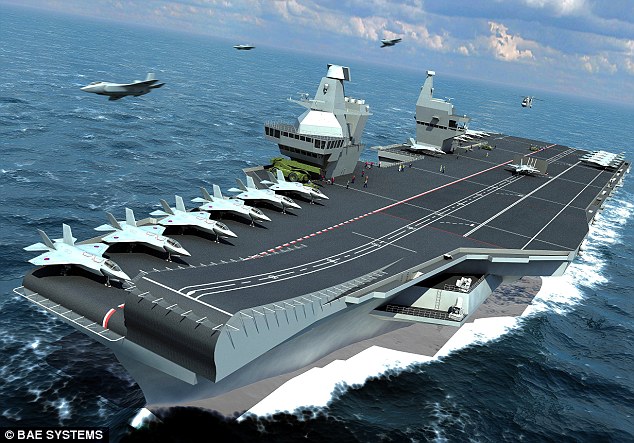
‘Laughing stock’: A computer-generated image of Britain’s super-carrier – but there will be no jet fighters on deck after its launch
talltowerSaab’s Mysterious S-2000 AEW&C Customer? Saudi Arabia
Article excerpt from Defense Industry Daily
Saab’s Mysterious S-2000 AEW&C Customer? Saudi Arabia
In early October 2010, Saab Group announced an SEK 4.5 billion (about $671.5 million) contract to supply its Saab 2000 airborne early warning and control system (AEW&C), which includes “a Saab 2000 aircraft” (singular), to an undisclosed customer. Now, reports may have identified that customer.
With its latest announcement of a Saab 2000 ERIEYE airborne early warning and control system sale, Saab has taken another step toward a position as a leading global supplier of mid-tier AEW&C surveillance…

Source: http://www.defenseindustrydaily.com/Saabs-Mysterious-S-2000-AEWC-Customer-06586/#more-6586
talltowerMilitary Notebook: Planned fighter retirements completed
Article excerpt from The Sun News
Military Notebook: Planned fighter retirements completed
The Air Force sent the last F-15 and F-16 fighters that were slated for retirement to the Arizona desert last week.
The retirement is part of a planned draw down of fighter aircraft that the Air Force has been working to implement for the past two years.
Some 252 fighters — A-10s, F-15s and F-16s — were retired from 21 bases around the globe.
Source: http://www.macon.com/2010/10/10/1296804/planned-fighter-retirements-completed.html
talltowerIsrael to get 20 F-35A Stealth Fighters for $2.75 Billion
Article excerpt from Defense-Update
Israel to get 20 F-35A Stealth Fighters for $2.75 Billion

Israel’s defense minister Lt. General (Ret) Ehud Barak has given the go-ahead to a $2.75 billion purchase of 20 Lockheed Martin F-35I Lightning II fighter jets. The new fighter will be provided along with an integral support package, sustaining the aircraft through its service life. The decision has yet to pass the approval of the Israeli government. The purchase will be funded by U.S. military aid to Israel. Israel originally planned to buy 75 such planes, with an initial option of 25 aircraft. According to Israel MOD sources, the flyaway cost of these aircraft will be $96 million, but this cost reflects only the net platform price.
The expenses including the preparation of the new squadron, initial infrastructure, logistical and support package is expected eventually to exceed $150 million per plane. Given the additional integration cost of locally developed Israeli systems planned for integration into this highly complex aircraft, the cost is expected to rise significantly for the fully equipped F-35Is in following years. Furthermore, for these enhancement and adaptations Israel may have to rely on local currency funding, unlike the aircraft acquisition program that will be funded entirely by the annual U.S. aid amounting over $2 billion per year.
Source: http://www.defense-update.com/features/2010/august/f-35i_15082010.html
talltowerIAI Introduces: Panther UAV – Electrically Powered Tilt-Rotor VT-UAV
Article excerpt from Defense-Update
IAI Introduces: Panther UAV – Electrically Powered Tilt-Rotor VT-UAV

The Panther combines the flight capabilities of an airplane with helicopter-like hovering, takeoff and landing employing tilt-rotor propellers, and a vertical lift augmenting propeller.
Israel Aerospace Industries (IAI) is unveiling two new unmanned systems, representing a breakthrough in Vertical Take off and Landing (VTOL) unmanned aerial vehicle (UAV) designs. Both designs, named Panther and Mini-Panther employ a new tilt-rotor propulsion concept patented by IAI. Both are designed for tactical use. The Panthers have already performed test flights and are expected to operational ready next year. The new Panther will be displayed tomorrow in Latrun, Israel
Panther combines the flight capabilities of fixed wing airplane with helicopter-like hovering, takeoff and landing, by employing two tilt-rotor propellers, and a vertical lift augmenter propeller providing additional lift for hovering, takeoff and landing. This configuration enables the Panther to be runway-independent, taking off and landing from unprepared areas. This unique, concept can be applied to UAVs of different sizes, providing land forces and special operations units at tactical level the capabilities commonly associated with much larger platforms.

Source: http://defense-update.com/wp/20101004_panther_uav.html
talltowerOn time and actually in advance F-22 Raptor plane production
Article excerpt from AvioNews
On time and actually in advance F-22 Raptor plane production
(WAPA) – F-22 Raptor plane production and consignments planning continues to be satisfied and actually exceeded by Lockheed Martin: 86 aircraft in total have been consigned on time or in advance to US Air Force. The industry, at now, has consigned a total of 166 aircraft, including 13 during this year.
Lockheed Martin/Boeing F-22 Raptor is an air superiority fighter that uses stealth technologies, manufactured in USA. Sometimes it is classified by American Department of Defense as an air sovereignty aircraft. USAF claims that the aircraft is unmatched by any known or projected fighter. The first flight test was in 1997, while the first production was delivered to Nellis Air Force Base, Nevada, on January 14, 2003. The first operating unit was given to US Air Force 27th Fighter Squadron.
Source: http://www.avionews.com/index.php?corpo=see_news_home.php&news_id=1120783&pagina_chiamante=index.php
talltowerUp to $11.9B for B-52H Maintenenace & Modernization
Article excerpt from Defense Industry Daily
Up to $11.9B for B-52H Maintenenace & Modernization
Officially, it’s the B-52H Stratofortress. Unofficially, it’s the BUFF. Either way, this subsonic heavy bomber remains the mainstay of the U.S. strategic fleet after more than 50 years of service. A total of 102 B-52H bombers were delivered from FY 1961-1963, and 94 were still on the books as of May 2009, flying mostly from Barksdale AFB, LA and Minot AFB, ND. Of these, 18 are slated for retirement, leaving a planned fleet of 76. By the time that fleet retires in the 2030s, many will be around 70 years old.
The B-52H can’t be flown against heavy enemy air defenses, but a steady array of upgrades have kept the aircraft relevant to follow-on strikes and current wars, where its long time on station and precision weapons have made the BUFF beautiful. Those changes have included advanced communications, GPS guided weapons, advanced targeting pods, and more. The USAF isn’t done yet adding new features, and maintenance remains a challenge for an aircraft fleet that’s always older than its pilots. All of these things require contracts, and the B-52H fleet has several of them underway. So, how does 2010’s 8-year, $11.9 billion umbrella contract fit in…?

Source: http://www.defenseindustrydaily.com/Up-to-119B-for-B-52H-Maintenenace-Modernization-06583/#more-6583


 Sign In







