 TEEJ
TEEJAre the gun in the RAF Typoons are usuable?
‘Royal Air Force (RAF) Eurofighter Typhoon FGR.4 combat aircraft carried out the first live firings of their Mauser BK-27 27 mm cannons during trials late last year.
The test firings by aircraft and crews from No 17 (Reserve) Squadron (Sqn), the Typhoon Operational Evaluation Unit based at RAF Coningsby in Lincolnshire, carried out the trials as part of the build-up to the operational declaration of the UK Typhoon’s air-to-surface capability. ‘
TJ
TEEJTEEJNice retort, TJ.
In this instance, I think that the ‘bird’ really is an aeroplane… that explains why the photographer says he heard a hushed jet noise as it went past:
Hi Steve,
Apologies. You might be onto something there with the Seawind. I took one look at the image and all I could see was out of focus Crow. The ‘beak’ could well be the nose wheel gear extended or cycling. The only problem is where is the tailplane from that angle? If the port wing is visible then the port side of the tailplane should also be visible.


http://www.airliners.net/photo/Seawind-300C/1238217/L/
There is a registry of Seawinds here. Possibly a route of investigation for the journalist who broke the story to contact the Seaplane Pilots Association?
http://www.seawindpilots.com/seawind_registry.htm
TJ
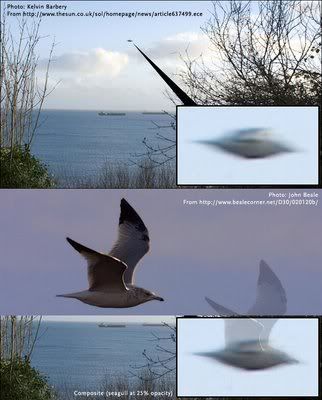
TEEJI would be highly skeptical on this one. Looks like the photographer has simply caught an out of focus crow and is attempting to pass it off as an aircraft. Looks like the autofocus is focused on the trees as the bird passes the camera.
There was a similar UFO claim for this image of a seagull.
TJ
TEEJThe Vulcan serial is XH563 for anyone wondering.
http://www.thunder-and-lightnings.co.uk/vulcan/survivorspics3.html
TEEJJacko, Six NF,
Very interesting debate. Why not take it onto PPRuNe? It would be great to see some input and perspective from the F-4 crews.
http://www.pprune.org/military-aircrew-57/
TJ
TEEJOn Friday XV232 burst tyres and went off the runway at RAF Kinloss.
http://www.pprune.org/military-aircrew/360165-off-road-nimrod.html
TEEJI still dont believe that 2 pics show a real YF-23. If you see both pics, you’d notice that their paint job is very perfect. It doesn’t look like the paint is painted over a metal surface. before you laugh, try comparing those 2 pics with the rest of the YF 23 pics in here, you’d notice how the shade of the paint on those others look more realistic.
And again if u notice in those 2 pics, you’d realise that the photographer’s eye sight is slightly higher than the plane itself. Normally a jectfighter is big and high enough for anyone to use ladders to get into the cockpit. If a photographer is taking a pic of the plane , the angle of the photo would be looking upwards of the plane, not downwards. Simply put u can not take the pic of the top surface of a jetfighter wing’s if you are taking from the ground.
and thirdly notice how the plane which is supposed to be big fits perfectly into the frame of the photograph. The plane should be long enough that you’d need to stand much further away to make it fit into the pic, but in those pics the photographer seems to be standing just few feet away.
The images are genuine as is the aircraft. The photographer is obviously on a platform using a wide angle lens. See EXIF data for both images.
Camera data for image 1
Image was taken with a wide angle lens set at 31mm.
Camera data for image 2
Image was taken with a wide angle lens set at 18mm.
TJ
TEEJThanks for setting me straight, but those were ground-designated. I could well be wrong again, but i don’t think there was an aerial designator in RAF service in 1982 – didn’t the Bucc get that capability later on?
No probs. The UK ordered Pave Spike in 1978. It was operational on the Buccaneer fleet during 1979.
‘RAF prepares for laser-guided bombs’
http://www.flightglobal.com/pdfarchive/view/1978/1978%20-%200207.html?search=raf%20buccaneer
‘RAF laser support contract for Ferranti’
http://www.flightglobal.com/pdfarchive/view/1978/1978%20-%201790.html?search=pave%20spike
TJ
TEEJThats still pretty much considered an overfly though, if they were at low alt then maybe not but at medium I think it’s pretty much over the top, besides they wouldn’t have turned to sharp either after bomb release so probably went right over directly.
The details are well know and revealed by the crew themselves. Ten thousand feet was the release height. The whole aim after bomb release was to get the Vulcan out of there as quickly as possible. Martin Withers, pilot, revealed that he didn’t even wait until the bomb bay doors were fully closed before making a 60 degree bank to port. On the run-in they had already jammed a Skyguard radar that had lit them up. The main aim was to get out of dodge city before the Roland systems were brought on line.
TJ
TEEJLGB’s would have been a bit of an anachronism anyway. They weren’t available to the RAF in 1982, let alone the problems of a designator (another Pave Tack-equipped F-111K over Stanley?) aircraft. And there really, really weren’t enough tankers available to bring two aircraft over Stanley. One Vulcan to Stanley needed the support of 12 tankers and a few airspares. Imagine what two or more F-111s would have needed.
Arthur,
Paveway was available and used in the conflict. Harrier GR.3s carried out LGB attacks.
http://www.flightglobal.com/pdfarchive/view/1982/1982%20-%202627.html
http://harrier.hyperlinx.cz/FAQ-falklandwar.htm
TJ
TEEJRAF Typhoon recovering to RAF Coningsby – Autumn 08

TEEJI am confident to say that the ‘F-111K’ would have a far greater range than the Buccaneer!:)
It ‘may have’ arrived over its target (Falklands Islands), but it would probably only have done so with a minimal bomb load (at least two of the four main wing hardpoints being utilized for the huge drop tanks, that the F-111 uses!). Whether this would be free-fall bombs (say 12 x 500lb) to take out the runway, or more than likely a couple of Paveway PGB per aircraft.
You only have to consider what was possible, with the use of airborne refueling, which the RAF was equipped with (although the F-111 is only equipped with a boom receptor – While the British use a hose and drogue arrangement! (I am unsure if the F-111K was to have been fitted with ‘hose and drogue’ receptor, during its manufacturing?Also unlike the Vulcan attack on the Falklands runway (which I salute for both achievement and skill of its crew and the typical tenacity of the RAF.), which was done at high altitude and directly over the target, if the F-111K was equipped with Paveway’s then it could of attacked the airfield from reasonable stand-off distance and safety.
But then again with the USAF and RAAF tactics of low altitude, ‘terrain following’ attack profile (as used by the RAF Tornado’s), this may have exposed the F-111K’s to the likes of the defending 20mm & 35mm AAA.
I know one thing for certain – if the Falklands airfield was defended by Argentinean Mirage III’s or Dagger’s (as they should have been!) I would rather have been in an F-111K than a Vulcan!But then again it is ‘What If’:D
Then again in ‘real world’ terms, you may want to look at the ‘legs’ used by the USAF to carry out their attack on Libya, with their F-111’s. This may give you some indication of distance-to-air refueling points.
Regards
Pioneer
Just a few points. The first Black Buck raid was at medium altitude and the Vulcan didn’t have to directly overfly the target. The bombs were released some two miles out. The throw weight took them forward onto target.
TJ
TEEJSee links on following.
http://forums.airshows.co.uk/viewtopic.php?f=2&t=4619&st=0&sk=t&sd=a
http://forums.airshows.co.uk/viewtopic.php?f=2&t=4619&st=0&sk=t&sd=a&start=25
Just a thought, but think of all the other Jag operators around the world?
TJ
TEEJS-300/400/500 or whatever system you like is merely a system. Good tactics will find a way to defeat said system.
The Israelis have already managed to breach S-300 and TOR-M1 with non-LO aircraft. Plenty of people say they can’t do it again, but plenty said before they couldn’t do it either…
S-400 is simply another threat. It will be examined and a tactical solution worked out…
The Israeli’s didn’t have to breach such threats in Syria. They took the path of least resistance to an undefended target. It was the likes of Debka that claimed that Syria had brand new and functioning Russian air defence systems. The Syrians took the gamble and didn’t draw attention to the building by providing it with air defence protection. They kept the site as sterile as possible – gambled – and lost.
See Imad Moustapha’s, Syrian Ambassador to U.S.interview beginning at 0:53
http://uk.youtube.com/watch?v=HGythooxBMc
01:30 in reference to unprotected site. – repeated at 03:24
http://uk.youtube.com/watch?v=GP5QK7ETGdU
http://www.iht.com/articles/ap/2008/04/25/africa/ME-GEN-Syria-US-NKorea.php
‘President Bashar Assad questioned the logic of such allegations and insisted once again that a site in Syria destroyed by Israel seven months ago was an unused military facility.
“Is it logical for a nuclear site to be left without protection and not guarded by anti-aircraft guns?” Assad told the Qatari newspaper Al-Watan, which published excerpts of the interview Friday. “A nuclear site under the watch of satellites in the middle of Syria in the desert and in an open location?” Assad added sarcastically.
He repeated Syria’s previous contention that the site destroyed by the Israelis was “a Syrian military position under construction and not a nuclear reactor.”‘
SOC has already pointed out that the nearest SAM site to the location was SA-6.
‘There is an SA-6 unit based just south of Dayr az Zawr to the southeast. They could have been moved to the site if it was felt they were needed, but then you’d still be left with SAM systems in a new position leading to questions as to why they were there.’
See post 235
http://forum.keypublishing.co.uk/showthread.php?t=74028&highlight=SA-6&page=8
TJ


 Sign In








