 ijozic
Regime forces retake a village of Atshan from al-Nusra. It seems important to control the main road towards north (and Aleppo).
http://www.reuters.com/article/2015/10/10/us-mideast-crisis-syria-idUSKCN0S40DF20151010
ijozicIn the same time ISIS alone have managed to take over an area in Northern Iraq larger than the whole of Syria. So exactly who’s on their last legs again?
ISIS mainly just entered Sunni base areas who dispersed from the army units without confronting them and their entrance without any major resistance was probably organized by the surviving Baathist networks cooperating with ISIS after the Maliki’s turn towards Iran disenchanted the local Sunni tribal leaders organized (and more importantly, paid) by the US as part of the Sunni Awakening project which pacified the Sunni areas (expelling the jihadists to Syria) and gave the US a chance to start with their exit (IIRC, they were supposed to leave a number of troops to help the Iraqi army, but Maliki under Iranian influence basically kicked them out as the IRGC seems to prefer the Iraqi army to be weak and that they depend on their radical militias).
You do have a point that Syrian regime has proven more resilient than expected, but the regime has been losing ground dramatically recently and time and again their poorly trained armed forces proved unable to perform any meaningful offensive operations. That can’t be good for the already low morale, plus the manpower shortages and the increasing role of Iranian Revolutionary Guard Corps and their various militias in running the SAA doesn’t boost the locals (especially Sunni) remaining dedication to the regime either. Their anti-Jihadist card (by releasing the Jihadists from their jails to turn the course of the rebellion) worked well for them in the short term locally turning most of the minorities and Sunni moderates to their side, but the Western countries are still not biting much, while the Gulf countries boosted the Islamist rebels unlikely to make a deal with the regime. With the IRGC not achieving much, I feel the Russians will need to increase their commitment to some ground troops eventually or quit while they’re ahead.
Thanks for the posted article, Austin, it was a nice read.
ijozicWell the exit strategy is certainly easier than Afghanistan or Iraq since there is already a standing government. However, when you attempt to replace a standing government with a vacuum then you have a problem with exit strategy and usually leave a mess behind when you do.
Standing on its last legs, to be more precise, as this was directly the reason for Russians to intervene. That didn’t stop the Russians to exit Afghanistan before, nor e.g. the US to exit Vietnam (leaving the local friendly regimes hung out to dry), but packing up so soon might be end up as a fiasco for Putin without at least bringing them to a diplomatic table with the rebels as something to show for.
ijozicFeeling compelled to stand by and defend a public standpoint regardless of how it appears now. Then again one could argue that it may take a lot more time before the “net result” of all these events can be properly assessed in order to find out if the whole thing was worth all the mess and so on. And people will most likely always disagree.
I have to add it’s easy to see all the flaws in those plans now and how it quickly became a sinking ship the US just wanted to get out of, but to be fair it’s much harder to make a proper decision at the time when a decision needs to be made in general. The much more passive approach of the current US administration regarding Syria didn’t work out much differently neither, because, as said before, the US role is arguably somewhat overstated in the wider conflict that’s going on, plus the complicated mixed ethnic/religious situation in those countries which are easily abused by the local politicians or religious leaders to gain or retain power. And the history seems to prove that in these situations, once these “ghosts” are awaken, they are almost impossible to contain as the radicals are ready to go much further than the moderates and in the ensuing chaos people will turn to their groups to survive.
ijozicThe decision to send Mi-24s as opposed to Ka-52s does defy understanding however. Similarly an air intervention without giving the SAA force-multipliers for their offensive ground operations (anything from portable thermals + optical dazzlers to a few dozen urban kitted T-72Bs) is just pointless. Overall, it is a weird strategy.
Definitely. Seeing those rebel TOW’s plinking off outdated Syrian tanks and paper thin IFV’s with little to no chance of resisting the hits (I didn’t spot any T-72AV’s which might stand a chance, but I’m assuming they’re using some later TOW missile variants, like TOW-2 or I-TOW at least) and spotting the launchers (without modern optics with thermal sights) AND no support helicopters capable of doing the same (i.e. using the obsolete Mi-24P’s) makes one wonder how the Russians think this half-hearted effort will do something here.
ijozicI kinda see the SATNAV antenna on the dorsal spine (?)
Which part? The small white thing before the standard antenna just behind the cockpit? Please pardon my lack of technical vocabulary.
I notice that the last plane in line on the photo doesn’t have repainted Russian markings (I guess they could have used some less crude method for hiding those markings). Perhaps a later arrival?
ijozicMost of what you’re saying makes sense to me, but I can’t help but think that the G. W. Bush Administration (among other key players) behaved in a questionable manner before (and during) the 2003 invasion. AFAIK, there was some “informed” opposition / warnings from former US national security advisers and military officers, academics etc., not to mention some Allied intelligence services, raising concerns about the reliability of some of the intelligence (i.e. “Curveball”), the uncertainty surrounding potential consequences of a large-scale invasion and occupation and so on. I think it’s fair to ask how reliable the Administration’s decision-making cycle really was given the information they had access to at the time.
That’s certainly true since some neocon members of the administration had a long standing agenda to “fix” the Middle East (to avoid the oil price crisis from happening again and again with various wars) so when they finally found themselves in position of power and had an open checkbook after 9/11 if was not unexpected that they would be (intentionally or not) rather biased and thus cherry picking those few intelligence reports which confirmed what they believed in (most of it based on some Iraqi defector’s statements IIRC). Arguably, Iraq was already on its knees by then under those severe sanctions (which ended up hurting the civilians and not the regime), but the people placed in running the post-war Iraq were not up to the task to say the least – dismantling the whole army and security services so quickly into the occupation (as part of the de-Ba’athification process) and putting the questionable Iraqis in charge without some longer carefully observed transitional period thus relaying only on much too few US and British occupational (I emphasize this as their mere presence was easily used or abused to stoke unrest) troops on the ground to maintain any semblance of order turned out to be a recipe for disaster.
Certainly it beggars belief how people in charge could make such biased and ill-informed decisions and thus leads people to suspect much more sinister ulterior motives (like creating chaos), but before we dwell further into OT, I’d just advise on reading more on e.g. the events leading up to and during WWI regarding British policies on the Middle East to see how prejudiced and uninformed the decision makers were and how government decision making process leaves a lot to be desired (e.g. you’ve had numerous government offices competing for their interests and views being put upfront, like e.g. the India office, the Cairo office, the Foreign office, etc.), plus the competition between allied and enemy countries for various interests leading to such conflicting issues such as promising Arab territory both to the French and to some Arab leaders, promising Zionists to help them create their state in Palestine, the occupation and attempted carve up of Turkey’s mainland of today, etc. Perhaps it wouldn’t be too far off the mark to say that the prejudice, arrogance and incompetence of people in charge are more often a rule rather than exception.
ijozicThe export price for an air-launched version of 3M54 was $2.5 mil few years ago.
Which variant exactly if you remember? Supersonic or subsonic? I’d presume the supersonic should be noticeably more expensive than the subsonic one (having the supersonic rocket payload).
These Russian Navy long range land attack variants presumably used in Syria – the 3M14T with 1500-2500 km range (from wiki) – have to be substantially more expensive, too, as I suppose they have a turbofan engine (compared to turbojet on the other models) to achieve such range.
ijozicwasn’t that the reason the canards were added? to compensate for the heavy nose?
I seem to remember that being the story for the canards on the Su-27M, which had a rather heavy radar due to obsolete tech state of the Russian electronics of the time IIRC. It was removed on the Su-35S, but of course, it has vectored thrust to offset it.
It would seem to make sense to have the canards fitted on the Su-34 to provide additional lift for the heavier frontal part to keep the plane level compared to a more draggy solution of trimming via horizontal tail surfaces only. For the Su-35S the canards probably provide too much drag at high supersonic speeds, but the Su-34 with it’s fixed inlets obviously isn’t bothered by that. The Su-30 variants might be, but I guess it’s still less draggy than the before mentioned trimming via horizontal tail surfaces.
It would be great if someone more “in the know” could chime in.
The long sting might be for CG
This is what I was aiming at with my question as perhaps the earlier prototypes had heavier electronics and thus the stinger had to be longer, but without in-depth knowledge of aerodynamics or the changes in the internal equipment (especially in the nose and the protruding part of the stinger), it’s probably pretty silly reasoning as it seems as a somewhat crude solution.
ijozicI never would use word “primitive”, but rather “different. For the rest, like it or not, they are clanic societies, and the onky way to stop them from fighting each other is that there is one leader strong/ruthless enough to have everybody else shut up. pt’revent it from happening, and you’ll never have peace there… and in 10 years from now you’ll come to this board abd say: who would’ve known there would still be such a mess?!?
If you don’t have anything further to contribute to this argument but the “clanic societies” theory, let’s leave it at that then.
ijozicNow, can you point out to me what “EXACTLY” we missed?
The situation is more complex than just “these people are primitive and need a strongman”. I’ll try again. Iraq and Syria were artificially created by Britain and France (along with most of the countries in the area you mention) in this case putting different ethnic and religious groups together and placing one group to dominate the others. Due to the lack of developed social and democratic culture (as being occupied by the Turks and then the West didn’t give them time to sort out their differences and split up or learn to share power), these divided “nations” operate on a “winner takes all” basis. These two dictators came to power at times of secular Arab nationalism mixed with marxism ideology which helped their minorities to justify/legalize their hold on power over other groups (e.g. both came from religious minority groups which constitute no more than 20-25% of the population). These ideologies died off as they failed to solve the economical and political issues, leaving these archaic regimes in power maintained by force with rising Islamist movements as a reaction to them (Sunni in Syria and Shia in Iraq). These various groups fear being dominated by others so democracy cannot really work without strong safeguards for the major minority groups there as it’s benefits are only appreciated by those with advantage in numbers (e.g. Maliki in Iraq was elected to power and gradually started replacing all Sunni and Kurdish ministers from power and turning to Iran which in turn made possible for ISIS to come back to Iraq and seize power with insignificant forces). So, after being subdued for so long by force, the religious/ethnic identities overpowered the weak national ones rather quickly as crisis struck which is an expected human self-preservation reaction additionally stoked by politicians/religious leaders to grab a hold of power. You cannot overstate enough the fact how this is all happening in context of a wider rising Shia-Sunni conflict with Iran and Saudi Arabia at the helm and the mixed countries such as Iraq and Syria are being the battleground. Add to that that even inside religious and ethnic groups you have unresolved conflicts between modernism and religion, socio-economic classes, political ideologies, the tribal mentality you mention present in the countryside, etc. further complicating matters.
So, US intervention did finally remove Saddam from power, but Iranian Islamic regime has been trying to do that for decades stirring Shia rebellions through the Dawa party (leading directly to the Iran-Iraq war) and the Kurds were constantly rebelling against the Baathist regime as well. The fear of the regime was basically the only thing holding the country together. On the other hand, US (being burned by the Iraq experience) played an insignificant role in Syrian uprising (compared to Saudi Arabia, Qatar and Turkey which have much more interest in removing the Alawite regime from power) and you still have a major civil war there. The regime lasted this long only because it cleverly played the Islamist card in the early stages rebellion (helped also by the US staying idle and the Gulf countries and Turkey providing help to Islamist groups) and thus gaining support from most of the minorities and Sunni moderates as well. The bottom line is, these countries were ill-created and forcefully maintained and the check is due for payment as part of a wider conflict in the region. With the external forces running the game, it might take a while before some deal is reached on the ground.
Regarding the Russian intervention, since the SAA seems unable to partake in offensive operations anymore and supposing that the Russians won’t go all in, at best they can perhaps force the non-ISIS rebel groups to a negotiating table, but at worst, they might just prolong the inevitable and directly and indirectly help ISIS defeat the other groups or weaken them enough that they get absorbed by ISIS, thus making matters even worse than they were (except perhaps for the regime which was actively working on such an outcome).
ijozicFlying this low with all those MANPADS and 23mm AA guns, the Steel Balls Award goes to this brave Russian Air Force Mi-24PN Pilot 😎
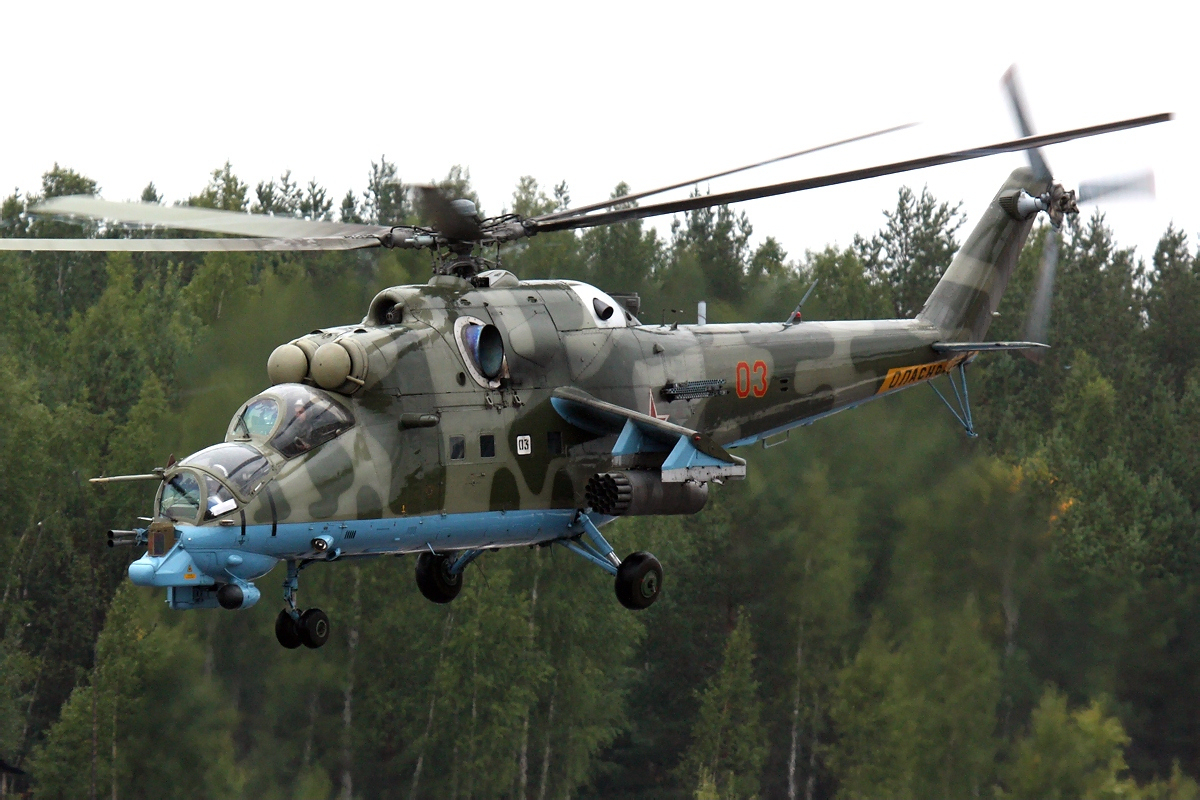
PN has this protrusion at the front and two pylons per wing, so as said several times in the thread, it’s the old Mi-24P which can be clearly seen at 1:39 of that video.
ijozicAPU. landing shute. Flare/chaff cartridge. And lots of fuel. I’m not so sure about electronic. .
I’ve read speculations about some defensive systems, as there does seem to be some radome at the tip. The APU is also supposedly a much larger unit than on the other Flankers.
What I’m curios about is why the stinger was so protruding by design in the first place – it used to have been even longer on the prototypes IIRC. Was there a need to offset the extra weight in the forward part?
ijozicI beg your pardon.. The amount of opposition to US invasion of Iraq in 2003 was quite immense. Even on this very forum..
I’m not doubting the opposition to the invasion – I’m doubting these ‘experts’ who now claim they knew EXACTLY how things would go after the invasion, discounting the complexity of the matter and how things could have gone either way – e.g. were it not for hardline Iraqi Shia leaders breaking the agreements, kicking the US forces out, aligning with Iran and grabbing all power to themselves which led Sunni tribes not wanting to be a part of that kind of Iraq and fight the jihadists anymore (which they kicked out to Syria earlier in cooperation with US forces). History is chock full of examples how various wars could have gone either way were it not for various coincidental events which greatly influenced the course of history. Admittedly, there was much less chance that things would go smoothly, but as I said, these ethnic divisions were constantly boiling under kept in check by force with tanks, helicopters and even chemical weapons so they would pop up sooner or later.
Do you really think it was as bad as it is today? 🙂 Not even close…
Hundreds of thousands died in those earlier wars, too. Where did I say things were better now? I just said that it’s preposterous to claim that these dictators were keeping things under control rather than starting wars and thus directly and indirectly causing death and instability in the Middle East and beyond and disturbing the flow of oil. The difference perhaps is they were keeping Islamists at bay (who were a direct threat to their rule) which seems to be primary judging criteria these days, but it’s forgotten that their oppressive actions also caused further radicalization of same Islamists who would turn up sooner or later once the secular national myths these dictators were imposing forcefully to legitimize their hold on power runs out of steam against ethnic and religious identities.
ijozic12.7mm has lousy range. They ultimately compromised on the twin 23mm on the Mi-35.
Nitpicking, but they installed those on Mi-24VP’s in the late 80’s and then much later on the export Mi-35M’s. The Mi-35 is the export variant of the old Mi-24V.


 Sign In







