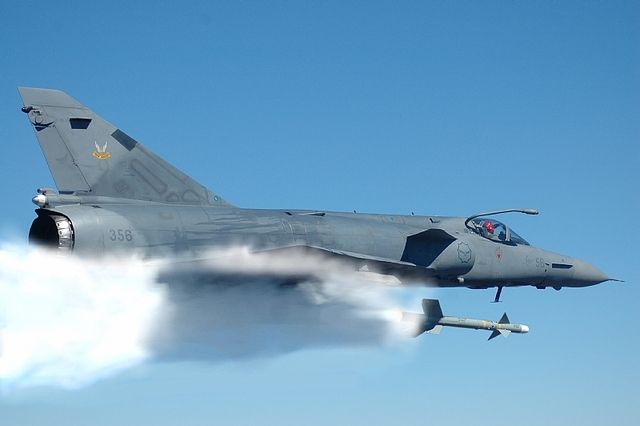
BTW, the Mirage F1 was never considered a supercruise type just like the F-104, F-105 EE Lightning, MiG-21 or any other fifties/sixties turbojet design.
Wrong again.
Seeing as there has never been one sold on the open market, there is no such thing as as a “price” for a static Ju-88.
Thank you.
I wasn’t aware of that.
When was the last time a Ju-88 changed hands on the closed market, and what was the transaction worth?
Or has that not happened?
I was talking about the pure sale of the Ju-88, not making it airworthy.
What sort of price was the Ju-88 as a static exhibit going for, roughly?
Either centreline also inboard pylon.
Certainly the weight allowance will let that happen.
Stormshadow weighs just over 1200kg.
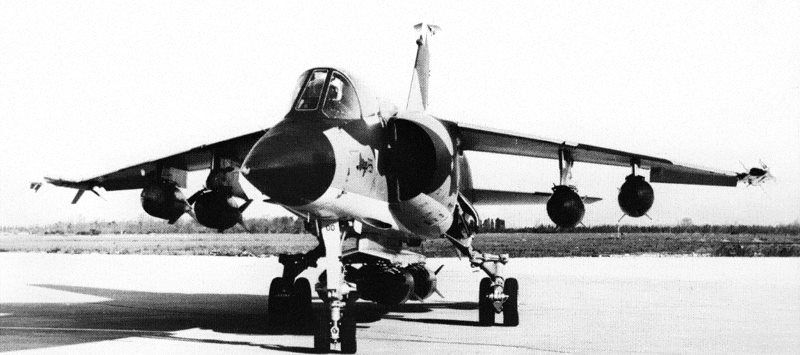
The Mirage F1 centreline pylon is rated at 2100kg, and the inboard pylons on each wing are rated at 1300kg.
I’m unsure about clearance around the missile body though. Just using my eyeballs, it appears that there should be no problem with clearance under the inboard pylons.
The same may be applicable under the fuselage centreline, as the F-1 can carry a very large (2200litre) fuel tank there.
Certainly looking at the bulk and length of this tank, and the fact that has carried an Excocet there which is almost the same length as Stormshadow, I would be surprised if it couldn’t physically carry one.
I believe all of the new build 262’s are now complete.
The last airworthy CASA 2-111 crashed a few years ago; there is one other that could be easily restored to flight; the others need a lot more work.
I did survey a Ju88A-1 a while ago that could have been restored to flight, but as yet, it is still available – for the right deal!
Having plenty of experience of German aircraft, restoration of a bomber is not something one would undertake lightly. Large pockets required!!
Bruce
Just for interests sakes, what would be the ballpark figure for the Ju-88?
yes. very high operational readiness and fast turnarounds between sorties. but they run out of “flight hours” very quickly in Iraq… and there were always a large number of out of operation aircraft back in france being overhauled.
I’ve read that in SAAF service it was also praised for its fast turnaround.
number of combat sorties was in the 40k + range. we are talking about 7 years of combat with 3 squadron’s worth of aircraft on average (starting with 1 squadron in 1981 and ending with 4 operational squadrons by 1988). On some days (intensive days) mirages would fly upto 150 sorties in one day, on “normal” days there would be maybe 20 flights including CAP, maritime patrol and land attack / recon flights. their use was intensive from day 1 right until the end of the war, and many were overhauled in france already just after 4 years in service since they reach their overhaul times very quickly. there are dozens of pilots with 1000+ combat hours clocked up on the mirages.
overall the IrAF flew 45k combat sorties in 1986 as an example (all types excluding helicopters of army aviation). the Mirages were about 15% – 20% of these missions.
Interesting, thanks.
I take it from what you say that the Mirage F1 offered high rates of availability?
It’s the sort of impression you get from this aircraft.
Didn’t the Iraqis launch hundreds of exocets in the 1980s from Mirage F1 (as well as a few from Super Etenard and maybe even Falcon?)?
Not to sure what the sortie totals were like, which is why I’m asking.
It would be interesting to know.

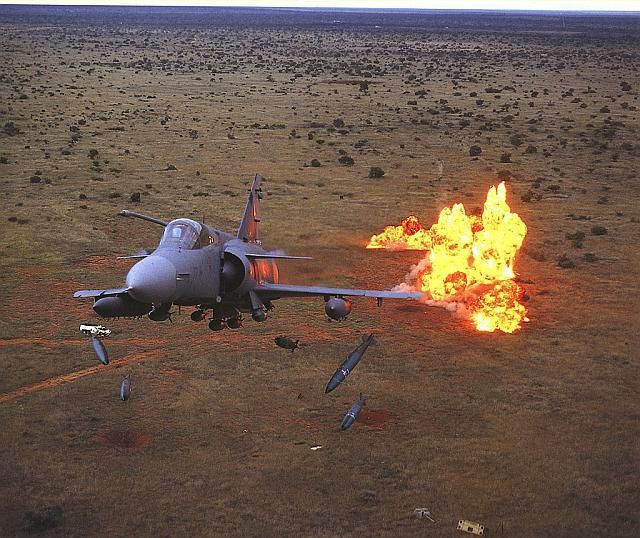
Probably pyrothechnical during an actual bombing run.
Either for public relations/marketing purposes, or some people can’t resist the opportunity for a really good photo.
Unless there was a previous aircraft dropping FAE or napalm, which cannot be discounted.
Outstanding picture, in any event.

… and probably no one flew as many combat missions with the type as the iraqis.
It would be interesting to actually find the amount of sorties.
1 Sqn of the South African Air Force with their F1AZ’s flew 683 combat sorties between Sept 1987 and March 1988 alone, delivering over 3000 bombs and having over 100 SAMS fired at them during this 7 month period.
They flew combat sorties before this period, as did 2 Sqn with their F1CZ’s.
Indeed.
This is the first I’ve ever heard of the F-1 having a “mediocre” rate of climb.:D
I think it climbs faster than almost any of the fighter variants of the F-4 Phantom.
The Mirage F-1 is also a very quick plane on the deck, with very few planes that have seen service being quicker down there.
A very under rated plane in my opinion.
The late Brig Genl Dick Lord rated it very highly indeed, and he flew a lot of planes, including both the F-4 Phantom and Mirage F-1.
Another thing to note here is the maintainability, availability, and turnaround of the 2 aircraft.
Only one winner in that.
So they are almost equal. And I even think Mirage F-1 is not a pure fighter for air-combat but an attacker, whereas Mirage F-2 was designed for a2a originally.
The Mirage F-1 was designed as a fighter.
An interceptor, in fact.
South Africa requested a modified version, the F1-AZ, that was turned into a strike platform.
This had additional internal fuel, different radar and avionics, a laser range finder, and retractrable refuelling probe.
That is not to say that the F1C fighter could not be used in the strike role. South Africa used them in that role initially, and of course, later F1 models were capable of a variety of missions.
A Mirage F1CZ interceptor loaded with 8 X 400kg bombs.