wilhelm
No, no…No!
It’s all about the GDP, you see.
Those other examples aren’t real!
Only magnificent China can do this.
I saw a link on AFM website that say’s they are smarter than the Americans.
Perhaps the smartest ever.
:rolleyes:
wilhelmI’ve always wondered why the Foch could only operate a Rafale in light condition whilst the CdG doesn’t need to.
The Foch is actually about 4 meters longer, albeit with a shorter, less powerful catapult than the CdG.
Is it a function of the catapult length or power?
The catapults on the Clemenceau Class, about 50m in length, could catapult an aircraft weighing in at a maximum of 20 tons.
This is close to the Rafale M’s maximum weight.
HMS Victorious, after her post-war conversion, had 44m length catapults, and could operate the Buccaneer.
HMS Eagle, shorter by 20 meters than the Foch, had BS5 catapults of 46meters and 61 meters length, and could operate the Buccaneer, and the Phantom as proven in trials.
Hermes, about 35 meters shorter than Foch, with BS4 catapults could operate the Buccaneer.
So, the Foch, from what I can gather on the internet, has identical catapults as the HMS Eagle and Ark Royal, in model, track, and stroke. It is longer by almost 10%, yet the British vessels were capable of operating the Phantom and Buccaneer, both larger, heavier machines, are also less powerful machines than Rafale.
Not being a naval man, am I missing something?
wilhelmI see the Chinese trolls are here.
Must be jealous of much superior life in Korea vs mighty China.
I am trying a corral experiment.
wilhelmI have a feeling that the Gripen will be eliminated. It’s a great choice, but even though being the cheapest of the three and providing the best industrial off-set (or atleast on par with Boeings offers) it should have been the most reasonable choice if Brazil is on a strained economy, which is why they’ve post-poned the decision oh so many times. But because they’ve postponed it due to financial reasons, I have a feeling they want something more expensive, i.e. Boeing or Dassault.
I don’t see why they can’t choose two types though. The Super Gripen for the FAB and the Super Hornet for the Navy. They use the same sort of engine aswell as weapons and you can’t have a common training either way due to the large differences in the way they’re operated. Since the FAB has in mind a larger number of fighters (36), a cheaper alternative might be preferred, whilst the Navy, that eyes a smaller number (10-16 fighters), a heavier and more expensive option might be justified.
Brazil has bought into South Africa’s A-Darter AAM.
I wonder if this is a pointer toward the selection of the Gripen, also operated by South Africa, or whether it will simply be integrated onto whatever platform they choose?
wilhelmkoreas economy is smaller than mexico. mexico can’t afford to make uavs of their own let alone korea.
So you think that Korea should not attempt to make their own UAV, to try and match Chinese developments in this field?
What is your esteemed take on Israel, with their gigantic economy, making successful UAV’s?
What should South Korea do?
Should they link up with Taiwan, who I think Slowman was saying is also studying an indigineous new fighter, just like South Korea?
Maybe they can extend this to UAV co-operation also?
wilhelmSlowman and Tigershark in the same thread, with all the entertainment potential this entails.
EDIT: add sgw06, you have the perfect storm. Well, almost. Just missing one or two others.
A Chinese, Taiwanese, and South Korean love-fest is on the cards, with oblique references to Japan, Russia and the USA.
Anyway, on the topic….
Why doesn’t South Korea just make it’s equivalent UAV?
They have the airframe and electronics experience and expertise.
Would they be able to match China’s recent UAV’s?
wilhelmWhy would you replace a Mirage 2000 with a JF-17?
wilhelmIn all serious, T-50 looks like the love child of F-15 and F/A-18:
In this regard, T-50 is indeed very originality, their desigin originality lies in the fact it looks nowhere near a true 5th generation fighter, but it can blend well with MiG-29, Su-27, F/A-18, F-15, F-16 generation of fighters.
To be honest if Russian throw out T-50 instead of Su-27, 30 years earlier, and someone tell you that it is the same generation of fighters as F-15, I bet few will even question about that claims, since they looks belong to the same generation of fighters.
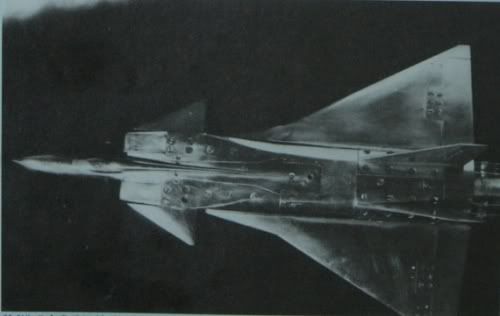
As for MiG-1.44, well their design layout looks more comparable to China’s 1960s-era J-9VI-2 proposal, instead of J-20, and this is the case, since both MiG-1.44 and China’s J-9VII-2 proposal belong to the same generation of fighters:
This is the J-9VI-2 wind tunnel test model:
This is China’s 1960-era J-9VI-2 drawboard model:
You can clear see the MiG-1.44 design is nothing beyond Chengdu’s 1960-era J-9VI-2 level, althrough the cancard layout of MiG-1.44 is a bit outdated at the time, espeically comparing with J-9VI-2’s vastly superior leading-edge couping canard design at the time.
For more about J-9VI-2 design, check here:
http://news.qq.com/a/20080807/001192.htm
http://military.china.com/zh_cn/history4/62/20091109/15694109.html
Why are you posting paper projects?
Did they fly?
I designed some pretty nice drawings of aircraft designs in the 70’s when I was at school in my notebooks, instead of paying attention in class.
There are millions of designs out there, most of which were beyond the creators resources and capabilities at the time.
If you know what I mean.;)
I particularly admire your ability to eyeball the PAK-FA/T-50 and conclude it is not a (insert favourite choice here) generation fighter.
Have you actually seen one in real life?
Tell us more.
I’m dying to know all the details.
wilhelmI dont see any China strong squad here, more like there are too many US strong, Russia strong squads who seems like they could lose their lives, let along sleeps if they admitted the obvious fact that China is indeed become superpower in aviations already. :diablo:
You obviously haven’t read the utter drivel Tigershark posts.
I’m sure he’s a big embarrassment to our more sensible Chinese posters here.
Cringeworthy.:(
wilhelmIt’s a J-11B.
…. unless you knew that and were being ironic….
Ken
😉
Although I suspect it went right over the trolls head…..
wilhelm
Open your eyes to look at this is not the engine, you can only engine obscenity, a few years what you can obscenity.
That’s a nice looking Sukhoi Su-27.
wilhelmThe Jaguar, which has fixed inlets, gets to Mach 1.6 with a poorer thrust to weight ratio from it’s afterburning turbofans.
I’ve always thought the Ching Kuo was quite capable of faster speeds than the 1295km/h originally listed for years.
I suspect that Wiki speed of Mach 1.8 at altitude is far more accurate.
wilhelmThere was also a rumour that a Spitfire achieved it as well. The wings were supposedly moved back 6 inches in the attempt. By that I mean they moved during flight.:eek:
I doubt it.
There is the story in 1952 a Spitfire got to within Mach 0,94 in an uncontrolled dive starting from 50 000ft (incidentally the highest altitude ever achieved by a Spitfire).
There were official high speed dive tests carried out in late 1943, the fastest of which achieved Mach 0,89. In a subsequent flight, the propellor blades were shed at a slightly slower speed.
wilhelmI would not be at all surprised to learn that a German pilot, in a 262, went through the sound barrier in a dive somewhere. To that end maybe the same could be proposed for the Me-163, though I doubt it.
There is indeed at least one claim in the Me-262
http://en.wikipedia.org/wiki/Hans_Guido_Mutke
I recall reading a few years ago in one of my books on the Me-262 that another pilot may have exceeded the spped of sound, but did not live to tell the tale. Apparently a sonic boom was heard in the terminal phase of his flight/dive.
On the Me-163:
Mano Ziegler claimed that his colleague, Heini Dittmar, who had previously been the first person to exceed 1000km/h in 1941, broke the speed of sound during 6th July 1944, reaching a speed of 1130km/h. His previous speed of 1004km’h in 1941 was achieved using less than full throttle. These were test pilots who were launched during those flights from carrier planes, just like Yeagers flight was.
Certainly, you’d think the Me-163 was probably quite capable of exceeding the speed of sound aerodynamically. Rudy Opitz recorded a speed of 1123km/h in a Me-163 in 1944.
Swerve is correct though.
I’d be very surprised if somebody, probably a Luftwaffe pilot or postwar US or British pilot had not exceeded the speed of sound in a dive, and just possibly on the level with an air-launched Me-163, perhaps after an initial shallow dive.
Yeager did it in level flight flight though, in controlled and measured fashion, and this is what the history books record, for what it’s worth.
EDIT: Dittmars claimed soinic flight apparently wa from a ground take off from another source.
wilhelmThis happened on a route that I am intimately familiar with, I flew this route at night – single pilot IFR – for a year without serious incident. In all I have about 6 years experience in the area single and multi crew operations, piston and turbine, and mostly night IFR.
The area has mountains up to 11,500′ high and heavy thunderstorm activity in the summer. It actually precludes unpressurized aircraft under IFR because the MSA is FL130
These guys went down in the daytime, but highly inclement weather. I don’t think that the investigation will reveal much because there is no FDR or CVR in those planes if I am not mistaken. I personally would have diverted to the west where there was lower ground and better weather. But hindsight is an exact science.
One night we refused to fly because of the weather. The boss frowned upon us. The next morning the newspapers were reporting that a private flight had disappeared enroute. The wreckage was found by chance by a hiker 6 months later in the same mountains, 60° off course. That passage has earned the name corridor of hell.
I have the book Fields of Air by James Byrom, which I read a couple of years ago.
It deals with aviation accidents in Southern Africa, and South Africa in particular over the decades.
I recall that the area you mention is notorious for claiming aircraft over the years, due to height/wind/meteorological conditions.


 Sign In