PMN1
PMN1Latest rumour is that is was a stealthy UAV under test.
PMN1I Short and Harland Ltd. had been shot-gunned by Minister Swinton 6/36 as part of his shadow system. To liberate Rochester to do Stirling, Sunderland was to be built by shipwrights, as it floated and its wing sat more on a keel than a spar.
Any other shipbuilders considered?
PMN1Ah… yes… a purely “civilian” ship… won’t violate WNT, nothing to see, move along… move along.
😉And in wartime it would simply be another merchant ship, sailing with convoys of other merchant ships…actually a decent idea for an early MAC/CVE.
And with all those “lifeboats” and “passengers” it would make a decent prototype “commando carrier”, too!
Too bad that pesky WNT would not accept it as a “non-warship”… at least the other signatories wouldn’t accept it as such.
Yeah, a bit more obvious that the Japanese ‘shadow’ programme – liners and depot ships designed in such a way to be easily converted into A/C when war came.
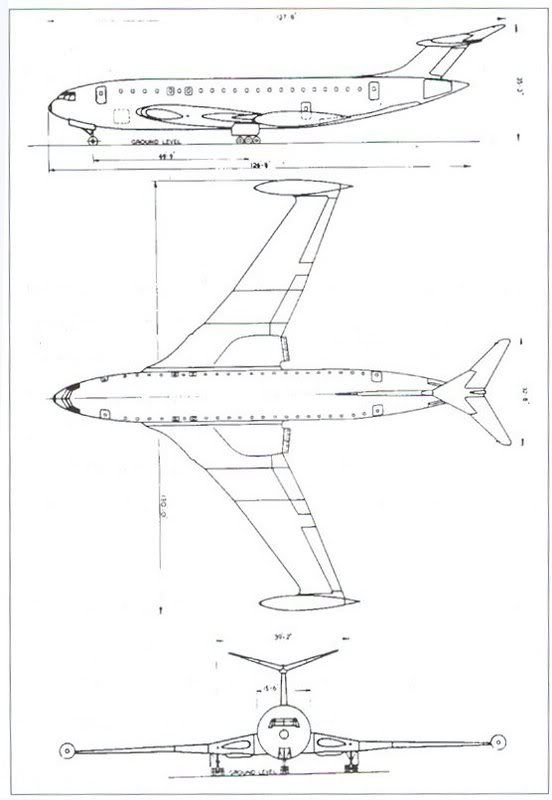
PMN1Having gone back and looked at what I have on the British proposed/cancelled jet transports/airliners of the 1950s, I find the following statement:
“Handley Page tried again in 1958 with the revised HP.111, this featured a new ‘widebody’ fuselage of circular section and was proposed to the RAF as a strategic transport and to BOAC as a 200 passenger medium range or 150 passenger transatlantic transport and civil freighter. In this form it was actually selected by the RAF but politics intervened and the Govt insisted the order went to the Short Belfast and HP never offered a large transport again.”.So you are absolutely correct, PNM1. My only question is… what was the planned cargo payload of the HP111? Could it have carried the floor weight/item size that the Belfast did?
That’s the bit that surprised me, the two aircraft look to be designed for two different roles??
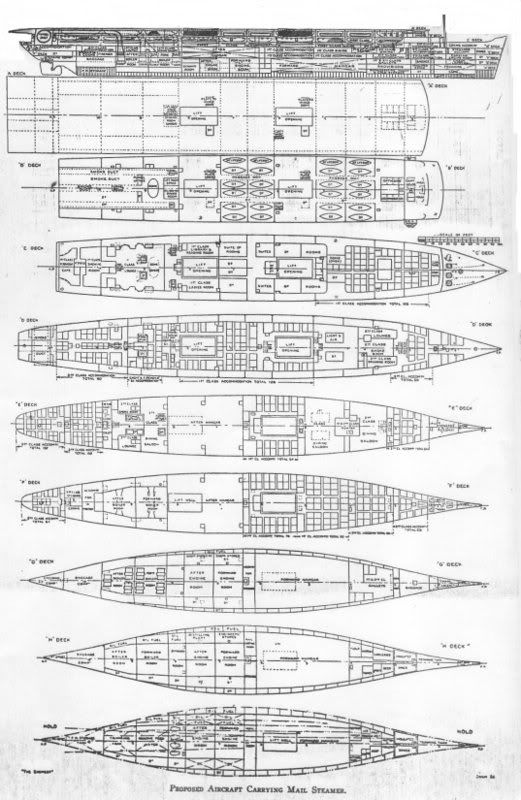
PMN1Not an aircraft but an interesting 1923 idea. This originally is suppose to have come from the publication “Transactions of the Institution of Naval Architects” Mar 1923 and was proposed by Eustace d’Eyncourt who was the British “Director of Naval Construction” from 1912 to 1923. According to Friedman’s “US Aircraft Carriers” there was a somewhat similar US proposal in 1928 for a 980-foot high speed North Atlantic liner.
The British proposal was for a 600/80/28 foot, 24 knot mail packet capable of carrying 80% of the first and second class and 40% of the third class passengers of the Mauritania for such routes as the
GB to NY with aircraft delivering mail to Canada on route
GB to Australia with aircraft delivering mail to Egypt and India on route
Vancouver to Hong Kong or Australia.
No armament was mentioned though it did say it could carry either 18 Sopwith Cuckoos or 21 Parnall Panthers or 21 Nieuport Night Hawks.
The mast was said to be not a problem because aircraft took off quickly but if it did become a problem an alternate folding mast and derrick was proposed. Bulges were fitted to protect against “icebergs”.

PMN1The contract to design & build the Belfast is given to Bristol, for one.
Richard Payne’s ‘Stuck on the Drawing Board’ suggests the RAF wanted the Handley Page HP111 but political considerations forced them to have the Belfast.
PMN1At the risk of sounding like an anorak…I have to point out a couple of WWII-era transports did have rear loading ramps:
The Budd Conestoga RB-1…A few were used by the Navy, perhaps their greater contribution came as being the initial aircraft for what became the Flying Tigers all freight airline.
And don’t forget the C-97s (f.f. Nov, 1944) had a rear loading ramp that was missing from the later, more numerous tanker variants of the Boeing B-29 turned transport.
Also, the Curtiss C-76 Caravan had a high wing but a hinged nose (obviously no good for dropping stuff in flight, but shows a they were on the right track with a single tail transport).
The German Ju90, 252, 352, 290 and 390 series and the EF100 transports did have a rear door/ramp but from what i’ve seen, they don’t represent proper ‘beaver tails’ and i’ve never heard of them being opened in flight – more a Blackburn Beverly type of tail althougth the original Universal Freighter GAL60 had doors and ramps.
PMN1Heres a good answer! Fuselage mounted tails were not developed to leave a rear entrance until the fifties so the above mentioned aircraft were easier to load/unload and parachute cargo and paratroopers from. The high wing mounted engines were out of the way of debris on rough field operations.
Ray
The GAL60 Universal Freighter had a ramp and doors, the actual tail projected further back from them, though I don’t think they could be opened in flight.
They were replaced by clamshell doors when it was developed into the Blackburn Beverley, the tailboom on this was used for extra accomodation.
PMN1Old post I know but since I was just wondering what the cargo hold dimensions for the Caribou were I didn’t see much point in a new post.
So, what are the cargo hold dimensions for the Caribou?
PMN14000HP – that’s almost as much as the 28-cylinder radials used in the Globemasters!
Bri 😮
And that was just the start though from what i’ve read, by that time designers could more accurately predict what kind of power they would be able to eventually get.
PMN1Can anyone tell me what the most powerful version of this engine was? I’ve searched the internet but there seems to be much less information on it as there is for e.g. Rolls-Royce engines.
Also, does anyone know of any books etc. that might provide a good description of its development history?
From Bill Gunston’s ‘World Encyclopaedia of Aero Engines’
Planned for heavy aircraft, the first Centaurus ran in July 1938 and was type-tested in 1939 at 2,000hp, but foolishly the importance of this engine was overlooked until 1943, despite the fact that the CE.45 prototype reached 421mph in a Hawker Tornado in October 1941. In late 1942 the 2-speed supercharged Centaurus was type-tested at 2,375hp, and cleared for production – in an underground quarry at Corsham – as the MkV and MkXI at 2,520hp. Many other versions followed for military and civilian aircraft, most having a Bendix or Hobson/RAE injection carburettor and being rated at up to 2,810hp with water/methanol injection. Post-war versions included the 2,625hp Mk661 for the Ambassador, 2,940hp Mk 173 for the Beverley and 3,220hp Mk 373 with direct injection into the Cylinders.
Before Feddon left the company in 1942 he had initiated constriction of the Orion, with 18 cylinders 6.25” x 7”, capacity 4,142 cu in, to give 4,000hp.
PMN1No, just Brown’s book published in 1991.
PMN1Here’s the ship I would use…………..
Wouldn’t an S-class container ship be a better bet?
http://www.globalsecurity.org/military/systems/ship/afsb-pics.htm
http://www.globalsecurity.org/military/systems/ship/afsb.htm
The first concept discussed in 2003 was the lease and modification of a foreign commercial container ship. This COA is preferred by MSC, PM-3 as of mid-2003. On the pro side, this COA could be realized within 8 months by the commercial sector and leased for up to 5 years. Conversely, after 5 years, MSC must either pay to retro-fit the vessel to original configuration, or purchase the vessel. The major obstacle is the fact that these are foreign flagged vessels and there exists legislation that prohibits their purchase in the interest of protecting American ship-building Industrial base. If MSC intend to pursue this program more than five years, new construction or conversion of a US ship is the only option available.
The flight deck capabilities are divided by the pilot house super-structure located approximately 2/3rd distance to the rear. The forward flight deck is 660 feet long x 122 feet wide with spots for 10+ helos. The aft flight deck is 400feet long x 122 feet wide with spots for 5+ helos. Both flight decks are serviced by a separate elevator to the hanger deck. The hanger deck capabilities include parking space for 30 helos. Other interior areas of the ship accommodate billeting space for 1,000 soldiers, a dry cargo area for 180 TEUs, an ammunition magazine in the foc’sel, and a modularized six-story office for C2.
Maersk Line Ltd., the large maritime services company that operates a five-ship squadron of MPF ships for MSC, proposed an Afloat Forward Staging Base that would consist of a modification of the S-Class container ship. This 1,140 feet long vessel with a 140-foot beam could provide selective offload of cargo, berthing and support for 6,000 troops. The flight deck on top could launch and recover helicopters and, potentially, short take-off and landing, fixed-wing aircraft. It could support simultaneous operations by a dozen V-22 tiltrotor aircraft. The ship would use modular berthing, feeding, medical and administrative spaces and would incorporate a selective cargo discharge system, automating supply selection and distribution. Devised in cooperation with naval architects Gibbs & Cox and Norshipco, a ship conversion company, the ship could be fitted with a side ramp for roll-off operations. As of mid-2004 Maersk said the ship would be built at modest cost and in the water within 18 months of an order.
PMN1Argus conversion involved adding new accomodation blocks to the existing superstructure, hence it’s enlargement. To remove the forward structure and build a starboard island would have been a lot more expensive, plus the accomodation would have had to go below decks soaking up hangar space. Also with the forward superstructure retained, the politicians would be less likely to view the ship as an aircraft carrier, still a politically sensitive issue at the time.
I wonder if an all aft superstructure as with Astronomer / Reliant would be more acceptable?
PMN1Speaking of conversions, looking at a picture of Contender Bezant as she originally was…
http://www.royal-navy.mod.uk/server/show/ConMediaFile.30945
…does suggest quite a bit of reconstruction around the original superstructure – any particular reason why it couldn’t have been done around the funnel?
IIRC, one of the options before Ocean was ordered from new was such a conversion with an island towards the stern of the ship.


 Sign In