 PMN1
PMN1From D K Brown’s ‘Rebuilding the RN’ Page 41
In November 1945 the Deputy Controller indicated that nine fleet aircraft carriers would be needed in 1950, of which three would be the Ark Royal class (the contract for the original Eagle had not then been cancelled), the other six being the Illustrious and her five contemporaries. Anything less than a full reconstruction was not recommended. The cost of reconstruction was said to be £2.5 million compared with £7 million for a new aircraft carrier. Nevertheless, the Fifth Sea Lord, who was responsible for aircraft in the fleet, considered it was not worthwhile modernising Illustrious, the money saved being better out towards the cost of a new ship. In any case there was now no money for the project so the subject was deferred for 6 months.
I’m not sure how close this possible rebuild was compared to the one that ended up being planned and carried out on Victorious.
PMN1Why not? Operated off smaller British carriers.
You have to remember that the Buccaneer had exceptionally good take-off performance – and deliberately so. It could operate from much shorter decks than anything else in its class. Very clever aerodynamics. One of my great regrets, that the Buccaneer was never developed to its full potential. Should have been given the terrain-following radar & other avionics developed for the TSR.2, a wider variety of stores, & more pylon & fuel tank options – and a bit more money on engine development, & keeping the avionics up to date.
Interesting Buccaneer site
http://www.blackburn-buccaneer.co.uk/0_Contents.html
Derek Woods’ ‘Project Cancelled’ has some interesting Buccaneer dveleopments.
PMN1It would almost certainly have made no difference to the eventual number of Harrier operators, those countries that gradually withdrew from the carrier game over time did so through their own decision based largely on cost and would have made the same decisions whether they were operating light fleet carriers or escort carriers, both types would have come to ten ends of their viable lives at about the same time and potential replacements would still have cost the same as they would have done in the real world.
Thats what i thought at first but then I wondered if the various countries that operated the British CVL’s operated the US CVL’s as helicopter carriers, would they be withdrawn from service at the same time as their British built CVL’s were historically.
If one or more are still operating them at the time Spain proves it can operate Harriers from Dedalo or even becomes the first to try, do they look at getting back into fixed wing naval aviation?
PMN1Found this, a rather large catamaran
http://www.enaa.or.jp/WE-NET/ronbun/1996/e1/ishikawa1996fig.html#z2
http://www.enaa.or.jp/WE-NET/ronbun/1996/e1/ishikawa1996.html
PMN1Some replies on warships1
PMN1This was an air-launched ballistic missile, a three-stage solid rocket version of the X.12.
Talking of three stage solid rocket ballistic missiles…
In Volume 59 Supplement 2, 2006 of BIS’s Space Chronicles – UK Spaceplanes
Based on studies of manned Blue Steel to do the same research as the X-15
The Vulcan Obiter Z 124
By October 1962 ambitions had increased to the extent of considering a brand new rocket vehicle completely different in principal from Blue Steel. The concept began with the recognition that the Vulcan, because of its delta wing, had very tall undercarriage. This would permit the installation of a large ballistic multi-stage rocket weighing up to 40,000lb (the drawing shows the missile hanging outside the bomb bay which appears to have had the doors removed). This would be carried and air launched much as was Blue Steel, from a height of about 50,000ft, but the trajectory would be more akin to that of the ballistic Skybolt as the obiter was wing-less. It was calculated that this three-stage vehicle could place a 650lb payload into a low earth orbit. Although less design detailing was done on the obiter than on the manned Blue Steel its potential was recognised. Here was a revolutionary way of placing application satellites (for communications, meteorology, survey, navigation etc) in orbit launched from a mobile platform. Two advantages sprang from this: firstly the Vulcan could fly to any base in Europe, collect its rocket and launch into a variety of orbital planes; secondly, with flight refuelling, the craft could be placed in an equatorial orbit. In this way Europe could have had its very own launching system, quite different from that of the USA, which was totally expendable.
This project was announced at a lecture and received a lot of publicity. Whether it was ever considered seriously by HMG is doubted but it could have given the RAF an opportunity to take a bold step, into spaceflight.
PMN1The problem with that is that the longer range standoff missiles had sufficient range to be launched from relative safety. It is very likely of course that the SSBNs would still have been bought, but a Skybolt or similar missile might have allowed the RAF to share the deterrent role.
Interesting you should bring that up, take a look at the wiki article for Chevaline, admitedly its wiki but its quite interesting regarding the redice range of Chevaline Polaris over the standard Polaris.
http://en.wikipedia.org/wiki/Chevaline
From what i’ve read in various places, Moscow was the target and the range requirement seems to have been based on launching from friendly airspace.
PMN1If a suitable working stand off weapon – Skybolt, OR.1182 (Bristol X12 or Avro W.140) – had been available, would Polaris have still been bought at this time or would a switch to SSBN’s have occured later?
There will still be the vulnerability issue with the manned bomber but a working system in place would have been hard for the Treasury not to pick up on.
PMN1Got some info on the original X.12
OR.1182 – 1,000nm range, Mach 3 performance at high altitude, and high-speed (mach 2) terrain following for the last 100nm to be in service by 1966.
Bristol X.12 (also known as Pandora) – This low-level stand off bomb had a slim 50ft (15.2m) long fuselage of just 3ft 2” (98cm) in diameter together with small delta wings 15ft (4.6m) long and 6ft (1.8m) span. The latter, and a semi-integrated BS.10-13 ramjet optimised for Mach 2.5, were mounted around the rear fuselage; a 28ft (8.5m) mid-fuselage section housed the fuel and the nose contained the warhead and guidance (Forward Looking radar from TSR.2). At 20,000lb (9,072kg) weight, X-12’s range would have been at least 1,000nm (1,852km); maximum ceiling was expected to be 70,000ft to 76,000ft (21,336m to 23,165m) and initially, a cruising speed of mach 4 had been planned. Projected in-service date was 1966.
Avro W.140 – This had a slim body 37ft 3in (11.35m) long with a 6ft 6in (1.98m) span delta wing, a Rolls Royce RB.153-17 jet and all-moving elevons for control aft of the wing. Launch weight would be 8,550lb (3,878kg). If the weapon was launched at mach 0.84 and 45,000ft (13,716m), a range of 1,550nm (2,871km) was possible but this fell to 950nm (1,759km) if the missile flew the last 100nm (185km) at Mach 1.5 at sea level; W.140 would cruise at Mach 3 at 70,000ft (21,336m).
PMN1Maybe this will concentrate attention a little bit, from today’s telegraph
BHP buys into Falklands drilling licences
By Russell Hotten, Industry Editor
Last Updated: 1:29am BST 03/10/2007
The world’s largest mining company, BHP Billiton, has struck a deal to begin exploration for oil and gas off the Falkland Islands.
Shares in Falkland Islands Oil and Gas (FIOG) hit a record yesterday after the company announced that BHP will help fund a drilling programme by buying at least 40pc in two licences.
It is estimated that there is about 60bn barrels of oil in the North Falkland Basin, but exploration has been limited by geography and a shortage of drilling rigs.
BHP has two rigs on long-term hire that could be used in the area.
“This finally cracks the rig problem,” said Tim Bushell, chief executive of FIOG.
“It’s a huge game-changer for us and possibly the other guys as well. We were just not big enough to attract a rig and BHP has the scale and size to bring them in.”
He said the “top ten” prospects in the region all have at least 500m barrels of reserves with the largest estimated at 3bn barrels.
It costs about $35m to drill a well off the Falklands, plus as much again in transportation costs.
FIOG shares closed up 8½ at 173p.
Additional info
PMN1Was a turbofan powered version ever considered before Shorts came up with the SC.5/45 proposal – Belfast fuselage (more or less) with C-141 wings?
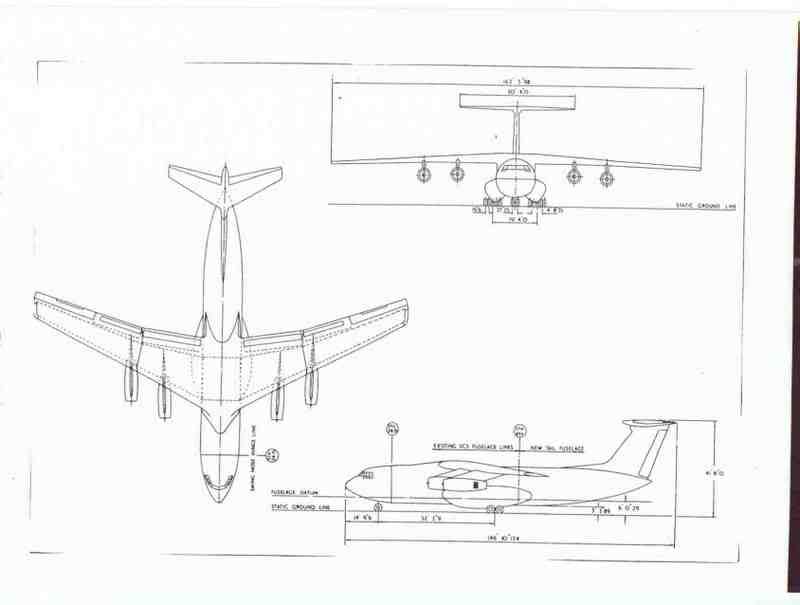
PMN1Does anyone know what the operating costs of a Short Belfast were compared to a Hercules?
How much extra would it cost operating a mixed fleet of large transport aircraft if the Hercules buy had been 10-15 less and the 10 Belfasts kept in service alongside the Hercules.
PMN1There is a page on it with diagram in British Secret Projects:Hypersonics, Ramjets and Missiles.
Everything mounted on a Bedford 4-ton truck – it would normally be offloaded from the truck but could be operated truck mounted if necessary.
9 missiles in a 3 x 3 format (similar to the US Mauler system) each side of the radar.
BSP doesn’t give any projected performance figures though.
PMN1What do you want to know specifically? There’s a chapter on it in the Putnam Supermarine Aircraft since 1914. Looks like the main fuselage was built before it was cancelled. There’s a photo of it, looks like a real monster.
Expected performance figures, engine type etc really – from the picture, does it look ‘right’ or does it look like a dog?
PMN1What Killed off HORIZON in the AWD competition was Britains withdrawl from the program to persure the Type 45’s instead
My reading if it is what killed Horizon was the French insistence on Project leadership and a workshare far in excess of what the 2 possibly 4 ships it said it would build would justify.
Considering at the time the UK was looking for 12, France expecting at least an equal share of the project was taking the **** to say the least – they did however lumber the Type 45 with Aster and Sylver when the RN would have prefered Standard and Mk41.


 Sign In







