Marcellogo
Marcellogo, no offense, but feel free not to include my posts in your banal commentary as if you have some superior insight. Your summaries are off the mark, rarely topical, and add no specific details to the discussion.
I’ve noticed this pattern in several threads, In essence dismissing others posts by offering nothing but your vague opinion. Thanks in advance.
Ok, sorry to have upset you.
I’ll spend more time doing research so, before posting again.
MarcellogoLoL, the F-35 would launch JDAMS/ Sdb at the same speed as the F-22, Mach 1.6
If the SAM in theory can see the F-35 then Big SAR can see the sam. If the SAM launches then every F-35 in theatre knows Its location. Hiding works. It worked for the Serbs. Try hiding
What? Dropping gliding bombs at supersonic velocity?
MarcellogoYes, its that easy [said with heavy sarcasm]. We now have some 50 years of SAM systems in action to research. While IADS operating with surface to air missiles, AAA, in conjunction with surveillance and targeting radar certainly have caused attrition in offensive air operations, not once have they been decisive. The problem is twofold: 1. As the system becomes degraded with the loss of command and control centers, surveillance radars, the launchers and targeting radars become targets themselves. 2. In order to avoid becoming targets of SEAD/DEAD sorties, the search radars and launchers need to reposition often.
Both lead to a breakdown in the kill chain. Decentralize the IAD system and it becomes difficult to control and coordinate. Centralized IADS are susceptible to decapitation. One command and control is lost, the individual launchers and targeting/tracking systems have to weigh risk of emitting for protracted periods vs brief exposure.Molnya, how is that search for any evidence of the six AH-64 shot down over Serbia going? I do believe we’ve gained another JSR level emeritus poster.
SDB is like a paper airplane, its range is proportional to release altitude, not airspeed.
you haven’t face upto date SAM network. at most 25 year older tech in battlefield. so your theory is unproven.
The early warning radar will be detect and located by asq-239
Such post seems me to show that we are always stuck at the same point: one side think that everything they will do would work flawlessy while anything the other do would fail, the other think the exact contrary.
Usually it never like so, it was not so in 1998 (kosovo), not in 2006 (South lebanon) not in 2008(Georgia) , not even now in which even the IS despite having no AD adapted to survive to int’l coalition bombings unscathed for more than an year and still now keep on operating even under intense russian ones.
MarcellogoIf you use the source document I quoted the you you need to take all of it, not just cherry pick small sections. What it clearly illustrates is that a VLO target with an RCS of the F-35 reduces the detection range to approx 50% for the larger lower frequency radars. So right away you reduce significantly the volume of space you are searching for these VLO targets.
Once you have found the target and pass this off to higher frequency radars for engagement, you then have to contend with an approx 75% reduction in detection range for VLO targets. The article puts the 30N6E1 at best case detection scenario of approx 25nm, well within engagement range for a host of air launched weapons.
More than likely, the S-300/400 will see the F-35 for brief moments while it launches SDB-II before the bomb bay doors close again and the only targets left to track are the SDB-IIs. The S-300/400 has to respect these targets and engage them at first opportunity, wasting missiles it would normally use to engage aircraft, and missiles that cost significantly more than cheap SDB-IIs.
There is no SAM operator on the planet who will launch a missile on a target from VHF radar acquisition alone, nor will most radar SAM systems work without the X-band engagement radar providing cueing of some sort. Finally you have X-band seekers struggling to acquire VLO targets at very short ranges during the terminal phase.
The whole point of VLO is to break the targeting cycle.
[ATTACH=CONFIG]245776[/ATTACH]
At every stage VLO targets make things significantly more difficult for defenders, both ground and air based, making find and fix difficult even before you get to the track/target portion of the targeting cycle.
Ozair, some time I oversimplify things but it is because of the sheer time and space limit of the media, not cherrypicking at all.
And the point of developing system like the above cited Nebo-M is right the one you highlight: given that VLO broke the F2T2EA sequence , you cannot use a single frequency radar to perform it: you will have to use different systems, one for the first phases of the sequence (VHS one), another for the intermediate ones (the l and X search radar) and one for the final ones (SAM battery radar and ARh sensor).
Critical would be the passage between one phase to the other it is because of this that an integrated command post, used for sensor and data fusion , is considered to an integral part of the system itself.
One more thing, the idea that the S-400 would directly engage incoming ammo is a slip in what I call brochure-like vision: every long range system in russian service come covered by a bunch of CIWS sistem like pantshir tasked specifically to engage such targets.
What made a russian-style Ad complex formidable is not a single system even an excellent as the S-400 can be but the fact that is multi-layer, multi-system and multisensor.
MarcellogoIf you use the source document I quoted the you you need to take all of it, not just cherry pick small sections. What it clearly illustrates is that a VLO target with an RCS of the F-35 reduces the detection range to approx 50% for the larger lower frequency radars. So right away you reduce significantly the volume of space you are searching for these VLO targets.
Once you have found the target and pass this off to higher frequency radars for engagement, you then have to contend with an approx 75% reduction in detection range for VLO targets. The article puts the 30N6E1 at best case detection scenario of approx 25nm, well within engagement range for a host of air launched weapons.
More than likely, the S-300/400 will see the F-35 for brief moments while it launches SDB-II before the bomb bay doors close again and the only targets left to track are the SDB-IIs. The S-300/400 has to respect these targets and engage them at first opportunity, wasting missiles it would normally use to engage aircraft, and missiles that cost significantly more than cheap SDB-IIs.
There is no SAM operator on the planet who will launch a missile on a target from VHF radar acquisition alone, nor will most radar SAM systems work without the X-band engagement radar providing cueing of some sort. Finally you have X-band seekers struggling to acquire VLO targets at very short ranges during the terminal phase.
The whole point of VLO is to break the targeting cycle.
[ATTACH=CONFIG]245776[/ATTACH]
At every stage VLO targets make things significantly more difficult for defenders, both ground and air based, making find and fix difficult even before you get to the track/target portion of the targeting cycle.
Ozair, some time I oversimplify things but it is because of the sheer time and space limit of the media, not cherrypicking at all.
And the point of developing system like the above cited Nebo-M is right the one you highlight: given that VLO broke the F2T2EA sequence , you cannot use a single frequency radar to perform it: you will have to use different systems, one for the first phases of the sequence (VHS one), another for the intermediate ones (the l and X search radar) and one for the final ones (SAM battery radar and ARh sensor).
Critical would be the passage between one phase to the other it is because of this that an integrated command post, used for sensor and data fusion , is considered to an integral part of the system itself.
One more thing, the idea that the S-400 would directly engage incoming ammo is a slip in what I call brochure-like vision: every long range system in russian service come covered by a bunch of CIWS sistem like pantshir tasked specifically to engage such targets.
What made a russian-style Ad complex formidable is not a single system even an excellent as the S-400 can be but the fact that is multi-layer, multi-system and multisensor.
MarcellogoNo offence but i think you have a wrong perception of how a radar works , when they say a radar have FoV of 120 degree or 360 degrees , that doesnt mean it will transmit a beam that is 120 degrees wide , the beam of fire control radar is normally only 1-2 degrees wide.You can focus the radar beam but only to a certain extend ( the limit is what we called gain )
I mean it would pass position to the integrated command post that would so made the linked L and X radar to concentrate their own research on such a particular area. Nebo-m system is made by three organical radar whose infotmation are shared and fused throughe the said command post.
MarcellogoSo again, you need to have a whole suite of radars up and running, and communicating with each other, just to have a chance of carrying out a successful attack against a stealth aircraft, and even in your ideal scenario the actual engagement radars and seekers will be badly degraded. (even once cued where to look their range and jamming resistance will be badly compromised)
What happens when the adversary starts throwing its own jamming against radars and datalinks? What happens when the sky is filled with decoys, false targets, and weapons of all types…
Nobody ever said it wasn’t possible to engage a stealth aircraft or that a stealth aircraft needed no support to go up against a comprehensive and state of the art air defense network. The point is that it is far far easier for a stealth aircraft to operate in that environment than it would be a 4th generation jet.
So, you are saying exactly what I’ve said all the time and said that it prove me wrong?
Many people said that is absolutely not possible, maybe not you or other but other did.
Even more worrisome was that the first ones that said that a stealth aircraft needed no support at all were the original proponent, both in the military than in the industrial complex, of the idea of stealth fighters.
Initial design of both F-22 and F-35 was greatly conditioned by that, it was only during the development of both that a more realistic evaluation of the possibilities and the limit of such a technology was finally assessed and correctives were applied. On F-35 mainly, as F-22 was designed along such mission parameters that they would simply not stand under new assestment.
I ,for my own part, have reiterated lot of times in this thread and in the other that RCS reduction measures are absolutely convenient and should be introduced in every type of combat hardware. Look back to my previous posting history and you would find several examples of that.
So, I reiterated it another time here: I AM NOT BILL SWEETMAN, NOR CARLO KOPP.
I don’t think that F-35 is a lemon: just a good A2G 5gen plane, whose major drawback is to be called to cover also a series of roles it was not originally designed for, ’cause the F-22 mess.
Saying, like you say, that a stealth aircraft would need support to operate imply rebus sic stantibus that it would need to work together with not VLO aircraft or resort to use stand off weapons.
So, I repeat here again my own position: implementation of LO technologies are a must for any military hardware, introducing brand new VLO is something still absolutely convenient but beyond a certain point investing additional resources and accepting to reduce performances just to get further reduction of RDS is actually counterproductive.
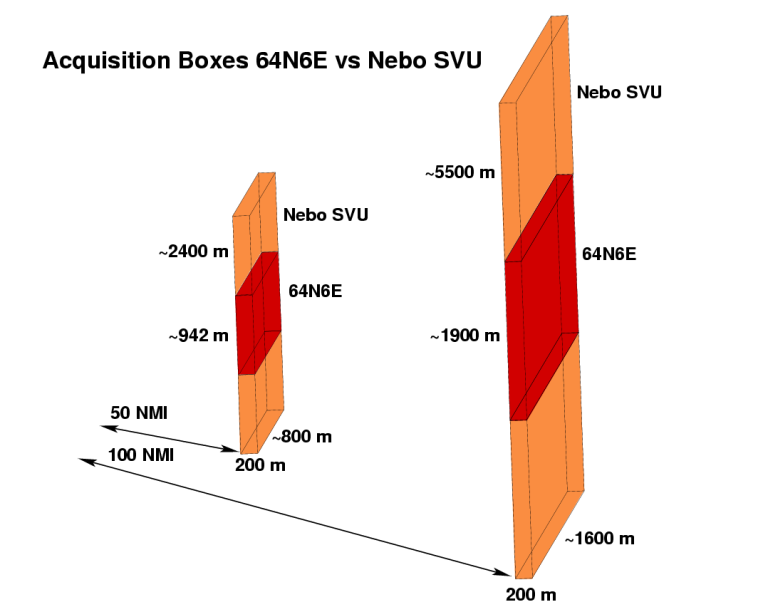
MarcellogoHow would that even work? A Nebo SVU VHF radar at 100 NM will have a 5 km range of error.
A 65N6E will have a 1 km range of error.The S-400 uses neither radar to lock on to it’s target. It uses a separate fire control radar. Which has way less error.
So if it did use the Nebo SVU to lock on and provide midcourse update, the missile would be so freaking inaccurate since it needs to go to a point 5 km off, and then hope miraculous that it’s ARH seeker finds it’s target(which is harder since the seeker is small and has to spot stealth), make a hard turn and hope it hits the target.
Again, if this trick will work, why do the Russians need X-band radars? Why not just use VHF radar for missile guidance?
I was oversimplifing the procedure, so forgive me if I have gave you the false impression that it was a direct thing.
As amatter of fact such procedure implies the combined use of different radars each one taking care of just a portion of the engagement sequence while against conventional planes a simple radar, usually in X band) can take care of all of them.
The VHF radars would so take care of the first part of the acquisition sequence, looking throught the whole sky in Wide search mode, they will detect incoming aircraft and give an initial assestment of its own position and ABOVE ALL route and pass the information to the decimetrical and centimetrical that would search just that portion of sky using narrow o even a spot on search mode , using such modes resolution and the range increase dramatically as they concentrate their power beam in just a portion of sky in order to reduce the acquisition boxes after they would pass the obtained data to SAM batteries that would launch missiles.using their own radars to do mid course guidance, usually such radar would be positioned at a consistent distance one from the other and would so illuminate the targets from different directions.
Give a look to the document Ozair has send there is a good illustration of how the NEBO_M i.e. their latest operative air defense radar complex operate.
MarcellogoWhat is the this nonsense that “the F-35 sucks at SEAD because many of the munitions are not ready yet’? Uh the F-35 is not meant to be FOC till around 2021. So saying that it a reasoning of why it shouldn’t be developed or will be a bad aircraft is laughable.
Low frequency radars? Are you people high? Who the hell uses low frequency radars for missile guidance? ARH missiles solve the problem? Eh, if that was the case, the Russians wouldn’t even bother making seperate Acquisition radars and separate Fire control radars for that matter, just let the ARH missile find it’s target.(which the seeker is very small). Not only is VHF-band and UHF-band radar inaccurate as hell but a lot easier to jam and spot. Without midcourse updates, the missile will be forced to rely on it’s seeker to steer it’s way inaccuratley to a target it may not even acquire(seekers usually don’t turn on till terminal phase) since it’s stealth unless it was super close and too late. You want, do not want your missile to engage in hard turns before terminal phase since inside an atmosphere that will slow down the missile due to drag. Add it to the fact that most modern MAW sensors can spot missiles very well at will engage in evasive maneuvers to throw the missile off target. You never want to fire your missile at max ranges against a fighter target.
Also what is the assumption that every single PGM will be shot down? A throw of MALD-J decoys at an enemy air defense will overwhelm it with false targets. You would need to cover every single location with the trajectory of a SAM and enough radar coverage. A storm of stealth weapons like the JAASM and JSOW armed with cluster munitions each can overwhelm a Pantsir system.
Even against a non-stealthy target, a S-400 missile system will rely often on hiding in clutter and surprise than outranging his opponents. Remember you never really want to engage at the maximum missile range, because fighters can engage in evasive manuvering. An S-400 unit with 40N6 will likely never fire at an F-16 at 400 km unless it wants to waste it’s missiles. 200 km maybe but it will mostly be ripple fire. Against a S-300 armed opponent, even a 4th Gen fighter like a F-16 just armed with these newer Small-Diameter bombs or JDAM-ER can cause nasty damage for they don’t need to engage the missiles in DEAD just their radars. It will force the SAMs to waste their missiles.
SAMs vs Aircraft is a lot like Artillery vs Tanks. The mobile weapon is simply more adaptable as shown in Battle of France where tanks all grouped together and engaged at a single point. They can focus all their power on one kill point, will the SAMs need to be spread out to defend every point in the border.
Armed update, what maximum range are you talking about?
Look how we are discussing about VHF being able to engage them at something between 50 and 100 NMI a quarter to an half of the S-400 maximum distance.
And the same for mid course update, from the beginning it was considered a fundamental part of the ecquation.
Every existent Arh missiles come with one just because differently than the previous SaRh such a guidance system doesn’t cover all the missile course but just the final phase.
For the rest exactly to who are you responding with this tirade about engaging a plane at 400km?
Maybe it’s just me that have lost some chapter of actual debate and wonder how such a topic sprang out.
On a more general note, a lot of response there keep to work on the principle that OUR systems would work everytime at 100% of their expected performances, YOUR systems and countermeasures would instead doesn’t work.
Starting from this point no real progress would be achieved, ever.
Warfare is something that involves someone trying to costantly disrupt everything you made and counter every innovation you introduce, so things costantly evolve.
In this case we are talking about two of the most difficult task aerial warfare can envisage: intercepting stealth planes and pass trought a russian style i.e. multilayered and overlapping AD system, really Good luck to everyone expecting to obtain such things in a simple and straightforth way.
MarcellogoIll be so glad, when certain posters here who are citizens of certain countries, hear news of thier respective countries recieving stealth fighters. Then atleast we can move on and not hear how stealth doesn’t work.
Jessmo, no one there is saying that stealth doesn’t work.
Just that relying on it only, doesn’t work anymore.
In such a case F-35 is much more ecquilibrated plane than the precedent planes introduced in service, not pushing so far into RCS reduction but sporting way greater ECM assets and sensor fusion.
We for the rest would sill use it for the role it was designed for and will have in service a even greater number of Typhoon for A2A+ stand off attack with Storm Shadow.
Still I see the same old rethorical argument used again and again: any critic about some aspect of the actual procurement program means automatically than one want to thrash all F-35.
MarcellogoYou should say that to F-35 fanboys who discount any counter stealth capability and who believe that its stealth makes it litteraly unbeatable in any circumstances.
So you have to get close to use your anti jam weapon. Even if the SDB1 has HOJ capability, the F-35 would still have to climb to high altitude to achieve a relatively long range with it.
Even if GPS works, you still haven’t solved the problem of getting the GPS coordinates in the first place, at long range that is.
You assume that the TLAM seeker would work against ground targets. It’s primary role is anti-ship. Even at that, the TLAM would have to loiter for some time to find the target. It is not stealthy so it would be shot down most probably.
The LRASM is an anti-ship missile. Maybe it could be programmed to have an anti surface capability, but its range is limited ( around 400km ). Some people in the USN have suggested decreasing its warhead to increase its range and to use it as an anti-surface missile, but it doesn’t seem to be a concrete path, as the Navy continues to invest in TLAMs and in its successor that won’t be available for about 10 years.
When deriding other posters as “fanboys” it helps when your own posts are factually accurate. Making broad, sweeping generalizations is, well, rather fanboyish.
Well, as I wrote in previous. GPS is not the only targeting method available, and that was a succinct overview.
TLAM = Tomahawk land attack missile. It’s primary role is land attack. The recent modifications make it dual capable. The TASM (Tomahawk anti-ship missile) was withdrawn from service. Yes, the improved TLAM block IV can, in fact, loiter.
The improved Block IV has capability against land and sea moving targets.
http://www.raytheon.com/capabilities/products/tomahawk/LRASM program has several increments. The initial AGM-158C will fill the air launched portion. The sea launched requirement for OASUW increment 2 was not planned until 2020’s (since modified into the new NGSC- dual land and sea capable). NGSC has the LRASM increment two in competition with future Tomahawk variants. Not to mention that Raytheon plans to backfill the improved block IV capabilities as a gap filler.
Reading such looong posts one cannot wonder into saying: but a normal plain, high speed ARM missile not? Something like the AGM-88E developed together with my own nation would be ideal for the task. You have just to found a way to fold it two times in order to made it fit into the F-35 bay and such problem are solved.
Yes, i’m being sarcastic there but just to exemplify how the STEALTH ONLY approach have ran deep into the “american way” (or better said the USAF way) of running things aand the damages it has made.
MarcellogoI think you mistaken between the range error and the angular error, i am talking about the angular error due to wide beam width
Even in this case are we talking about an acquisition box of 200X 1600 meters at 100 nautical miles, nothing than a ARH seeker can’t cope with.
Problem lies probably more in elevation error but in this case a altimetric radar can be easily added.
And Nebo SVU is a radar introduced in 2001, so hardly the newest kid on the block.
MarcellogoSo spend billions developing a stealth plane, then fly at an altitude that’s statistically more dangerous where stealth is irrelevant?
Statistically? Have you idea how a VHF radar is much more efficient in detecting a target flying at high altitudes?
MarcellogoI understand your point , my point is that the box may be enough again legacy aircraft , it wouldnt be enough again stealth aircraft , because the seeker range will be degraded greatly
So we have reached a point in which just a point is left to be examined and discussed, a great progress in my own way to see things…
For what I have seen looking into VHF radars brochures even the most modest ones claim a probable location errors of some hundreds of meters while ARh missiles ones claim their own seekes ranges in order of several kilometers or tenth of kilometers also, even in the case of low RCS targets.
So, i’ll place my own bet on: difficult but definitively worth trying.
MarcellogoNot sure if this article has been posted here previously but the following link is to a journal article written by three members of the Hellenic Air Force and published in the Journal of Computations & Modelling in 2014.
http://www.scienpress.com/Upload/JCM/Vol%204_1_9.pdfIt gives a reasonably good explanation of current and planned stealth and anti-stealth technologies. Most interesting is their assessment, based on the modelling done by APA so hardly the best case scenario, of the stealth characteristics of the F-35 and the capability of adversary radars to detect it. The F-35 specific section starts on page 14 and provides an excellent example of different in production radars across multiple frequencies and platforms.
OOOH, finallysome useful and not partisan source contribution, thanks a lot Ozair.
Ihave just gave a look at the first two or three pages but I found much more common sense in these than in all our debate.
I ‘ll keep on reading, promise.
Hope also other would do the same.
I’ll just report them just two excert it, just to highlight what are the key point the debate there would focus on.
Today, all military equipment take into account low
observable principles (l.o.), trying to be discreet at all aspects, reducing acoustic,
radio, radar and infrared emissions, as well as in the optical region, trying to blend into surronding environment.
Furthermore, stealthiness comes at a price.
Apart from the development cost, stealth aircraft have higher flyaway cost and important maintenance costs, while they have significant operational limitations due to the specific aircraft shape imposed and materials used, and also due to the limited fuel and weapons, which have to be carried internally.
The following systems have been reported to be potential counter stealth approaches: passive / multistatic radars, very low frequency
radars, over the horizon radars and sensitive IR sensor systems.


 Sign In