 m3bobby
The booster size looks about right. The barrel jacket needs to be about 1″ longer at the wide end with an external thread about 1/2″ long. This would screw into the trunnion of the gun and would be silver soldered in place (the extra length wouldn’t be seen as it would be inside the gun)

m3bobbyHi all! m3bobby, you’re starting to mix up the actors in this play, it’s Mike H who’s making the drawings :D.
Anyway, these are the dimensions I took some years ago when I was allowed to study a Browning at the Brussels Army Museum.
– length of barrel casing between blast adapter thread and muzzle attachment : 454 mm
– dia of barrel casing where it meets the blast adapter thread : 39.6 mm
– dia of barrel casing where it meets the muzzle attachment : 32.3 mm
– there are 6 rows of four cooling slots, the slots are 48 mm long and 11 mm wide, distance between two slots is 58 mm
– the rows of slots are alternating and on the Brussels gun the first slot of one row buts up against the blast adapter thread. The first slot of the next row
then starts at 53 mm from the adapter thread, the third row then starts against the thread and so on. Not easy to explain in writing, I hope you get the idea :rolleyes:
– the barrel casing is made of 2 mm thick steel plate.m3bobby, it will be very interesting to see how you intend making that barrel casing, especially so as it is tapered. Do keep us posted please!
Cheers,
Walter
Sorry for the mix up Walter, don’t know why I did that. Half asleep I expect.
Thanks for the figures, that matches near on perfectly with the measurements I took of the gun in the Weapons School at Cosford.
The original tube was cold drawn over a mandrel so I intend to do similar but use a little heat.
I have a section of steel bar to machine down with a 1/2′ cut to make the taper.
I then plan on drilling and tapping the narrow end of the mandrel and fitting a threaded bar.
I’ll also make a former/guide to fit over what will be the narrow end of the tube to protect it.
I then fit what will be the large end of the tube over the start of the narrow end of the mandrel.
The threaded bar will protrude through the other end of the tube and the former/guide and place a nut on the end.
I then heat up the tube where it touches the mandrel.
The mandrel will retain the heat and I’ll tighten the nut.
Hopefully the tube will then start to slide down the mandrel.
When the tube has been drawn all the way over the mandrel the job is done.
Now my problem is that I’ve had to start with a heavy gauge tube with a 3mm wall thickness because I don’t know how thin the wall will become at the wide end. So I’m going to have at the wide end a wall of approx. 1.5 to 2.0mm and at the small end a wall of 3mm. To overcome this I’ll leave the tube on the mandrel and place it between centres on my lathe. I won’t change the angle of my cross slide after machining the mandrel so that when I machine the outside of the tube, it will remain parallel with the mandrel and therefor have approx. equal wall thickness all the way along the tube. A real pain in the backside but at least the first hurdle will be out of the way.
I hope that makes some sense!
m3bobbyWalter, you need to add the internal threads onto the booster where the flash eliminator screws in.
Turretboy, is that you gun? If it is, would you mind measuring the length of the barrel jacket from behind the booster upto where the jacket screws into the trunnion. I’ve got 3 conflicting measurements, 17 7/8”, 18.885” and 17” and that’s what’s holding me back from making a jacket for my gun.
Regards,
m3bobbyThis is the MkII I’m trying to restore at the moment. It’s a BSA 1939 gun but it has a Vickers brass thread protector. The barrel jacket and booster/muzzle attachment were missing when I got it. I managed to find an incorrect booster but no barrel jacket so I’m going to have to make one.

m3bobbyI think that’s what m3Bobby is referring to as the “booster”, don’t know if it boosts anything though! None of my documentation seems to refer to it as a booster.
Hi Walter, take a look at my post #30, with out the booster and eliminator the gun would be sluggish at best, it certainly would have a cyclic rate of a lot less than 1150rpm. The second reason for the booster/muzzle attachment is to support the end of the barrel. The Vickers Gun had the same problem and it also had an armoured booster.
The .50 cal Browning M2AC had a similar arrangement with a barrel support at the end of a jacket but didn’t need a booster as the cartridge was plenty powerful. It did however require a oil filled buffer to cushion the recoiling working parts. The M2HB (Heavy Barrel ground gun) had a barrel support which extended about 12″ from the trunnion and didn’t require a barrel jacket due to the heavy weight barrel. Because the barrel was much heavier than the M2AC, it was much slower, and because it was much slower, it didn’t require a oil filled buffer, so they emptied the oil and used it empty. Just some trivia for you.
This is my 1919A4 in .30-06 and L3A2 in .30-06
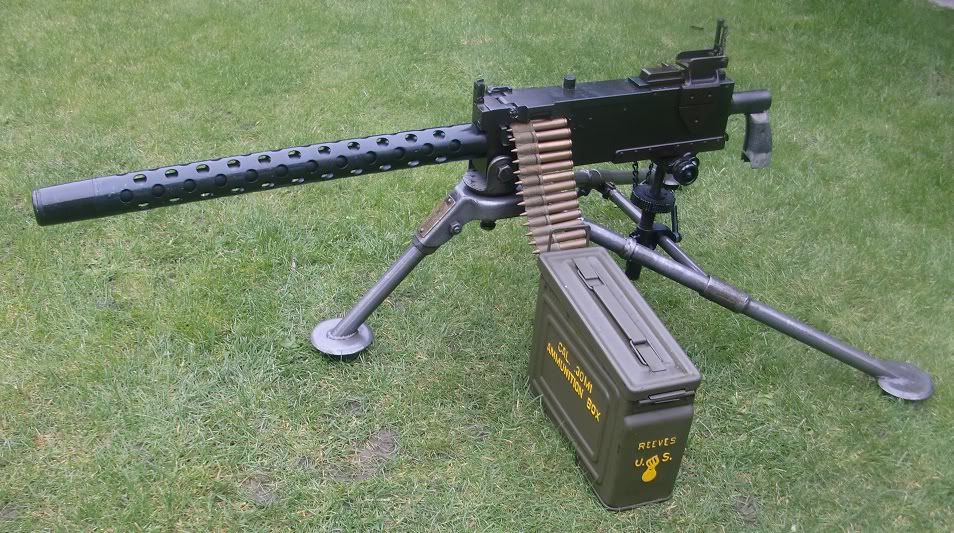

M2AC cutaway and M2HB in .5″ Browning (Not very good as they’re in the attic).
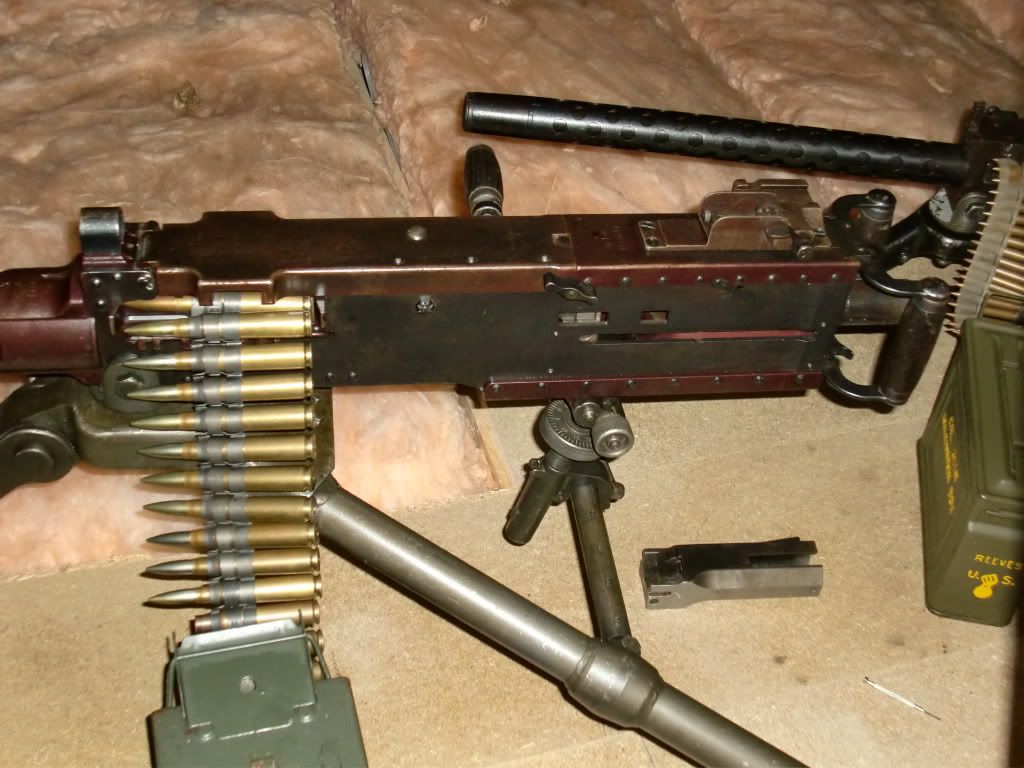
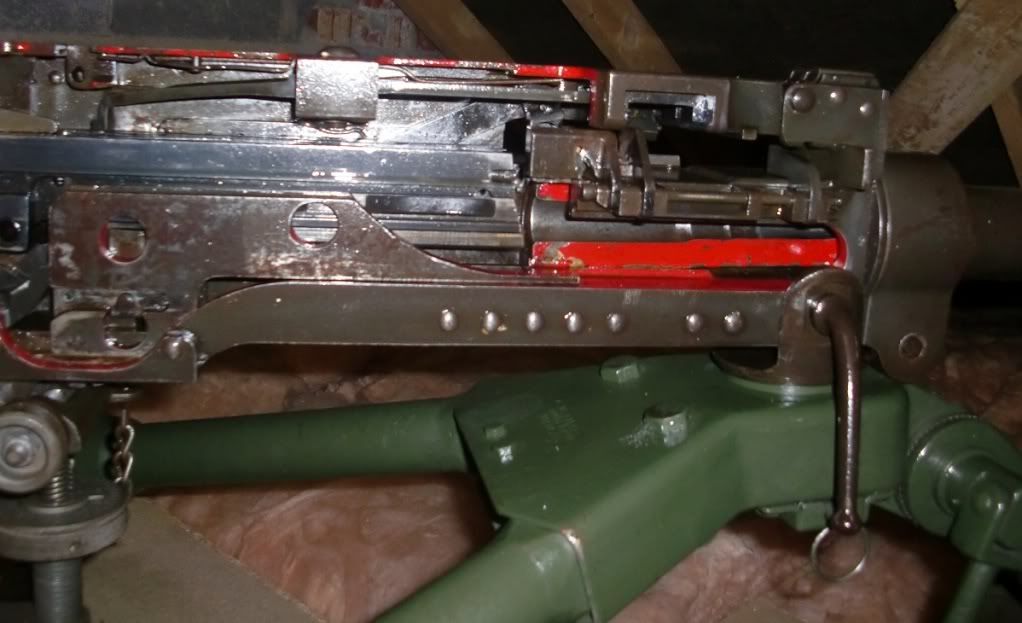
m3bobby
This 1939 MkII belongs to a friend in NZ and it can still fire despite it being a cutaway.

m3bobbyMike, You need to remove the second set of threads (On the right in your image) my bad photo may look like they’re threads but it is all smooth. The single set of threads fit into the cooling jacket.
Just to clarify the mark designations,
The Gun, Browning, MkI was a Colt built ANM2 (I believe it was never called the MkI, just refered to as the Browning Machine Gun)
The Gun, Browning, MkII was British built gun (BSA, Vickers, Standard). This had a ‘Booster, MkII’ and the flash eliminator is the ‘Eliminator, Flash, Mk1’ (When Fitted).
The Gun, Browning, MkII*was a Commonwealth built gun (BSA, Vickers, Standard and Inglis of Canada). This had a ‘Booster, MkIII’ and ‘Eliminator, Flash, MkII (When Fitted).
The gun you have drawn is a Browning Machine Gun MkII*.
In late 1944, the designation of the Browning (And all other small arms) changed from MkII and MkII* to Mk2 and Mk2/1. Most of the MkII guns were modified to MkII* when they were returned to work shops for overhaul, hence why there aren’t many MkII guns remaining.
m3bobbyMike, I’ve got a fair bit of reference material on the .303 Browning which I’ll be happy to share with you if you can let me have your e-mail address.
And yes, as you remarked earlier on, the barrel casing is tapered, something which is neglected in quite a few replicas, for ease of manufacture no doubt. Also, Turretboy’s drawing (hi Mike) shows the gun in its Mk I version with the early flash eliminator, I believe the Mk II version with the revised muzzle brake and flash eliminator is somewhat shorter overall. Attaching one of the many photos I took of a .303 years ago at the Brussels Army Museum, as a teaser 🙂 .[ATTACH=CONFIG]227671[/ATTACH]
I don’t suppose I could have a copy of some of the info could I? I’ve been slowly restoring my example and trying to get the correct AP but it’s slow going.
m3bobbyThe MkII has the early non finned booster and flash eliminator. The MkII* has the more usual finned versions. I think the Mk1 version is the Colt made ANM2.
I’ve got a MkII rather than the MkII* but I have a MkII* booster and flash eliminator to fit as I can’t find the correct MkII parts.

m3bobby[ATTACH=CONFIG]227549[/ATTACH]
m3bobbyI can get you some in the morning.


 Sign In







