 milmascaras
If you ask me the most beautiful i will say
Most beautiful bomber is the Tu-22M
The most beautiful fighter of all times

and Transport or cargo jet
milmascarasBombardier jet to be assembled in Mexico
2009-10-09
Mexico City,— Flavio Diaz Miron, CEO for Bombardier Mexico, informed Mexico was chosen as the site to assemble Learjet 85, thanks to the fact that productivity by Mexicans was 25% higher than that in Belfast and Montreal.
During his speech in Mexico Summit Forum, organized by The Economist, Mr. Diaz Miron, head of this company which manufactures rail vehicles and aircraft, informed that the first carbon compound prototype will be built in Queretaro, thanks to the support granted by federal and state governments.
He stressed Mexico’s the advancement in the last five years in aviation development, which has gone from 61 to 164 manufacturing enterprises; presence has also been expanded from three to sixteen states, which crushed efforts to create industrial corridors for this sector.
In the next 10 years, he said, estimates are 11 thousand 500 executive airplanes and 12 thousand 400 commercial units will be assembled globally, which could represent an opportunity for Mexico.
Source: El Diario
http://www.maquilaportal.com/cgi-bin/public/board.pl?klie=5
milmascarasShorts in Belfast WERE building the fuselages for the Learjet. Does this mean a round of job losses in Belfast? I hope not.
Rgds Cking
I do not know if they are going to lose work or not but the report clearly says the reason they won the contract is mexican workers do a more efficient job than even canadian workers, up to 25% more cost efficient and it is not only salaries but the fact mexican workers do a better job in terms of less mistakes and quicker manufacture.
The learjet 85 is a new model though so at least with respect the learjet 85 mexico won the assembly and production of this new airplane made by Bombardier
milmascarasi just watched the future dogfight’s on you tube. now i will except that the f-22 is a extreamly good aircraft but would somebody please confirm my suspicion that this program is somewhat one sided and slightly biest? got me wondering who paid for this program!
link if any ones not seen it
http://www.youtube.com/watch?v=9KpjgHYjcA4&feature=relatedAlso if any 1 is really cleaver they could have a go at suggesting how this fight would really play out 😀
lol the usaf throws away 8 reapers in part 4!! as a decoy!
it can be biased but i loved the computer animation done in that program
milmascaraslink? I’ll try google but a link would make me extremely happy 🙂
The J-8II has undoutedly technology borrowed from the MiG-23 via reversed engineered parts tailored to be adapted to the J-8, russians sources claimed it, the engines are the same the Su-15 had though
milmascarasSukhoi/HAL FGFA a Indian Stealth Fighter
The Fifth Generation Fighter Aircraft (FGFA) being jointly developed by India and Russia will look substantially different for the two countries. While the Russian version will be a single-pilot fighter, the Indian variant will have a twin-seat configuration based on its operational doctrine which calls for greater radius of combat operations. The program is initiated to develop a fifth generation fighter aircraft to fill a role similar to that of Lockheed Martin’s F-22 Raptor and the F-35 Lightning II, the world’s first fifth-generation fighter jets.
“The Indian FGFA is significantly different from the Russian aircraft because a second pilot means the addition of another dimension, development of wings and control surfaces,” said Ashok Baweja, chairman of the Hindustan Aeronautics Ltd (HAL), which is developing the aircraft along with Russia’s Sukhoi design bureau.
Speaking to media persons at the eighth Indo-Russian Inter-Governmental Commission on Military-Technical Cooperation (IRIGC), Baweja said that both sides had moved closer towards identifying the key areas of participation in the Fifth Generation Fighter Aircraft Programme (FGFA) for which both countries had signed a joint agreement in 2007. India would bring into play its expertise in composites, lightweight high-strength materials that significantly bring down the weight of an aeronautical platform.
The Russian aircraft is thus called because it is a successor to virtually every fourth and 4.5 generation fighter aircraft like the MiG-29 and Su-30 MKI in the inventories of both countries. It has been dubbed the ‘Raptorski’ for its similarity to the US F-22 Raptor that entered squadron service on December 2005
The first prototype of the Sukhoi Design Bureau’s PAK-FA ‘T-50′ fighter aircraft is set to fly in Russia next year. “We are in the process of defining what part of the contract to give to the Indian production agencies,” said Alexey Fedorov, president of the United Aircraft Corporation, the umbrella organization of Russian fixed-wing aircraft manufacturers. Fedorov said that the process of identifying the participation of Indian partners in the FGFA would be completed by the year-end or in the shortest possible time.
According to Baweja, it features stealth, or a drastic reduction in the aircraft’s radar cross-section or ’signature’, and the ability to ’super cruise’ or jet engines that fly stealthily without engaging noisy afterburners even at supersonic speeds, embedded weapons with the capability to engage multiple ground, sea and air targets and seamless communication between the fighter, other aircraft and ground stations. Baweja said that the first prototype of the FGFA was to fly next year with the AL-37FU engine. He said he would want an engine that had 15 to 20 per cent more growth than this engine in the final aircraft configuration. The FGFA is to enter squadron service by 2015 and will replace at least three classes of aircraft in the IAF
The joint-venture borrows heavily from the success of the Brahmos project but seems fated to repeat its story. By the 1990s, Russia, the world’s only operator of supersonic surface-to-surface missiles, had already perfected the Yakhont missile but lacked the funds to pursue its development. Indian stepped in with the finance in 1998 and the missile was re-launched as the Brahmos.
Designs for the PAK-FA have already been frozen by the Sukhoi design bureau, which means that Indian aircraft engineers have already missed out on the critical knowledge curve of aircraft design. Also, the unequal status of the Indian and Russian aviation industries means India will be the junior partner contributing very little except finance. “So if we have missed out on the design phase, we have to analyze the cost-benefits of acquiring only super cruise and stealth technology for $ 10 billion,” asks Air Vice Marshal Kak.
Decks were cleared for India to jointly develop and produce the fifth generation fighter aircraft with Russia, with New Delhi making the “final choice” on the matter and Moscow saying the work on signing contracts on the deal could begin soon. Observing that Russia had started developing the warplane about three years ago, visiting Deputy Premier and Defence Minister Sergei B Ivanov said “some time back, India showed interest in joining this project. It took them (India) some time to scrutinize the various options. “Now, India has informed us that a final choice has been made. We can (now) open up contractual work for Indian accession to the project,” Ivanov told reporters at a joint press conference with his Indian counterpart A K Antony, after signing four documents. Although interaction has begun on the joint development and production of fifth generation fighter jet, the actual signing of agreements could take some more time.The two sides inked an inter-governmental agreement and a general contract for licensed production of the AL-37FU engines.The fifth generation fighter is based on the Sukhoi fighter and is expected to take its maiden flight in 2012 and inducted by 2015.
Source: http://www.defenceaviation.com/2008/10/sukhoihal-fgfa-a-indian-stealth-fighter.html
your pakfa is great see my MiG-29
milmascarasIs that view through the cockpit rear vision mirror/persicope?
It is, the visibility was limited but not as it has been claimed
milmascarasI am sure they did – it certainly had some excellent characteristics. Bear in mind, however, that the opinions in the book (and on the forum) come from men who had flown the F-15, F-16 and F/A-18 before they ever set eyes on the Flogger, so their frame of reference is quite different.
You see, that’s the kind of useful contribution that I can actually work with to provide a counterbalance should the book ever go to a second edition. Thanks.
Opinions are most of the time biased and a realistic opinion should be made always considering aircraft evolution, the MiG-23 had different variants and all of them had different engines, claiming the MiG-23 had bad engines is unrealistic without saying what engine and what variant.
A simple accident can not claim to say this aircratf was not good and just because it was a western pilot who said that is true it is even more biased. More than 3000 MiG-23s of the fighter versions were built all of them improved as new batches were deployed.
See the MiG-23 had a limited but acceptable rear visibility, contrary to most opinions
generalizations are in this case very unrealitic and limited.
milmascarasI’m pretty sure the original MiG-23 was a bomber destroyer, not a tactical fighter.
It was an interceptor with limited fighting capabilities, not a dogfighter in the strict sense of the word but it was not a bomber killer
see this weapons load, it was wired to used air to land weapons
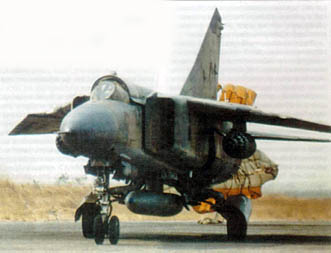
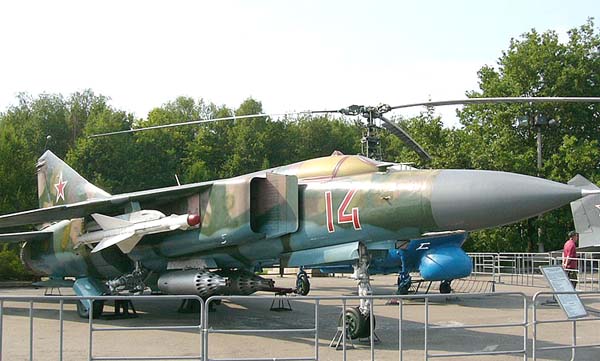
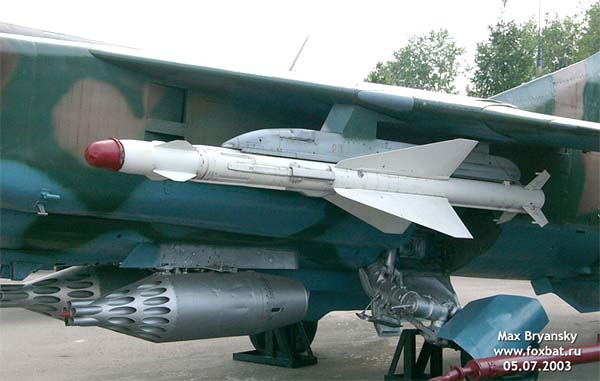
milmascarasThe MiG-23 was no multi-role fighter. It was designed as a tactical fighter and could be used as that as an interceptor too.
The best thing of the Su-15 was the radar and the automated interception device similar the the F-106. In both cases that system was not freed for export and in the 70s the Su-15 was oudated already.
The agility of the F-106 did allow to be used in that both roles too. But is was to be too expensive to be wasted in that. So the F-4 from the same time-scale could do both missions with ease.
In Afghanistan in the 1980s the MiG-23s were used as bomber as well as fighters in fact some MiG-233MLDs were scorting while other MiG-23MLDs were attacking and i mean MiG-23MLDs not BNs but the same fighter version and the same Angola.
milmascarasThe newer design and later technology, the MiG-23P for sure. With the introduction of the MiG-23 the production of the Su-15 stopped. 😉
Early MiG-23 were designed as fighter and interceptors, the MiG-23 was far more agile than a Su-15, the difference between the MiG-23 and Su-15 was that as interceptor the MiG-23 was a multirole aircraft, while the Su-15 was a bomber aircraft killer, the MiG-23 had better radars and weapons than the Su-15, but the MiG-23 was basicly a fighter, not an interceptor it was designed to get close to the enemy as the F-4 did, they were ill prepared to deal with lighter and specialized fighters like the F-5, MiG-21 or F-16, but the MiG-23 was a F-4 type aircraft or multirole while the Su-15 was like the F-106 a pure interceptor
milmascarasIt is an option, but I’m not sure that it is the best option. Keeping a small number of upgraded MiGs would be good for close-to-home, fast response engagements. They could be deployed at bases along Russia’s borders and fulfill their role well. However, they don’t perform as well in the interceptor/fighter role as the Su-27. When it comes to air defense, the Su-27 looks like Russia’s best bet.
Having a lower cost, lighter fighter like the MiG-29 is needed to an extent, but not in the current numbers.
For the russians in my opinion keep a large fighter force at this moment is unnecesary, why? simply Russia is to big, most potencial threats coming from Europe or China are tactical aircraft, none of these aircraft have real long ranges to become real threats such as the B-1B or the B-2.
China`s Tu-16s are obsolete less capable even than the Tu-95s Russia has and its fleet of FB-1 is to small, in fact with SAMs and nukes both China and Europe are neutralized.
Europe`s Eurofighters, Tornados or Rafales do not have real ranges to be a direct threat to many military instalations in far east Russia and basicly are still not available in large numbers.
The US is the most capable nation but it won`t do any thing against Russia because it will mean a direct war with a nation with still thousends of nukes.
So basicly leaving to rust those MiG-29s might be a bad thing for the air force but Tu-22Ms, ICBMs, Tu-160s and SLBMs are more important for Russia in the long run.
The MiG-29 has not long range and only has a few BVR missiles; only the Su-27 and MiG-31 have some long range endurance and large weapons load, but still for the Russians is simply better to wait for the PAK FA.
milmascarasMy comment as a US citizen is…Don’t believe the period at the end of the sentence any elected official makes…….its all politics, there is no truth behind it.
What he is saying is true, not a lie or anything that is based upon fantasy, if the F-15 or F-16 would be better than the Su-27 family then it is better to buy F-16s and F-15s in new guises but the reality is in performance weapons and in some aspect of their avionics the Sukhois are better.
That is the reason they are building F-22s and F-35s, what the guy is simply saying we need more to keep a credible deterrance and air supremacy.
Of course you might always think the quality of russian aircraft is inferior, to western fighters but in fourth generations the Su-27 and MiG-29 are the best even in their latest incarnations they can beat the Eurofighter and Rafale.
The F-22 is the best all around aircraft in the world better than the Su-27 family.
milmascarasWhat could be fired was related to the radar-system. See the proposed upgrades of the MiG-23-98 about that. Even within the units of 16th AA there was a wide range of MiG-23M* and a similar range of Saphir-23M* radars equipped.
The regular AAMs were R-60s and R-23s. 😉
The MiG-29 is a different story.
The MiG-23 had diferent variants fitted through the years and each version used diferent radars, the russians had the technology already in the 1980s to fire AA-10s and AA-12s from MiG-23s even helmet mounted sights on MiG-23s.
However they never used them simply because contrary to many European nations they possessed Su-27s an F-15 equivalent and MiG-29s an F-18 equivalent.
There was no need to upgrade the MiG-23 since it was superflous.
The MiG-23 was only a 1970s aircraft when in Europe only were F-4s or F-104s or few Viggens and Mirage F1.
Much later both sides got MiG-29s and F-16s and some nations even F-18s, but the reality was by 1988 the MiG-23 was not the mainstain of the Soviet air force and by 1997 there was no need to have MiG-23s, only a few nations retained the MiG-23 longer among them Bulgaria or Belarus.
Poland and the Czech replublic also did have a fewer MiG-23s.
the MiG-23 to the contary was retained in some iar forces like the Angolan, Libyan or Algerian.
The German F-4s like the Japanese, Israeli or Turkish were kept just to keep some numbers and a limited combat capability since in 2001 an F-4 was not really a great threat.
milmascarasYou will get an excellent idea about real capabilities of the MiG-23, when you do follow the time-scale of the GAF F-4F upgrades. That had to face the most advanced MiG-23s with 16th AA in the GDR. The USA and FRG did track the development of the MiG-23s constantly to avoid nasty surprises from that. FRG did not even buy a interim fighter to bridge the time gap till the introduction of the later Eurofighter/Typhoon. 😉
Sens the MiG-23 also was developed but Germany never had something like the MiG-29, Russia did, by 1986 the MiG-23MLDG was able to fire the AA-11 with a helmet mouted sight and even able if they have wanted to fire the AA-10 and AA-12 but the MiG-29 simply make that an unnecesary thing.


 Sign In







