 milmascaras
Just that it basically lacked all advantages of these, but incorporated all disadvantages.
From technology point of view, the MiG-23 always trailed the Western aircraft, and when first introduced in 1972, the -23M was less advanced the 10 year younger F-4C.
The earlier Phantoms radars such as AN/APQ-50 fitted to the F-4D, the AN/APQ-72 fitted in the F-4C and the AN/APG-100 also employed in the F-4C were less advanced than the Sapphire-23D-III or later radars fitted to the MiG-23 late variants
The F-4 and MiG-23`s close combat missiles were quit comparable, it must be noted that the AIM-9A and AIM-9C “Sidewinder” variants and the Soviet R-3S air to air missile were quit similar. The MiG-23M had the advantage in the early and mid 1970s with the highly maneuverable R-60 air to air missile. Similar missiles did not arm its main opponent in the year 1975, this situation changed only when the United States deployed in 1978, the AIM-9L with a more sensitive IR head seeker than the one fitted to the R-60. In assessing their gun weapons, it may be noted that in comparison with the American gun “M61 Vulcan” , the Soviet Gsh-23L had better ballistic characteristics and much much heavier caliber projectiles. However, the F-4E firing rate was 6 or 7 rounds a second while the MiG-23M had a firing rate of only 4 rounds a second. Comparing their weapons sighting systems of both machines shows that the ability to detect aerial targets and their capability to engage aerial targets was virtually the same, with a slight advantage for the Soviet radar. The “Sapphire-23D-III” had a higher jamming immunity and an advantage over AN/APQ-120`s radar detection range when they mutually detected their respective targets, the AN/APG-120, the MiG-23M; and the Sapphire-23D, the F-4E at extremely low and medium altitudes. Using infrared tracking systems the MiG-23M could carry out covert attacks in the rear hemisphere of the F-4E. In close combat the MiG-23M was superior to F-4E by the fact it was armed with R-60 and later R-73s, This in fact somehow compensated its shortcomings in gun armament.
With respect their sighting weapons system MiG-23M was not fitted with an optical sighting system, however the F-4E had the AN/APQ-120 radar and the optical sight AN/ASG-26 however in some parameters the MiG-23M substantially exceeded the F-4E. The AN/APQ-120 radar compared to the Soviet Sapphire-23D-III was uncapable of detecting targets upon the backdrop of the ground, in few words it had no look down shoot down capability, and it was less inmune to electronic jamming. The presence on the MiG-23M of an IRST system significantly enhanced its combat capabilities and allowed it to perform military tasks successfully, even in the face of powerful radio-electronic countermeasures. The TP-23 had a detection range of F-4 fighters from the rear hemisphere in fair weather of about 20 km.
The IRST systems TP-23M and TP-26 detect aerial targets within a maximum range of detection from rear hemisphere of the target against the backdrop of the ground up to 60 km. Infrared search and track allows to the MiG-23 getting imperceptibly closer to the enemy and be within launching range of its air to air missiles . The IRST system has the following modes of operation: TI -This mode cues and locks the target to the R-60, R-23, R-24T and R-13M-R in the range of 60 °in azimuth to 15 °at vertical scanning; T-I – due to the contraction of the sector of survey to + -7° along the azimuth and + -3 ° in the angle of elevation increases the scale of image, T-III – this is main mode used during automatic target engagement while maneuvering with the angular velocity of 6-8 ° / sec. Information from the radar and IRST system including the gunsight is displayed on the HUD.
milmascarasThere is nothing sadly about that. Cold facts did tell, that those countries did buy Russian fighters. They got that for a political price and they were willing to pay that. In that years there was a time-gap of two years at least, before a new Russian frontline-fighter was freed for export and something similar was done by the USA too. In the 70s the Russian clients did learn the hard way, that the military technology delivered by the Russians was no longer sufficiant despite some political claims. See the fate of the MiG-23 about that. Most WP-countries did refuse to buy the MiG-23 in numbers to replace the outdated MiG-21 in the 70s as the Russians did. By the way that did free “surplus” MiG-23 for exports. The Iraq with enough money in that years did bolster his inventory of MiGs with Mirage F1s. Egypt did switch to Western equipment already, see the Mirage about that and the MiG-23MS were between the first to withdrawn and replaced by old F-4E in the 70s.
To stay fair, the MiG-23 can be useful, when it is clever used and in the role it is designed for. It did offer a much higher performance compared to the MiG-21, when one is willing to pay the related cost of that. Like the higher number of training hours f.e. , higher costs per flying hour or to allow the pilots some autonomy in operations.
The airforces with F-15 and F-16 at hand can not be blamed to use their superior assets at first and keep the older ones for the fighter-bomber role. 😉
I agree with you in most things, but i think is kind of sad the MiG-23 got a reputation that does not deserve further the MiG-23 never was exported in large numbers to some warsaw pact countries except Bulgaria but so was the MiG-29, even it was exported in lesser numbers than the MiG-23 to the Warsaw pact nations.
The main problem was the MiG-23 did offer few more things than a MiG-21 and much less than the MiG-29.
But it was widely exported in the middle east and widely used by the Soviet Union, Cuba and India.
However the MiG-23 was a good aircraft, was the soviet Phantom equivalent with F-111 influence.
It was not inferior to its western equivalents such as the Mirage F1 and Viggen but saddly and i say saddly i fought rivals of much modern designs and more updated weapons.
Its combat record might be debatable ist performance for today`s standards unimpressive but as an aircraft it was the first true variable fighter in the world beating the F-111 for that title and was a relatively complex machine with the advantage of high producibility.
In my opinion was one of the most beautiful aircraft coming from the Soviet Union aircraft industry.
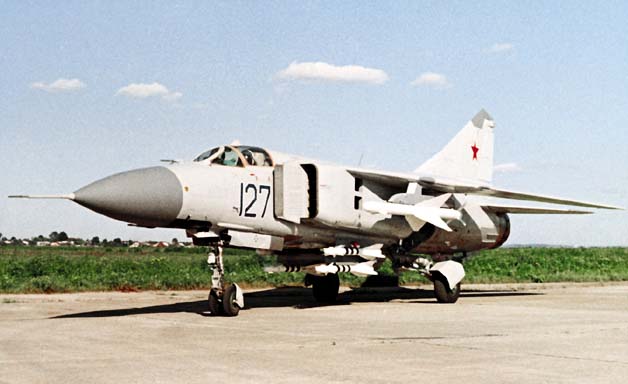
milmascarasWhen you do look into history, you have to do that in a serious way.
The F-111 was selected as the winner of the 1960 contest resulting from the formulation of the TFX requirement in Frebruary of that year.
First flight of F-111A Dec. 21, 1964“The MiG-23 silhouette emerged gradually. The OKB built an aircraft of a total different concept. It had a fixed delta wing, and its power ack included two lift jets ….. That aircraft was the 23-01. In the course of development, which started in 1964, OKB engineers quickly realized that the lift jets became dead load after takeoff and that the 23-01 was an uneconomical proposition. When the aircraft was almost completed, Mikoyan grew doubtful about the rationaity of the project. [Belyakov] The fourteen flights of the 23-01 and the sad end of the Balzac confirmed the pointlessness of the formula…. As soon as development was halted on the 23-01 VTOL, the highest priority was assigned to the 23-11 VG projet. In 1965 by decree of the ministry of aircraft production that detailed the main specifications: “The MiG OKB is commissioned to design and built a second prototype of the MiG-23 fitted with a high-lift variable geometry wing. …. The preliminary design was drawn up in short time, from January to March 1966.
The 23-11 went for its first flight on 10 April 1967.
On 9 July 1967 at Domodyedovo air show, Fedotov put on a remarkable demonstration of the 23-11 variable geometry aircraft. It was the prototype’s fourteenth flight.
The R-27F-300 reached its twenty-five hour life limit on the prototype’s forty-fifth flight. (What is ~33 minutes per test-flight.)
Tests resumed in January 1968 after the engine was replaced and the aircraft was equipped with the three-axis AP-155 autopilot. ….. The target was to get the MiG-23 as frontline fighter for the 70s.
The similar Dassault Mirage G had its first flight Nov. 18, 1967. The F1 with first flight Dec 23, 1966 offered similar performances without VG.
By the way, the F1 was offered Israel as replacement for the Mirage III and test-flown by Israeli pilots.
Not before the MiG-23M, the Flogger had become an useful interceptor. The MiG-23S delivered to Egypt, Syria and Libya in 1974 and were “look-a-like” at best. Saphir 21 radar from the MiG-21, R-3 AAMs and R-27 engine. Inferior to every ordinary F-4s.The Ye-155P high-altitude supersonic interceptor project was confirmed by a decree of the council of ministers in February 1962, when some design work had started in 1960 already.
The first flight of the MiG-25R1 was March 6, 1964, when the interceptor was 6 month later. The P was not certificated until 1970; it entered service with the VVS only in 1973, despite series production had started in 1969.
The MiG-25R protypes were shown at that Domodyedovo event in 1967 too.
Before that they had untertaken record flights as Ye-266 since 1965.
Both the MiG-23 and MiG-25 fighters did see frontline-service from the same time scale in the 70s. The fights from Cairo-West AB in 1971 were with MiG-25R/RB for recce-flights.The US FX study did start in the early 60s after the F-111 was choosen. In 1965 that get a boost by news from the SU and first experiences in Vietnam.
In 1968 the impact of the Domodyedovo revelations was felt and there was no shortage of different designs by several US producers. First choosen was Grumman F-14 in 1969 for the USN as replacement for the F-4, which had the first flight Dec. 21, 1970. The next turn for the Russians to follow.
We have to look everything into perspective and see everything with 1960s and 1970s eyes.
In 1974 Israel did not know if the newly delivered MiG-23MS were worse of better than the F-4, probably they had a good idea but not a complete idea of the MiG-23.
Like today we have no idea of the PAK FA which basicly can be a moden MiG-23 or a MiG-25.
The F-15s were not delivered in 1972 at least took four years for the US to deliver the first operational examples.
So only by the time the MiG-23ML was flown the first F-15s were delivered to the USAF.
The MiG-23ML was a stop gap between the MiG-23 and MiG-29.
You should always consider the arms race is a race where once the other sides builds something better to what you have you have to inmediately to start development of a new aircraft type that will be sooner or later surpassed by the competition and will make you again to design a even newer and more powerful aircraft and so on, there is no end to such race.
Basicly the Russians built the MiG-23 to fight F-105s, F-104s, F-4s, Mirage IIIs and as a technological response to the USAF`s needs for a variable geometry fighter in the form of a cheap soviet F-111sky.
The Americans responded with the F-15 and F-14 and much later with the F-16 and F-18, this prompted the development of the Su-27 and MiG-29 and the west then designed the Eurofighter, Rafale Gripen and F-22 to counter the MiG-29 and Su-27 threat.
Saddly for the Syrians or Iraqies, their fleets had mostly MiG-23s, when Israel or the allied anti Iraqi force in GWI had mostly F-15s and F-16s.
The MiG-23 had to fight a war with F-15s and F-16s not a war with F-105s or Mirage IIIs.
Israel never used the Kfir against the MiG-23 in air to air beyond its own self defence.
The USAF never used F-4s or F-104s to fight MiG-23s and the F-111 never was used to fight MiG-23s.
Russia did not sell the any MiG-31 or Su-27s in the 1980s and the first MiG-29s did not enter service in the Syrian air force first.
The only war where the MiG-23 showed to be more or less capable to deal with the F-16 was in the Soviet-Afghan war and perhaps in the Iraqi experiecne if we are to believe some historians, beyond that it showed what was expected from it.
But so far most likely the MiG-23 was in part unlucky to fight more advanced western fighters in the hands of less capable Middle eastern air forces however it does not mean it was defenseless or did not do a decent work.
milmascarasJust sticking to the “known facts”.
The F-15 was introduced in Israeli service in December 1976. The selection between the F-14A and F-15A had taken place in 1974.
The trigger to invest into the F-15A was the MiG-25 in Egypt, before the shortcomings of the MiG-25 were learned in full by the defection of Belenko in 1976.
When the F-4E was introduced into Israeli service in September 1969, its main role was a striker. Israeli name was Kurnass= ‘sledgehammer’.
The Israelis made the first requests for the F-4 or the A-6 in 1965 (Seen as replacement for SNCASO Vautour!). But the reduced A-4F was offered instead. In 1968 the renewed quest for F-4 did come through.
In 1975 Israel did look for the F-16 as replacement for the Mirage IIIC. (The Mirage F1 was seen as the natural replacement before!)
In 1978 a formal order was placed and it was agreed by the USA in 1979 as part of the Camp David peace accord. Israel did receive their first F-16s in July 1980 or two years earlier as planned. [ In 1982 the Mirage IIICs had reached 20 years of servicetime!] Because the political change in Iran 1979 did free the examples built for the Iran and that did went to Israel instead.
Without that turn of history, no Osirak-mission with F-16s in 1981!
With ~100 F-15/F-16 at hand in summer 1982 all the other types in Israeli service were kept for the Strike or CAS role. 1982 was a limited conflict for Syria and Israel, when the military experiences from that did rose general intrest. 😉
This is not correct, by 1967 the Soviet presented the MiG-25 and MiG-23 in a public display and in the Moscow`s air show.
Western intelligence knew by 1968 the Russians were already surpassing their projected super fighter F-111, the MiG-25 was faster and the MiG-23 was more agile, the F-4 was suffering versus MiG-21s even old MiG-17s, so the request for both the F-14 and F-15 was made in those late years of the 1960s.
In fact the Admiral Connelly admited publicly that by the late 1960s the F-4 had no edge versus the new breed of Soviet Fighters, the MiG-23 was a fighter and the US saw the F-111 had no chances against a MiG-23 in dogfights.
Specially since the first MiG-23 armed with AA-8s surpassed the early AIM-9Bs and AIM-9Cs and the AIM-9L came late in fact few years after the R-60s, in fact the AIM-9L came until 1978.
The MiG-23 appeared in middle eastern skies in early 1974 and Israel was sure the MiG-23 was at least as good as the MiG-21 and F-4.
the solution was a new fighter to take on the expected large numbers of MiG-23s and very high performance of the MiG-25s flying over Israel.
Israel used the F-4 then basicly as a bomber and recce aircraft since by 1973 SAMs and MiGs did make a toll on their F-4 fleet.
If Israel wanted to keep air superiority needed the F-15 and the F-16 and that was seen soon in 1974
milmascarasA classical example how misleading a simple comparison by some numbers can be. 😀
That does say nothing about the related speed, turning radius or surplus energy left, when doing so. Non pilot will work-up a full 360° circle for the statistic. Inst. is much more important at least when it is coupled with a spritely roll-rate.
At least that data did show, that it will never be a good idea to do a “knive-fight” with the MiG-29 in the “telefon-box”. Nothing new, see the F-6F Hellcat versus a Zero-fighter or a F-4 versus a MiG-21 about that, when the energy fight is the better option.
It is no classical example, they`re simply facts.
When they say Max means the aircraft will not do better, a F-15 won`t be better than a MiG-29 dogfighting in turn or roll, in fact if you were in a F-15 facing an MiG-29 in 1987 you would have a nasty surprise when the Su-27s would have covered the MiG-29s with an overwhelming amount of BVR weapons and making CAPs and scorts deep in enemy airspace.
However Historians always like to mention what they like and ommit what they do not.
In your case you have to acknowledge this.
the MiG-23 can fight F-15s in the same way an F-15 will do to MiG-29s.
The F-15 had always a gread advantage over these two types.
with the MiG-23 simply was overwhelmingly superior, it never faced MiG-23Ps guided by MiG-31s as Russia had in the early 1980s.
The F-15s basicly faced 1971 Soviet technology.
with the MiG-29 it was simply sheer numbers and AWACs what decided the battle but see the F-15 never faced MiG-23S or Fulcrum Cs and Su-27Bs with AWACS cover in equal numbers.
Was the F-15 lucky sure it was, it faced old russian fighters either MiG-23s or old and few MiG-29s.
The only looser in any war remember is truth it self.
There are many myths about many wars and most wars employ propaganda more than facts
milmascarasHave a look at the time line.
The MiG-23M was flown first 1972, so the time the F-15 had its first flight.
The -23M entered squadron service earlier, it equipped first squadrons from 1974ish on.
The -23ML was flown first in 1978. So after the YF-16, and at the time the F-16A Blk1 entered initial service.
At that time the F-4Es were slowly leaving front squadrons.The F-4 version of that day were slatted F-4Es, lighter F-4Fs and slatted F-4S. All with full pulse-doppler capability and second crew member, due to slats more maneuverable than the -23M and -23ML in most of the flight envelope (see my excerpt from F-4F flight manual).
Note that all F-4s were at the same time fully air2ground capable, actually that was their primary task after 1980.
Time line: R-73 entered service in mid 1980ies.
The initial MiG-29 didn’t really change the picture, the Iraqis for example were quite disappointed.
first MiG-23 prototype flew on 10 April 1967
the MiG-23A has its first flight in 1969, MiG-23 etalon 1971 followed and later the the MiG-23M in 1972.
The first F-15 flew on July 1972 a few days after the MiG-23M however they are not comparable the first MiG-23 belongs to 1967 and the first MiG-23ML flew in January 1975 almost a year after the first F-16 prototype.
The first MiG-29 flew in 6 October 1977, 5 years after the F-15.
Compare the F-15 to a MiG-29 or MiG-31 and you will see the Eagle yields more to the MiG-29 than the MiG-23 to the F-15.
Max Sustained turn rate for a F-4E is 14.7 deg/s at sea level
Max sustained turn rate for a MiG-23ML is 14.1 deg/s at 1000 meters
Max sustained turn rate for an F-15 16 deg/s
Max sustained turn rate for a MiG-29S 23deg/s
so see the F-15 is not very much better than a MiG-23.
Its main advantages were better weapons and a higher instantaneous turn rate of 21 deg/s versus the MiG-23ML`s 16.7 deg/s however see this detail the MiG-29 has a 28 deg/s instantaneous so Russia made a much better dogfighter with better weapons in 1977
milmascarasMax G-Load depends on gross weight, and the manual uses quite low flying weights. Additionally, it doesn’t use Mach number but indicated airspeed, which becomes quickly misleading.
The results for other wing sweeps are worse. In case of foward swept strict Mach and airspeed limits apply (so that it would only be useful up to M0.55 at 1000m altitude), and the 72° position makes sense from M.95 (or high airspeeds) onwards in level flight and M1.3 for maneuvering flight.
It does. The only thing I used a better computer! :diablo:
You talk about minimal differences and at the same time say “F-4” as if there were only one type. Which version is exactly where superior to which version of the other type?
F-4F versus MiG-23M: no chance for the MiG
F-4B versus MiG-23MLD: advantages for the MiGMy proficiency of Bulgarian is still in its infancy.
However, the graphs do not really look encouraging, looks more like a day spent at the local pub to be more promising.
My point the whole time is not the maximum range of the radar, a point much too overstressed, but the necessary effort to get good situational awareness via a radar (and the remaining time to do basic defensive duties).
Just have a look at this one:
http://www.habu2.net/vipers/viperpits/block05.front.jpg
The APG-66 was computer controlled multi mode radar, offering the pilot so much more information, even though the maximum range at altitude was limited (while the first indication of a Flogger normally would be the RWR screaming).
Tha manual does not use any misleading number, most graphs use half fuel and two R-24s and many are in Mach or km/h and they indicate speed and altitude, so misleading they are not.
The Bulgarian report is clear
The MiG-23MLD vs the F-4E
The MiG-23MLD surpases it most of the time except at speeds between 700km/h and 1000km at altitudes below 5000 meters.
It has a better radar and weapons.
The MiG-23 also surpasses the F-16s at top high speeds and altitudes.
It outclassed the Kfir except at speeds of 1000km/h to 1100km/h.
in General the MiG-23 was as good as the F-4 and late variants of MiG-23s were slightly superior.
So the MiG-23 an aircraft that first flew on 10 April 1967 was superior to the aircraft it supposed to beat: the Mirage III, F-105, F-104 and F-4
The F-5 outclassed the MiG-23M in agility.
If you want a proof see that Israel never used F-4s against Syrian MiG-23s.
in fact the introduction of the MiG-23 in the middle east forced the Israelies to get F-16s and F-15s
milmascarasWould be difficult if you don’t really get it yourself.
A good starter for you would be a feet-meter conversion factor and an idea how much … km/h indicated airspeed is as Mach number. Then you both posted graph easily show that you disproving yourself with the very graphs you posted (the MiG-23 makes 7g where the F-16 makes 9+).Funnily the F-16 has a advantage especially for transonic Mach numbers, with disadvantages in lower speed regions and the very high speed regions.
Transonic close combat was exactly the name of the game, and the F-16 can stay transonic while maneuvering.Good news at last!
If you have used the MiG-23ML you do know there is not G turn rate graph and no graph where yo can know the exact turn. If you know the MiG-23ML graphs and manual you know the MiG-23 can do 7.5Gs in level flight and as overG has shown you the max overload at max afterburner so there is no need to make a secondary graph as you`ve done.
Also the graph in the manual are not linear what holds in one speed does not necesarilly repeats it self in another wing sweep.
You did a good job trying to make the graph but definitively your data does not come from the manual but from your own assertions which can be true or not but which can not be used as a complete autyhority in fact if you use the turn radius graph of the MiG-23 manual you will know the MiG-23 is not inferior to the F-4 and as the MiG-23MLD combat manual says it has some superiority at higher speeds and heights.
also if you get the MiG-23MLD combat manual you will know the MiG-23 uses against early F-15s the beaming maneuvre blinding the early F-15s radars
read it http://krilebg.net/main/index.php?option=com_content&task=view&id=12&Itemid=34
It is not russian but bulgarian but it shows you things are not linear the F-16 had advantages in radar but not all the time and the same applies for weapons


 Sign In







