TinWing
Have you read nothing on the C1 concept? Some of the emphasis has shifted to land attack, with several options requiring a larger VLS than CAAM requires. Serious consideration is going into adding Tomahawk or SCALP-N.
I really don’t believe any “requirement” should be read too literally. In this case, it seems unlikely that the RN can afford a real land attack capability for the Type 26. Perhaps CAMM will come to fruition, as it is mostly a domestic make-work project, and if the timescales are to be believed, CAMM will replace the current Sea Wolf VL systems fitted to the Type 23s and then will be transplanted to the Type 26s.
TinWingExcept . . . that the first Type 26 is expected to enter service before any of our current T23s retire, & the first few T23s to retire are unlikely to get the updated systems. Allowing for the first batch receiving new weapons & radars, we’ll have to build more than 10 new frigates just to have hulls to transfer all the updated systems from the remaining T23s to.
Only 8 Type 23 frigates will have received the Type 2087 sonar, meaning that there is only a requirement for a total 8 Type 26 frigates as direct replacements.
In effect, the supposed requirement for 10 Type 26 hulls is a fiction, and no doubt, the intention is to “cut” the extra 2 hulls as a meaningless sacrifice to future budget pressures.
As far as the remaining 5 Type 23 frigates and 4 Type 22, these ships have effectively been reduced from the status of ASW escorts to general purpose patrol vessels, meaning that they would be replaced by C2, if at all.
TinWingI agree
For the type 26
I do not believe that VLS are greatly different from those used on the daring (history of having a certain commonality in the fleet). Simply, the VLS on type 26 will probably launch cruise missiles of British or European type.
Actually, it seem very clear that the Type 26 will feature only a very small VLS solely for the CAMM missile.
CAMM is the Sea Wolf replacement, and with quad packed cells, will require very little cubic capacity – so there’s no need for the large Sylver A50 VLS of the Type 45, let along a MK41 or A70 capable of accommodating cruise missiles.
The Type 26 is simply a new platform for updated Type 23 systems. That should be a hint that not even the RN believes there will be 10 Type 26s.
TinWingPeeDee you have to remember this is just the design costs. Looked at objectively why are we cutting a successful hull down?. High length to beam ratio is good for hull efficiency. Without the Sampson mast the hull wont need all that beam but a roomy hull is a good thing….you need more propulsive force to push a higher displacement hull…..but we have a good, economical, power plant available in T45’s IEP. So where is the problem in leaving the T45 hull as intact as possible and redesigning the stern module to incorporate this mission bay and an expanded hangar for a pair of Merlins or a Merlin and a couple of UAV’s?.
Why do we need to sustain 300 people for 5 years to redesign a hull that seems pretty well designed in the first place?. Is it for operational reasons or is it to keep 300 people in employment for 5 years?. I have no problem with the latter, I like the idea of the skills being maintained in-country very much, but let that £127mn come from the Dept of Work and Pensions budget and not the Defence budget!.
The Type 45 will have been out of production for some years by the time the first Type 26 in under construction. I suspect that a number of systems will be obsolete. For instance, the WR-21 is already obsolete, with the RN being the only likely customer and RR having shifted its efforts to the promotion of the MT30 some years ago.
It is also questionable whether current Type 45 is fully optimized as an ASW platform. Given the delays, downgrades and cost overruns, I wouldn’t be surprised if the basic Type 45 has a number of basic shortcoming that must be rectified for the Type 26.
Of course, the larger issue is the support of an entirely uncompetitive domestic shipbuilding sector that is very nearly dead from a strictly commercial perspective.
TinWingThere’s already a land-based version of Aster 30, called SAMP/T, & it has been bought by Italy & France. Currently, it uses an Arabel radar, but no doubt it could be adapted to use SAMPSON.
The same was said about PAAMS – and now the Type 45 has become an embarrassment of delays and cost overruns.
TinWingOk guys we dont really have a land based sub forum, but I wanted to ask something.
The Falklands have become a small issue again and some people question if 4 Typhoons are enough. I say more than but I wanted to ask about a change in set up on the island.
Every time I drive home to Portsmouth area I pass the Type 45 Sampson radar test site on portsdown hill. This is basically a exact copy of what is on the type 45’s used to test the radar and such.
Could we pack that up and put it on the falklands? With a land based cannister of Aster 30 missiles arent we pretty much saying you dont have a chance in hell of getting anywhere near us?
1. The British requirement for a land based, medium range SAM was canceled shortly after the end of the Cold War.
2. Even when the requirement existed, it seemed likely that a cheaper, non-European solution was preferred – a surface launched derivative of AMRAAM.
3. There isn’t any funding to revive such a requirement, there hasn’t been any funding and there won’t be.
4. It seems likely that there if there was a funded requirement, it would be for a more capable system such as PAC-3, although there is no need for such a system in the Falklands.
5. A British version of SAMP/T would most likely be even more expensive than the current Franco-Italian system, with even worse export prospects.
6. Adding SAMPSON to SAMP/T would be an expensive and problematic move, meaning that it would cost the UK taxpayers far more than buying an existing system.
TinWingIt isn’t hard to see the export potential for a cost effective C-RAM that’s been proven in real world conditions. Obviously, it’s easy enough to mount a naval CIWS on a flatbed truck, and that sort of gun based solution might be far more than an interim solution. There’s enough room in this emerging market for both the repurposed gun systems and an innovative, low cost missile based system.
Some posters are choosing to focus on a narrow application for Iron Dome, and it can’t be denied that there must be a domestic demand, driven by the events of recent years and ongoing concerns. That’s shouldn’t suggest that a C-RAM system of this sort wouldn’t be applicable to COIN warfare in larger coalition operations, or even for the point defense of static installations, both major and minor. We’re talking about a huge emerging market!!!
TinWingThe Super Tiger simply came along too late. To be sure, the J-79 was almost a generation more advanced than the J-57, but the J-65 was very poor engine indeed and ruined the credibility of the Tiger to begin with. Arguable, the Super Tiger seems to have had superior flight characteristics in comparison to the F-104, but Grumman had lost any opportunity for a USN sale, the F-104 might have been easier to manufacture overseas, and Grumman didn’t employ the same “sales techniques” as Lockheed. A few years later, there was a major scandal concerning how Lockheed managed to rack up all of those foreign sales……
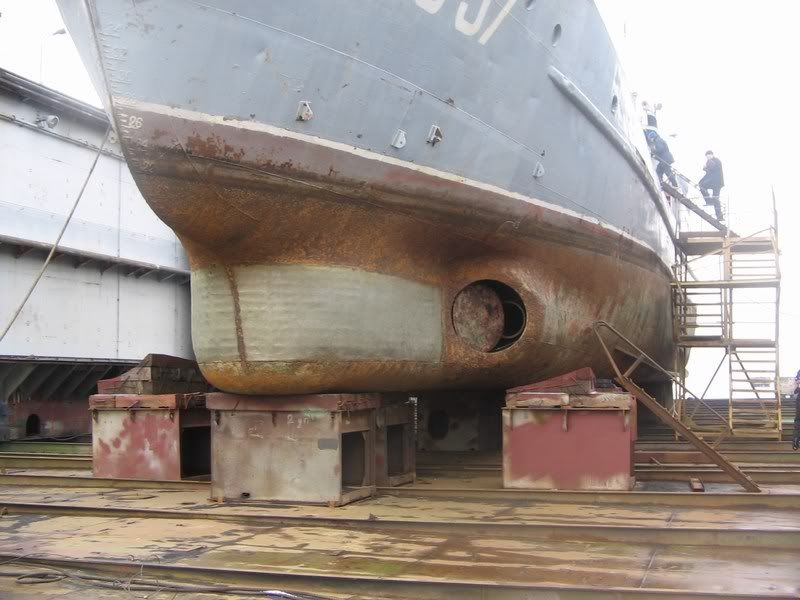
TinWingThe prime missile of Soviet AGI (Auxiliary General Intelligence) trawlers was to monitor USN submarine bases and carriers and perform electronic surveillance (SIGINT). Several hundred were deployed across the globe. During the cold war, AGI trawlers like these were also used to actually disrupt carrier flight operations. These torpedo tubes could fire conventional torpedoes, which could be used against an opposing force being shadowed at sea. However, they could also be used in or near ports, to covertly deploy naval spetsnaz forces [combat swimmers], or to deploy certain types of mines. The sonar housing contains an high frequency (active?) sonar in the 32khz – 45khz range.
Again, this appears to be a torpedo trials ship.
TinWingFolks,
Below is something that the US found out about those spy trawlers the Russians had that shadowed our carriers.
.
I thought this well known photo depicted a torpedo trials vessel? After all, any navy that develops torpedoes, or even a navy that simply has a stockpile of imported torpedoes, requires a trial vessel for purposes of weapons testing. The Dutch have a small surface ship with a similar underwater torpedo tube. The vessel in question is the submarine tender Mercuur, a ship which is undeniably an auxiliary, not a clandestine combatant.
Look back, the Soviets employed a large fleet of trawler-type AGIs for electronic surveillance, not as torpedo platforms.
Actually, that urban legend has long been debunked. The Soviets deployed trawler type AGIs for electronic surveillance, in much the same way that the USN deployed ships like the USS Liberty and Pueblo. I suspect that Soviet AGI’s were largely unarmed, much like their American counterparts.
TinWingRe-read what I posted, the current Gripen is rated for a much higher sink rate than other land-based fighters, and Saab IS planning to further strengthen the airframe, landing gear, and hook to allow for full carrier sink rates, impact forces, catapult or ramp take-offs, and arrested landings (the current hook is for the “field arresting gear” which allows it to stop in less than 800 meters on roads).
To repeat, the Gripen might be rated for a higher sink rate than other land based fighters, it might have a tailhook, and the existing flight dynamics are generally favorable, but it is a long way away from being a naval fighter. It’s pretty obvious that neither Saab or the Swedish government will fund these extensive modifications, and there aren’t very many potential launch customers.
So it doesn’t really matter all that much what Saab is “planning?”
In any case, a number of posters are overestimating the correlation between road based operational deployments and genuine carrier operations. For instance, Singapore regularly practices fighter operations from a stretch of highway with very conventional F-16s. I would imagine that most modern fighters could deploy to suitable stretches or motorway, and many types have emergency arrestor hooks. This is not especially unique.
TinWingNavalising the Hawk involved a major re-design in many areas. The Gripen, as the Saab press release says, is already designed for high controllability at slow speeds, high sink rates, low approach speeds etc. Seems to me that the Gripen is half way there, and the amount of work involved would actually be less than the Hawk required.
The big difference is the USN was funding the Goshawk and there was a 3-digit order. In contrast, Saab doesn’t have a launch customer, domestic or foreign, and even if they did, they might only have a launch order of a couple dozen – at best. On the face of it, the launch customer would be paying the development costs, which would be spread across a relatively limited number of units, making this a very expensive Gripen, perhaps more expensive than existing, proven carrier capable types – which defeats the whole purpose of the exercise.
The fact remains that while the Gripen might have suitable flight dynamics for a carrier landing, it can’t withstand the sink rate and isn’t current reinforced for either a tail-hook landing or a catapult launch. Saab estimates the weight penalty from carrier modifications to be 500kg, but it should be remembered that Saab doesn’t have any experience in this field.
TinWingHMS Edinburgh makes naval history as last of Type 42 destroyers to undergo upkeep period
HMS Edinburgh in dry dock, Portsmouth
HMS Edinburgh has entered the dry dock in Portsmouth for a major overhaul under a £17.5 million contract with BAE Systems. As the last of the Type 42 destroyers to undergo an upkeep period, the move marks the end of a successful maintenance schedule for the Class that began in 1979.
The 30 year old vessel will be returned to the fleet in October 2010 as a greener, more efficient ship and will sail on until 2013.
When were the bow bulwarks installed? Wouldn’t this feature have been of even more use with the shorter hulled Type 42 Batch I and II ships?
TinWingIt would be interesting, why the Kongo and Atago class have such high superstructures. They are probably two decks higher compared to the Arleigh Burke class.
Since the Japanese and Korean destroyers are wider than the Burke class, they probably have the stability to raise the AEGIS arrays to increase the radar horizon.
TinWingThe de Havilland Sea Venom was altogether superior, which explains the MN order. Putting aside the fact that the compound prop/jet fighter was a doomed concept, the lack of a suitable space for an air-to-air radar set would have precluded the night fighter role, the one role where an early straight wing jet could still compete against early swept wing types.


 Sign In