Which was the first?
Don’t let’s forget the Noratlas.
Which was the first twin boom transport? The C82 design dates from 1941 (first flight 1944), while the C119 and Noratlas were of 1947 vintage, although I think the C119 flew first (1947 as opposed to 1953 for the Noratlas). So was the C82 the first, or were there any earlier?
Laurence
The coroner seems to have got some details wrong: I doubt that the accident was due to the Meteor’s “bomb-bay” door not being “properly secured before take-off”.
It is interesting though that no wreckage, apart from that, or remains were found.
It would indeed be good to know if anything ever turned up.
Laurence
9 AFTS
Bonjour Anthony
9 AFTS was at Wellesbourne Mountford 1951-1954
Laurence
Dh115 at 115 ATC
Bonjour Avion!
Concerning ATC airframes: when I was in 115 Sqd ATC at RAF Peterborough (Westwood airfield), we had delivered to us in November 1963 Vampire T11
XE887 (DH115 – quite a fitting fate at 115 Sqd!).
I recall that it had Cranwell blue bands instead of the usual yellow training bands on the booms, but I have not found any reference to it having served at Cranwell. Maybe someone can advise.
I read that it had the maintenance serial 7824M allocated, but it did not carry it while I knew it.
It stood outside the Sqd hut for some years. I last heard of it being broken up at Beverley in 1973.
Anyone know its unit service?
Since 2004, 115 Sqd have had Canberra TT18 WK127 cockpit, after it was with 2484 ATC at Bassingbourn for a while.
http://www.bywat.co.uk/wk127.html
Transport Command “M” codes
Slightly off the Hastings thread, but relevant to the meaning of the “M” code:
Beverleys in the late 1950s – early 1960s used the M callsigns too. The last letter was the aircraft’s code, as displayed on the fuselage:
eg XL148 of 242OCU was MOBCY, coded Y
XB268 of 53 Sqd was MOBXD, coded D
XB284, also of the Abingdon group (53 or 47 Sqd), was MOBXH, coded H.
If I remember correctly the M code was on the instrument panel in front of the pilot, for RT use.
Laurence

You mentioned the Spitfire replica in Switzerland. As I live fairly close to Bex where it first flew it is (was ) of some interest to me. No-one seems to have mentioned that in fact its constructor Stéphane Haug was killed in it on 20 August 2005 at Dittingen.
If you do not know it, have a look at:
http://www.spitfires.ch/
It is in French and German: anyone needing any translation, please let me know.
It may seem a bit melodramatic to some, but it was posted by a grieving family. However, there are a lot of data of the building and flying of this replica.
Laurence
Yes, I think the KKH is clear. Also, I saw it at Tollerton in 1959. It was decorated in day-glo at that time!
Laurence
Mauld: what was the identity of the Messenger in “633 Sqd”?
Cesnna 170 panel
I still have the instrument panel, with all instruments, from a Cessna 170 I used to fly. Would anyone be interested?
Laurence
G-ALAW was also one that used to hang around Westwood, between 1952 and 1960, although not actually based there I think. It was red.
G-AJKL also flew around the same area: I saw it at RAF Upwood in 1954.
Messengers seem to have liked flying across to Le Zoute: in August 1959 when I saw G-AIEK there, there were also visits from G-AHZT, G-AIDK and G-AJFC, all three of which I also saw at Sywell the previous year. Another at Sywell was G-AKIR.
Laurence
I last saw G-AILL at the Biggin Air Fair in 1968.
Laurence
The Tipsy looks lovely too!
Laurence
Thanks for that low’n’slow. Funny, I saw G-AKIN at Sywell on 12 April 1958 the same day I saw G-AIEK there. Is your photo a recent one, maybe at Sywell?
HL
And Humphrey Lestocq actually flew Typhoons.
http://myweb.tiscali.co.uk/609photos/Gilbert.htm
A rare old Italian
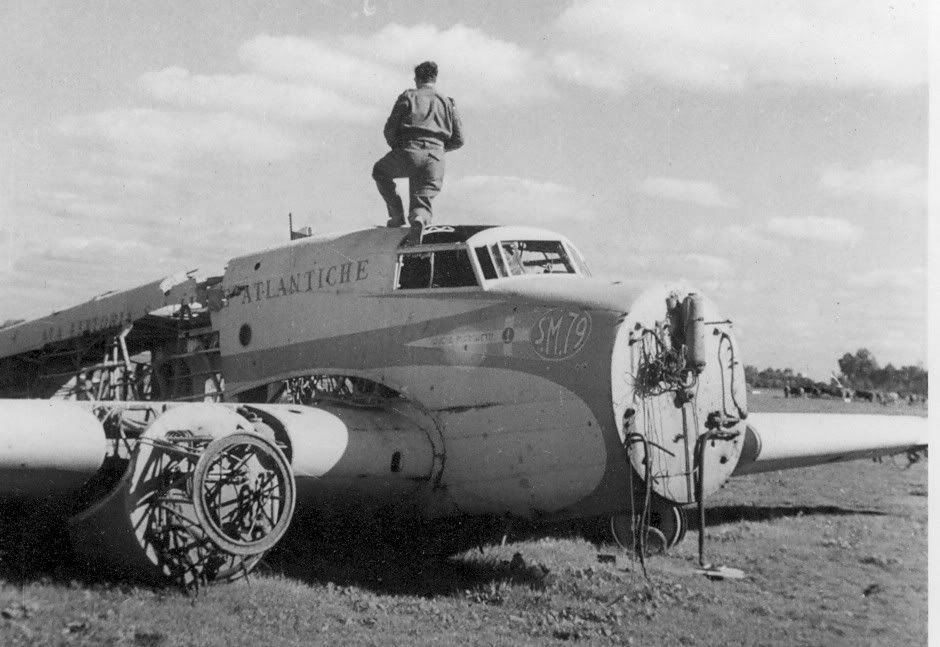
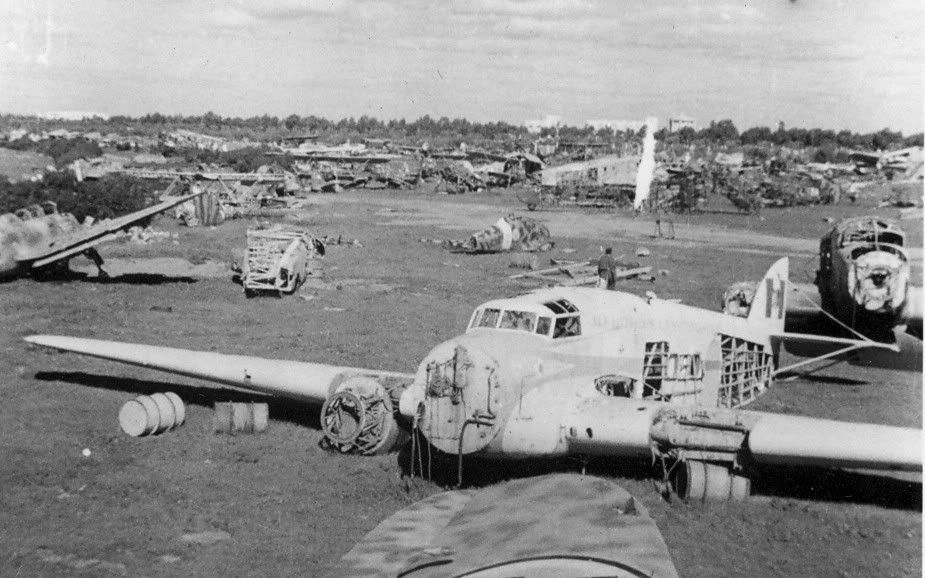
I wonder if these two pictures fit in this new thread. They are part of the collection that Tony Tubbenhauer took at Benghazi in 1943, and that we published on http://l.garey.googlepages.com/benghazigraveyard
Two views of an interesting SM79. This is not the usual hunchbacked bomber version, but an SM79T “Atlantici” of which three were used on the famous flight from Rome to Rio in January 1938. The wording on the fuselage is:
ALA LITTORIA S.A. LINEE ATLANTICHE
This is probably I-ALAN, used for regular flights between Italy and Brazil, mostly for mail. In May-June 1940 it was impressed in military service, still in civil markings, for flights in the Mediterranean area and to Abyssinia. On July 16 1940, en route to Abyssinia, it aborted take off at Benghazi and the undercarriage collapsed. British troops found the wreck in February 1941, and Tony found it still there in 1943 when flying Baltimores with 203 Sqd RAF.


Laurence Garey