 l.garey
Jim: Excellent pictures of the Meteors, Harvards and Spitfire at Middelkerke.
I put a couple on
http://l.garey.googlepages.com/aviationphotos
taken on 3/8/59 (scroll down to nearly the end). Not as nice as yours though.
The following were there on that date:
OO-GEU C45G
OO-GEW C45G US marks painted out in black. 51-11613
OO-GEX C45G US marks painted out in black. 51-11772
OO-GEM Harvard IIA (EX542)
OO-GEN Harvard IIA (EX371)
OO-GEP Harvard IIA ex H-45 “L17” (EX680)
OO-GEQ Harvard IIA (EX181)
EG-178 Meteor F8 (-OO-ARV)
EN-20, ND-H NF11 L7 on nose (WD596)
EN-23, ND-L NF11 L8 on nose (WM221)
OO-ARO NF11 EN-18, ND-F. (WD661)
OO-ARP NF11 EN-21, ND-J. (WD741)
OO-ARQ NF11 EN-16, ND-D. (WD594)
OO-ARR NF11 EN-2, KT-E. L1 on nose (WD775)
OO-ARS NF11 EN-6, KT-W. (WD730)
OO-ARW NF11 EN-5, KT-S. L2 on nose (WD729)
OO-ARX NF11 EN-11, KT-T. L3 on nose (WD735)
OO-ARE Spitfire HFIXc SM-36 just visible (NH238)
OO-ARA Spitfire LFIX SM-41 just visible (MH434, -G-ASJV)
OO-ARB Spitfire LFIX (MK297, -G-ASSD)
OO-ARC Spitfire LFIX SM-39 just visible (ex NH188)
OO-ARF Spitfire LFIX SM-37 just visible (MK923)
OO-ARD Spitfire LFIXb SM-40 just visible (MH415, -G-AVDJ)
l.gareyBeautiful, Richard! I shall put in on
http://l.garey.googlepages.com/benghazigraveyard
Thanks
l.gareyRecoveries from Libya
Not that I know of. I do not even know who cleared the “graveyard” and when. But the WW2 Italian and German experts on the forum might know.
l.gareyAirart: PM
Richard: I just sent you a PM
l.gareyThanks again Richard. Your web site is beautiful. I wish I could be transported back to Benghazi 1943, but I guess it might be too hot (from several points of view), and I would regret it.
Tony has a great collection of photos of that time, which he allowed me to use on my site. But he nearly always managed to stand in front of the serial of his planes! A great man.
I look forward to your next post!
Laurence
l.gareyThanks Richard. I should be very pleased if you can produce the colour picture you mention. If you do, with your permission, I shall add it to my web page.
So it was Squadriglia 351. Only the “51” appears in Tony’s photo but I believe 151 used the G50 also. It is good to know the story of the unit. I should also like to add this data to my site, if you do not mind, and I shall acknowledge your input.
Benghazi must have been an amazing place in 1943. What did you think about the “Atlantici”?
Laurence
l.gareyThe author
Quite right. He is not exactly known for his scientific reporting, although he has had programmes on the brain as well as science fiction, among many other subjects. What surprised me was to see it reported that he is a diver and pilot!
I have not seen the book yet, but one begins to wonder …
In the end, maybe this is not the last chapter of the St-Ex story. Perhaps he is enjoying what is turning out to be his literary come-back!
l.gareyDiverted thread
Sorry, just trying to clear up the fate of the Caudron that St-Ex liked so much and that nearly cost him his life ten years earlier.
By the way, the Geneva newspaper is also covering the Rippert story today, so they got their publicity alright.
l.gareyResponse tpo tangmere
Yes, the CUAS Chipmunks wore the famous “light blue” stripes, whereas we in OUAS had “dark blue” ones. I remember an interesting intermediate scheme between the old standard Chipmunk silver with yellow rear fuselage bands to the day-glo patch jobs. I was with Nottinghan UAS at Newton in 1960 and we had the “old” yellow bands replaced by day-glo paint, which extended to the fin. The only photo I have is one I posted last year on another thread of WD345 which was “doctored” by the RCAF boys from Langar one night. The only RAF Chipmunk with the maple leaf! At OUAS a year or so later, we had the day-glo patches, rather like the top photo in this thread, but rather variable in position and colour (yellowish or reddish).
Cranwell Chipmunks wore a green band instead of the yellow one.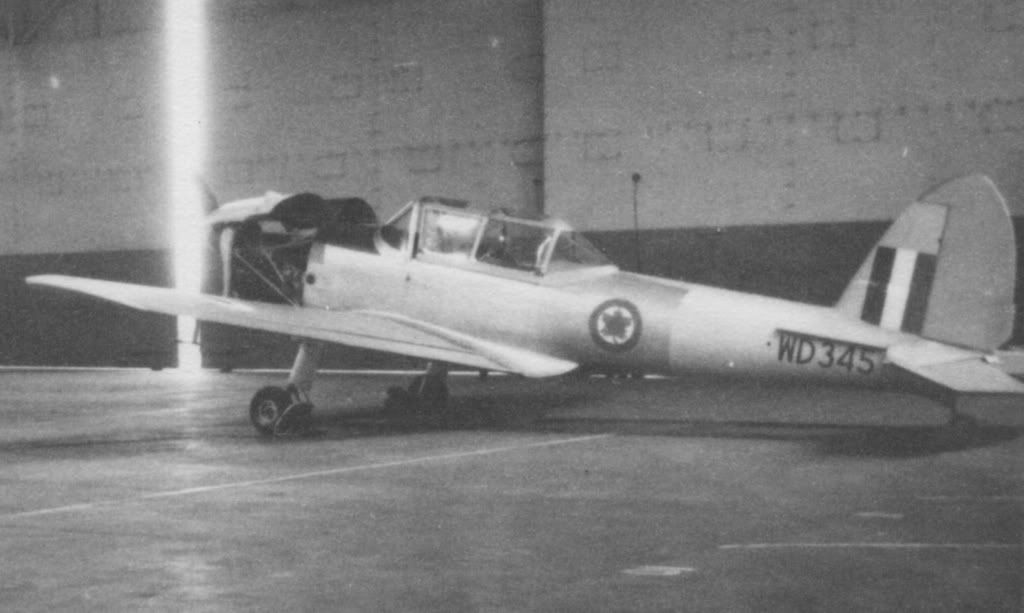
l.gareyOUAS livery
When I was in Oxford UAS at Bicester 1960-1963 ours were rather like that livery. Maybe not exactly as each unit varied a bit. They were stick-on panels of day-glo as I remember. OUAS had dark Oxford blue stripes along the fuselage too.
I shall try to find some pictures.
l.gareyT-21: Caudron again
And here is the translation of the article on the Simoun for T-21
Albert PROST has left us, with his Simoun…
Albert PROST, director of a hat company in ROANNE, was known in the world of historic aviation collections as the owner of the last flyable Caudron Simoun. He acquired the aircraft in 1974 in the USA and restored it with a mechanic, his friend Abel MOULS, and it flew again in 1977. The aircraft, cn7865, had been hangared after serving in the 1930s and early 1940s as the aircraft of the air attaché in the USA (F-ARCH). The restoration was particularly well done and brought this famous French plane of the 1930s back to its original condition.
Monsieur Albert PROST (left) and his mechanic Monsieur Abel MOULS pose in front of Caudron C 635 Simoun n° 7865 at the end of its restoration in 1977. Photo © Collection AviMag
Monsieur PROST had a passion for fine engineering and maintained this plane lovingly and flew regularly in spite of his 87 years. He was lost on Friday 6 September 2002 at the controls of his plane, after striking a meterological pole, in the fire that destroyed the Simoun near ROANNE aerodrome where he was based. Cocardes presents his family and friends our sincere condolences.
We thank Éric JANSONNE for information.
This is our forum’s own JANNSONNE. Merci Eric!
l.gareyF-AZAM accident report for T-21
T-21: here is the translation of the crash report on F-AZAM
Pilot – fatal, Aircraft – destroyed
Caudron C 635 “Simoun”,
Engine: Renault 6Q09 of 1937.
Friday 6 September 2002 at 0930
Private flight
Roanne aerodrome, France
Test flight after engine maintenance.
Persons on board: pilot
Licence and experience :
86 years old, PPL since 1955, 3219 hours of which 193 on type. None in previous 3 months
Met. at accident site: wind 030/10kt, visi 8 km, few at 3000 ft, temp 17C
The pilot, owner of the aircraft, took off to test the engine after numerous periods of maintenance. Ground witnesses saw the aircraft after take-off at about 300 feet turning left at a slight bank angle. It continued the turn descending gently until perpendicular to the runway heading. It collided with a meteorological pylon 8 m high, turned onto its back, crashed near the airfield and caught fire. The aircraft was destroyed by the fire.
Bearing in mind the damage resulting from the crash and fire, examination of the wreckage could only ascertain that the engine was delivering power and that the propellor was in coarse pitch. Witnesses who knew the pilot stated that he was in the habit of selecting coarse pitch for a few seconds after take-off to avoid overheating the engine.
The AFIS contoller on duty at the time of the accident stated that he received no messages from the pilot during the manoeuvres after take-off.
l.gareyI just saw this from Reuters:
Extracts of the book “Saint-Exupery: The Final Secret” were published in Le Figaro magazine over the weekend, and Le Figaro quoted Rippert as saying: “It’s me, I shot down Saint-Exupery.”
However, Rippert also said in the article that he could not be certain of the identity of the French pilot whose plane he shot down. He also hoped it was not the French author as he was a big fan of Saint-Exupery’s works.
So he is not saying it was St-Ex! Maybe he is being pushed into it. Good publicity for the book, I quite agree.
l.gareyThe Simoun of Albert Prost
T-21: another interesting site for the St Ex-Caudron-Prost saga:
http://www.cocardes.org/archive/articles.php?lng=fr&pg=78
l.gareyT-21: St Ex’s Caudron
I presume this is the Caudron to which you are referring:
http://www.airliners.net/search/photo.search?regsearch=F-AZAM&distinct_entry=true
The entry says:
F-AZAM Unfortunately F-AZAM crashed on September 06, 2002 killing her 86 years old pilot-owner. The aircraft has been destroyed by fire.
There is also the French accident report:
http://www.bea-fr.org/docspa/2002/f-am020906/htm/f-am020906.html
Do you need a translation?


 Sign In







