 fightingirish
Well, wait until next week!
With some paint you can make every woman, ah, I mean aircraft, look beautiful!!! 😀 😀 😀
fightingirishPower lim
Hi folks,
Global Hawk’s AE3007 engine is very power limited
We need the then the quantum nucleonic reactor powered Global Hawk !!! 😀
Go to the link:
http://www.popularmechanic.com/science/aviation/2004/5/atomic_wings/

Project managers for Northrop Grumman and the U.S. Air Force Research Laboratory tell POPULAR MECHANICS they have begun discussions that could lead to the conversion of a Global Hawk to a nuclear-powered aircraft.
With enough power, we will maybe soon see Global Hawks as AWACS and comucations aircrafts over cities!!!
Hope, the never fall down!!! 😮
fightingirish
fightingirishGripen-Movie
Just enjoying the Gripen – movie!!! 😀
http://www.gripen.com/4.195dd5bfa0ba32d1e7fff2705.html
Music reminds me of the Blockbuster “The Rock” with Sean Connery (ex-007) and Nicolas Cage!
fightingirishCan anybody post the specification of Gripen.
Go to:
http://www.flug-revue.rotor.com/FRTypen/FRJAS39.htm
I hope, this time the link works!
fightingirishBm-747
Hi folks,
for some information about the BM-747, go to the following link:
http://www.g2mil.com/bm747.htm
Here a pic from the link:
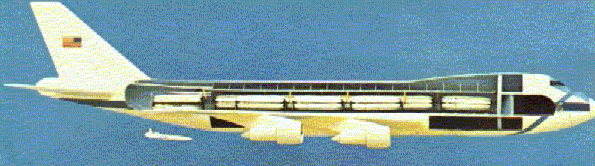
Why did the Air-Force not fight for this bomber?
It’s much cheaper than the SSGN-Ohio refits!
See you!
fightingirish
fightingirishSuper Darkstar ?!
do you realise that darkstar or a version of darkstar exists out there??
I thought that this project was doing well ,and it certainly wouldnt seem likley that a major aerospace company in this day and age would produce an aircraft like that with serious defficiencies, its one of the easiest to design!yes this went quiet very quickly, then a report in a mil av magazine mentioned that intelligence from an undisclosed aerial vehicle had been used for afghanistand and iraq…..darkstar was mentioned.
Source: http://www.spyflight.co.uk/DarkStar.HTM
Lockheed Martin-Boeing RQ-3A DarkStar
In the early 1990s, the USAF decided to integrate various Intelligence, Surveillance and Reconnaissance (ISR) systems to ensure that all US Forces would be provided with the appropriate information necessary to successfully conduct military operations. As part of this integration, the Defence Airborne Reconnaissance Office (DARO) issued a requirement for long endurance UAVs with reconnaissance, surveillance and target acquisition capabilities. This in turn led to the Defence Advanced Research Projects Agency (DARPA) overseeing development of a pair of complementary High Altitude Endurance (HAE) UAVs, under their policy of producing Advanced Concept Technology Demonstration (ACTD) versions of each design and then ensuring they perform as advertised. The two designs were the RQ-3A Darkstar, developed by Lockheed Martin & Boeing and the RQ-4A Global Hawk developed by Northrop Grumman – two different designs to meet specific mission criteria. Northrop Grumman’s relatively conventional UAV design enabled the Global Hawk to provide long range & endurance and carry a multi-sensor payload in a low –to-moderate threat environment.
However, Lockheed Martin developed a low-observable design, incorporating a considerable amount of stealth technology, enabling the UAV to operate in highly defended areas. The Lockheed Martin Skunk Works were responsible for building the fuselage and integrating the ReconOptical Electro-Optical (EO) sensor and various other sub-systems. Boeing were responsible for building the wings and avionics, as well as integrating the Westinghouse Synthetic Aperture Radar (SAR), a legacy from the US Navy’s cancelled A-12 programme, as well as the vehicle management system.
The DarkStar was designed to carry either the interchangeable SAR or EO sensor at altitudes above 45,000ft and 250kts, operating up to 500nms from its base for around 8 hrs and was powered by a single Williams-Rolls FJ44-1A turbofan engine – the same engine used in the Cessna Citation business jet. The digital SAR and EO systems enabled images to be transmitted in near real-time to a ground station or satellite. Designed to be fully autonomous and follow a programmed sortie, DarkStar could take off, fly to its assigned target area, transmit its sensor imagery, return to base and land without any human intervention. Nevertheless, if DarkStar was within line-of-sight of its ground station, it could be re-programmed in flight to alter course and direct its sensors at another target; beyond line-of-sight the ground station could remain in touch via a satellite link.
DarkStar first flew from Edwards AFB on 29 Mar 96, but then on its second flight on 22 Apr 96, due to a software fault in the flight control system, the vehicle developed uncontrollable oscillations after take-off, stalled nose high and crashed.. A second DarkStar first flew on 29 Jun 98 and during testing on 11 Jan 99 reached an altitude of 25,000ft on a 2hr 37 min sortie. The third and fourth DarkStar vehicles were completed when, because of budget cutbacks, the DoD cancelled the DarkStar programme in late Jan 99. The thinking behind the decision has never been explained, however, it was probably becoming apparent that the Global Hawk could meet every requirement for both programmes, apart from the need for stealth. Also, as Global Hawk would probably only ever operate within airspace in which the USAF had already gained air superiority, the requirement for low-observable technology was minimal.
To date, the DarkStar is probably the stealthiest UAV to have publicly flown, given the profile of the vehicle, the radar cross-section would have been extremely small and would have enabled the DarkStar to operate with virtual impunity in the most hostile airspace, whilst sending back crystal-clear images to its ground station. However, DARPA realised the value of such a UAV and have developed and flown other stealthy UAVs as well as instigating a concept programme to develop a revolutionary UAV named SensorCraft. Indeed, some well informed commentators have even suggested that, rather than actually being cancelled, the DarkStar programme simply dissappeared into a ‘black’ project and that the the DarkStar was a small-scale ‘Technology demonstrator’, in the same mould as the ‘Have Blue’ flying prototype that proved the concept of the much larger F-117, of a much larger, very stealthy, UAV. Whether this is the case and also whether the larger, more developed version actually operated over Iraq during ‘Operation Iraqi Freedom’ will hopefully be answered at some future date.
The only surviving DarkStar to have flown is now preserved in the USAF Museum.
Source:http://www.spyflight.co.uk/Latest%20News.HTM#Superdarkstar
Super DarkStar?
Although the stealthy Darkstar UAV was cancelled back in Feb 99, there have been persistent reports that, as part of a ‘black’ programme, a larger derivative of this UAV was developed by Lockheed Martin and has been used in operations over Iraq. These rumours have been given added strength by the apparent inability of current UAVs to meet a long-standing USAF requirement for a very low observable, high-altitude UAV that can fly 1,000nm to a target area, penetrate a modern air defence system, loiter for at least 8hr and then return to base.
Although the first Darkstar crashed during a test flight on 22 Apr 96, the second Darkstar was modified and flew successfully, later reaching 25,000ft on a 2hr 37 min test flight. Undoubtedly, some problems had been encountered during the development programme with the flight control system, the command & control system and the stealthy apertures, but these could almost have been expected during the development cycle of such an advanced UAV and were effectively cured. So if these problems had been overcome it seems odd for the programme to be have been cancelled, when the requirement remained extant and these doubts have fed persistent rumours of a follow-on programme.
Little if anything has been said by Lockheed Martin about the new ‘Super Darkstar’ or whatever name it has been given, other than the tacit admission recently by some well placed individuals from Lockheed Martin that the vehicle exists and has been used successfully in operations. They also confirmed that, whilst it cannot carry the same payload as a U-2S, it nevertheless is capable of carrying an LPI synthetic aperture radar as well as infra-red and electro-optical sensors. A number of U-2S pilots reported seeing an unknown high-flying vehicle, operating at or above the height of their own aircraft, whilst flying over Iraq.[…]
There was an article in AirInternational last year !!!
[…]Lockheed Martin will probably attempt to keep this new UAV out of the limelight for as long as possible. Presumably the USAF have been willing to pay considerably more for this vehicle, compared to the non-stealthy Northrop Grumman Global Hawk, because of its capability to penetrate highly defended airspace undetected and the quality of intelligence it provided
.
Source: http://www.spyflight.co.uk/Sensorcraft.HTM
SensorCraft
The USAF has learnt, through sometimes bitter experience, that however good a design looks on paper, it’s only by actually building, flying and thoroughly testing a design that its true capability can be determined. In recent years this practice has been used to good effect for a number of manned aircraft was also used in the development of the Dark Star and Global Hawk UAVs. Even though the Global Hawk has just begun full-scale production and entry into service and the Dark Star has evolved into a larger ‘black’ UAV, the Air Vehicles Directorate element of the Air Force Research Laboratory (AFRL) at Wright-Patterson Air Force Base, Ohio has already begun developing the concept of a next-generation advanced UAV to replace these vehicles.
Throughout the remainder of this decade the AFRL will investigate a wide variety of the latest sensors, communications links, air vehicle components and propulsion systems and consider how they can all be incorporated into the concept of a next generation long-range high-altitude ISR UAV – known as SensorCraft. When and if it finally enters service, this cutting-edge vehicle will carry an integrated mix of radar, cameras, ELINT equipment and data links, whilst orbiting a battlefield at 65,000ft for between 60-80hrs at around 350kts, gathering intelligence and passing it onto supporting elements in near real-time.
For the design of SensorCraft the traditional design process has been reversed. In previous UAV designs the vehicle has been constructed and then the sensors have been incorporated into the available space. In SensorCraft the optimum mix of sensors will be determined and then the vehicle design moulded around the systems, with sensor apertures embedded in the fuselage as necessary. This unusual approach to UAV design has already resulted in some radical proposals; in particular, a diamond shaped structure that would facilitate sensor coverage. Another proposal is for a flying-wing design, not dissimilar to the B-2 Spirit stealth bomber along with a large U-2 style design with a 200ft wing-span and an endurance of 60hrs.
Particular attention is being paid to the sensors planned for this UAV and they will probably operate on a wide variety of frequencies, such as VHF to allow foliage penetration and X-band for improved image resolution, as well as hyperspectral and passive sensors. There’s even as possibility that the vehicle will be able to operate in a bistatic mode, allowing for passive operations, and be equipped with active countermeasures. As technology advances, this next generation Global Hawk could well have a combined Air and Ground Moving Target Indicator (AGMTI) built into an Active Electronically Scanned Array (AESA) giving it the air-to-air capability of an E-3D AWACS together with the air-to-ground function of the E-8 JSTARS.
The SensorCraft concept will allow the ARFL to establish how evolving technologies develop and enable the programme to determine if they can eventually mature into a viable UAV. The ARFL aim to launch an aircraft programme around 2010 and the eventual system could enter service around 2020
Hi folks,
visit also the links for the pic’s! 🙂 🙂 🙂
fightingirish
fightingirishIs Stealth sexY?
found from the USN webpages…
For higher resolution, go to the following link:
http://www.news.navy.mil/view_gallery.asp?category_id=26
Also, looks like a variable geometry wing with the hinge in the rear a la the fictional Switchblade. You can see the wing deployed on the second and third pic.
Link Switchblade:
http://www.area51zone.com/aircraft/switchblade.shtml
Question 1:
Does this aircraft show any navy or air force labels?
Or only a Reset-Button? 😀
Edit: The aircraft may be part of a new combined navy – air force!!!
Question 2:
That silver thing in the front of the cockpit looks like a IRST, or maybe the robots eye like “2001” or R2D2 in Star Wars?
Question 3:
What is more sexy? :confused: 😉
The aircraft – or Jessica Biel ?! 😀 😀 😀
fightingirish
fightingirishcome on guys, the greek don’t need a new trainer, they just beat Portugal! 😉
Well the Greek history is full of acts of God weather it be Athena or one of the lesser Gods.
Yes, with a German “trainer”!
Not the Mako, his name is “Koenig” (King) Otto Rehagel! 😀 😀
fightingirish
fightingirishhi folks,
thanks Kenneth for pic’s! It has nearly been 10 years ago, when I visited “Flugwerft Schleißheim”. That time it was newly open.
Quote:
I don’t suppose you know what the missile/launch vehicle is in the background of the jet row photo is ?Looks like a Europa rocket from the 60’s.
Yes, as I am just reading in the museum guide (in German only!!! 😡 ), that missile/launch vehicle is the Europa rocket F-15 from the 60’s/70’s.
More info over the Europa rocket F-15:
Link: http://www.univ-perp.fr/fuseurop/europa_e.htm
Link “Flugwerft Schleißheim”:
http://www.deutsches-museum.de/e_index.htm
Only some pages are in English!!! 😡
But I recommend the page “Aeroplane restoration – A workshop made of glass”:
http://www.deutsches-museum.de/zweig/werft/e_rest.htm
Kenneth, hoped you enjoyed your visit in Munich!
fightingirish
fightingirishFair Strike
Hi folks,
I was just reading the newest issue of the german magazine “Flug-Revue”, when I saw an article of the helosim “Fair Strike”:
http://www.fair-strike.com/
Has anyone played this game yet & how good/bad it is? :confused:
You can fly the Ka-58 “Black Ghost” the “Comanchski” in the “Hokum” family! 😀
Was this helocopter a real study by Kamow or a model dream like the Mig-37 “Ferret” or F-19 “Ghostrider” ?
Here some facts and pic’s: 😎
Ka-58 Black Ghost
The newest “invisible” Russian helicopter, manufactured using stealth technology. At the same time, the use of composed materials and a concealed weapons mount improves the helicopter’s responsiveness, and the use of an internal mount and shortened external pylons makes it possible to carry on board about two metric tons of weapons, including a guided ground missile system, air-to-ground rocket launcher, and anti-aircraft missile systems.The helicopter differs from previous models by its higher maximum speed, its precision aiming equipment for its on-board artillery system, and its increased maneuverability and responsiveness. Maximum speed is achieved when the external pylons for hung equipment are removed.
Weaponry (6 mounts, 2 of them internal):
– built-in 30mm 2A42M cannon
– Vikhr guided anti-tank rocket
– Igla-V rocket launcher
– Kh-29T rocket launcher
– S-8 unguided folding-fin rocket
Thanks for your answers!!!
fightingirish
fightingirishEurofighter Typhoon: Operation Icebreaker
Hi folks,
I wonder, why the British in the beginning did not build the Harrier Gr.5-9 with the Blue Vixen radar instead of the Sea Harrier FA2 ??? :confused:
F-35C well, maybe Europe will see one day some Nimitz-class in British colours ?
Mabye not in British colours, maybye in European colours!
Carrier built by French and British, based in Italy (short route to the middle east!!!) and a multi-national squadron on board flying the Sea Typhoon. 😀
If failure of the JSF, many other European nations like Norway, Denmark or the Netherlands will buy the Typhoon.
Just like the great flightsim:
Eurofighter Typhoon: Operation Icebreaker !!! 😀 😀
Just a wet, I mean, a Navy dream 😀 😀 –
but why not vote for it on Sunday (The european parliment elections) !!!
Good night!!!
fightingirish
fightingirish1. EF 140
2. IL- 215 (“bicycle” landing gear configuration test bed!)
3. EF 150
4. Ju 287
5. Early version EF 150
And some more pic’s:
6. EF 140
7. First German passenger jet “152” (also called “Baade 152”)
8. EF 150
9. HFB 320 Hansa Jet D-CHFB before the first flight
So, hope you all enjoy the part of german-russian aviation history! 🙂
See you,
fightingirish
fightingirishJunkers engineers in the USSR
Hi folks, hi Ja Worsley,
after WW II. Wocke, Baade and a lot of other Junkers engineers and technics were forced to work for several years in the Soviet Union where they developed several military jets.
The OKB-1 EF 140 was a prototype aircraft developed in the Soviet Union originally conceived as a bomber, but later considered as a reconnaissance machine. The aircraft was a follow-on from the Junkers Ju 287 bomber prototype, but while it used the same basic layout and engineering concepts, it was an entirely new design by Brunolf Baade.
Only one EF 140 was actually built, and began flight tests on March 15 1949, using Rolls-Royce Nene engines as the intended Mikulin units were not yet ready. The project was cancelled before the second prototype was complete.
Baade and his team developed at the OKB from S.M. Alexejew then in 1948 the OKB-1 EF 150 as a bomber. It didn’t have forward-swept wings anymore, because the sucess of back-swept wings (35°) . It had 2 engines, Ljulka AL-5 with 2*5000 kp, on pylons under the wings (80°) and a “bicycle” landing gear configuration ( just like the Boeing B-47 😀 ). This gear configuratin was tested on the the experimentel fighter IL-215.
Construction began in 1951 of the first prototype, which flew first on the 05.Oktober 1952 in Lu-chowitzy. Until April 1953 EF-150 flew 16 times. It had problems with landing gear and brakes configuration. On 09.Mai 1953, during landings trails the brake parachute suddenly opened so the fuselage, engines and gears got heavily dameged. At that time there was competion between the OKB’s in the USSR. The IL-28 “Beagle” first flew 1950, the TU-88, aka Tu-16 “Badger” first flew in winter 1953, so they had no need for the EF-150.The plane EF-150 was eventually scrapped.
Wocke and Baade returned to Germany from 1950 to 1954 and took part in the development of the East-German aeronautics industry. As chief developer of the VEB Flugzeugwerft Dresden Hans Wocke was involved in the construction of the first German passenger jet “152” (also called “Baade 152”).
But in 1957 Wocke went to West-Germany (before the first flight of the “152” in 1958), where he came to the Hamburger Flugzeugbau (HFB). The design of HansaJet was started in March 1961. It was intended primarily as a 6/11-seat executive transport, but was projected also as 12-passenger feeder-liner and for a variety of military duties. The prototype of the HFB 320 Hansa Jet reg. D-CHFB took off for first flight at Hamburg-Finkenwerder by Loren William Davis and H. Bardill on April 21st, 1964. The flight lasted for 73 minutes and went to Bremen-Lemwerder. The first deliv-ery to a customer was to General Air of Hamburg in March 1968. Two prototypes and 45 aircraft were produced.
Here some facts over OKB-1 EF 140
Description
Role Bomber/reconnaisance prototype
Crew: 3
Dimensions
Length 19.70m 63′
Wingspan 19.40m 62′ 1″
Height 5.70m 18′ 3″
Wing area 58.4m² 627ft²
Weights
Empty 12,500kg 27,500 lb
Loaded 24,500kg 53,900 lb
Maximum take-off 27,000kg 59,400 lb
Powerplant
Engines 2x Mikulin AM-01 turbojets
Power 68.7kN 15,400 lb
Performance
Maximum speed 1,230km/h 767 mph
Range 2,500km 1,558 miles
Service ceiling 12,300m 40,000ft
Rate of Climb
Armament
Guns 4x 23mm machine guns
in 2 remotely-controlled turrets
Bombs None
production version was to carry
4,500kg (9,900 lbs)
The facts of the EF-150 I have only found in russian: 😡
http://legion.wplus.net/guide/air/b/150.shtml
Facts over the Baade 152 or HansaJet, just google around! 😉
And, at last, some pic’s:
fightingirish😀 I forgot some facts: 😮
Junkers Ju 287 V1
Description
Role Bomber prototype
Crew two, pilot and co-pilot
Dimensions
Length 18.30m 60′
Wingspan 20.11m 65′ 11″
Height 4.70m 15′
Wing area 61m² 655ft²
Weights
Empty 12,500kg 27,500 lb
Loaded 20,000kg 44,000 lb
Maximum take-off ???
Powerplant
Engines 4x Junkers Jumo 004B-1 turbojets
Power 35.3kN 8,182 lb
Performance
Maximum speed 560km/h 348 mph
Range 980km 1570 miles
Service ceiling 9,400m 30,000ft
Rate of Climb 575m/min 1,840ft/min
Armament
Guns None
production version was to have
2x 13mm MG 131 machine guns
in tail turret
Bombs None
production version was to carry
4,000kg (8,800 lbs)
Anyway, it is the big ugly grandfather of the Grumman X-29, HansaJet and Su-47! 😀
fightingirish
fightingirishForward swept wing Bomber!
The Junkers Ju 287 was a flying testbed built to develop the technology required for a multi-engined jet bomber aircraft. It was powered by four Junkers Jumo 004 engines, featured a revolutionary swept forward wing and was built largely from scavenged components from other aircraft. The flying prototype and an unfinished second prototype were captured by the Red Army in the closing stages of World War II and the design was further developed in the Soviet Union after the end of the conflict.
The Ju 287 was intended to provide the Luftwaffe with a bomber that could avoid interception by outrunning enemy fighters. The swept-forward wing was suggested by the project’s head designer, Dr Hans Wocke as a way of providing extra lift at low airspeeds – necessary because of the poor responsiveness of early turbojets at the vulnerable times of take-off and landing. The first prototype was intended to evaluate the concept, and was cobbled together from the fuselage of a Heinkel He 177, the tail of a Junkers Ju 388, main undercarriage from a Junkers Ju 352, and nosewheels taken from crashed B-24 Liberators. Two of the Jumo 004 engines were hung under the wings, with the other two mounted in nacelles added to the sides of the forward fuselage.
Flight tests began on August 16 1944, with the aircraft displaying extremely good handling characteristics, as well as revealing some of the problems of the forward-swept wing under some flight conditions. Tests also suggested that the aircraft would benefit from concentrating more engine mass under the wings, a feature that was to be incorporated on the subsequent prototypes. These were to have been powered by Heinkel HeS.11 engines, but because of the development problems experienced with that motor, the BMW 003 was selected in its place. The second and third prototypes were to have six of these engines, the former with a cluster of three under each wing, the latter with two under each wing and one on each side of the fuselage, as the first prototype had. These machines were to have all-new, purpose designed fuselages, and the third prototype was also to carry armament and serve as the development aircraft for a production version.
Before the second prototype was complete, though, the Junkers factory was over-run. Wocke and his staff, along with the two prototype aircraft, were taken to the Soviet Union. There, the second prototype (returned to its original Junkers in-house designation, EF-131) was eventually finished and flown on May 23 1947, but by that time, jet development had already overtaken the Ju 287. A final much-enlarged derivative, the OKB-1 EF 140 was tested in prototype form in 1949 but soon abandoned.
For more information about “Secret Weapons of the Luftwaffe”, I recommend following link:
http://www.luft46.com/ 😉 😀
fightingirish


 Sign In







