Flying_Pencil
The thing with spraying is that unless you get 100% coverage of all the parts it will continue to corrode no matter what ! Whilst its possibly more time consuming to break it down into smaller components and physically clean and treat each item by hand would probably be quicker in the long term and more cost effective. There are going to areas in the airframe where to stand a chance of stopping the corrosion it will need derivetting.
If it makes you feel better, I will gladly get a garden hose and spend hours on end making sure each crevices is properly washed, every day.
😀
Flying_PencilIt occurred to me that more important then the spraying is monitoring of the treatment.
Soaking it may not be needed, keeping it wet might suffice.
Flying_PencilFirst, the data plate in question came, I think, from the wing/fuselage fillet section and is sub-assembly plate from a section of the airframe manufactured under licence from Henschel AG.
It shows us the drawing number (Zeichnung Nummer) and order number (Bestellen Nummer) for this part and that it is for a Dornier 17-Z. I do not believe that this data plate has any relevance to the supposed identity W.Nr 1160. I have three identitcal data plates from Do 17Z aircraft lost over Britain in 1940. None of them bear any number or inscription that relates to the identity of the aircraft.
I agree that the article for which Xtangomike supplies a link tells us that a data plate confirming 1160 has been found on the fuselage. The associated photograph rather implies that the data plate illustrated is the data plate that confirms the identity. I do not think this can possibly be the case, and if a data plate has been found that confirms 1160 then we have not yet seen an image of it.
I would also add that Chris Goss, who has been acting as historical adviser to RAFM posted on Friday:
“Latest update: Most of the dismantling is complete and it will be moved to Cosford soon. Still no positive proof but they are still hunting for the evidence that this was 5K+AR so whatever you read in the Press in the coming days:
1. It is still not definitely 5K+AR
2. It was not definitely shot down by Desmond Hughes of 264 Sqn
3. It was not attacking Debden but Manston.
4. There is no evidence that they got lost in cloud as if you stand in the harbour at Ramsgate, the target is behind you and you could see where the planed ended up! The captured crew probably spun a yarn to their interrogators (who wouldn’t!)
5. Any photo showing 3 crewmen (one has an eye patch) in front of a Do 17’s nose does not show Effmert on the left but Willi Lüder who transferred to KG 28 and then 4/LG 1 and was taken POW 15 Aug 40 (one of the perils of illegally lifting photos from one of my books!)
6. There is no evidence that any of the crew baled out but what we can say is the pilot was still on board when it landed on the sea.
7. Correct me if I am wrong but Ste Trond was not changed to Ste Truiden after the war-it has always had the French and Flemmish names?More to come!”
…
GREAT job keeping the facts in order, Andy!
Cant wait to see that “more”!
Flying_PencilSo the options remain:
– Flipped during landing
– Tidal / sea action washing it off the bank and turning over in deeper water
– Sand movement action over time
– Military towing/dragging the wreck into deeper water
Either way, it now seems 5K+AR ended up, “inverted”.
Regards
Mark Pilkington
Mark,
I believe the 17 made a belly landing, and as “Sandy” sank flipped on her back.
An 88 and 111 pulled from Norwegian lakes where on their backs, even though they sank thought the ice level.
The idea of the wing tip hitting water making it spin and flip would cause a lot of damage, and Sandy is pretty well intact.
Still, examining the remains could prove otherwise.
Flying_PencilNo word.
The picture on this site is amazing!
New desktop!
Flying_PencilJust had a thought….are there any traces of paint left on the underside?? Would love to chat some more about my DO17 relic and Hellblau!!!! 😉
Uh oh….
:p
Flying_PencilIn case people didn’t catch it, yes I AM happy it is recovered.
I had high hopes looking at the Plan A cage the recovery would be more successful.
Flying_PencilA technical report to my fellow historic aviation buffs here:
The Do-17 was built in basically 3 large pieces.
1. The fuselage from nose to tail was one continuous piece, built that way, no splits.
2. The wing is also one piece, from tip to tip. The fact it broke just past the #1 engine was due to damage.
3. Horizontal tail also one piece.
The entire Do-17 series was designed to fit on two 18m long rail carriages for transport.
Good question – even if the upper surfaces have survived in better condition due to inversion, the shoulder wing surely makes more difficult any prospect of “righting” the aircraft for display, as it would compress the fragile fuselage unless some intrusive supporting structure were introduced? I wonder if it will be displayed in a pseudo underwater diorama in the way that the FAAM dealt with the Skua : http://forum.planetalk.net/viewtopic.php?p=53814
Tim
Yes, that is good question, left for a later date (after cleaning).
But consider any aircraft, what is the best way to display, say a Spitfire? Sure it can be propped on the ground, but you do not get the full grace of it.
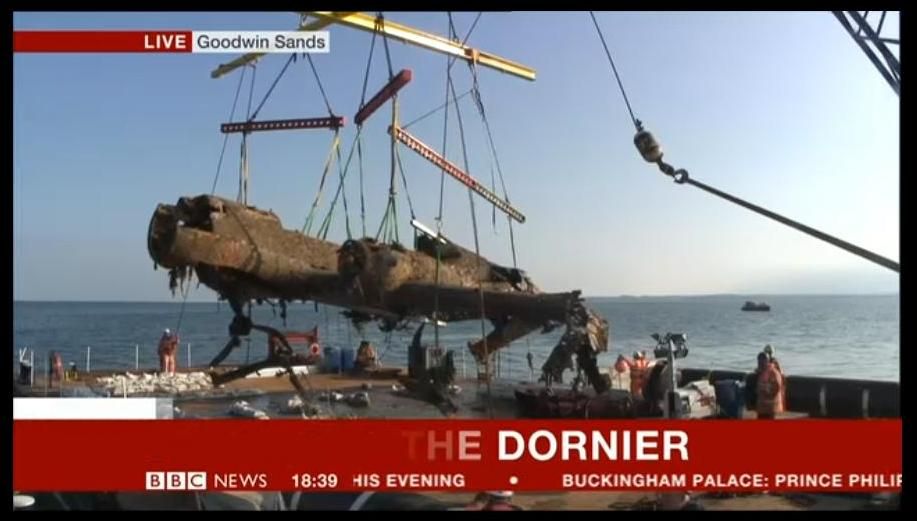
Flying_Pencil[ATTACH=CONFIG]217529[/ATTACH]
http://www.dailymail.co.uk/news/article-2339105/Back-deep–600-000-rescue-operation-lifts-German-bomber-Channel-bed.html
YE GADS!
No wonder the tail was broken like it was!
It is an after the fact image, but I am pretty sure anyone seeing the setup would say the rear needed better support.
Flying_PencilI told Ian to be concered about the rear fuselage, found lots of pictures to suggest that was major weakpoint
(EDIT seeing picture below, it was more then that point, it was the method of attaching it)
It looks like this was a plan B attempt, so I guess it could not be helped.
(yes, only just discovered about it here in good new USA).
I am happy it is out.
Completely expected its condition, still a bit shocked looking at it.
Still, once the encrustation is removed it will look better.
Flying_PencilIf you visited sites that deal with crew training, that is one way you would receive such advertising.
Difficult to remove watermarks will make it hard to steal the image, and you can also sue the one using it, although it may be hard in this global world.
Flying_PencilTo be safe embed watermarks or text into photos?
I guess you need to be a bit aggressive so it will not be removed.
Flying_PencilTo the best of my knowledge there is nothing in any Air Intelligence ‘K’ Report relating to the two POWs taken from what isBut reasonable supposition would surely support the suggestion that it entered the water in level flight, perhaps slightly tail-down, and then sank before settling onto the sea bed on its back.
I agree with you Andy.
2 other sunken LW bombers ended up on their back despite entering the water level.
Many films of ditching aircraft show a nose-low, tail high attitude, eventually sinking straight down, hit the floor, and then pushed over by currents. The sonar images show clearly defined wingtips, which would be unlikely if the tip hit and then flipped over.
Will see more clues when it is pulled out.
Flying_PencilI would think it will be ‘conservation’ and ‘preservation’ not ‘restoration’
Agree.
Look at other salt water aircraft condition, the level of deterioration is tantamount to building new.
How this aircraft got to be on its back is pure supposition as already stated. The actual ditching process is influenced by so many factors, speed of touchdown being one, slow means high AoA and the rear fuselage strikes the water first and might break off, a faster touch down gives a flatter angle but more stored energy to lose and any weak point (glazed nose) is a potential scoop that could fill the fuselage with water in seconds. Dipping a wing tip in first will result in a violent rotation(again possibly breaking the tail off) which may or may not help survival, more help in the case of high winged aircraft which turn upside down if ditched straight ahead. Add to all of this the wave state, wind strength/direction, crew incapacitation, control difficulty due to damage and visibility then anything could have happened. I desperately hope that when it is eventually turned the right way up the upper surface is in a good state of preservation, fingers crssed.
Richard
Well, Richard, a fresh water recover showed the worst corrosion where the skin was in contact with sediment/mud.
I only hope with salt water and the active currents prevented this.
Flying_PencilIn the absence of anything being suggested otherwise then I am quite sure it wasn’t a bomb – else we would doubtless have heard by now!
However, I am unclear and somewhat curious as to how you have ‘scaled’ this object to determine it is not the correct size?? Having seen and handled a good few 50kg bombs (including on recovery operations) I can only say that it looked extraordinarily like one when it popped into view, and others agreed. You seem to be suggesting its size must be only about 30cm long?
I have studied the 17’s bombbay much over the years, and the mystery object you pointed out simply does not come close to the size of a 50Kg, although it is obscured and covered in sand.
I also viewed the full length copies of the dive video and the diver did not find anything like a bomb in his rummaging abound the bay.
I also saw and photoed 50kg bombs in person and I can definitely see the similarities, but the scale simply did not match some technical drawings I had. I could say it should be 2x larger, but it is simply too small IMHO.


 Sign In