 mark_pilkington
I don’t really think so, that’s the impression the Australian government and PR would like you to have.
The research and discovery was undertaken by a passionate and determined private researcher Lambis Englezos. Essentially he presented a situation that – thanks to publicity – the Australian (and British) authorities had no choice but to act. And we were talking a mass grave – a lot of families of ‘the missing’ involved.
Regards
While the discovery of the remains in the mass grave are certainly only due to the determined efforts of Lambis Englezos in the face of doubting “official” historians and war grave experts, the Australian authorities have, since the discovery, been strongly supporting DNA identification and individual re-burial of the remains.
Apparantly that strategy was not strongly supported by the UK government, and therefore I think the Australian authorities are deserving of credit for pursuing that more complex and obviously more costly process.
regards
Mark Pilkington
mark_pilkingtonYep!
Best guy I know is Brian Cocks, who is a specialist second hand aviation book dealer. He advertises in all the mags, and I am almost certain he has all the manuals you require!
Graham could you PM some contact details for Brian Cocks shops, ie Telephone, Fax or email details? thanks.
I’m looking for an ADC Cirrus Manual too. Doesn’t necessarily have to be original, a copy will do – digital or hardcopy.
Hello Paul, and welcome to the forum, good luck with the Avian
copies of the ADC and ACE Cirrus Manual’s are readily available, I have a copy of the ADC mark II manual somewhere.
http://www.aircraft-manuals.com/cirrusadc.html
http://www.esscoaircraft.com/Cirrus_Engine_Instruction_1929_p/30391.htm
http://www.eflightmanuals.com/detail/itemList.asp?cID=4530
Original Manuals, and the engines themselves are much harder to come by.
I had a mark II crankcase that I acquired from Hughes Trading many years ago and later swapped it overseas for a rare but incomplete 60HP ADC mark I engine which unfortunately has been sectionalised. I am trying to collect parts to complete it as a static display and consequently have been chasing parts all over the world. It differs quite significantly from the later 90HP mark II.
I did have details and photos of a Cirrus mark II for sale in South America, not sure if I still have the owners contact details?,
(The ADC Collector I was swapped my mark II crankcase to in the UK was also pursuing it, so I suspect it may be sold).
I have had some leads and photos on some ACE Cirrus engines in the USA via Barnstormers, but didnt follow them up, but they seemed easier to track down than ADC engines? (perhaps the UK scrap drive during the war consumed them more readily?)
ADC Cirrus Engines and parts are very sparse in Australia, I know of two display engines in museums, and of course there are some aircraft containing engines as well, but not many that are loose and available?
Attached are some pics of my Mark I, and the Mark II in South America.
Regards
Mark Pilkington
mark_pilkington.
Looks like an Avro Anson rudder right over in the back corner against the wall, and perhaps a upper turret cupola for the (edit) “Bristol B.17” turret from an Avro Lincoln to the left of centre?
Regards
Mark Pilkington
mark_pilkington[QUOTE=A79-RAAFVampire;1513739] Looks American to me and
post war but i cant match the inspection stamp to any list on the net.
QUOTE]
Actually it looks more British and pre-war, I think it may be Avro Cadet?, with post war civilian padding fitted?

Regards
Mark Pilkington
mark_pilkingtonPaul,
The only two references I have, “Aircraft Pioneer” (Wacketts autobiography) and “Wirraway to Hornet” (The CAC official history), make no mention of the Westland Whirlwind being offered or considered for production in Australia.
The 3 man team lead by Wackett left Australia in 1936 to investigate a type suitable for production in Australia by CAC, a country which at that time had still not achieved mass production of its own car, the design therefore had to be sufficiently advanced to launch Australia into modern construction methods, but simple enough to be the first type built, allowing for more complexity later. It also had to be a type that had some useful purpose to the RAAF.
The UK Government, Air Ministry and Society of British Aircraft Manufacturers all opposed aircraft production in Australia as the colonies were seen as natural markets for UK production, indeed until the DH86 failed in service in Australia the import of US commercial aircraft was prohibited.
In “Aircraft Pioneer” Wackett explains that the Spitfire and Hurricane prototypes were both inspected by Wackett but considered too complex for the first production in Australia, the Spitfire was of particular interest but ruled out specifically due to the complexity of manufacturing the Merlin in Australia, he advises no other UK aircraft was found to be suitable.
In “Wirraway to Hornet” it is stated that the report from the 3 man mission considered the Fairey Battle to be the only UK aircraft capable of production in Australia, but was considered obsolete and its merlin engine again to complex. Apparantly the Westland Lysander was also considered but discounted as being of little value to production capabilities in Australia, no mention is made of the Whirlwind in either book, and any other source is probably mistaking references to Westland as being for the Whirlwind rather than the Lysander.
The Whirlwind was a response to a 1935 RAF Specification, the contract was not placed until 1937 and the prototype did not fly until 1938, I doubt it was ever considered for use or production in Australia, and certainly unlikely to be made available to the 3 man mission from Australia as it would have been a top secret design on the drawing board in 1936, especially given the attitudes in the UK to this mission and its intentions for Australian production.
CAC’s selection of the North American NA-16 as the first simple steel tube, stressed skin wing panel and radial engine design to wholly manufacture in Australia was a sound choice, simple but relatively modern construction, and provided the RAAF with a modern trainer and general purpose aircraft faster than its existing fighter aircraft.
However this choice of a US design hardened the attitudes in the Air Ministry, UKManufacturers and UK Government against CAC and Wackett, resulting in later UK designs considered for construction in Australia to be steered away from CAC, in 1938 Miles would not permit CAC to build the Magister as they would not permit it to be manufactured “where those American aircraft were being built”. Not surprisingly CAC was to never construct a UK design, but went on to built 3 designs from North American including the P-51 and F-86.
Later when the Australian and UK governments chose the Beaufort for production in Australia to provide Australia with a modern bomber, CAC was overlooked for involvement, despite having established a foundry, design, production and test flying capabilities including production of the Wasp engine. The Beaufort was chosen for production due to its sub-assembly contruction being suitable for production across multiple sites, and a DAP production capability was established on Railway workshops across NSW, Victoria and South Australia with senior Railway personnel in management positions, and its own engine factory built to make P&W twin row Wasp engines, it failed dismally, and BHP and GMH senior management had to be brought in (BHP and GMH were shareholders and founders of CAC!).
Clearly CAC with its existing factory and resources, particularly its construction of the single row P&W wasp for the Wirraway was the logical choice to base Beuafort production with, but the UK resistance to Wackett and CAC involvement wasted a lot of Australian efficiency, resources and time, by the time the Taurus engine was rejected for production in Australia and the P&W twin row Wasp 1830 chosen to power the DAP Beaufort the limitations of DAP were recgonised against the strengths of CAC and the new government engine factory built in Lidcombe to make the 1830 was handed over to CAC not DAP.
Its clear the railway based DAP resources could not have taken on the Whirlwind for production in Australia, and I suspect it equally wasnt considered in place of the Beaufort, as the project was specifically targetted at Bomber production for both the RAAF and RAF.
In simple terms in 1936 to 1940, Australia supposedly faced no known threat, it was protected by the might of the Royal Navy and the Singapore defence, and at most it needed operational maritime patrol aircraft such as the Anson, Hudson etc, the torpedo carrying Beaufort, or the Sunderlands that were ordered and delivered to 10 Squadron but left to fight in the European war, equally the locally built CAC Woomera was designed to carry two torpedos.
When Japan entered the war in late 1941, the UK had already declared no further wartime materials would be made available to Australia due to its own dire situation. As Japan quickly advanced south Australia had to turn to its own production and designs, and further designs and outright supply from the US.
Suddenly Australia itself was at risk of invasion and now urgently needed more modern fighters and bombers, leading to more Hudsons, Catalina’s and P-40’s being rushed to Australia, and the local production of the Boomerang.
In 1943 Wackett, DAP and the RAAF went on another mission overseas to select a more modern fighter and bomber for production in Australia, by this time the Whirlwind was long gone, and in this case the Mustang was selected over the Spitfire for production by CAC in Australia, a decision supported by Air Marshal Sir Ralph Sorley and Sir Roy Feddon of the Air Ministry, note that it wasnt until 1943 that Wackett considered Australian production of the V-12 Merlin, clearly making the 1941 Peregrine unthinkable at that earlier time.
By 1942 De Havilland in Australia commenced work towards Mosquito production in Australia with the first FB40 being delivered in July 1943, surely filling any role the Whirlwind mark I may have ever been considered for Australia?, and by 1942 the Whirlwind mark I was finished in its UK production and proposals to re-engine it with Hercules or Merlins as a mark II etc simply reproduced the Bristol Beaufighter already in service in the RAAF from UK stocks, and about to be constructed by DAP and by 1943 the Whirlwind mark I itself was being withdrawn from Operational service in the RAF.
I dont think the Whirlwind would have ever been seriously considered for Australian production, and definately not with Peregrines, the four cannons of the Beaufighter and Mosquito provided most of the benefits to Australia offered by the Whirlwind
Regards
Mark Pilkington
mark_pilkington.
Hudson gets my vote, the thin fuselage, the tapered and dihedral wing seems clearly a Hudson.
Regards
Mark Pilkington
mark_pilkington.
An ex-RAAF Australian built PR41 (ie solid/fighter nose as per FBVI) entered in the 1953 England to NZ air race??
I understand the colour was a crimson red???
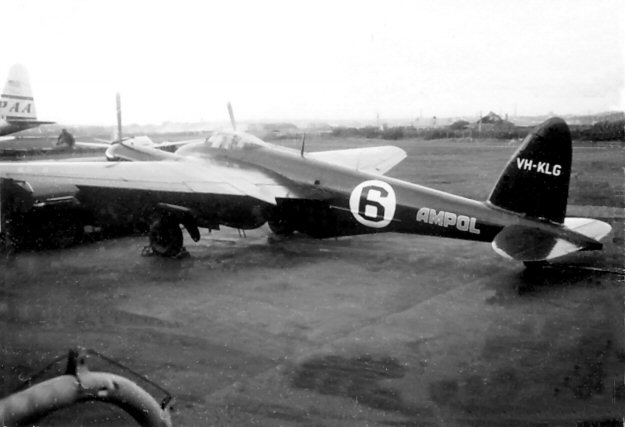
http://www.edcoatescollection.com/ac1/austcl/VH-KLG.html
Regards
Mark Pilkington
mark_pilkington.
hmmmm “windscreen”?? yachts have those too, along with a cockpit!
“sacrificial anode”, I think some metal aircraft have had those????
Every modern airliner has had a “Galley”! They also carry “stewards” or “stewardess”‘, “purser”and a “Captain” and “Navigator”, as do a passenger ship, both have a “crew” and “passengers” and in the past some aircraft even had a “cabin”, both have “toilets” and “sickbags”!
A ship sometimes needs a “pilot” to assist the captain, whereas an aircraft normally has a “pilot” as the captain – smiles.
In the past aircraft carried “sextants” and still carry “compasses”!
aircraft and ships both have “cargo holds”
an aircraft and ship can have a “datum line” and a “C of G”, and both can “pitch” and “roll”.
you can have a “sail” boat and a “sail” plane!
you can have an “air” boat, and a “flying” boat but although similar sounding they are not the same – smiles
Military ships can have “guns”, “cannons”, “cruise missiles”, carry “torpedos” and “depth charges” and in the past or present so have Military aircraft.
“fin” – no thats a fish not a ship smiles!
“dorsal” ?? no thats a fish too!
“stuffed motor” on an aircraft = “boat anchor” – now thats a ship!!!
smiles
Mark Pilkington
mark_pilkingtonHi All,
just wondering if anyone can help with detailed dimensions for the Warner Super Scarab 165 engine? I’m working on a 3D model of the Australian CAC Wackett trainer which used this powerplant, and I need some detailed drawings showing dimensions. The 3D model is not for a flight sim, since they are usually just outside skins, I’m working to include all the internal structure as well (hence the need for engine dimensions). I have many detail photos (see some attached), but need real measurements before I can go any further. I’m told the overhaul manual does not have dimensioned drawings, so I’m looking for some other source…Regards,
Derek
Hello Derek,
mark up some dimensions on your photos and I will measure my engine for you.
regards
Mark Pilkington
mark_pilkingtonDerek,
from page 4 of the 1946 Warner Engine Handbook Super Scarab Model 165:
Overall Diameter 37- 1/4 “
Overall Length 30-1/2″
If you scale up the 145HP Scarab drawing from John above to these 165D dimensions it should give you everything you need?
regards
Mark Pilkington
mark_pilkington.
I am very well thanks Derek, although my Wackett and Warners are still in hibernation at this time due to family, work and other things – smiles
I didnt realise you were O-S at the moment?
just email me the photos or your drawing at [email]mark_pilkington@hotmail.com[/email] and I will get the exact measurements from the engine itself.
regards
Mark Pilkington
mark_pilkington.
I dont have any manuals, parts or experience with the 125hp or 145hp Scarabs, as my only involvement is with the Super Scarab 165D.
According to a copy of “Aircraft Handbook” F.Colvin 1942 – McGraw Hill, the differences are:
Scarab 40 = 125hp, bore = 4 1/4″ stroke = 4 1/4″ displacement = 422
Super Scarab 40 = 145hp, bore = 4 5/8″ stroke = 4 1/4″ displacement = 499
Super Scarab 165= 165hp, bore = 4 5/8″ stroke = 4 1/4″ displacement = 499
From page 4 of my original copy of the Warner Engine Handbook Super Scarab Model 165:
Overall Diameter 37- 1/4 “
Overall Length 30-1/2″
bore = 4.635″ (4 5/8″) stroke = 4.25″ (4 1/4″) displacement = 500
It also describes the 185 as
Overall Diameter 37- 1/4 “
Overall Length 30-1/2″
bore = 4.875″ (4 7/8″) stroke = 4.25″ (4 1/4″) displacement = 550
I understood the 165D was known as the R-500 in military service with the 185 being the R-550 and obviously the 125hp was the R-420
John’s 125hp drawing has
Overall Diameter 36- 9/16″
Overall Length 28-31/32″
An online 145 manual is available here http://www.russellw.com/manuals/warner/default.htm
Which lists the 145hp dimensions as
Overall Diameter 36- 9/16″
Overall Length 29 to 29-3/4″
So it appears likely the 125 & 145 are the same engine simply with different bores.
As the bore and stroke is the same for the 145 and 165 I suspect the different diameter comes from a revised larger & higher compression head?
As the dimensions above are sourced from manuals I assume them to be right, where as the following from Wiki is unsourced?
http://en.wikipedia.org/wiki/Warner_Scarab
Specifications (Warner Scarab 50)
General characteristics
Type: 7 cylinder air cooled radial
Bore: 4 1⁄4in (108mm)
Stroke: 4 1⁄4in (108mm)
Displacement: 422 cuin (6.92L)
Length: 14in (355.6mm)
Width: mm (in)
Height: 36.5 in (927.1mm)
Power output: 125hp @ 2,050 RPM
Specifications (Warner Super Scarab 50)
General characteristics
Type: 7 cylinder air cooled radial
Bore: 4 5⁄8in (117.5mm)
Stroke: 4 1⁄4in (108mm)
Displacement: 499.8 cuin (8.19 L)
Length: 14 in (355.6mm)
Width: mm (in)
Height: 36.5 in (927.1mm)
Dry weight: 305 lb (138.35kg)
Dry weight: 285 lb (129.28kg)
Power output: 145hp @ 2,050 RPM
As Derek is modelling the CAC Wackett Trainer it is the Warner Super Scarab 165D that he needs the dimensions of, as per my manuals details above.
Those dimensions and Johns 125hp drawing should be enough?, as the 165 dimensions are only 2% and 5% larger than the 125/145 dimensions in anycase and hardley likely to compromise Dereks model?
I have 4x 165D engines in my shed so if you need other dimensions or need the manual dimensions confirmed, just let me know.
Regards
Mark Pilkington
mark_pilkingtonJohn,
I dont have any BA Manuals, but I may have access to a BA Swallow manual to copy, I will let you know.
I would be interested in your DH-84 manual if your willing to part with it?
Regards
Mark Pilkington
mark_pilkingtonhttp://avialogs.com/category/de-havilland/
more on makes on the right
thanks for the link TonyT,
those are copies scanned onto CD, I already have some of these below in that form, but am still seeking to buy original copies of the following DH “Manual of Instructions”
DH 60 Cirrus Moth
DH 83 Fox Moth
DH 84 Dragon
DH Gipsy II Engines
And although not DH, an original ADC Cirrus Engine Manual
Regards
Mark Pilkington
mark_pilkingtonBeen a while since this matter has popped-up but the last gossip I heard was that the one at Pima had been virtually abandoned and/or gutted? Not seen any information to confirm this though.
. The one magnificent remaining Shackleton which left the UK without fanfare and was never to return – and then left to rot in the desert.
Likewise, I guess the chances of raising money must be slim when so many people have been worn-out by the Vulcan saga.
27th January 2010 19:54
Chox Well yes, I’m more than aware of Pima, where it is, what they do, blah, blah. But I’m positive that I read somewhere not too many weeks ago, that the Shack appeared to have been abandoned and was indeed doing little more than rot. I honestly can’t recall where I saw the story so it may be wrong (certainly hope so) but that was what I heard, for what it’s worth.
Chox, I am rather dismayed and surprised at your remarks regarding Pima’s preservation of Mr Grumpy, or the fact that it had to be sent to the USA to be kept in the air, given your proposal of the exact same outcomes for the Vulcan only a year ago? particularly as it has suffered the same end result many indicated your Vulcan to USA proposal would end in, ie grounded in a foreign country where its historical significance is low?
The Shak owners has reached deeply into their own pockets to maintain and operate an historic aircraft as long as they could, at great cost given its size and thirsty four engines, long after it was retired from service and could be operated in its home country. They have then placed it into dry desert conditions with a museum willing to care for it.
Your unconfirmed comments of it being stripped, and throw-away derogatory comments regarding its location and treatment with Pima are disappointing to see, and certainly undeserved by the owners or Pima?.
There is a new project to return a Shak to the air in the UK, and yes it is probably sufficated by the constant consumption of funds and donations by the Vulcan, but if you really lament the loss of Mr Grumpy and a flying Shak then reach deep into your own pockets and make a donation?, instead of knocking the active efforts of others? – “blah blah blah”
Chox
Rank 5 Registered User Join Date: Feb 2007
Posts: 641Well, as I said previously, if anyone can think of a more practical means of possibly keeping 558 flying, I’m sure we’d all like to hear about it…
The notion that it would be some sort of national crime if 558 went to the States is almost hilarious. Presumably then, these Vulcan enthusiasts would rather watch the aircraft slowly rot away in the corner of some British airfield (like so many other Vulcans have done) instead of taking the one remaining chance (albeit a slim one) of getting the aircraft into the air somehow? That’s absurd isn’t it? Likewise there’s no point in using the HLF as an excuse for a sudden burst of nationalism; as I said previously, I seriously doubt if HLF has any interest in the project now – if they did, I would imagine they’d be asking very serious questions as to what happened to the “touring exhibit” plan for which HLF provided the funding in the first place.
It’s all too easy to pick holes in the US option, especially when nobody seems to have any alternative solution. I don’t have any desire to see 558 disappear across the Atlantic, but I certainly don’t want to see the aircraft left to rust over here. Unfortunately, when all the carping and whining is put aside, it’s patently obvious that this is what is going to happen as nobody (particularly TVOC) has even considered the idea and everybody seems hell-bent on simply flogging the tired old donations angle until it is completely exhausted, at which stage the alternative options are… er, zero.
Oh, and bubbles, I think you’ll find (if you bother to read any of the posts before you reply) that you appear to be the one with personal grievances. I think you’ll find that I have simply been making observations and suggestions, offering my views and arguing my case. You don’t have to agree with me but perhaps you could stop the carping? It adds nothing to the debate.
——————————————————————————–
Last edited by Chox; 31st December 2008 at 01:35.
Regards
Mark Pilkington


 Sign In







