 mark_pilkington
.
Interesting “what if” James,
The Angled Deck was primarily developed in response to the higher landing speeds of jet aircraft, and not for the added advantage of dual operations of recovery and launches as away of improving combat turn-arounds.
I too felt that Midway was the main engagement that may have yielded a different result if the Japanese carriers had been able to turn around aircraft more quickly – particularly with the need to re-arm bombers etc.
Had the Japanese developed angled decks in 1940, it is likely that the benefits and need for them may not have immediately been appreciated and copied by the allies, who were already focussed on low cost high volume light carriers to protect the Atlantic convoys and fight in the European conflict, in anycase, until proven to create a combat advantage I doubt existing ships under construction would have been delayed to add the angled deck?
If the Japanese were the sole users through 1940 to 1941, and used them with success in Pearl Harbour the earliest consideration of utilising the design elsewhere would have been due to the December 1941 attacks?
Yet the element of surprise, and the lack of readiness by the US Defenders probably meant an angled deck would not be considered a major contributor itself to the Japanese success at Pearl Harbour.
Regardless of that, the fact that Midway only occured some 6 months later would have ensured that no US angled deck modified, or new design, could be constructed due to Pearl Harbour experience and be ready by Midway.
Obviously had the Japanese Navy not lost 4 aircraft carriers and a heavy cruiser at Midway, (and the US only 1 carrier) the weakness of the Japanese supply lines may not have been exposed and exploited as quickly, the war in the south west pacific continued on with full occupation of PNG, and clear threats to invasion of Northern Australia, NZ etc, perhaps allowing Japan to secure control over south east asia under a negotiated peace settlement?
The development of the angled deck commenced in 1952, and the first carrier to be laid down with the angled deck was HMS Ark Royal in 1955.
Australia’s HMAS Melbourne was only the third angled deck Carrier to be commissioned when it entered service in 1955.
launched in late WW2 as a british Majestic Class light carrier, its construction was suspended until 1947 when purchased by the RAN, it was then decided to modify it to angled deck resulting in the 8 year delay through to 1955.
Its sister ship HMAS Sydney launched in 1944, retained the original straight deck, and was put into service with the RAN in 1948, some 7 years prior to Melbourne.
While the peace time pace of Melbourne’s conversion would not suggest a similar 8 year period would occur in wartime conditions its clear that unless all Nations concurrently saw the benefit in 1940, then the first mover would have that lead for perhaps 3 or 4 years unless the advantages were instantly recognised, and design/construction immediately implemented?
regards
Mark Pilkington
mark_pilkingtonYes I’m sure miggy will be giving it full coverage in all of his columns,
smiles
Mark Pilkington
mark_pilkington.
I agree a 6 degree “painted” angled deck might technically support concurrent landings and take-offs, however I think the improved turn around and concurrent operations the Japanese required at Midway to change the outcome of that battle and the war would be reliant on the placement of the hangar deck and its elevator/lift in a location off the angled landing deck and to “feed” the takeoff deck to maximise the aircraft undertaking the concurrent operations?
At Midway Admiral Nagumo’s carriers were caught with their bombers on the deck being re-armed from conventional bombs to torpedos, preventing the zero fighter air group being launched against the American attacking aircraft.
I would have assumed its not just concurrent landing and takeoff of one aircraft that is required, but management of entire departing and arriving air groups at the same time, that either requires space on the deck to accomodate many aircraft from both, or access to the hangars to bring up or store below.
That might not be an easy outcome for a pre-war straight deck carrier simply re-painted to the 6 degree angle. Most elevator /lifts to hangars were at the rear of the straight through decks to load the rear of the ship with aircraft to launch an attack.
Relocation of the elevator/lift may only become a priority and design feature if your reasoning for specifically designing the angled deck carrier by 1940 was to maximise concurrent operations?, which still remains the logical reason to do so in WW2 as against the post war introduction of jet aircraft.
Of course the other post war features which supported angled flight decks was the external “deck-edge” elevators, and the “overhang” storage/parking of aircraft, not a feature of WW2 designs in anyway.
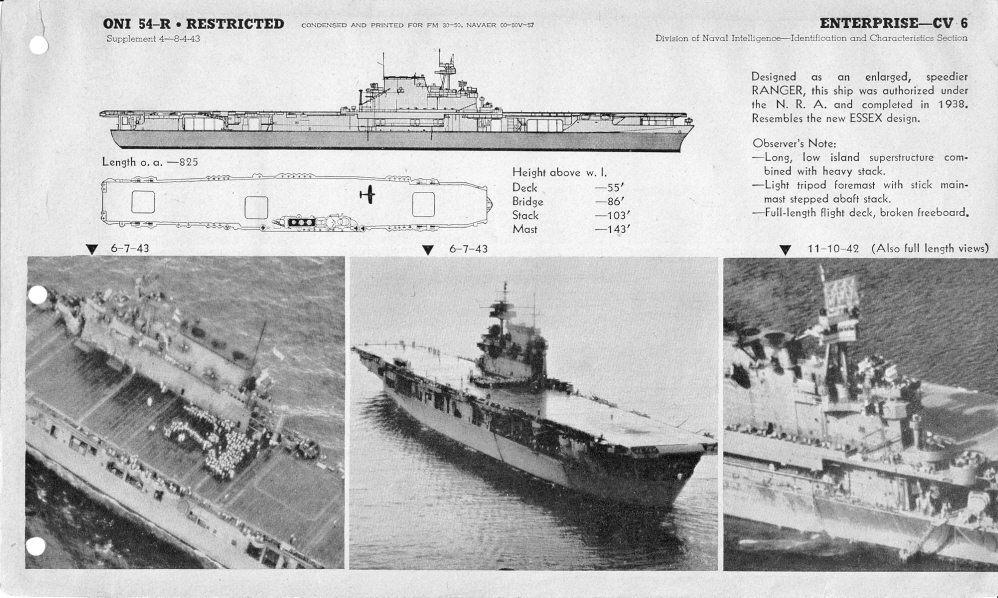
The 3 Yorktown class Carriers the US had after Pearl Harbour, such as USS Enterprise(CV-6) and USS Hornet (CV-8) all had 3 elevators/lifts, two of which were aft of the Island and therefore still compromised by landings being undertaken on the angled deck, while the third was at the front and under the launch deck, compromising take-offs, where as the ideal location would be forward of the island off the angled deck, but at the rear of the launch deck.
The second USS Hornet of WW2, CV-12 launched in 1943, was fitted with an angled deck in 1956 as CVA-12 and shows the impact on moving old elevator #3 from its ww2 position directly in centre of the angled deck , and creating the external “deck edge” lifts #3 & #4, to maximise concurrent operations and minimise hinderance of elevator access from the hangar to the deck flight operations.
The two deck edge elevator/lifts remove landing aircraft to the hangars without significantly compromising the continued use of the angled deck for additional landings.

Elevator/Lift # 1 at the back of the launch deck feeds the two adjacent catapults with aircraft.

Had you designed it for that purpose, you would have maximised the benefit through position of the elevators in the construction, and training of pilots/crews to operate in that concurrent mode, prior to Pearl Harbour etc.
I had in this “what if” assumed the Japanese had designed and built a full angled deck carrier or carriers in 1940, to maximise concurrent operations, and trained prior to the entry into war to hone their pilot and deck crew skills.
Even if the US had then “rushed” simple “painted” angle decks into service immediately after Pearl Harbour in response to an apparant Japanese carrier “angled deck” advantage, was 6 months enough time to train pilots/deck crews in concurrent operations, even if the hangar elevator locations supported that outcome?, given the 4 US carriers were continuously required for operations post Pearl Harbour? seemly precluding any such training?
regards
Mark Pilkington
mark_pilkingtonhello Ross,
The ground is that dry down here in Victoria that its cracked wide open and any rain runs into the ground, not over it and into the run-offs to feed the Dams.
Obviously ground water acquifiers are being replenished but it will take a lot more (years) of these types of rains to make a dent in our dams and reservoirs, Victoria has been in Drought for over 10 years, Geelong where I am has been on level 3 water restrictions for all of that time.
Regards
Mark Pilkington
mark_pilkingtonMost W.W.II carriers I can think of had a fore and an aft lift.
How well positioned these would have been in the circs is a good question though.
James my generalisation that “Most elevator /lifts to hangars were at the rear of the straight through decks to load the rear of the ship with aircraft to launch an attack.” wasnt to suggest they didnt also have forward elevators, but that those elevator positions still on the angled deck could limit concurrent operations.
As exampled in the Hornet redeveloped as CVA-12 postwar into a Angled Deck, to optomise operations there was a need to retire the aft “centre-line” deck elevator and construct two “deck edge” elevators.
Had the Japanese developed Angled Decks to maximise concurrent operations in 1940 you would imagine elevator locations would have been part of the considerations, where as a 6 degree painted angled deck on an existing straight deck carrier has to suffer the existing positions of the elevators.
In the post above I put the USS Enterprise CV-6 deck plan up to show how two of the three “centre-line” elevators may have compromised any benefit of the painted angled deck? on that design?
That image doesnt seem to be showing properly in the post above so I have attached it seperately.
What about the effect on escort / Woolworth carriers?
Without lifts or hangars they were limited in the outfit of aircraft they could carry. An angled deck would have increased the number at a stroke.
Moggy
Moggy’s probably identified the main area of advantage where the 6 degree painted angle deck would have added value and the constructed angled deck certainly so, as the deck cargo capacity of atlantic and pacific deliveries of aircraft, and the air delivery directly off the deck would have been enhanced by those features.
Had the Allies implemented that in 1940 as the first use of angled decks, the Japanese with their keen monitoring of the Carrier use and success in the European war would have easily adopted it (ie the painted angle deck) to increase aircraft capacity to replenish Japanese Army land based and even Japanese Navy carrier based aircraft within the Pacific campaigns from 1941 onwards?
Of course the Japanese supply lines and factory outputs still would have been their downfall, unless Midway had been a different outcome.
At Midway the Japanese error was primarily to approach Midway at the same time they were able to be targetted by the US carriers, resulting in the land based US aircraft being able to match up the overall combat aircraft numbers on the US side, and to create a large unsinkable carrier in the form of Midway itself. Of course this also had to do with poor Japanese intelligence on the whereabouts of the US Carriers, and expectation that only 2 remained in action, and without the knowledge that their code had been broken and that the USN knew their exact where-abouts and battle plans.
Even a Angled Deck on each of the 4 Japanese Carriers may not have overcome all of those issues, but it would have avoided them being caught with aircraft on the decks and as sitting ducks?, and perhaps increased the losses on the US carrier side, and reduced the losses on their own? Midway still seems a defining battle in Carrier warfare.
Regards
Mark Pilkington
mark_pilkingtonJerryW, / Roger
Heres a new one for your list, and in my own backyard:
Aero Engine – Sunbeam-Coatalen Maori 1, Airship Engine, circa 1918 Reg. No: ST 017924 Summary:
The Sunbeam-Coatalen engine was made by the Sunbeam Motor Car Company Ltd in the United Kingdom. It is a V-12, liquid-cooled engine producing 273 horsepower and fitted with four Claudel Hobson carburettors. It was intended primarily for use in airships during the First World War but was used in many types of service aircraft.. This Type 1 example carries the serial no. 1-250-23. This example may be an Afridi engine coverted to Maori 1 configuration during production
Acquisition Information:
Loan & Subsequent Donation from Science Museum (London), 1929
Discipline: Technology
Dimensions: 987.8 mm (Height), 959.8 mm (Width), 1569.9 mm (Length)
Weight: 507 kg (Weight)
Hidden away in the stored collection of the Museum of Victoria in Melbourne Australia!
regards
Mark Pilkington
mark_pilkington.
Who else other than the RAAF is operating one, ? they are being retired this year in Australia, it would be interesting if one being flown up to the UK for a final display or preservation?
Regards
Mark Pilkington
mark_pilkingtonJDK: Thanks again Canberra. That taken onboard, why would you want to put (not receive) an RAAF aircraft with no type or unit relevance into the UK?
I understand Cosford has a former US F-111 as does the American Air Museum at Duxford, so perhaps there is little need for a third to be preserved in the UK. Regardless of it being of RAAF service history it is an important technology type of the jet age, but 2 already cover that requirement?
I cant think of any other logical “ally” in Europe that Australia would donate one to? but then again perhaps someone has specifically requested one? (buy an F-111 from us, we throw in a W Class Tram as a freebee).
Perhaps the French would like one, (did we use F-111’s to spy on their Nuclear tests in the Pacific?)
On the other hand I could see the Rudd Government enjoying flying the flag with a European swansong tour of the F-111 now that Australia is again a “middle power” and seeking a seat on the UN Security Council, but I certainly cant see any training benefit in operating one lonely aircraft so far from home, particularly a type about to be retired? It would be more relevent to operate a RAAF training mission to Iraq or Afganistan and participate in some tactical or recon missions?
Regards
Mark Pilkington
mark_pilkingtonCees,
I only know of two surviving in Australia, both are in museums, one is in an airframe, I assume they are few and far between elsewhere, however the BAPC lists 24 in the UK?
I have always thought these to be rarer than rocking horse – s#*t or is that flying horse S#*t – smiles, and I assume the twin re-creation you refer to will need 2 engines? perhaps its better to try get access to one to create a fibreglass casting of the front of the crankcase/nose and cylinders? and build two dummy engines?
Regards
Mark Pilkington
mark_pilkingtonI’ve also seen large Lincoln nose sections, with that unique glazing, half buried in soil mounds at the northside bomb dump at RAF Kinloss around 1983, amongst some Anson fuselage skeletons. The location was used by 45 MU to destroy WW2 aircraft, but I suspect the whole area has been sanitised now though…
Paul / anyone?
I would certainly be interested in knowing if any Lincoln bomb aimers nose glazing sections are remaining at the RAF Kinloss site, obviously 27 years is plenty of time for a clean up, or more dumping over the top, or to simply rot away, but it is a piece of interest, (we already have a partial section to transport home from the UK, more remains added to the pile would be welcome)
regards
Mark Pilkington
mark_pilkington*Bump*
For those able to make it, the meet at 11.30 at the Boxkite Project, which I understand will be in the Restoration Hangar on the day, is ON.
See you there!
James I am reshuffling my committments to be there for a while on Sunday (Point Cook Pageants are always worth going to, far more interesting than Avalon!), so I will aim for the Boxkite rendeavous at 11.30.
regards
Mark Pilkington
mark_pilkington.
We are being spoilt in Victoria this year, Point Cook in late Feb, Melton (Houdini) Airshow in March, Tyabb (Centenary of Australian Aviation) April and Bendigo (Duigan) in October, and of course Avalon for those interested, in March 2011.
regards
Mark Pilkington
mark_pilkingtonRedarrrow,
you might get a better result to your question if you post it on this American forum > http://www.warbirdinformationexchange.org/phpBB3/viewforum.php?f=3
regards
Mark Pilkington
mark_pilkingtonGreat to meet up and sorry to those who I didn’t get a proper chance to chat to – maybe next time! Anyone interested at a longer forum meet at the RAAFM in a couple of months, feel free to say, too.
I think that would be a great idea James, I could follow it up with one at Moorabbin if there is interest?
For those interested, I am the one with the hat in the photo above lol
regards
Mark Pilkington
mark_pilkington.
And heres some from inside the museum hangars:
1. Depperdussin Replica
2. Farman Shorthorn Composite Replica/original
3. Hawker Demon restoration with prototype CA-26 Sabre in background
4. CAC Boomerang with DH 84 Dragon in background
5. Avro Cadet with CAC Boomerang in background
6. GAF Jindavik with GAF Pika and PBY-5A (Canso) in background
7. GAF Canberra in Strike Hangar
8. Phantom in Strike Hangar
9. F-111G in Strike Hangar
10. Bristol Boxkite replica in Restoration Hangar
The RAAF Museum is a real treasure trove, the pics above are only an appetizer!
regards
Mark Pilkington
all photographic images copyright 2010 from the “Pilkington Collection of blurry piccy’s” smiles


 Sign In







