 mark_pilkington
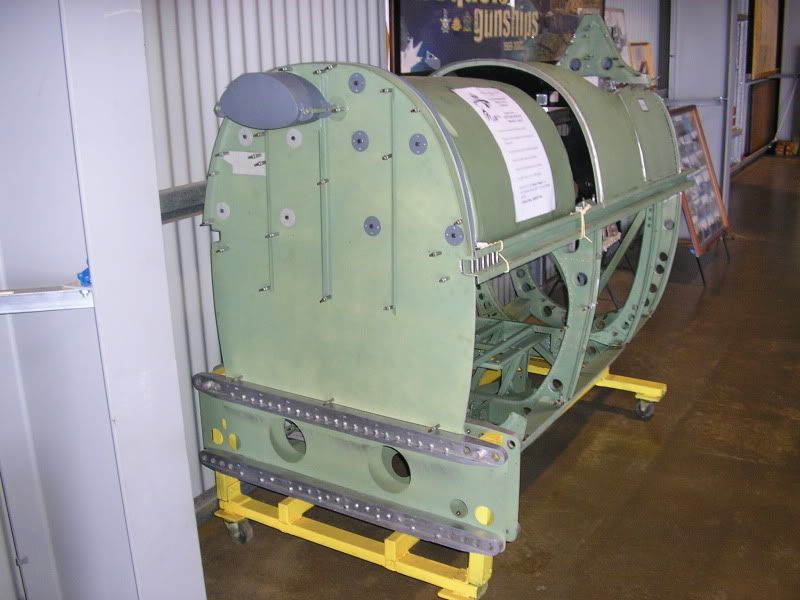
Perhaps today the oldest surviving RAF 100 Squadron aircraft?
http://www.aarg.com.au/Beaufort.htm

DAP Beaufort A9-13 was the 13th locally built Australian mark V Beaufort Bomber, with the first 20 being assembled from imported UK parts, but fitted with Australian built Pratt and Whitney 1830 Twin Row Wasp engines. A9-13 was originally built to an RAF order of 180 aircraft and was delivered as RAF serial number T9552 in January 1942 and was one of 20 Australian Beauforts delivered to 100 Squadron RAF which operated at Richmond NSW.
DAP Beaufort A9-13 was the 13th locally built Australian mark V Beaufort Bomber, with the first 20 being assembled from imported UK parts, but fitted with Australian built Pratt and Whitney 1830 Twin Row Wasp engines. A9-13 was originally built to an RAF order of 180 aircraft and was delivered as RAF serial number T9552 in January 1942 and was one of 20 Australian Beauforts delivered to 100 Squadron RAF at Richmond NSW.
The first 58 aircraft were constructed with British serial numbers for delivery to the RAF for use by RAF 100 Torpedo Squadron at Singapore, however only 6 aircraft ever left Australia for Singapore, with 1 crashing on the way, and the remaining 5 hurriedly returned to Australia following the Japanese invasion.
T9552 joined Q Flight of the RAF 100 Torpedo Squadron at Point Cook on 21 January 1942 as the 8th aircraft on strength, and being allocated the RAF squadron codes NK-B. By the end of January the squadron relocated to Richmond RAAF Base in NSW.
On 9th of April T9552 was involved in a 5 hour escort duty of a large RAN Convoy, and in late April 1942 was transferred to Number 1 Operational Training Unit at Nhill.
All former RAF Beuaforts were transferred to the RAAF in May 1942 following the fall of Singapore, along with all other Australian RAF Beauforts and a new RAAF 100 Squadron was formed to operate Beauforts adopting the number and many aircrew from the RAF 100 Squadron attachment already in Australia along with those who escaped from Singapore.
Renumbered as RAAF Beaufort A9-13 in OTU service in June 1942 it moved to Bairnsdale in Victoria for use in the training of Beaufort aircrew before allocation to operational squadrons and served with 1 OTU until December 1942 when it suffered a forced landing due to engine failure
A9-13 continued to serve with 1 OTU until January 1944 when it was transferred to 1 Aircraft Deport at Laverton from where it was issued to 8 Communications Unit serve in New Guinea as a replacement for A9-79 in a communications and support role.
While serving with 8CU in New Guinea A9-13 was used to calibrate ground based airfield and early warning radar installations, as well as general communications and “milk” runs.
During a flight to deliver fruit and vegetables in May 1945 to the 100 Squadron base at Tadji airfield near Aitape in Northern PNG A9-13 suffered a forced landing and was converted to components
regards
Mark Pilkington
mark_pilkingtonI understand NEAM have been inundated with emails and offers of purchase and have suspended the sale while they reconsider the process.
regards
Mark Pilkington
mark_pilkingtonSiag Travels Facebook page includes the following info to those attending the trip on 1st June :- ” please to not attempt to remove or alter any items of or around the plane. This a great discovery and will be removed to the Alamein Museum where it will be on display. A scale model of the plane will be placed there in the future and used as a historical site. This is a national treasure and us desert enthusiasts should be the first to protect it.”
Steve.
A worthy objective that simply now needs some effort to deliver it as a completed result. The Alamein Museum is a suitable resting place even though I had hoped it might make it back to the RAFM.
regards
Mark Pilkington
mark_pilkingtonMark
I think we are going around in circles here and coming back to the same place, and I don’t think many would neccessarily disagree with much you have said. However….there are some things I simply must take issue with!
Could I just make the point, though, that the whole premise of your post (and posts) seems to be coming from the point of view that pre-supposes that there are a good many flying warbirds that are misrepresented as to what they are and, equally, owners and restorers are somehow dishonest in misrepresenting what they are. I do not feel that is the case at all.
Now your putting words in my mouth Andy, I havent at any stage quantified the number of airframes I consider are misrepresented by their owners/operators, if you read my posts you will simply see I suggest there are reasonable categories or labels that can be applied, in fact you seem to be acknowledging the same thing in your use of the term “re-construction”.
So putting it simply I dont believe “a good many flying warbirds are mis-represented as to what they are” but I do believe “some are”.
You go on to say:
“If its truelly a “re-construction”, (I read that as a largely new metal “reproduction”), I still dont think anyone is suggesting its not “allowable” as long as your airworthiness regulator permits you to operate it. But “if” you tell me its an “original” thats been “restored”, and flew in the Battle of Britain, please dont tell me “I need to take a healthy dose of realism”.”
You go on to add that we should all celebrate the enthusiasm and zeal that has gone into creating them. Well, hear hear! However…there is always another however, and I must just take you to task on the above statement.
My comment was “rhetorical” to your apparant advice to those who questioned provenance to take a healthy dose of realism, ie “if” you tell me its an “original” and its not, then “dont” tell me I “cant” comment on that.
I did not specifically accuse “you” of telling me “anything” in relation to any specific airframe – P9374 included, which I dont recall you had mentioned until this post? (and neither had I?)
However on re-reading the first posts in the thread John Green’s original post suggested there were people who opposed a flying restored aircraft from having “any” new components in it (I dont think I have ever seen anyone express such an opinion online or in real-life?).
And having seen John’s debating style in other threads I simply took his statements as a fishing trip and baiting for a hotly contested discussion.
Your follow up post included the quote above relating to anoraks, and doses of realism, and I would agree it was made in the context of the suggestion re-constructions or new components were somehow “not allowed”, and in reviewing my reply to you above I agree that I have taken it out of that context.
However I think you are also putting words into my mouth and taking what I said out of context too.
You have shown P9374 to be transparently a re-construction, and I had’nt and have’nt made any comments in relation to it in anycase, in this or any other thread, or extended my view to it or most other flying warbirds, as you seem to suggest.
It seems you and I both agree there are many compromises to get and keep flying aircraft flying, and that can compromise their originality while a number of aircraft are re-constructions most of which are transparently and openly admitted and acknowledged as such.
In his otherwise very sensible post, Mark Pilkington said:
“But that doesnt put any obligations on others to simply accept the “provenance” claims, despite appreciating and applauding the efforts and outcomes.”
Could I just comment that this, again, infers that some are making unjustified or unjustifiable claims of provenance. Are they? If that is so, then it would be unfair to tar all with the same brush. (And Mark, I am not otherwise being critical of your comments!!)
Yes it does intentionally infer that some are making such claims Andy, and I dont see why if I infer “some are”, that this in anyway tars “all with the same brush”?
And if “some are” then that would be “mis-leading”, and people would have a right to be sceptical about those.
You seem to consider “none” do, and I consider that “some” do?, but I have never suggested “most” do, but do consider a set of labels would easily remove the confusion and arguments.
We are now going around and around on the same issues, and clearly most are not up for it, and I have already said everything I need to say on the matter.
But for those of us who stand accused of being “purists, anoraks, rivet counters etc” or what ever other derrogatory name is to be applied to us, we are still entitled to our opinions or views, and happy to debate them.
If those rebuilders and owners who “arent” transparent or “do” intentionally “mislead” take issue with my opinions, I dont really care, and those who are “transparent and open” surely shouldnt consider I’m “tarring them with the same brush”?
regards
Mark Pilkington
mark_pilkingtonIf there are specific issues as to provenance arising over a specific aeroplane then that is one thing. It is also something to be addressed between vendor and purchaser prior to point of sale. Making generalisations about provenance or originality is quite another, especially when it comes to what I think are often implied slights upon the aircraft restoration industry.
In his otherwise very sensible post, Mark Pilkington said:
“But that doesnt put any obligations on others to simply accept the “provenance” claims, despite appreciating and applauding the efforts and outcomes.”
Could I just comment that this, again, infers that some are making unjustified or unjustifiable claims of provenance. Are they? If that is so, then it would be unfair to tar all with the same brush. (And Mark, I am not otherwise being critical of your comments!!)
Andy
It still revolves around the terms used and the provenance that then is implied by the use of those terms.
Above you refer to the Aircraft Restoration Industry which encompasses aircraft being maintained, repainted, refurbished, restored, reconstructed, reproduced/reconstructed and even into the realm of replicas.
As you said in a much earlier post:
Originally Posted by Tangmere1940
Those who want to see these aircraft flying need to accept reality and, frankly, get over it. If you want “no new content” (an utterly impossible and ridiculous concept) then you will not see these aircraft fly! Period. They will be static museum exhibits only.
I think we all accept any flying historic aircraft will have compromises in originality for safety, maintainability and operational standards, ie the BBMF spitfires with their much later mark Merlins for but one example of neccessary compromise of what in the main were complete airframes.
Additionally, if I own and fund the re-construction to flight of an historic airframe and invest my own time and very considerable sums of money into that process then I probably don’t appreciate the emergence of anoraks telling me that it isn’t “allowable”. Allowable by whom, for God’s sake?! I think some people need to take a healthy dose of realism medicine.
If its truelly a “re-construction”, (I read that as a largely new metal “reproduction”), I still dont think anyone is suggesting its not “allowable” as long as your airworthiness regulator permits you to operate it. But “if” you tell me its an “original” thats been “restored”, and flew in the Battle of Britain, please dont tell me “I need to take a healthy dose of realism”.
Hence I do support the use of appropriate labels to describe what the object or machine’s status and origin is – ie its originality:
Ie originality as in where it came from, not how well it duplicates or recreates what is seen in the pilots and maintenance manual photographs.
I made the same comments below in my first post in this thread, and have made similar comments in previous debates here and in other forums such as WIX.
There are various guidelines to categorising aircraft as museum objects just like any other cultural art, a former curator of the NASM came up with his version in a well regarded book, but I feel the following better fits the practice across both static and airworthy historic aircraft.
I think there are obvious categories of surviving historical aircraft along the following lines:
Conserved Originals
(typically static museum examples acquired in good condition, but could equally apply to a conserved wreck such as the RAFM Halifax)
I would personally put the 3 early mark Spitfires in the IWM, AWM and Canadian collection in this category, as they are largely timecapsules of wartime spitfires.

Restored Originals
(typically requiring a fairly major refurbishment but essentially a complete airframe – most flying examples are in this category)
Clearly the BBMF Mark IIa is an important historical aircraft as well, but it will have had some compromises to get it airworthy in 1968 for the BoB Film and ongoing replacement of parts etc to keep it airworthy, including its engine?

Re-constructed / Composite Originals (ie hybrid reconstruction or composite from original parts often from disparate identities, with some new metal) (could be static or flying outcomes, might derive its identity from a major structure)
This is the Mark Vc in the NMUSAF, it is based on a former RAAF service aircraft A58-246/MA863, its fuselage is 75% or more “new metal” ie “reproduction” reconstructed in the 1980s/1990s including all new fuselage frames, stringers and skins, its wings are original ribs and spars but new skins.
the cockpit frame, and wings, are from the identity aircraft, but its hardly an original spitfire in the same league as the two above.

Reproductions (ie authentic design, largely new metal) Typically exotic flying outcomes of highly sought types or extinct types, may adopt an identity from very scant remains.
Below is the wonderful Spitfire “reproduction” underway at the Museum of Army Flying at Oakey in Queensland, it is adopting the identity of A58-27 to reflect that aircrafts scrapping at the site, but is not claiming to be based on any substantial remains of that airframe.
It will be a static museum display when finished and may well reproduce every aspect of a Spitfire in every detail undetectable from the examples above, but certainly not equal to each of them in provenance.
I understand its possible to purchase kitsets of Spitfire fuselage frames from the UK, certified for airworthy use?
There isnt much stopping such a project being undertaken for airworthy rather than static outcome, with the same lack of provenance or original airframe structure, as such I would not consider it equal in heritage or historic importance to the examples listed above.
http://spitfireprojecta58-27.blogspot.com.au/

Replicas (alternative and sometimes compromised design/construction, including scale and profile compromises, typically flying examples), no true relationship to the historical type or identity other than in shape and paint.
Heres a “Supermarine” “Spitfire” but not really an original WW2 combat veteran, its a little “short” (by @10%) and despite the right shape and paintscheme isnt quite to the original design, its clearly not a restoration or a reproduction its a “replica”, and a 90% fractional scale one at that..
Nice toys to have fun in, but not an historic aircraft, or carrying any provenance at all.
http://www.supermarineaircraft.com/#

Full Scale Mockups (same as above “Replica” but purely a static display outcome with no regard to airworthy or structural integrity or even operational engine capability) no true relationship to the historical type or identity other than in shape and paint.
Here’s a commercially available full size fibreglass mockup of a Spitfire mark IIA, it “looks” like a spitfire externally, but structurely is clearly not, but it can be painted up to look exactly like the BBMF mark IIA above, this one has a sliding canopy and cockpit fitout, but it can never claim the provenance of a real 1940’s Spitfire built by Supermarine and operated by the RAF in WW2, hence its not in the same league as the real “original” early mark Spitfires in first examples above.

Of course there are no % rules that could reliably define entry into one category over another, but I think most aircraft would fit readily into the above categories and most people would fit the same aircraft into the same category.
I dont see any issue in placing such labels on certain outcomes, and I certainly have concerns about mislabelling some outcomes to suggest they are on par with some others, either for provenance or financial gain, (there is similar practice in other parts of the cultural art world and is called fraud)
I dont want to name specific aircraft, but I think there are a number that come to mind as claiming to, or permitted themselves to be presented as restored originals where the amount of “original” within the finished product is “little if any”.
If we all agree there is “no attempt to mislead”, and the information about their origins and content etc is “transparent and well known”, then why not simply label them as what they are – “reconstructions” or “reproductions”?
rather than “restorations”?, and celebrate and appreciate the real workmanship that has still gone into them?
As I said earlier, there are F3F’s, FW190’s, Zeros, Yak 9s and Me 262s that happily acknowledge their origins and contents and happily apply and accept the “reproduction” label by the builder, and owners, and also the “anoraks”.
I dont think anyone who openly admits and transparently promotes the true origin and content of their airframe is at risk of being tarred with the same brush as those that dont acknowledge their “reconstruction”/”reproduction” status or “cloud that issue”, or discourage discussion and consideration of it?
You yourself indicated “no one does”, and obviously if they are “open and transparent”, then there is no possible risk of being accused of being otherwise or “tarred with the same brush”.
regards
Mark Pilkington
mark_pilkingtonIts all quite simple really.
In terms of aircraft being restored to airworthiness; as long as you follow the airworthiness rules for the type in question, then you can change as much as you like, and it will still be insert name of aircraft here
Curators seeking the best example of an aircraft for their museum, where it will be on static display inperpetuity will look at a different set of rules.
Clearly, the term ‘Historic’ can have two different meanings!
Bruce
I think Bruce sums it up nicely, if an aircraft conforms to the design of the type, and can show it is based on an orginal identity and repaired /reconstructed in accordance with the manufacturers specifications then the regulatory bodies “allow” it to fly.
When the same object starts to claim some level of provenance and heritage is when it crosses over into the realm of the museum/cultural heritage world and as long as its deep restoration or significant reproduction/re-manufacture status is openly admitted there – then there is no complaints from anyone either, and of course there is no “allow” process, other than peoples scepticism, or acceptance of “questionable claims”.
Open, transparent records and evidence of what was started with, and what was replaced/reproduced easily removes scepticism and distrust.
When its “not available”, and the rumours or known history supports a different story to that being promoted or portrayed, then credibility is suspended and disbelief takes hold.
I would hope that a buyer was provided the truthful and accurate details of that situation, and I would assume the air worthiness regulators seek to inspect those records in anycase.
Claims of “I found it complete in a barn, and simply filled the tanks” or its rebuilt from a “smouldering hole in the ground”, get treated much the same scepticism as claims trying to pass off “turtle bones” as evidence of the discovery of the remains of lost pre-war female pioneer pilot on a deserted Pacific island.
There ARE acknowledged reproduction projects of FW190’s, ME262’s, Zeros, Yak 9s, Grumman F3F’s that are openly acknowledged by their producers and owners as “reproductions”, despite perhaps the odd small part of original NOS component that might be used, and are authentically following the manufacturers design, so they are reproductions not replicas’ (although some of the above do depart dramatically from the design in engine type or other aspects)
I dont see much difference between those and many other airframes that consist of very significant portions of new fuselage frames and wing structures all from new metal, they clearly conform to the manufacturers design, but are not consisting of structure built at the time, by the manufacturer or or sub-contractors, so are effectively new constructions – ie reproductions, not restorations.
Those rebuilders and owners are entitled to spend their money on creating such wonderful “reproductions” as they can afford and wish to do, and I thank them for their efforts and placing them on public display for us all to enjoy.
But that doesnt put any obligations on others to simply accept the “provenance” claims, despite appreciating and applauding the efforts and outcomes.
I dont see any controversy with the positions of “either camps”, only with the apparant attempts to stir it up or enflame it, or to deny it occurs?
It seems some people consider we’re not permitted or “allowed” to have such opinions or views?, and that there is no problem in any case? (so why the apparant attacks??)
I’m not aware of anyone saying such outcomes shouldnt be “allowed” to exist, other than if its suggested they are being misrepresented as to what they are, which of course would be “conning and “misleading” and that surely that shouldnt “be allowed” or “accepted” without comment or question?
If we are all in “furious agreement” that the details of such re-constructions should not be (and are not) “concealed” or “mis-represented”, and are in fact usually “openly” presented and promoted, then I would wonder why there is a need to “complain” about those of us who value and appreciate the “more original” examples over the “less original” and “reconstruction/reproduction” examples from a heritage or provenance (museum) point of view?, and are sceptical when such information does not seem to be “openly available” or “admitted”, or “contradicts” known facts?
Certainly I personally enjoy and applaud the efforts of all of these flying outcomes, and more so if they are openly acknowledged for what they are and detailing the efforts made to recreate them.
And of course it goes without saying that a flying historic aircraft has to be safe first and original second, and there will always be compromises required for safety, serviceability, availability of parts/spares or simply to comply with modern regulations and communications.
regards
Mark Pilkington
mark_pilkingtonThanks for the clarification Mark ! The RAF museum online document on the history of their machine seems to indicate they have the original cockpit of T9952 !
David,
The RAF Museum documents the composition of parts from the various aircraft quite well on page 2, other than as you point out the mis-identification of A9-557 being previously in service with the RAF as T9552 in one line.
A9-557 is the AWM DAP Beaufort Mark VIII and clearly as a late model mark VIII was built long after deliveries of Australian Beauforts to the RAF had ceased.
I dont believe there is anything identifiable of A9-13 in the RAFM example.
Interestingly not only did these aircraft all share @30 years of time together rotting away at Tadji PNG, but A9-557 and T9552/A9-13 also then spent about 5 years in the same hangar at Point Cook from @1977 to 1982, but thats the closest the two identities ever came to being the same “one”.
Also I note T9552 (A9-13) is seperately acknowledged in the last paragraph on page 3 detailing other survivors, so its strange the mistake on page 2 wasnt picked up by a proof read.
regards
Mark Pilkington
mark_pilkingtonDavid – I haven’t had a chance to read the article yet, but can you explain further your comment? As far as I am aware there are no surviving British built Beauforts, and I’d be interested to find out if I’m wrong.
Sorry of the slight digression.Andrew
Andrew,
I think you will find David is referring to T9552/A9-13, a DAP Beaufort Mark V, fitted with Pratt and Whitney engines, recovered from Tadji in PNG in 1974 as part of the Dave Tallichet recoveries, and in the same batch of recovered Beauforts that the AWM and RAFM examples came from.

It was produced in Australia for an RAF contract and delivered to Q Flight of RAF 100 Squadron, then located at Point Cook in Victoria, Australia with intention of replacing the Vildabeast at Singapore with Australian built Beauforts, however the Japanese interrupted those plans and instead T9552 and the rest were transferred to the RAAF in the fledging RAAF 100 Squadron.
The debate is over this airframe (as the 13th production example) being assembled from the 20 airframe sets of parts sent out from Bristol to support the DAP production.
It is clearly an Australian built mark V, not a UK built mark I (no taurus engines) or a UK built mark II (with P&W 1830s) which corresponds structurely to the Australian mark VIII hence the “look a like” in the RAF Museum.
But having examined the constructors plates for the aircraft I am of the opinion it is a British (Bristol) built, Australian assembled airframe, and therefore probably does technically carry the unique credentials of being:
Oldest surviving Beaufort
Only surviving Bristol built Beaufort
Only surviving RAF service Beaufort
Only surviving DAP mark V Beaufort
Only surviving example of the early model turret installation as seen in the mark I, mark V, mark VI and mark VII Beauforts
However as appropriate to the theme of this thread, it is not all surviving, the centre fuselage and rear fuselage and one wing are from T9552, the cockpit, centresection and other wing, and sundry other parts to make it completely restored will come from the remains of many other DAP Beauforts, including the later model DAP Mark VIII.
Its original cockpit and centre-section were left at Tadji during the recovery as they were badly fire damaged in the forced landing suffered by the aircraft in 1945. (ie the cockpit on the RAFM Beaufort is not from A9-13 but instead is from A9-557 the AWM example)
It currently has the derelict cockpit of DAP mark VIII Beaufort A9-210 recovered and retained for the aircrafts restoration, however now having joined the Moorabbin collection and the existing cache of parts already held, its likely the restoration will eventually fit the museums already restored DAP mark VII Beaufort cockpit of A9-150, allowing the cockpit of A9-210 to be preserved as is with its intact RAAF 100 Squadron nose art.
The result will carry the T9552/A9-13 provenance and identity, but it will all be DAP Beaufort parts from the 1940’s so while not being the completely original aircraft containing 100% only from that airframe, it will be an authentic Beaufort with original parts, but a hybrid or composite reconstruction, not a reproduction or replica.
http://www.aarg.com.au/Beaufort.htm
Clearly there are authentic orginal intact conserved aircraft existing in static collections, Lancasters “S for Sugar” and “G for George” perhaps are good examples.
Then there are hybrid or composite assemblies of original parts from desparate identities ascribing the identity of a major portion or part to the entire finished product.
Then there is the perculiar practice in the USA to fit NAA dataplates and histories to perfectly intact and original CAC mustangs to get around FAA issues, (known as “rebirthing” in the car trade?)
Then there is the more questionable practice in the UK of fitting new built data plates, or straightened out, badly burnt data plates to near 100% new metal airframes and calling them restorations to get around CAA issues?
There are various guidelines to categorising aircraft as museum objects just like any other cultural art, a former curator of the NASM came up with his version in a well regarded book, but I feel the following better fits the practice across both static and airworthy historic aircraft.
I think there are obvious categories of surviving historical aircraft along the following lines:
Conserved Originals
(typically static museum examples acquired in good condition, but could equally apply to a conserved wreck such as the RAFM Halifax)
Restored Originals
(typically requiring a fairly major refurbishment but essentially a complete airframe – most flying examples are in this category)
Re-constructed / Composite Originals (ie hybrid reconstruction or composite from original parts often from disparate identities, with some new metal) (could be static or flying outcomes, might derive its identity from a major structure)
Reproductions (ie authentic design, largely new metal) Typically exotic flying outcomes of highly sought types or extinct types, may adopt an identity from very scant remains.
Replicas (alternative and sometimes compromised design/construction, including scale and profile compromises, typically flying examples), no true relationship to the historical type or identity other than in shape and paint.
Full Scale Mockups (same as above “Replica” but purely a static display outcome with no regard to airworthy or structural integrity or even operational engine capability) no true relationship to the historical type or identity other than in shape and paint.
Of course there are no % rules that could reliably define entry into one category over another, but I think most aircraft would fit readily into the above categories and most people would fit the same aircraft into the same category.
I dont see any issue in placing such labels on certain outcomes, and I certainly have concerns about mislabelling some outcomes to suggest they are on par with some others, either for provenance or financial gain, (there is similar practice in other parts of the cultural art world and is called fraud)
if someone suddenly pops up with an original SE5A recovered from a “Shed in Australia”, or a “Spitfire” rebuilt from an airframe lost in the deep in the English Channel and “apparantly” never recovered , or a “P40F” from apparantly “nowhere”?, or a pacific war veteran “P-51K” that was previously the week before a twin of an airframe in another country, both claiming to be recovered from a single airframe in Israel, then I have a right to be skeptical about the claims of authenticity and originality made over such identities and airframes.
When a pellet of new metal can come out the other end as a new spitfire then as far as I’m concerned thats what it is, a new one, not an original one, a great achievement, I will be glad to see it, but it doesnt change what it is?
Dick Melton had the appropriate approach if serialising his reproductions with his own identification, although I understand subsequently they had dataplates and identities retrospectively fitted by others?
I do understand the Air worthiness issues of the CAA registration process, and appreciate the regulatory tiptowing that is undertaken, and as was stated earlier it is that regulatory decision that defines whats “allowable”, but while the owner might pay for it with his own money and therefore can own it and call it what he likes, and paint it and present it how he wishes, but he cant own my opinion or dictate my view of “what it is” and “what it isnt”.
That doesnt mean the outcome shouldnt be applauded and appreciated, but if owners and rebuilders get touchy about such opinions or debates occuring then I think they are the ones who need to reconsider their position? as the debates wont go away, as shown by yet another thread on the topic, and I’m sure it wont be the last here or elsewhere.
Regards
Mark Pilkington
mark_pilkingtonIf it wasn’t going to be restored, I can’t think of a better place for it.
I think the NMUSAF would have also been an appropriate place for it “as is” but the Pacific museum is just as good and as appropriate.
It is also pity PNG itself is not advanced enough to have its own museum display space for such relics to be recovered, preserved and displayed but clearly it has some more fundamental issues to focus on, and such items are of great risk of being scrapped or scavenged to extinction otherwise.
regards
Mark Pilkington
mark_pilkingtonAlways has been a really handsome type, in all its variations.
I’ve flown in a Dominie and loved every second
Moggy
I love the DH pre-war twins including the Dragon and Rapide and Dragonfly, and the big brother Express.
Sir Geoffrey certainly extracted the best performance he could from such large bi-planes with his streamlining etc.
But it is sobering to compare the first flights of these types against some of their contemporaries and consider the rapid design and technology changes that were underway in the mid 1930s.
We are indeed fortunate a number of Dragons are still airworthy (surprising given how few survive in total) along with the more numerous Rapides to allow us to still experience this by-gone day in the air.
DH 83 Fox Moth – March 1932
DH84 Dragon November 1932
DH86 Express January 1934
DH89 Dragon Rapide / Dragon Six – April 1934
DH90 Dragonfly August 1935
Boeing 247 February 1933
Douglas DC-1 (DC-2) July 1933
Douglas DC-3 December 1935
Regards
Mark Pilkington
mark_pilkingtonre 37
Personally, I much prefer Confederate. Commemorative is not bad. What I dislike intensely and I note that you deliberately duck this point, is the element of spiteful compulsion so typical of the attitude and behaviour of the left wing nonentities who infest our society – on both side of the pond.
Make a point – certainly! Debate your point by all means. Convince by argument. Do not bulldoze your opinion just because you have the means to do so. By any interpretation, the CAF were blackmailed into acquiescence. How disgraceful is that.
John Green
John, having read this thread through including all your posts and replies to them I think you are becoming the “pot calling the kettle black”, and have dragged your own political views and prejudices into a simple debate over the CAF name change process, rather than others – as you accuse.
I actually consider the other debaters have provided convincing arguments based on facts (ie the quoting of the CAF’s own website as per the 2002 members vote), it seems to be you who continues to bulldoze your opinion without support of any facts?
I admire the CAF greatly, and understood the origins of the “Confederate” name for the organisation and in some ways its self “mocking” of a formal military organisation, and have never considered it in anyway linked to the north-south political divisions of the US or slavery, but I can imagine the word invokes such attitudes outside the southern states and it therefore could reduce corporate or philanthropic fundraising.
I understand that was the experience and justification for the name change by the CAF executive, and accepted by the membership in formal vote?
I am not aware of any “left wing lobby groups” black banning them, or applying “politically correct” public pressure on them to change their name, as you seem to constantly imply?
I’m not a member of the CAF, but understood like many other posters above who read WIX that the name change was a democratic decision inside the organisation, but also that it wasnt a unanomous decision and many members resented the name change.
I sub-consciously still remember/refer to them as the “Confederate” Air Force as I grew up knowing of them as that, but equally accept the organisations decision to position itself more seriously as a “Commemorative” flying museum to attract the funding such an operation requires.
This wonderful organisation puts two B-17s, a B-24 and the sole flying B-29 into the air, along with many other rare and high cost warbirds, it is the US equivalent of the Battle of Britain Memorial Flight in its role, it seemingly exceeds the workload and asset base of the BOBMF, but all without the government funding, and is certainly worthy of support, regardless of what it calls itself.
The “Confederate” name was very suitable and apt to a privately funded group of southern pilots flying aircraft for fun and private preservation – all at their own cost.
However they evolved from a simple group of private owners, to a formal organisation with a museum focus, and collection and public display objectives, collective/organisational ownership of aircraft rather than private ownership, and costs far exceeding the individual owners or members contributions.
The “Commemorative” name is more suitable to a National organisation flying aircraft as a quasy National Flying Collection or Memorial Flight.
It is surprising that the CAF doesnt receive Federal Government or USAF funding support (despite the P-82 dispute) given the public relations and heritage preservation role they are performing.
The Marketing or re-branding is entirely understandable and simply part of the steps to ensure the organisation continues to operate successfully by accessing reliable sources of corporate funding, even if many, (including myself) looking fondly on its original name and simple origins.
I admire them regardless of any name they choose to operate under, its their achievements and ongoing success that really matters.
As I’m not a member I dont consider I have a say in their decisions to change the organisational name,
I assume your not a member either?
regards
Mark Pilkington
mark_pilkingtonre 37
Personally, I much prefer Confederate. Commemorative is not bad. What I dislike intensely and I note that you deliberately duck this point, is the element of spiteful compulsion so typical of the attitude and behaviour of the left wing nonentities who infest our society – on both side of the pond.
Make a point – certainly! Debate your point by all means. Convince by argument. Do not bulldoze your opinion just because you have the means to do so. By any interpretation, the CAF were blackmailed into acquiescence. How disgraceful is that.
John Green
John, having read this thread through including all your posts and replies to them I think you are becoming the “pot calling the kettle black”, and have dragged your own political views and prejudices into a simple debate over the CAF name change process, rather than others – as you accuse.
I actually consider the other debaters have provided convincing arguments based on facts (ie the quoting of the CAF’s own website as per the 2002 members vote), it seems to be you who continues to bulldoze your opinion without support of any facts?
I admire the CAF greatly, and understood the origins of the “Confederate” name for the organisation and in some ways its self “mocking” of a formal military organisation, and have never considered it in anyway linked to the north-south political divisions of the US or slavery, but I can imagine the word invokes such attitudes outside the southern states and it therefore could reduce corporate or philanthropic fundraising.
I understand that was the experience and justification for the name change by the CAF executive, and accepted by the membership in formal vote?
I am not aware of any “left wing lobby groups” black banning them, or applying “politically correct” public pressure on them to change their name, as you seem to constantly imply?
I’m not a member of the CAF, but understood like many other posters above who read WIX that the name change was a democratic decision inside the organisation, but also that it wasnt a unanomous decision and many members resented the name change.
I sub-consciously still remember/refer to them as the “Confederate” Air Force as I grew up knowing of them as that, but equally accept the organisations decision to position itself more seriously as a “Commemorative” flying museum to attract the funding such an operation requires.
This wonderful organisation puts two B-17s, a B-24 and the sole flying B-29 into the air, along with many other rare and high cost warbirds, it is the US equivalent of the Battle of Britain Memorial Flight in its role, it seemingly exceeds the workload and asset base of the BOBMF, but all without the government funding, and is certainly worthy of support, regardless of what it calls itself.
The “Confederate” name was very suitable and apt to a privately funded group of southern pilots flying aircraft for fun and private preservation – all at their own cost.
However they evolved from a simple group of private owners, to a formal organisation with a museum focus, and collection and public display objectives, collective/organisational ownership of aircraft rather than private ownership, and costs far exceeding the individual owners or members contributions.
The “Commemorative” name is more suitable to a National organisation flying aircraft as a quasy National Flying Collection or Memorial Flight.
It is surprising that the CAF doesnt receive Federal Government or USAF funding support (despite the P-82 dispute) given the public relations and heritage preservation role they are performing.
The Marketing or re-branding is entirely understandable and simply part of the steps to ensure the organisation continues to operate successfully by accessing reliable sources of corporate funding, even if many, (including myself) looking fondly on its original name and simple origins.
I admire them regardless of any name they choose to operate under, its their achievements and ongoing success that really matters.
As I’m not a member I dont consider I have a say in their decisions to change the organisational name,
I assume your not a member either?
regards
Mark Pilkington
mark_pilkingtonHi
Sorry disagree, it is not a wargrave.
The pilot is not in the aircraft, so it by definition it can not be one.
It only might be technically, if they find the pilots remains under the aircraft, when it is moved.
Most likely he walked off site, so his ‘war’ grave is elsewhere, hopefully one day it is discovered.
To class it as a wargrave, in my opinion, lowers the respect given to the real wargraves, where servicemen still lie.
Cheers
Jerry
Most “likely” he left the cockpit and closed it, used his parachute as a sunshade and removed the radio’s in an attempt to contact base to be rescued, but of course someone else over the last 70 years “could” have removed those items.
The canopy is closed, the cockpit appears full of sand to the base of the seat, we dont “really” know much for certain as to where the pilot’s remains now lie.
He “could” have re-entered the cockpit to sit out a bad sand storm, he “could” be lying under a wing, at this point its got the same prospect of being a wargrave as a shipwreck as far as I’m concerned, until real onsite investigations are concluded.
He “could” have walked off and perished in the sands nearby or miles away.
A shipwreck is considered the wargrave of all the missing crew, without knowing which bodies are contained in it, and which others survived the sinking clinging to debris but still perished in the sea from the sinking, I dont see much difference at all to this situation.
If his body is found not to be under or in the wreck it would perhaps redefine its status as definately not being a wargrave, but we are surely not able to make such conclusions yet.
But there seems little point in arguing such issues from other continent’s via views through a PC Screen, the most important thing is for UK representatives on the ground to conduct such a search.
regards
Mark Pilkington
mark_pilkingtonHi
Sorry disagree, it is not a wargrave.
The pilot is not in the aircraft, so it by definition it can not be one.
It only might be technically, if they find the pilots remains under the aircraft, when it is moved.
Most likely he walked off site, so his ‘war’ grave is elsewhere, hopefully one day it is discovered.
To class it as a wargrave, in my opinion, lowers the respect given to the real wargraves, where servicemen still lie.
Cheers
Jerry
Most “likely” he left the cockpit and closed it, used his parachute as a sunshade and removed the radio’s in an attempt to contact base to be rescued, but of course someone else over the last 70 years “could” have removed those items.
The canopy is closed, the cockpit appears full of sand to the base of the seat, we dont “really” know much for certain as to where the pilot’s remains now lie.
He “could” have re-entered the cockpit to sit out a bad sand storm, he “could” be lying under a wing, at this point its got the same prospect of being a wargrave as a shipwreck as far as I’m concerned, until real onsite investigations are concluded.
He “could” have walked off and perished in the sands nearby or miles away.
A shipwreck is considered the wargrave of all the missing crew, without knowing which bodies are contained in it, and which others survived the sinking clinging to debris but still perished in the sea from the sinking, I dont see much difference at all to this situation.
If his body is found not to be under or in the wreck it would perhaps redefine its status as definately not being a wargrave, but we are surely not able to make such conclusions yet.
But there seems little point in arguing such issues from other continent’s via views through a PC Screen, the most important thing is for UK representatives on the ground to conduct such a search.
regards
Mark Pilkington
mark_pilkingtonWell done!
hopefully the British PM can now be prompted by the press to get involved in this find and increase the diplomatic activity with Egypt, and a recovery actually commence.
Regards
Mark Pilkington


 Sign In







