 mark_pilkington
Correct, and that engine came originally from the Red Beaver based at Popham.
DHC? Beaver??, are normally fitted with a P&W 985 Wasp Junior of 450HP? doubt any have ever had a 165HP or 185HP Warner Scarab fitted?
While the Warner has been the engine of choice for WW1 replica’s wishing to replicate a rotary installation? Today the Australian built Rotec radial would be the logical choice, as Warners are very expensive and scarce and even harder to support with operational spares.
Rotec have a 150HP 9 cyl and 110HP 7 cyl. http://www.rotecradialengines.com/
The 110HP 7 cylinder Rotec would seem perfectly suited to replicate an AVRO 504K in place of the original 100hp Monosoupape, 110hp Le Rhone or 130hp Clerget?
The AH Lynx was a 180HP, 7 cyl, but that engine was understood to be underpowered? so perhaps the 110HP, 7 Cyl Rotec would remain the best “imitation” given the HP of the other original engines above, although in this case the 7 cyl, 165HP Warner might be a better name plate equivalent to the Lynx?
“Shakin Jacobs” are still available fully overhauled in the US, the R755 has 7 cylinders also, and a slightly larger diameter than the Warner, but has a comfortable 200HP to power most replica’s.
regards
Mark Pilkington
mark_pilkington.
Scott,
Can you take some pictures from the water manifold side of the engine?
Can you also elaborate on any information the museum has on Mr Howcraft and his aircraft, and flight in 1908?
Has the museum explored the local newspaper at Hartlepool?
I understood SF Cody was the first to fly in the UK in October 1908, so I would have thought Howcraft’s flight in the same year would be well documented?
It would be interesting to know what links existed between Cody and Howcraft as both appear to be “showmen” at the time?
regards
Mark Pilkington
mark_pilkingtonPhilip.
An interesting topic and proposal.
Any replica, static or airworthy is a major workload, and if an original engine is to be a defining aspect then it can be an expensive or impossible task ,even for static, depending on the type selected and the rarity of the powerplant.
Obviously such a project relies on your own abilities, time and facilities, but beyond that there would seem to be many other equally important aspects to consider?
I have contemplated similar such projects for a museum I am associated with, and consider the starting point should be:
1. Where will it end up when you have finished it?
2. How much space will it take up?
3. What role will it play at its final destination?
ie if you are building a static, then display at a museum is the most likely worthwhile outcome, and this might provide a solution to two questions:
What aircraft type is relevent to their collection
What engines could they install in your replica?
Other questions are:
4. How accurate will it be?
5. Will you retain ownership, or donate it?
ie its value to you or someone else when it is finished?
The next question is the source of technical information, pattern parts, reference aircraft etc
Then finally a review of your own ability, tools, finance/funds, workshop space etc to achieve the selected type?
The use of replica’s or Full Scale Mockup’s to fill a hole in a collection, or even to represent an extinct type nationally is a worthwhile endeavour and I wish you luck.
Some iconic British wood and fabric types to consider might be:
-Early Birds
Bleriot IX (yes I know its not British but it is an important type to Britain)
Avro Triplane
Cody Biplane
Shorts type 1, 2 or 3
White Boxkite
-WW1
BE2A
BE12
Sopwith Tabloid
Bristol Monoplane
-Interwar
DH Cirrus Moth
Avro Avian
(BTW having stood next to a couple of Avro 504K replica’s I’m not sure they qualify as “small” smiles)
most of these are not well represented by originals or survivors and would seem to be relevent to most museum collections?
An original engine need not be obtained, a replica static engine could also be fabricated, particularly if most of the engine is cowled.
I would however recommend you explore the opportunity of building it in conjunction with a museum as its end destination, as this might provide the best inspiration and selection of type?
In the end if it cannot find a permanent home in a collection its probably not worth commencing?
regards
Mark Pilkington
mark_pilkington.
I have’nt been able to find any google reference to Mr Howcraft and his aircraft at Hartlepool, although it is confirmed his coach building company made fairground rides.
Novelty is always important in attracting customers; if a trip through the Channel Tunnel, complete with smoke and steam did not appeal, then a ride on Razzle Dazzle might. Sitting on seats on a circular platform, it dipped from side to side as it rotated. As early as 1893 Savages held a patent for the machine, but later examples built in Hartlepool by the Howcroft Carriage and Waggon Works proved superior.
I personally agree with Creaking Door and think it could be an upright, inline 6 cylinder water cooled internal combustion aero engine.
The copper and brass is consistant with the water jackets etc applied to the cast iron cylinders of other water cooled aero engines of the period such as the V8 E.N.V. (as seen under restoration in the De Cater’s Voisin in Belgium below), and therefore not neccessarily indicative this engine is associated with either marine applications or steam locomotion.
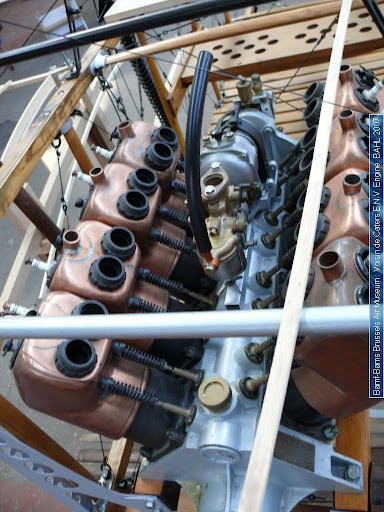
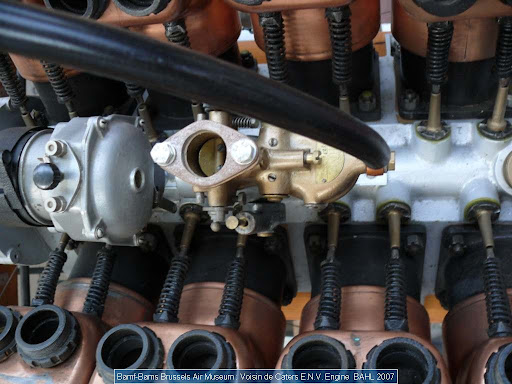
Links to the above pics as they do not seem to be visible?
http://picasaweb.google.com/bamf.bamrs/VoisinDeCaters/photo#5188458859203623650
http://picasaweb.google.com/bamf.bamrs/VoisinDeCaters/photo#5188458683109964434
I have a 1972 reprint of “The Aero Manual – 1910”, it describes the water cooled V8 E.N.V. ,the water cooled upright 4 cylinder Bayard-Clement and the water cooled upwright 6 cylinder Buchet motors.
I suspect the Howcraft engine is a self created engine on the same principles?
It seems from the photo below that:
1: It is possible spark plugs exist top dead centre of the cylinders
2. It seems the fuel inlet manifold is missing from the LHS of engine (can we have a better side on pic from that side?
3. It seems the water inlet manifold was located on the top of the engine adjacent to the sparkplugs?
4. It is assumed the carburettor is missing with the inlet manifold?
5. There is an exhaust gas manifold on the RHS of the engine, venting to the rear?
6. It seems there is a water jacket outlet manifold on the LHS of the engine
7. It is assumed there is some inlet and outlet to the manifold to allow connection to an external radiator and header tank that was a feature of water cooled aircraft of the period?
8. the “front” of the engine has a single gear/cog fitted to the crankshaft, possibly a drive shaft for the magneto?
9. The “rear” of the engine has three gears/cogs fitted to the main crankshaft, the closest to the engine drives the two camshafts, (one of the camshaft gear/cogs is missing).
10. The remaining two large gears/cogs are identical, and appear to be for chain drives to propellors, suggesting a Wright Flyer type twin pusher prop configuration?
The 1907 and 1909 Wright Flyers used a 4 cylinder upright inline water cooled engine, I wonder if this engine by Howcraft was used to power a Wright Flyer or derivitive? in the UK.
Short Brothers built 6 Wright Flyers at Leysdown UK during 1909-1910, but “apparantly” used French built engines?
Flugmaschine Wright GmbH in Germany constructed 22 Wright Flyers during 1909-1910, details of engines used is unknown?
Elsewhere the Green Engine Company of the UK is listed as supplying the upright water cooled 4 cylinder inline in November 1909 for the Short brother’s Wright Flyers?
Is it possible Howcraft was competing with Green’s for Short’s business?

The following webpage extract suggests there were many other inline 6 cylinder engines in development over the same period?
It would be interesting to unearth the 1910 Critchley and 1912 Clark engine lists referred to in it?
A later development of the Green engine was a six-cylindered vertical, cylinder dimensions being 5.5 inch diameter by 6 inch stroke, developing 120 brake horsepower when running at 1,250 revolutions per minute. The total weight of the engine with ignition system 398 was 440 lbs., or 3.66 lbs. per horse-power. One of these engines was used on the machine which, in 1909, won the prize of L1,000 for the first circular mile flight, and it may be noted, too, that S. F. Cody, making the circuit of England in 1911, used a four-cylinder Green engine. Again, it was a Green engine that in 1914 won the L5,000 prize offered for the best aero engine in the Naval and Military aeroplane engine competition.
Manufacture of the Green engines, in the period of the War, had standardised to the production of three types. Two of these were six-cylinder models, giving respectively 100 and 150 brake horse-power, and the third was a twelve-cylindered model rated at 275 brake horse-power.
In 1910 J. S. Critchley compiled a list showing the types of engine then being manufactured; twenty-two out of a total of seventy-six were of the four-cylindered vertical type, and in addition to these there were two six-cylindered verticals. The sizes of the four-cylinder types ranged from 26 up to 118 brake horse-power; fourteen of them developed less than 50 horse-power, and only two developed over 100 horse-power.
It became apparent, even in the early stages of heavier-than-air flying, that four-cylinder engines did not produce the even torque that was required for the rotation of the power shaft, even though a flywheel was fitted to the engine. With this type of engine the breakage of air-screws was of frequent occurrence, and an engine having a more regular rotation was sought, both for this and to avoid the excessive vibration often experienced with the four-cylinder type. Another, point that forced itself on engine builders was that the increased power which was becoming necessary for the propulsion of aircraft made an increase in the number of cylinders essential, in order to obtain a light engine. An instance of the weight reduction obtainable in using six cylinders instead of four is shown in Critchley’s list, for one of the four-cylinder engines developed 118.5 brake horse-power and weighed 1,100 lbs., whereas a six-cylinder engine by the same manufacturer developed 117.5 brake horse-power with a weight of 880 lbs., the respective cylinder dimensions being 7.48 diameter by 9.06 stroke for the four-cylinder engine, and 6.1 diameter by 7.28 stroke for the six-cylinder type.
A list of aeroplane engines, prepared in 1912 by Graham Clark, showed that, out of the total number of 112 engines then being manufactured, forty-two were of the vertical type, and of this number twenty-four had four-cylinders while sixteen were six-cylindered. The German aeroplane engine trials were held a year later, and sixty-six engines entered the competition, fourteen of these being made with air-cooled cylinders. All of the ten engines that were chosen for the final trials were of the water-cooled type, and the first place was won by a Benz four-cylinder vertical engine which developed 102 brake horse-power at 1,288 revolutions per minute. The cylinder dimensions of this engine were 5.1 inch diameter by 7.1 inch stroke, and the weight of the engine worked out at 3.4 lbs. per brake horse-power. During the trials the full-load petrol consumption was 0.53 pint per horse-power per hour, and the amount of lubricating oil used was 0.0385 pint per brake horse-power per hour. In general construction this Benz engine was somewhat similar to the Green engine already described; the overhead valves, fitted in the tops of the cylinders, were similarly arranged, as was the cam-shaft; two springs were fitted to each of the valves to guard against the possibility of the engine being put out of action by breakage of one of the springs, and ignition was obtained by two high-tension magnetos giving simultaneous sparks in each cylinder by means of two sparking plugs–this dual ignition reduced the possibility of ignition troubles. The cylinder jackets were made of welded sheet steel so fitted around the cylinder that the head was also water-cooled, and the jackets were corrugated in the middle to admit of independent expansion. Even the lubrication system was duplicated, two sets of pumps being used, one to circulate the main supply of lubricating oil, and the other to give a continuous supply of fresh oil to the bearings, so that if the supply from one pump failed the other could still maintain effective lubrication.
It would be interesting to know what archival information/ photos exists about Howcraft’s aircraft? in 1908?, as to if it was his own design, and what its configuration was? (twin pusher etc?)
regards
Mark Pilkington
mark_pilkingtonNorm
The tale is very long and infact involves two tails.
The Lancaster cockpit/nose is from Lancaster TW911 which was a former A-W Python testbed airframe, the cockpit/nose was later fitted to Lincoln RF342 (apparantly due to improved esacape features of the Lancaster over Lincoln?) and used in that form by Napier when the Lincoln was used as an airfoil test bed, the cockpit/nose was sold off seperately while the Lincoln was at North Weald, the remains of the Lincoln spent many years at Sandtoft before recent export to Australia.
http://forum.keypublishing.co.uk/showthread.php?t=74
it is unclear if the cockpit from TW911 was fitted to RF342 during its radar test bed work with the RAF, or during its time with Napiers?
the Lincoln is in Australia for long term static restoration and display
http://aarg.com.au/Lincoln.htm
regards
Mark Pilkington
mark_pilkingtonExcellent and informative post,
I understand there is only 1 Mark 21 left, that being at the RAAF Museum, and only one other early example is a mark 1A surviving in Argentina.
With all others of the total 13 survivors being Mark 31’s, it would seem that CF-QWJ/G-AMLP was not only the last flying long nose Freighter, but also the last surviving one?
regards
Mark Pilkington
mark_pilkington.
It always amuses me that some people seem to be rather aggrieved (agrieved – edit lol) their viewing time is taken up reading posts requesting “easy to find elsewhere” information, but the same people always have the time to log on, and post a message telling the enquirer to search the topic via “thread archive” or “google”, before asking such questions in the forum.
If a topic is “uninteresting”, or the enquirer being “lazy”, simply leave the unaswered post to die a natural death? or for someone else to reply?
A forum was recently described elsewhere as being akin to a chat “down the pub”, (other than your conversation is publicised worldwide, and left up for posterity.)
The quality of the discussions, and the naivety (niavety -edited lol) of the questions raised can vary accordingly.
The forum will attract people of various ages and expertises in the subject matter, if someone asks “Dorothy Dicks” questions or starts a thread that was beaten to death by analysis in 2002 what does it matter? surely those who “cant be bothered”, “wont be bothered”, and those “who can” – “will”.
While information anywhere on the NET should be questioned for its accuracy, the responses in a forum are only as good as the person typing at the other end of the keyboard (much the same in the pub), and as raised above, should not be taken to be more authoritative than more formally structured and “published” texts on the web (which are likely to have some level of research underpinning their claims.)
Though a heavy “surfer” of the Net and digester of aviation information online, which includes surfing google via keywords just for fun, I personally still prefer to independantly reference such information back to a bound book of some description if I am relying on it in any way.
Similarly there is sometimes a “school master” approach by some people on forums to correct minute facts (including grammar and spelling) of such posters, that seem more about evidencing the corrector’s “pre-eminence” in the topic rather than maintaining a clean flow of communication.
(often referred to as “pissing competitions” smiles)
However, despite all of the above, it is always good manners to be polite and thankful to someone who has chosen to take his own time to research information for you, regardless of that coming from his own knowledge, his book collection or simply his online search engine?
And yes I do agree that if you are computer literate “enough” to read and post at a forum you are probably able to master the art “keyword searches” on Google prior to posting the question here – but then do you ensure you do the same thing before asking such a question down the pub?
regards
Mark Pilkington
mark_pilkington.
Ed Storo built a Bristol Fighter replica in the USA, & is now building a Bristol Bulldog replica.
A number were also built for a film in Canada, and they are supposedly in storage in the US?
Regards
Mark Pilkington
mark_pilkington.
Interestingly, I saw this film, or more correctly the US release version “No Highway in the Sky” last week on Foxtel’s “Entertainment” channel in the FOX Classics section here in Australia.
FOX classics is where they re-run I love Lucy, MASH, John Wayne movies such as the Son’s of Katie Elder” and other classics from their catalogue, usually the same program airs a couple times a week and then dis-appears.
The “Reindeer” isnt listed for any more airings in May but I noticed “Gomer Pyle” and “Green Acres” are both apparantly running over the next few weeks.
Dont pity me too much though, the same channel has let me watch the “Battle of Britain” twice in the last month, and “Tora Tora Tora” twice and Midway once since Xmas smiles.
In regard to the internal cabin shots, these seemed to be too wide for any aircraft of the period and I suspect they are done in a studio and not inside either the”Halifax/Halton/Hermes” fullscale mockup or any other real aircraft.
The storyline is of a aeronautical engineer/ mathematician who works for the manufacturer and has already inspected a crash site and determined aircraft will fail due to fatigue at a set number of operating hours.
He absent mindly finds himself riding on one of the aircraft on a return flight from the crashsite and determines it will reach its target hours mid flight and crash due to metal fatigue, it however makes it to the next landing ground to re-fuel, disproving his calculations.
The Cabin consists of two rows of two seats on either side of a vey wide aisle, the seats form “compartments” seperated by clear plastic dividers to the set in front or behind. The passenger windows are wide similar to the post war DC3 “Viewmaster” configurations.
The rear cabin has a full kitchen with heavy electric oven, that forms the basis for Jimmy Stewarts Character’s theory for the only safe place to survive an impending crash of the aircraft to be in the mens toilet directly behind the reinforced wall holding the oven in place. (Interestingly the toilet door bears little resemblance to an aircraft toilet door, and looks more like a house door!)
He tells this to Marlene Dietrich who plays a film star travelling on the aircraft as well as Glynis Johns who plays the Hostess and later his wife.
After his crash theory is proven incorrect, Stewart is kicked off the flight by the pilot, who inspects the aircraft and can find no fatigue, before the flight can depart on the next leg of the journey Stewart enters the cockpit and raises the undercarriage, sabotaging the aircraft.
Strangely, despite being considered a looney by the pilot, crew and most of the passengers, the air hostess on the flight decides he needs her to marry him to look after him? and they end up married?
He later undertakes a structural stress test of a tail section in his laboratory to prove his theory, his test piece “fails” at the same time two members of the Government Ministry are visiting him, and are coincidentally told the tail of the aircraft he had sabotaged, had fallen off while the aircraft was taxi-ing for take-off and a second aircraft’s tail had also fallen off in some other incident – all with no further loss of life – he then realises his calculations had not taken into account the colder temperature of high altitude and that is the cause of the error in his predictions of the midflight failure- in the end a corny movie where every one lives happiliy ever after, and Jimmy gets the girl, and saves the day, and modern aviation is proved safe once more.
(I suspect the storyline is somehow related to the Comet 1 issues? and trying to reassure the travelling public)
regards
Mark Pilkington
mark_pilkington.
This photo must be very old based on the known history of G-AIHI being:
Gemini M.65 6283 G-AIHI Untraced France 1948 F-BENP
Known History: The CoA was issued on 6 November 1946 as G-AIHI. To France in February 1948 as F-BENP.
suggesting the photo was taken between November 1946 and February 1948.
A likely explanation is that the marking G-AIHI was incorrectly placed on another s/n Gemini and that was discovered & rectified (and therefore temporarily duplicated) before sale of the correct G-AIHI s/n 6283 to France as F-BENP?
I assume as new aircraft both AIHI’s are shown at the manufacturer before the successful sale to France of one of them.
There is NO record of any other Gemini’s intentionally carrying the AIHI marks either as G, D or ??-AIHI, so it most certainly seems like an unintentional or “intentional” duplication by the paint shop? of G-AIHI??
Another possibility is an intentional temporary marking of another aircraft as G-AIHI to facilitate the sale to the overseas buyer at time of inspection? due to some unforeseen unavailability of the real G-AIHI?
I seem to recall reading in Stuart McKay’s excellent book of a similar technique used by DH to sell a Moth where the buyer demanded a certain colour be available at time of order and refused to sign until he could see his completed aircraft, so the customers rego marks were temporarily applied to a correctly painted other aircraft to satisfy the customers whim, with the actual aircraft delivery being delayed after contract signing to discretely allow the true purchased aircraft to be repainted in the customer’s colour scheme and be delivered in its correct rego marks.
http://members.aol.com/warwicaero/milesaircraft/aircraft/m65afhis.htm
The prototype, G-AGUS, presented no problems with its construction and was first flown by either F G or George Miles on the 26 October 1945. It originally had fixed undercarriage, but this was a temporary measure due to the non-availability of the retractable units that were powered by Miles electric actuators………The first production machine was G-AIDO, now fitted with the retractable undercarriage units, and it was designated the M.65 1A. It was certified on the 30 August 1946. Another five followed quickly, and the last large scale production run for Miles had started.
The above website demonstrates some strange relationships between s/n and CoA dates
s/n CoA date
4701 (prototype) 15/3/46 (G-AGUS) built as fixed undercarriage
6280 20/6/47 (G-AJOJ)
6281 20/6/47 (G-AJOK)
6282 8/8/47 (G-AJOM)
6283 6/11/46 (G-AIHI)
6284 3/10/47 (G-AKDD)
6285 3/4/47 (G-AISD)
6286 – 6304 various dates in 1947 G-AJ?? & AK?? series)
6305 4/11/46 (G-AHKL)
6306 “second proto” 30/8/46 (G-AIDO) * listed as first production a/c
6307 27/9/46 (G-AIHM)
6308 30/10/46 (G-AIDG)
6309 4/11/46 (G-AIKW)
6310 10/12/46 (G-AIIE)
6311 30/1/47 (G-AILG)
6312 – 6329 Various dates in 1947 various G-AI, AJ & AK series
6444 – 6478 Various dates from 47 to 59 various G-AI, AJ & AK series
By “serial number” 6283 G-AIHI is the 5th Gemini built? and yet 7th to recieve a CoA “by date”? with many of the other 6280 block aircraft receiving their CoA’s much later in 1947?.
Interestingly the other 1946 CoA aircraft are all in the 6300 block including 6306 which is listed as the second prototype or first production a/c.
Also of interest is that the registration of 6305 as a “G-AH” series would seem an earlier registration mark than the “G-AI” series aircraft with CoA’s dated earleir than it?
Were these aircraft assembled and flown under a manufacturers number? prior to being issued a CofA? could the marks be reserved and allocated prior to the CoA being formally issued on a particular date?
Is it possible the first s/n aircraft built on the production line in the 6280 series were held up on the production due to issues with the retractable undercarriage etc and upgrades to M.65 1A in a similar way to the prototype, causing the first production aircraft to actually issued and flown with CoA to be from the 6300 block.
This might explain that 6283 was actually caught up in this issue and out of sequence ,and either its s/n incorrectly linked to a 1946 CoA while another airframe was actually marked and flown as G-AIHI at that time, until the error was found and corrected during inspection at time of sale in early 1948?
This situation may well have then resulted in the duplicate registrations being carried by two airframes? for a brief period at the factory? prior to delivery of of s/n 6283 to France.
Unfortunately it does not seem possible to identify a likely candidate for the incorrectly “second” marked AIHI? or indeed to identify which is the future French aircraft in the photo?
An interesting puzzle you found Mark12
Regards
Mark Pilkington
mark_pilkington.
Australia has a number of sites with dams, quarries or holes filled with aircraft parts, the Archerfield quarry is linked to in an earlier post and yielded a Wirraway wing, Lincoln and Mosquito parts, there remains the legends of Spitfires in mine shafts in Qld or the P40 and zero’s in the Bundeburg bunkers yet neither of those legends have progressed beyond that status.
Another site that has yielded alot of aircraft parts over the years is Tocumwal at the former USAAF McIntyre Field and laterRAAF Base, complete aircraft such as the Moorabbin Air Museum T7 Meteor were recovered from the site, as well as many Wirraway fuselage frames (from nearby properties) Wackett Trainer and Boomerang frames, B29 Undercarriage, and B24 ailerons etc that survived in the area.
On my own first visit to the site in the mid 1970’s roads into the airport still had items such as Beaufighter narcelle panels lying in the dirt.
On my last serious visit there a few years ago I unearthed an anti-glare panel from a wartime Wirraway rear instrument panel, and a gun camera mount from a Wirraway centre-section, both were in excellent usable condition with no corrosion or metal damage, and only requiring paint stripping and re-painting.
Water Irrigation channels around the airfield were reputed to have 30 and 50 cal machine guns dumped in them but I never saw evidence of those.
The well known “Dam” at Tocumwal is full of steel aircraft parts dumped after the smeltering process, with a few odd aluminium parts also being in existance, these include B24 waist gun mounts, and many steel parts from Wirraway, Boomerang, Anson, Mosquito and Tigermoth, representing the types scrapped nearby.
The Dam still contains a mountain of parts, but action of heat during the smelting process to remove aluminium and the subsequent years of water submersion has rendered most useless other than as patterns or for use in a static display.
Again this is not evidence of the military burying surplus material, but more the actions of the scrapper to dispose of waste scrap material, and assumed permission to do so via “land fill”.
Regards
Mark Pilkington
mark_pilkingtonFrom the Wkipedia link “West Meon Tunnel is currently used to store caravans and other building supplies together with a large amount of Cold War era scrap left behind from the aircraft storage and breaking during the 80’s”
Is this where the Lasham scrap dump aircraft ended up?
The Wiki link had a more direct item of information worthy of pasting here:
During the early 1950s, British Railways drew up its ‘Modernisation Plan’. This mainly concerned itself with the planned withdrawal of steam locomotives and the electrification of its main trunk routes. However, the plan also listed several lines that could be closed either because they were redunant in a nationalised, competition-free network or because they were unsustainable to operate. The Meon Valley Railway fell into both these catergories
After the 1962 closure of the southern portion of the line, a Mr. Charles Sadler purchased Droxford station and the right to run trains over the railway. He used it for testing a design of railbus that he had developed called the ‘Pacerailer’. Like the similarly-named British Rail ‘Pacer’ of later years, this was essentially a bus-style body on railway bogies. As well as the MVR itself, a special steep-gradient section of track was built for testing at Droxford. The Pacerailer was then moved to the Isle of Wight for testing in service, but was not adopted.
The northern section of line to Farringdon was lifted almost immediately after closure. The two tunnels at West Meon and Privett were sold to private users. West Meon Tunnel was used by a scrapdealer for breaking up ex-military vehicles and aircraft until the 1980s, whilst Privett Tunnel was used for growing mushrooms.
It would seem then that the tunnel was used by a scrap dealer from the 1960’s to 1980’s who was responsible for bring the post war wreckage on site tfor reclamation, not burying.
While technically fitting the legend and most likely the source of that particular story, it is not strictly evidence of the military using such locations to dispose of wartime surplus materials by burial rather than simply sale to a scrap dealer.
Regards
Mark Pilkington
mark_pilkingtonQldSpitty,
It looks great and good luck with the project.
By the way, well done to the group for presenting the project as a reproduction (using original parts) rather than a restoration.
It doesnt take anything away from the effort and accuracy of construction to do so, but unfortunately so many projects do falsely make claims to be restorations.
regards
Mark Pilkington
mark_pilkingtonMartin and Ross,
Thanks very much for that,
I suspected the airframe was VH-FIA as I had found a Moorabbin Air Museum display sign marked “VH-FIA” with the parts.
I have recently acquired the fuselage frame and other Anson remains from a film set and that fuselage ID is from the fuselage frame, while VH-FIA did go to South Australia it would seem its basic fuselage frame was not used in their restoration of EF954, despite perhaps many other parts being consumed into that project.
Interestingly these parts were acquired from the Navy at Nowra so since 1984 “FIA” has travelled from Victoria to South Australia, to New South Wales and back to Victoria, all long after it stopped flying, a round trip of @3000 Km (@1800 miles) not a bad effort from an aircraft grounded and derelict from the early 1960’s?
While these parts are joining the remains of EG426 and may others in my own ownership, the long term intention is donation to a Museum I am associated with, so it seems AW965 / VH-FIA might also be part homing pidgeon? and it may eventually return after departing nearly 25 years ago? smiles
Regards
Mark Pilkington
mark_pilkington.
Not that “google & wiki” are any great references but this line from the wiki entry seems to support the possibility?
As well as re-engining with the Jaguar, Major Green decided to redesign the Siskin with an all steel structure, as the Siskin III. The Siskin III first flew on 7 May 1923,[1] with first deliveries to the RAF (six for evaluation) taking place in January 1924. The fighter was the first all-metal fighter in the British Royal Air Force.
as well as:
The origination of the Armstrong Whitworth Siskin series of aircraft can be traced back to a post-World War One aircraft design designated as the Siddeley Deasy S.R. Siskin. Initially composed mainly of wood (common for aircraft in the First World War), the system had to be redesigned at the behest of the UK Air Ministry, fulfilling their new requirements for “all-metal” aircraft.
As such, the redesigned Siskin III entered operational service in 1924, becoming the Royal Air Forces first all-metal purpose fighter in history
A great find, and perhaps able to yield a wing panel or two for future display? and preservation?
(I am not aware of any complete survivors or major components?)
By the Way Ali, have you thought to pop next door to make sure their barn roof isnt built with Siskin Fuselage side frames smiles?
Regards
Mark Pilkington


 Sign In







