 mark_pilkington
Rob,
My earlier post was simply to say that with the decision made by the City of Calgary the need to grill to Richard was a bit pointless.
This is why I ask how the City has the airframes listed not if they plan on selling them now or latter. maybe the first thing you folks should do is to make sure the City has listed them and if they wish not to then ask why.
Most heritage laws, particularly local government and State Government, have been framed around “built heritage” rather than “moveable cultural heritage” hence at this point they are filled with heritage buildings and places, and not cars and aircraft. This situation is slowly changing as those heritage “authorities” expand their roles and areas of knowledge and interest.
In Australia we have seen the B24 listed by the National Trust, and a number of aircraft are now under consideration for listing on the Victorian Heritage Register.
In Australia our peak Heritage List is the National Heritage List, however our moveable cultural protection laws, the ones which control exports, do not require an object to be listed on any heritage list to have it prevented from being exported. I suspect this is the same situation in Canada.
By the way it was explain to me was say I lived in Ottawa and want to purchase the Mossie I could being that I live in Ottawa there would be nothing that Heritage Canada could do to stop the sell.
Then I ask well what if I decide after a few years I want to sell it to say an American Collector they told me that under Heritage Canada Laws that it would be very hard for them to stop a private person selling there personal items.
Similarly the local/state or National heritage listings do not stop a current owner selling his object/place or building to someone else – even an “American Collector” – neither do our moveable cultural heritage laws, it is the prevention of export permits that causes the problem – not a prevention of ownership. Again I suspect this is the same situation in Canada.
I think the Heritage Canada answers you received do not in anyway undermine the likelihood that the Mossie would face export restrictions from Canada?
Regards
Mark Pilkington
mark_pilkingtonMondariz,
I came across this pic on a link in another KP thread, but it graphically shows what jungle can do to hide an airframe, making location by air or GE very difficult.

Even though it appears to be in a clearing, its broken form, discolouration and partial covering of leaves and plants would make it virtually impossible to locate from the air.
Regards
Mark Pilkington
mark_pilkingtonRoss,
the recently recovered Proctor Mk III G-AKEX appears to have suffered some fuselage damage in transit with photos posted in an earlier KP thread showing new holes in the rear fuselage and bracing added to avoid further damage, I wonder if in its current state it might offer easy access for all the photos you are seeking?
http://forum.keypublishing.co.uk/showthread.php?t=76545&highlight=proctor
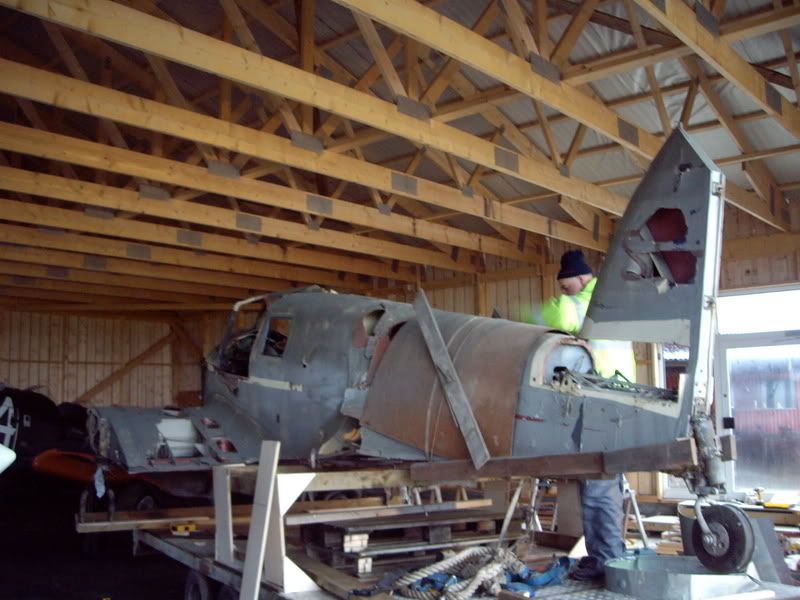
Otherwise if you can confirm how the photos are accessed via inspection panels I can explore photos of VH-AUC at the Museum at Moorabbin, (or chase up access to DUL with Maurice?)
Regards
Mark Pilkington
mark_pilkington.
Although worthy of its own thread, I thought it most appropriate to proove this threads subject line to be incorrect by advising to those interested that the Camden Aviation Museum’s website is back up and operational and forecasting a re-opening in Mid 2008.
Congratulations to all concerned, and great to see this most significant collection remaining intact, in Australia, and most importantly in memory of the Thomas family efforts to preserve it.
http://www.camdenmuseumofaviation.com.au/index.asp
Regards
Mark Pilkington
mark_pilkingtonRob,
I think you are a flogging a dead horse here, the current situation seems to be that the owners of the aircraft – the City of Calgary, have rejected the museum board’s proposal to sell the Mosquito, it is their property and therefore their decision.
(I suspect this is the stage the previous sale attempt reached, before also being vetoed by the City itself, – if the aircraft belong to the City rather than the Museum board, then a contract of sale cant be enforced on a body that has no rights of ownership.)
Richard has made it clear he was involved in the setting up of the museum, and available to assist in future operations, but that all of that is awaiting the museum’s AGM?, outcome of a City review into way’s the museum can be assisted, and the response to this decision by the current Museum board.
It is also clear that Richard has played a role in the opposition to this sale, but that is his right to do so.
I dont think Richard, or more importantly the City of Calgary need to defend their storage methods, or previous disposals? to justify them keeping their own aircraft?
In fact I think Richard has pointed to past sales being largely due to funding the operating costs of the museum rather than due to decisions on relevence to the collection, or capability to restore the aircraft.
What hopefully does come from this is a long term strategy and solution to the museum’s operations and restoration resources?
I would be perfectly happy to see the City of Calgary retain and restore both the Mossie and the Hurricane, and with the restoration offer from Nanton or additional funding from the City itself the museum would seem to be capable of achieving that.
The Calgary collection is quite impressive, covering:
WW1 with a replica Sopwith Triplane,
WW2 with Lancaster Mk X, Tigermoth, Anson, Harvard, Cessna Crane, Auster III,
Post War Military
CF100, CF101, Vampire, F86
Civilian Aircraft
Beech 18, Norseman, DC3, Twin Otter, and a couple of Wacos.
http://www.asmac.ab.ca/html/aircraft.html
The retention of both the Hurricane and Mosquito would seem to be quite relevent to the Calgary collection, while this Mosquito is of UK production, the type, along with the Lancaster and Hurricane, is one of three wartime production types built in Canada during WW2.
The same three types are also three of the most significant flown by Canadian EATS or “RAF” Squadrons in combat in Europe, regardless of where the airframes were built.
This particular aircraft also has an appropriate Canadian history relating to its important work in aerial mapping with Spartans, and given the other examples in Military finish, it would be quite appropriate, and refreshing to see it restored in its civil guise (and possibly the only Mossie to do so?)
I think a “restore and display” lease arrangement with Nanton, where the Mossie, (and the hurricane?) were both lent to Nanton under a bonefide project managed restoration by the Nanton Volunteers, and retained for display at Nanton for an agreed period of time – (20 years?) before return to Calgary, could resolve all of the concerns about storage, restoration, public access and display, and retention within the Calgary collection could be thereby achieved at a relatively low cost? to the museum and the City of Calgary.
Such “Restore,Retain and Return” loans between museums seem quite an appropriate tool to use.
Regards
Mark Pilkington
mark_pilkington.
Not sure if JDK posted these updates on the Boxkite after the Point Cook Air Pageant two weeks ago, but here is a picture of the display of completed parts in the RAAF Museum restoration hangar, along with the replica Deperdussin that is its contemporary from the CFS in 1914.
regards
Mark Pilkington
mark_pilkingtonThis is indeed great news, and the CAF deserve all our support for undertaking the responsibilities of keeping such aircraft in the air for us to all to see.
I know the CAF has copped its share of criticism over the years, and I am not in a position to defend nor judge them on those issues.
But from afar over here in Australia, and from my own point of view, the CAF is seen to do a wonderful job, and without its early efforts in the 1950s and 60’s I wonder how many of these particular aircraft would have survived and indeed what the modern “Warbird” movement would look like today had the group not existed.
While the 1960’s Battle of Britain film may have saved a number of Spitfires and spanish ‘109’s and He111’s for posterity and flying operations, and certainly re-envigorated an interest in these wartime aircraft, I understand the CAF played a major role in supporting the flying etc, the same I understand is true of the Tora Tora movies, and without the full size flying aircraft the movies would have been a poor presentation of their respective stories, and perhaps had little effect on the interest in Warbirds.
Despite all that and in any case, I feel that while others have since worked to establish flying examples of the B24 and B29 – and many other rare and exotic aircraft, it is certainly hats of to the CAF to have taken on both, and achieved it, and all the other aircraft, along with being a pioneer and flag ship to the warbird movement world wide, all on a volunteer, not for profit basis.
I certainly feel they deserve all of our support and thanks
I personally hope to get over when the B29 is back in the air, and visit Fifi, ‘Lil, and Gary!
Regards
Mark Pilkington
mark_pilkingtonThanks for the excellent information, Mark! The test pilot’s comments were very interesting. It’s a shame production was delayed till the point where it was too late, but I guess we should be thankful the CA-15 was at least built and flown.
Ah, yes I’ve seen the 1/6th scale model before and especially the last shot is utterly convincing!
The marvellous head-on shot from the Lincoln, while flying over Melbourne and piloted by Lee Archer (this may give a clue as to the date, as the CA-15 flight log has survived somewhere I believe – can’t remember which book it was published in though but either way I don’t have it) can be found in Wings of Fame #4, page 119. It shows the red dots in the roundels so it must have been in 1948 or later.
One feature of the CA-15 has puzzled me for awhile now and that’s the gun ports. It was never armed but from some photos there do appear to be gunports with something(???) in them, while on others they’re not visible at all and in the head-on shot they appear to be covered (tape? puty?). None of the photos I have seen show the spent shell ejection openings in the bottom wing, but I assume these were there as well. Can you or James confirm?
I think the air to air photos from the Lincoln is most likely from the 1948 period of flights, the CA-15 first flew from 4 March 1946 through to 10 December 1946 when it had a forced landing at Point Cook.
The first Lincoln flew on 12 March 1946, and by December 1946 a total of 7 had been delivered, of course to have the then two most advanced products displayed together may have been an opportunity, but it would be expected that many more photo’s on the ground and air would have occurred.
I think the red centre roundals would then certainly date it into the post 1948 flights with ARDU and most likely their allocated Lincoln, and at that time the lincoln had been inservice for some time and of little interest.
The issue of blanked over gun ports actually seems to be miss identification of the ports, they are located outboard of the undercarriage and are not much more than “holes” and therefore very hard to see in some photos, there are some very shiny skin sections directly in front of the undercarriage attach points (perhaps access panels?) and these might be mistaken as the ports being tapped or blanked over?
Regards
Mark Pilkington
mark_pilkingtonMondariz,
One you could go looking for is a complete B24 sitting on a high mountain plateau in SEA (Indonesia I believe).
I saw it in on the net many years ago in a poor aerial photo and associated article, with its rear fuselage broken off and near by, but largely intact and remote from scrappers etc.
Since that time I have been unable to find reference to it or photos elsewhere, and wonder if leads to it can be found, and it be searched for via GE.
Does anyone else – (rob?) recall this wreck?
Regards
Mark Pilkington
mark_pilkingtonI think a massed formation fly-past is unlikely in our life times, but some fantastic items recovered including some surprising non-Hawker bi plane items, too. Quite breathtaking. Have to admit I kinda regret declining the invite to be on the recovery, but Kabul was not high on my “places I must visit” list.
This is the second “cryptic clue” to some other type being included in the recovery, is there an embargo on its identity, or can those be elaborated on (while not wanting to distract from the wonderful news on the Hind recovery)
Obviously not all 15 Hinds will make it into preservation in their own right, let alone into the air (and by the sound of it not all 15 are in anyway complete in anycase) but such a cache of parts must be likely to yield one or two potential flying projects and a handful of static displays eventually, still a far better outcome than ongoing rotting in a minefield.
I am glad I didnt have the same dilemma that Tangmere grappled with, although I am sure I would have made the same decision.
all in all wonderful news
Regards
Mark Pilkington
mark_pilkington.
This thread has been an interesting and thought provoking debate of the merits of using GE in aiding wreckology and recoveries.
There has been polite but vigorous debate about the issues, benefits and likely successes, all in good manners, and recognition that there is no harm in trying.
It is therefore dis-appointing to see a P3 pissing competition develop well away from the topic and debate of this interesting thread.
If a P3 was, or was not used in the Steve Fossett search, and its usefulness or otherwise is of little relevence here.
The reference to the Fossett search was in relation to the use of GE, and obviously it was considered a worthwhile tool to try and use.
It may or may not have “found” a wreck, or at least identified an anomoly? and it may or may not find a wreck in the Pacific.
It is simply another tool like underwater side scans, that may assist in the search for a known or suspected wreck.
It has its obvious limitations and it will be seen as to what true role it can play, but thankyou to Mondariz for creating an armchair debate, for armchair enthusiasts to consider an armchair method of becoming involved.
Hopefully our vigorous challenges and debate is not seen to be, or allowed to become a pissing competition.
Regards
Mark Pilkington
mark_pilkingtonMondariz,
I wish you luck, and hope you do uncover something interesting.
My own use of GE has related to trying to view wrecks that I already know exist, and have found GE great to provide local knowledge and interpret photos and maps of thel locality, but generally of little value to find the actual wreck.
The Tofino Canso/PBY in Canada, is viewable from the air as per the attached pic but last time I tried, the hi res stopped @ 5km south of the wreck and the low res images were worthless.
The Yukon Lincoln wreck is on hi res on GE, and still impossible to identify from GE, whereas aerial photos suggest it is visable from the air.
So on My own experiences so far, I am not convinced GE provides a great value, if I cant find wrecks via GE that I know are there, I suspect I wont find wrecks that I hope are there?
But thats no reason not to look if you do have a hunch, and the time to do it.
Regards
Mark Pilkington
mark_pilkingtonMondariz,
I think we all agree that if you restrict your search to areas where known losses are listed you may well find something new, but finding that wreck in the Russian wilderness via GE scanning would still be like finding a needle in a haystack IMHO.
Regards
Mark Pilkington
mark_pilkingtonMore Hawker Biplanes??, I remember the days when an Issacs Fury was all the rave, and a full scale flying replica the ultimate achievement.
Now we have Hinds, Demons, Harts and Nimrods everywhere, and yet now another 15?? Hinds.
Seems these things have moved of the extinct and endangered list to becoming a common garden variety pest, looks like we will have a plague of them! smiles, oh well such is life.
Great news to hear they have been recovered from war torn Afaganistan.
Regards
Mark Pilkington
mark_pilkingtonThe Japanese runway on Tarawa was parallel to the beach, the current one was originally only a taxiway. Can you see the coastal defence guns that are still in place on the eastern and western points of the island? I don’t have GE.
Paul
Perhaps then this is the real value that GE could be put to, rather than endlessly searching the wider pacific landscape, undertake a project to establish a website of GE images of Japanese and Allied airfields, with natural and “enhanced” images, and other support data as an online resource and historical record.
The “Enhanced” image could overlay the original layout of taxiways / revetments, runways, buildings, workshops, fuel dumps, repair yards. This would require a bit of work to use the GPS co-ords on the the GE images against accurate wartime scale maps, but the outcome would be of great use in a number of ways:
1. anomolies at the site could be interpreted relative to the historical land use, ie is it a building remains or possible aircraft part – your intended purpose.
2. Tourist or other visitors could orientate the current landscape against the historical landscape, adding to the interest etc of a visit, regardless of the purpose.
3. Forms an historical/ heritage study resource in its own right, ie understand where the historical boundaries of Clark Field in the Philippines, or Jacksons Field in Port Morseby PNG were, regadless of current redevelopment etc, even though there is no “warbird” recovery aspects to such information it is a valuable historical tool.
4. Provides an online historical and tourism resource for the Pacific Islands involved, who might then become a bit more actively involved in preserving some of the remaining relics? – perhaps even providing images of relics still remaining, (and helping to identify the anomolies found??)
The GE images, together with the mapped overlays could then be supported with historical photos of the base during the war and a short history of operations, creating an online resource for all of the above outcomes, and still creating the opportunity to trip over something of interest in the process?
Such a project may enlist far more helpers willing to take on research and publishing of individual “airfields” as their own projects, all on the one website.
I do agree with other comments that the existing “Wreckologists” have a fair idea what is out there, and know the hot spots to still look in, historically know where the dumps were, or where the scrappers didnt get to, I dont see GE being of much interest to them as they have access to local resources to undertake on the ground or in the air investigations.
But GE can be used to provide more information on the web on these battlegrounds, and to encourage further presevation of what is left.
Regards
Mark Pilkington


 Sign In







