 mark_pilkington
I think its important to understand the objectives of heritage law before this debate drifts off to a simple argument between free market, private ownership rights, rather than the issues arising from the Canadian Mosquito that encouraged this seperate thread.
In Australia we have had – in my opinion, a reasonably successful Moveable Cultural Heritage Law, in part the great exodus of vintage aircraft that occured from Australia in the late 60’s & 70’s contributed to calls for such a law.
The following quotes are taken from the Government website relating to the Act at http://www.environment.gov.au/heritage/movable/
Objects that people create or collect can be an important part of our cultural heritage. These objects can be artistic, technological or natural in origin.
There is increasing trade and exchange of this movable cultural heritage between nations. This exchange can be of great benefit by enhancing international appreciation of cultural diversity. It can also lead to the loss of significant aspects of a nation’s cultural heritage as these objects are traded in the international market.
In Australia’s law at least, it aims to stop the Export or loss of “Significant” Aspects of a Nation’s Cultural Heritage.
Rob himself is quickly able to list the Wright Flyer and a number of other US airframes that are to him considered significant enough to warrant such listing or protection.
The opposition to such Heritage Laws usually arise when the “Significance” of a particular item is disputed or questioned.
In 1970 the United Nations Educational, Scientific and Cultural Organisation (UNESCO) adopted the UNESCO Convention on the Means of Prohibiting the Illicit Import, Export and Transfer of Ownership of Cultural Property. Australia ratified the convention by passing the Protection of Movable Cultural Heritage Act 1986 (the Act), giving the 1970 Convention force in Australian law.
The Act regulates the export of Australia’s significant cultural heritage objects. It is not intended to restrict normal and legitimate trade in cultural property and does not affect an individual’s right to own or sell within Australia.
The Australian Laws are based on the UNESCO convention, but I in part agree with Tom, Heritage “significance” should not be only defined in terms of world significance – , ie the Wright Flyer, that is the purpose of the World Heritage List etc, and there is clearly a role for National and even local heritage significance.
In Australia we have a hierachy of local heritage registration lists, state heritage registration lists, Commonwealth heritage registration lists ,and the National Heritage List (created in 2004) that Point Cook was recently added to in 2007. (These lists primarily contain built or natural heritage sites but are open for moveable cultural heritage to be placed on them as well – the Werribee B24 is Heritage Listed by the National Trust).
Clearly, the Australian law primarily intends to limit the export of items of National significance.
It implements a system of export permits for certain heritage objects defined by the Act as ‘Australian protected objects’. Australian protected objects are objects which form part of the movable cultural heritage of Australia and which meet the criteria established under the National Cultural Heritage Control List. The Control List is located in the Regulations to the Act, and divides Australian protected objects into two classes:
Class A objects which may not be exported
Class B objects which may be exported if granted a permit under the Act.
A person wishing to export a Class B object is required to apply for a permit in writing. Applications are processed in accordance with the legislative process established under section 10 of the Act.Certificates of Exemption, granted under section 12 of the Act, allow Australian protected objects that are currently overseas to be imported into Australia and subsequently re-exported. This includes Class A objects.
The Act also includes provisions that allow Australia to respond to an official request by a foreign government to return movable cultural heritage objects that have been illegally exported from their country of origin.
While we now have a National Heritage List in place, it is not required that an object be previously listed on that to be denied export under the law.
The law itself contains two specific “control” lists the first is very prescriptive, and relates to items that CANNOT be exported.
Class A comprises:
Victoria Cross medals awarded to Australian service personnel as listed at Part 7.2(A);
Each piece of the suit of metal armour worn by Ned Kelly at the siege of Glenrowan in Victoria in 1880 as listed at Part 9.2(A); and
Aboriginal and Torres Strait Islander objects which cannot be exported. These are:Sacred and secret ritual objects
Bark and log coffins used as traditional burial objects
Human remains
Rock art
Dendroglyphs (carved trees)
The remaining section of the control list describes the remaining categories of objects including that which historic aircraft are placed.
Class B comprises objects that are of cultural significance to Australia and require permission to be exported. The categories are:
Australian Aboriginal and Torres Strait Islander Heritage
Archaeology
Natural Science
Applied Science or Technology
Fine or Decorative Arts
Documentary Heritage
Numismatics (coins)
Philately (stamps)
Historical Significance
Our laws require anyone intending to export an aircraft, as an object of applied technology, to obtain an export permit.
We have had attempts to flout the intent of such laws, (A spitfire was exported prior to the current laws described as scrap,- now flying in the UK), and more recently a ME109 disguised as a mustang so as to qualify for export.
The Moorabbin Beaufighter was denied an export permit when the then current committee was intending to sell it.
While many other historic aircraft have been successfully exported.
The law has further requirements for an aircraft, – as with all machinery, to be tested against.
For a machine to be an Australian protected object under this Part, it must meet
four criteria:(i) It must fall within one of the classifications described in Part 4. These
classifications include;
agricultural objects;
engineering objects;
objects of air transport;
objects of rail transport;
objects of road transport;
objects of scientific interest;
objects of water transport; and
weaponry.
(ii) it is not represented in at least 2 public collections in Australia by an object of
equivalent quality.
(iii) It was made or used in Australia at least 30 years ago. This means that for an
object;
! of Australian origin — it was made in Australia at least 30 years ago; or
! that has substantial Australian content — the Australian content was made in
Australia at least 30 years ago; or
! that is not of Australian origin — it was in use in Australia at least 30 years
ago.
(iv) it is of significance to Australia, in that it;
! is associated with a person, activity, event, place or business enterprise,
notable in history; or
! has received a national or international award or has a significant association
with an international event; or
! represents significant technological or social progress for its time; or
! is an object of scientific or archaeological interest.
Significance to Australia can also include significance to a region or district within Australia.
For a country the size of Australia, (7,600,000 Sq KM) the requirement for two examples in public collections is not a very restrictive requirement to expect or support. (How many spitfires would the UK or Mustangs would the US accept as a minimum to be preserved locally?)
However even objects that do not have two preserved examples can be exported if not considered of sufficient significance to Australia, uniqueness or rarerity in Australia is not a sole reason for denying export.
It is important to note that not all old machinery meets these criteria, and that even where a
machine meets all of the criteria to be an Australian protected object it may not have a sufficiently high degree of significance to Australia that an export permit would be refused.
The Act is framed so as to retain in Australia only those objects that have high level of significance to Australia. For example, a machine that was integral to establishing a business or activity notable in history might be refused a permit. Such an object could be a machine that was the primary means of establishing a new Australian agricultural industry.Because of this, the Act is framed from an historical collections perspective and not from a private collectors perspective. The fact that some objects may be rare in Australia or highly sought after by collectors is not in itself sufficient to warrant the object being classed as an Australian protected object or to be refused an export permit. The Act is designed to permit
owners the maximum freedom to deal with their own possessions, while at the same time protecting for future generations those objects that are of the highest cultural significance to Australia.
Research is required to establish the level of an object’s significance, and applicants for export permits should always supply with their application as much background information about the object as they can. Environment Australia calls on the assistance of expert examiners registered under the Act to assess if the object is a Class B object, its level of significance to
Australia, and whether the export of the object would significantly diminish Australia’s cultural heritage. The subsequent advice is considered by the National Cultural Heritage Committee, which advises the Minister for Environment and Heritage on the operation of the Act. The Minister decides whether an export permit is to be issued or denied.
Because an object seeking export is referred to independent examiners, whose findings are required to be presented to the applicant, and can then be disputed and appealed, the Australian Act to my view operates successfully to balance the interest of the private owner, and the world market for “warbirds” and “vintage” aircraft collectors with the public National interest, and heritage collections of Australia.
Regards
Mark Pilkington
mark_pilkingtonIt would be fascinating to know what international talks/agreements took place to determine which country would use what markings.
I’m sure someone with knowledge of this subject will contribute.
A cease fire was called, and a “best of 3” game play-off of “noughts and crosses” was used to decide “who used what” for national markings.
Of course they had to toss a coin to see who went first, and who was the “nought”.
grabs my hat and coat on the way out.
smiles
Mark Pilkington
mark_pilkingtonTom
The Heritage Register is produced by the British Aviation Preservation Council, a body similar to your own CAPA.
I wrote an email to the Secretary of BAPC requesting a copy, our museum is currently undertaking significance assessments of its own holdings.
The Register lists all of the preserved aircraft in museums in the UK, the edition I have (2001 the last edition?) does not categorise Gliders, Hang-gliders, man-powered aircraft or lighter than air ships, on the basis that the author does not consider he understands those area’s sufficiently to categorise them.
Powerer/heavy than air aircraft are listed alphabetically, with a brief description of the type, a numeric reference to those preserved world wide and within the UK (only counting museum examples) and then lists each preserved airframe, including partial frames and cockpits, each has been given points relating to significance (various attributes), rarity, condition, preservation, environment etc, and the best of each type are categorised as National Benchmarks, significant examples or noteworthy.
It is an excellent resource to both document the national holdings of each type, and to highlight airframes that are significant, but also allows individual museums to seek support to preserve significant airframes through the recognition given by this process.
It is something other nations such as Australia would benefit from duplicating.
regards
Mark Pilkington
mark_pilkingtonJDK,
I am not sure Tom was limiting his comments to composite airframes- although very relevent to that situation, there are many world wide examples of complete intact airframes being displayed in colourschemes not original to the airframe.
Obviously there are many flying “warbirds” displayed in more famous colourschemes, in same cases we have two or more aircraft representing an original, but that market has it own drivers beyond preservation and display to the public.
You would be well aware of the F4 Phantom and Catalina at Point Cook, neither being ex RAAF aircraft but both presented as such, a good outcome in my opinion, although I understand the Catalina is a former RCAF example with combat service.
It is difficult to know where draw a line between preserving an artefact for its own history, or using it to portray a more relevent or “representative” example.
Where an aircraft is unique, or has a very significant history of its own, I think it is most appropriate to present it in its own identity, however having said that, paint is only skin deep, and it is better to see an airframe preserved even in another colourscheme than to see it unpreserved or lost fore-ever – a case in point being the rare ex RAAF Bristol Beaufighter now displayed in the NMUSAF in US colours.
Although a problem to be faced in the future, the display of the Lincoln in Australia will be faced with the issue of presenting it as a RAAF Mark 30, as against restoring it as the only surviving test bed Lincoln, a role important to the history of the type, and a role associated with Australia although not via this particular airframe.
In the end, I believe it is appropropriate for a museum to present an aircraft in a way most relevent to its objectives and collection policy, ideally without destroying the underlying airframe for future research or even return to its own identity – all subject to the significance of the airframe in its own right.
Where that can be achieved by the aircraft remaining in its own relevent identity and colourschemes all the better.
good topic Tom
regards
Mark Pilkington
mark_pilkingtonScorpion/Rob,
If this is for Gary’s CAF Hangar project I think your seeking a DH”94″ Moth Minor in 1/72nd scale? rather than 1/17 scale?
http://www.hannants.co.uk/search/?FULL=HPM7281
http://www.hannants.co.uk/search/?FULL=DUA72117
You may wish to check the WIX post as it seems someone else has taken on the Moth Minor model?
Regards
Mark Pilkington
mark_pilkingtonAircraft come and aircraft go…globally…and it is healthy.
Mark
Mark, – I agree
While I have my personal gripes about certain losses from Australia, thats more dis-appointment in the apathy and lack of interest locally than anger at the oversea’s purchaser.
The great thing about the global market and trade is that it is a measure of the underlying strong interest in historic aircraft, and that few are now left to rot away unwanted, example the recent Japanese aircraft being recovered in the Solomons, and this is translating even down to aircraft that will never be rebuilt to fly on the warbird circuit.
The various heritage laws in England Australia and Canada are primarily there to prohibit very significant artefacts from leaving their respective nations, not to prohibit all such trade.
Beyond that the local “markets” of museums, collectors and warbird operators have to compete with oversea’s interests, and conversely have access to oversea’s exhibits and parts for their own collections, as your example shows.
However the difference in response may also relate to the emotional attachments one type may enjoy as against that for the other?
regards
Mark Pilkington
mark_pilkingtonrob/scorpion,
Those of us who know of your efforts dont doubt your heart is in the right place, but there is no value in debating the Canadian Heritage Laws here with Tom or others, the fact is they are the law of the land and need to be respected, and no doubt will play a role in the resolution of this current situation.
I would agree with Peter and think it would be better to leave this thread on topic on the issue of the possible sale and export of this mossie, and to consider creating another new thead (as Tom has done in regard to his museum’s mossie) if you wish to lay out a case of evidence on the application of Canadian Heritage Laws to particular recoveries/artefacts and invite comment there?
Regards
Mark Pilkington
mark_pilkingtonI
In regard to CF-HMQ, hindsight may make its current state or modification a regrettable outcome as compared to an inaccurate paint scheme, however it is undercover and not deteriorating any further, and perhaps at some time in the future , its time to revert back to its own form may eventually come, and it would seem the original acquistion and restoration was subject to these constraints. While perhaps regrettable, would the airframe have been saved otherwise? and exist in any form today?
Stuart Howe’s book on Mosquito survivors tells the unfortunate story of this aircraft’s modification which goes back to 1967 and a back breaking drop when being unloaded, external fibre-glassing, external display and vandalism long before donation to the City of Edmonton in 1975 and the more recent display in Tom’s museum, I think it is lucky to exist in any form, the Glynn Powell jigs etc were only a twinkle in the eye when all of this happened, and over the same time there were other derelict mossies lying around unwanted (the Mexico City XB-TOX / TA 717 or even Australia’s own VH-WAD A52-319)
In relation to “modifications” our own museum at Moorabbin for many years displayed its P40E fuselage mounted on a pair of CAC Mustang wings, a case of Australian ingenuity to display it as a more complete aircraft and allow it to undertake engine runs.
At the time it was the only P40 on public display in Australia, and a pair of P40 wings were not available. While attracting concern over the in-accuracy and sacrilege, the P40 has survived the “ordeal” and is currently under restoration (but still in need of a completed set of wings).
Regards
Mark Pilkington
mark_pilkingtonThere are of course 3 Spartan Mosquitos in Canada – CF-HML seems to be forgotten. It is in private hands and under restoration to airworthy (although nothing has been heard of it of late, as I understand!), but is another B.35 that was used for surveys, and in B.35 condition.
And CF-HMQ keeps turning up in the discussions – as far as I am concerned in its current condition it’s little better than a fibreglass model. It doesn’t appropriately represent anything, as it has combinations of features that never existed on any mark of Mosquito. http://www.mossie.org/images/VP189/Ron_Anderson/VP189.jpg. Sorry Tom H, but I really think it’s a waste of a good airframe and really ought to be re-restored to B.35 photo survey condition, and the abuse of an artifact like that is far worse than the export of an airframe to be restored.
Eddie thanks for that.
I had forgotten about CF-HML still remaining in Canada with its own Spartan history, and would think that the existance of two other “Spartan” mossies (regardless of neither being displayed in Spartan colours) would reduce the uniqueness / significance of this particular example in terms of that aspect of relevance to Canadian History.
An objects provenance doesnt reduce with it paints scheme – there are many former combat veteran P40’s recovered from PNG that are currently sporting AVG or other spurilous colour schemes, but retaining their original identity for future reference or even eventual correction.
If CF-HMS is denied an export permit due to its “Spartan” heritage and remain in Canada, that will not neccessarily cause it or either of the others to be painted as such, if it is exported, it is most certainly unlikely to be painted in those colours.
Unless an aircraft has its own very unique history, most warbirds are painted up in more glamourous paint schemes representing the “type” rather than the “individual” example, museums are not usually so constrained, but may still paint an aircraft to represent a more “typical” colour scheme than that of its own, or a colour scheme more relevent to the collecting institution.
The former RAAF Bristol Beaufighter A19-43 sits in the USAF Museum, along with the former RAAF Spitfire mark V MA863 / A58-246 – both are in spurilous US markings, a dis-appointment to me given their respective service combat records with the RAAF, but they still are those Australian aircraft, and at least restored and preserved, and under cover, regardless of their paint schemes, and therefore available for research etc ongoing.
I note Tom has started a seperate thread on the situation of that aircraft and dont wish to cause this one to divert from its debate of the sale of CF-HMS but in regard to CF-HMQ, hindsight may make its current state or modification a regrettable outcome as compared to an inaccurate paint scheme, however it is undercover and not deteriorating any further, and perhaps at some time in the future , its time to revert back to its own form may eventually come, and it would seem the original acquistion and restoration was subject to these constraints. While perhaps regrettable, would the airframe have been saved otherwise? and exist in any form today?
Stuart Howe’s book on Mosquito survivors tells the unfortunate story of this aircraft’s modification which goes back to 1967 and a back breaking drop when being unloaded, external fibre-glassing, external display and vandalism long before donation to the City of Edmonton in 1975 and the more recent display in Tom’s museum, I think it is lucky to exist in any form, the Glynn Powell jigs etc were only a twinkle in the eye when all of this happened, and over the same time there were other derelict mossies lying around unwanted (the Mexico City XB-TOX / TA 717 or even Australia’s own VH-WAD A52-319)
In relation to “modifications” our own museum at Moorabbin for many years displayed its P40E fuselage mounted on a pair of CAC Mustang wings, a case of Australian ingenuity to display it as a more complete aircraft and allow it to undertake engine runs.
At the time it was the only P40 on public display in Australia, and a pair of P40 wings were not available. While attracting concern over the in-accuracy and sacrilege, the P40 has survived the “ordeal” and is currently under restoration (but still in need of a completed set of wings).
regards
Mark Pilkington
mark_pilkingtonThis is obviously an emotional issue for Canadian forumites to deal with, and concerning a type that is currently extinct in terms of flying examples, generating great interest in this example’s potential to reverse that situation.
However I think logical analysis of the heritage worth is possible and likely under the Canadian laws, I understand the Connie went through a similar process recently?
I dont see anything wrong with the Council / Museum deciding to sell their asset, and to seek a financially advantageous outcome, including restoration of another significant aircraft in their collection, I dont think suggestions of conflicts of interest, parts subsitution on the hurricane, defaults on earlier trades/sales are constructive to the debate or eventual outcome.
If the Council rejected the previous sale, it would seem a contract (consisting of agreement on both sides and consideration being provided) never existed, and the previous party would therefore seem to have no rights to object or intervene in the current process?
If the current sale has not proceeded in line with Canadian Heritage Laws, or will now have to achieve export approval under those laws, that seems entirely appropriate, to test its significance.
Bruce, I think Tom has stated previously that the other Mossie was “converted” to “FBVI” configuration under an arrangement to display it as the “donor’s” or “sponsor’s” wartime aircraft, I dont think that situation (regardless of appropriateness or otherwise) changes the significance of another airframe?
(btw is that “FBVI” conversion limited to a solid nose “conversion” or is it also a flat windscreen “conversion” as well)
The Canadian heritage laws will determine the significance of this airframe to Canada and impact on the ability to export it, that however will not preclude any future owner within Canada painting it (or even permitting it to deteriorate in condition?) however they may wish?
In fact if the use by Spartan is considered an important heritage to be preserved it is possible the existance of the other Spartan example (despite its current modifications and colour schemes) in preservation in a public museum may be considered to contribute to preservation of that heritage and therefore lessen the limitations placed on the export of this example.
Rob/Scorpion I am surprised you question or oppose these laws and views but similarly opposed the export of the USAF Museum Lackland B24 to Duxford due to its significance to the USA?.
I’m also not sure there is any parallel to the Canadian Heritage laws that manage export? and the US Navy laws that outright preclude recovery or tampering with a wreck, as I assume the wrecks in Canada could be recovered for local preservation and display? (although there may well be other state or national heritage laws relating to disturbing a wreck – seperate to the heritage laws relating to sale and export overseas)
I can understand the emotions surrounding this situation, our own museum had a similar issue with an intended sale of the DAP Beaufighter, (the most complete, and one of only two (Aust built) on public display in Australia and the world). That sale was also caught up with Australia’s moveable cultural heritage laws, (in the end the membership rejected the sale proposal and the Government denied the export permit in any case on heritage significance).
I understand the UK has export laws relating to Ministerial review of export of artefacts over a certain age and certain $ value, while Australia requires advertisement locally, and tests for significance via indepedent Heritage examiners, and takes into account assessment of other examples in public preservation when an export is reviewed, while the Canadian law seems even more robust with requirements for local museum “first rights”.
Australia also has a heritage fund to allow museum’s to acquire an artefact that is of risk of being exported, but to my knowledge this has only been used a handful of times, and never for an aircraft.
The Mossie is my favourite aircraft and I do hope one day to see one in the air.
Having said that I do also support retention of significant aircraft within their historical settings/locales, I hope the Canadian processes can resolve this situation logically and satisfactorily and seperate emotional arguments from logical arguments. The existance of 5 intact examples, regardless of the size of Canada, would seem to lessen this particular example’s significance (and certainly would undermine the prospect of export limitations if in Australia)
I would also love to see a flying Beaufighter but would not support loss of our example overseas or use as the basis of such an airworthy restoration – it is too historically significant. I am sure there are many other similar museum aircraft that fit in the same class – the prototype mosquito is clearly too significant in my opinion to ever leave the UK, or to be used as the basis of an airworthy restoration even within the UK.
While as a warbird enthusiast I enjoy seeing exotic types imported into Australia to fly the airshow circuits for me to enjoy, I do lament the loss of some of our historic airframes overseas.
One of our oldest Military aircraft, a Maurice Farman Shorthorn from Point Cook is now in the Canadian National Collection after being sold into the USA in the 1960’s. Luckly a composite replica/original has now been built at Point Cook from other remains. Obviously some of the early exports from Australia saved those airframes from possible deterioration or scrapping at the time.
However some airframes ARE significant to a Nation’s history and should be retained, or sought after for return, not unlike the “pantheon marbles”, there will always be debate as to when and where that line stops at a particular airframe or type.
Hopefully if there is sufficient support for retaining the aircraft in Canada another museum can attract some sponsorship money along with heritage funding to acquire the aircraft?
Regards
Mark Pilkington
mark_pilkingtonI do support the retention of some of these aircraft/wrecks in the Pacific Nations for heritage preservation of the battle ground, these wrecks are part of the heritage of the locality, even if the “locals” didnt own them at the time, fly them or maintain them.
But I would prefer to have debates on the issues rather than the individuals concerned, I have some sympathy for Justin for the drumming he is getting in these forums, he is entitled to his opinion, and he openly defends it, and should be respected for that, and the effort he has made to promote the importance of these wrecks in the Pacific.
I also think he is correct to argue for better management of the wrecks in situ, having said that I dont agree at all with the view of leaving a rare aircraft like Swamp Ghost in situ, or not recovering near intact examples or composite components of currently extinct Japanese aircraft for restoration.
It would be great if a major tourism income could be delivered to the local communities through some of these wrecks but the basic truth is that the majority of western tourists are off to “club-med” type resorts and not into backpacking into the jungles to see aircraft wrecks.
Some of these nations appear to have serious law and order issues that would work against such objectives, the “rascal” gangs of PNG, and even the indescriminant scrapping of wrecks for beer money, or even entrenched corruption.
Similarly there is a “western” type central government structure that is overlayed above local tribal law and individual land owner rights, making “ownership” and legal rights apparantly very uncertain.
Against that background it must be a difficult process to negotiate a successful recovery for the benefit and “satisfaction” of everyone.
It also makes it difficult for us to establish the true “legality” from the other side of the world over the internet.
The Tallichet recoveries of the 1970’s included retention of a number of aircraft in the various recovery areas as war memorials such as the B-25 at Tadji.(I am not sure how well that aircraft has fared in the subsequent years or how many tourists have rocked up to view it?)
Similarly the RAAF Museum recovery of the Bostons included a substatial gift back of a restored A20 for a future PNG National Museum.
It would seem that the current Solomon’s island project has a similar “local museum” outcome as part of its agreement.
What has soured the local communities and Central Governments (or Opposition parties) and perhaps fueled Justin’s arguments is that many of recoveries has delivered little true “visible” benefit back to the local communities or the preservation of wartime heritage locally.
Thats not to say the recovery groups hav’nt provided what was asked for, unfortunately it would seem the way of doing business requires payments to individuals rather than provision of a “public” good, and the complaints seem to arise from those who feel they missed out.
Hopefully the Solomons recoveries will deliver a successful outcome that can form a template elsewhere such as back in PNG to overcome the current empasse?
Hopefully Justin will use his own influence to lobby for, and support a recovery management process that permits rare aircraft to be recovered and restored, while allowing some preservation of wrecks for both tourism and heritage retention in the local areas, as well as recoveries of more intact airframes for the future restoration and display in the pacific nations own museums.
However corruption, and worse still local scrapping will be a difficult and ongoing issue for these Nations to manage, and they have many other problems like law and order, employment, education and health to manage.
While some people are concerned by the money making “incentives” of these aircraft recoveries, it is clear “National Museums” in the US, UK, Japan or Australia are not going to recover many more of these wrecks for static restoration and it is left to the “warbird” collector who is effectively funding these recoveries, along with the restoration “houses” that will undertake the restorations.
While there may be a lot of value in a completely restored and airworthy Japanese Betty Bomber or a combat veteran B17 “Swamp Ghost”, the transport and restoration costs alone will still probably exceed the realisable market value of the completed aircraft, without taking into account any “purchase” price to the current “owners” and it is therefore unreasonable to ascribe “restored” values to a wreck sitting in the jungles of the Pacific.
In the end I admire and applaud all of those who are recovering these wrecks for future posterity, particularly the recovery of rare/extinct Japanese aircraft, they will rot away if left insitu, and worse be at risk of indiscriminate or “organised” scrapping.
I do hope some common sense prevails to see properly managed recovery arrangements in the future that allows for preservation (and protection) of selected wrecks insitu, recovery of certain airframes for the local Nation’s own “National collections”, and recovery of further rare and important aircraft and parts before they are lost to scrapping or the elements.
Unfortunately to do that the Nation’s themselves would need to appoint managers to review what still survives, determine its worth as a preserved wreck, airworthy restoration “interest” or suitable recovery for their own National Collections, and then actively manage all of those wrecks, unfortunately such issues would likely get caught up with arguments between local and Central Government officials, as said before these Nations would seem to have more pressing issues to manage?
Regards
Mark Pilkington
mark_pilkingtonThe Albury Council appointed a Trust to raise funds to restore the aircraft after its removal from the poles and external display, and proposed to include the aircraft on display in the new terminal.
The Trust does not have any local volunteers and has had some commercial restoration costs provided that are significant ($200k to $400k) and has been unable to raise those funds.
The Trust instead proposed sectioning the airframe to mount the cockpit, engines and leading edge of the wing centre-section on the wall of the new passenger terminal.
That proposal was rejected by the Council.
Council is now considering releasing the airframe to an Australian Museum and instituting some other Uiver memorial in the terminal.
A30-11 is the oldest surviving DC2, one of 8 surviving in the world, and the oldest Douglas Commercial Airliner in the world.
It is unlikely to leave Australia, certainly unlikely to be dis-assembled etc for the Albury display and most likely to be passed onto a volunteer aviation museum under some arrangement.
Regards
Mark Pilkington
mark_pilkingtonHere are some pics of early NA-16 derivitaves related to the Harvard Mk 1
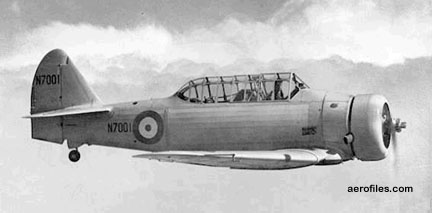
An early NA-16 form, fixed undercarriage, open cockpit –
the Granddaddy of T6/SNJ/Harvards

A USAAC BC-1 the US equivalent to the RAF Harvard I and RAAF Wirraway
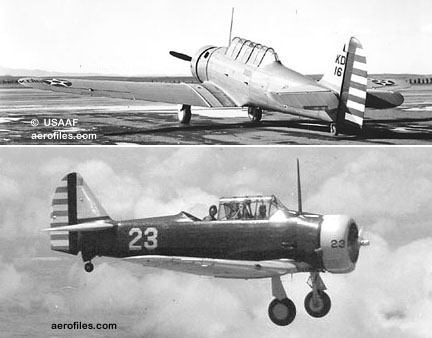
A USAAC BT-9, a fixed U/C version with smaller engine, unfortunately none survive today, this photo shows the fabric side panels to great detail, there is a monocoque belly skin along the underside of the rear fuselage on the NA-16’s.

The recreated NA-16 in Sweden using a Wirraway rear steel tube fuselage

The original NA-16 surviving in South America (this is a fixed U/C version)

The 8th production, and oldest surviving Wirrawat A20-10 at the Australian National Aviation Museum

A Bare Wirraway steel fuselage frame showing the engine mount fitted (no firewall in place) and the rear steel fuselage frame, missing its lower monocoque belly skin.

A photo source of various NA types
http://www.aerofiles.com/_noram.html
regards
Mark Pilkington
mark_pilkingtonAnt,
here is some info on the parentage of the Wirraway in North American family tree previously posted on the KPAF board
the NA-16 was “Britishized” by Australia into the Wirraway with BA hardware on u bolts etc, but is essentially a licence built NA-16, The Nearest American Service A/c to the Wirraway was the BC-1, but with non-geared 1340.
regards
Mark Pilkington
******************************
******************************
30th July 2004, 12:02
Mark_pilkington
Rank 3 Registered User Join Date: Jun 2004
Posts: 76
NA-16- Wirraways, Harvards T6 and SNJ’s
——————————————————————————–
Wirraways NA-16s, T6/SNJ & Harvards are all part of the successful North American NA-16 family of trainers.
The North American Trainer model numbers and Contract numbers become quite confusing, the following is based on the WARBIRDTECH series NA-16/AT-6/SNJ
The Wirraway is a direct NA-16 derivative with the distinctive all steel tube/fabric covered fuselage and straight trailing edge wing (The NA-32 and NA-33 were “contract” numbers as well as “model” numbers), The Contract numbers primarily related to the customer order, CAC received contract numbers 32 (actually an NA-16-1A with fixed gear and 2 blade prop), and contract number 33 (actually an NA-16-2k with retract gear and 3 blade prop and geared 1340).
The Harvard 1 is also an NA-16 derivative (NA-49 actually an NA-16-1E) while the Yale, NJ-1, SNJ-2 and BC-1 are themselves all seperate branch off derivatives of the NA-16 developments with various combinations of tapered wing, straight wing trailing edges, monocoque and steel tube rear fuselages.
The NA-16 design evolved further from the BC-1 (NA-26) and BT-9 (NA-29) family of T6 Ancestors with differing engine sizes, The NA-16 model references cease at the Contract number NA-56 which is an AN-16-4 and the BC-1A (NA-55), Yale (NA-57) and BT-14 (NA-5 at last started to bring together the monocoque fuselage and tapered wing and adoption of the ungeared P&W 1340 Wasp engine.
AT6 as contract number NA-59 commences the new T6/Harvard/SNJ family derivatives and leads on to the SNJ-2 as contract NA-65, Harvard 11 as contract number NA-66.
Finally the definative AT6A/SNJ-3 emerge as contract NA-77, with a multitude of contract numbers applying to the following T6-C,D,F and G, SNJ-4,5,6 and Harvard 111 and 1V models but are all effectively the same basic airframe structure of monocoque fuselage and tapered wing, hidden inside them all is the steel tube front fuselage frame derived from the basic NA-16.
regarding the posts above regarding Harvard II and IIA differences, the Harvard II (NA-66) was built by North American and “was effectively a BC-1A fitted with british equipment and circular control column”(T6 in Action – signal publications), whereas the Mk IIA were lend lease T6-C’s (NA-8, explaining the US cockpit configurations.
The Harvard IIB were built in Canada by Noordyun and was similar to the NA built Harvard II above (but given no NA contract number
mark_pilkingtonThere are no recorded survivors of the Harvard Mark 1 or NA BC-1, the oldest and most similar “NA-16” family survivors are the NA-16 in Sweden, the NA-16 in South America or the CAC Wirraways in Australia.
The Harvard Mark I or NA BC-1 are quite different from the later T6-SNJ or other Harvard series of aircraft with the primary differences being:
1. Steel tube rear fuselage frame c/w monocoque structure & aluminium skin
2. Fabric side panels on both forward and rear fuselage c/w aluminium panels
3. straight trailing edge wing outer panels c/w swept forward trailing edge
4. round/flat bottomed rudder c/w triangular rudder.
many of these differences are shared with the CAC Wirraway.
There have been a number of hybriad “NA” aircraft restored in the USA in recent times including a Boomerang “lookalike”, NA64’s etc.
It would be possible to create a Harvard mark I in a similar vein but the most obvious changes would be the steel tube and fabric covered fuselage.
A Wirraway steel tube “rear fuselage” frame, lower monocoque and either Wirraway or T6 “forward” steel tube frame would seem to be the basic requirements.
Fuselage capstrips based on the Wirraway could be reproduced, along with new fabric side panels.
The straight trailing edge wing outer panels are like hens teeth and it would be simpler to stick to more readily available T6/SNJ Wing throughout as few would pick the difference.
The T6/SNJ tailplanes and elevators and fin should attach to the Wirraway rear fuselage without any modification, while a T6 triangular rudder would need to be rebuilt to form the rounded/flat bottom rudder of the Harvard mark I, or alternatively an SNJ-2 rudder could be obtained if they are readily available.
There are many other differences in the form of the Centre Section, cockpit furnishings and engine cowling however the above would seem to break the back of the problem?
Regards
Mark Pilkington


 Sign In







