I once read an account by an F-8 pilot who had experience fighting against F-104s. He wrote that the F-104 had a one trick zoom advantage over his F-8, but he definitely preferred his F-8.
You want to get rid of the majority of the USAF D: ?
No, but we are being forced to slash somewhere. Nothing else can do what the A-10 can. We need KC-10s. The B-1 is too useful. The F-15E can do the job of the F-16. The F-35A is in the pipeline anyway.
Why not dispose of the F-16s? They don’t have the ability to do anything that an F-15E can’t do. I know that is a large chunk of the Air Force, but if we are forced to slash muscle, it at least isn’t killing anything with a unique capability.
If UAVs weren’t around, an RF-22C Raptor (F-22B was cancelled dual seater) would’ve been a good choice for a high altitude theatre level recce platform.
And what if its cloudy out? Now our $100 million Raptor with its big wings is down in the weeds flying through a hail of AAA, and gets taken out by a golden BB. RA-5C Vigilantes ended up doing that in Viet Nam, and the pictures came out blurry because it had such a big wing, the whole plane shook going through the thermals in the dense air.
UAVs may be the way to go, because low level Recc is so dangerous, but I question the survivability of the big, slow UAVs that we have. Maybe we should have turned all of those old RF-4s into UAVs.
I’ve always though it would be interesting to take the basic RF-4C platform (assuming new build) and update it with modern engines, avionics, some structural enhancements, and then make use of the internal and external space for whatever systems you could fit onto a platform that size. Surely it would have some unique capabilities that could complement UAV’s and high-altitude assets like the U-2.
I know it’s a pipe dream, but it’s fun to think about.
Thoughts? (again I know budget constraints and newer platforms could do the job……just fun to put the RF-4 in that situation and see what you can come up with)
A Tornado would have some advantages over the RF-4 in that role, but the RF-4 was pretty good. You don’t want a low wing loading for low altitude work, and it was fast. An RF-4 with F404 engines and modern digital recc avionics would be excellent. But the reason it won’t happen is because that would be another aircraft type in the inventory, and that is expensive. If the USAF wanted a manned recc platform, I am sure it would make a variant of the F-35, which would be better and drive down the unit cost of the program. And if that is too expensive, they woud make a variant of the F-15.
I’ve heard that the potential exists for F-7PGs to serve past 2020 for PAF. The PGs are very advanced and when networked, can still be very relevant and very deadly.
But will they be able to catch a B-52?
Not quite.
The airflow over the wing is up, back, and down. Usually, this airflow passes below the tail. However, as AOA is increased, the tail moves down into the airflow. At some point, this airflow then hits the top of the T-tail, thereby pushing it down, causing the nose to pitch up.
Interesting. Thanks for that info!
Depends on what speed is being used and what opponent is being used as a comparison.
“Better”? Probably not, particularly in the layman’s view of slow speed knife-fighting.
I was assuming a high speed. I would think the small wings would bleed less energy in a high g turn.
That wasn’t the point.
Granted. I’m being hypothetical.
In the example given (50s-60s era high altitude environment), bombers could cruise at the same altitudes as could fighters…but they could do it slower…and when fighters tried to follow them in stern gun attacks, the fighters couldn’t match the turn.
So why cruise with the bombers when you can zoom up at Mach 1.5 and hit from below, and then from above on the way back down? Is the closing speed too much?
These altitudes were high enough that the fighters did not have the energy available to mount a slashing attack from above…the bomber’s cruise altitude was the “above”.
The F-104C set a world altitude record of 103,389 feet in 1959. Of course it couldn’t sustain that, but there were no bombers up there… So was there a problem of controlling the fighter at high altitudes, or was it too difficult to get in position?
To rephrase that…the limitation was the pitch up problem that arose from high AOA conditions that the airplane experienced when trying to generate a hard turn at slow speeds.
I understand that the F-101 had the same problem, which was caused by the wings blocking the airflow over the tail at high AOA.
Sure! Back in my day, most air combat took place at lower altitudes…what may have been seen in the designer’s eyes, didn’t happen as real life turned out.
The F-104, for example was designed for superior performance at higher altitudes…meaning climb rate, max altitude, and max speed. As it turned out, air combat was flown at much lower altitudes.
I expect a turbojet powered fighter is going to perform better at high altitude. But I would think a fighter designed to turn at high altitudes would have a much bigger wing, like the F-106 or Mirage III had. My impression has always been that the F-104 was designed to make vertical slashing attacks at high speed, and avoid horizontal turning fights with those little wings.
But at lower altutudes, I would think the F-104 would turn very well compared to other fighters. In the thick air, even the small wings would be able to generate plenty of lift, and it would have less drag and weight, and therefor a better thrust to weight ratio. Would not an F-104 be the better fighter in a turning fight at lower altitudes?
Maybe folks here might have heard stories about 50s and 60s era fighters not being able to turn with bombers at high altitude. The reason was simple. The bomber would be cruising at a IAS that for it was reasonable…but that IAS for the fighter was too slow. So, if the bomber started a turn, the fighter could not follow it at that speed. The fighter would quite literally ‘fall out of the sky’.
But what if the fighter was moving much faster? Could a fighter then sustain its altitude and make slashing attacks?


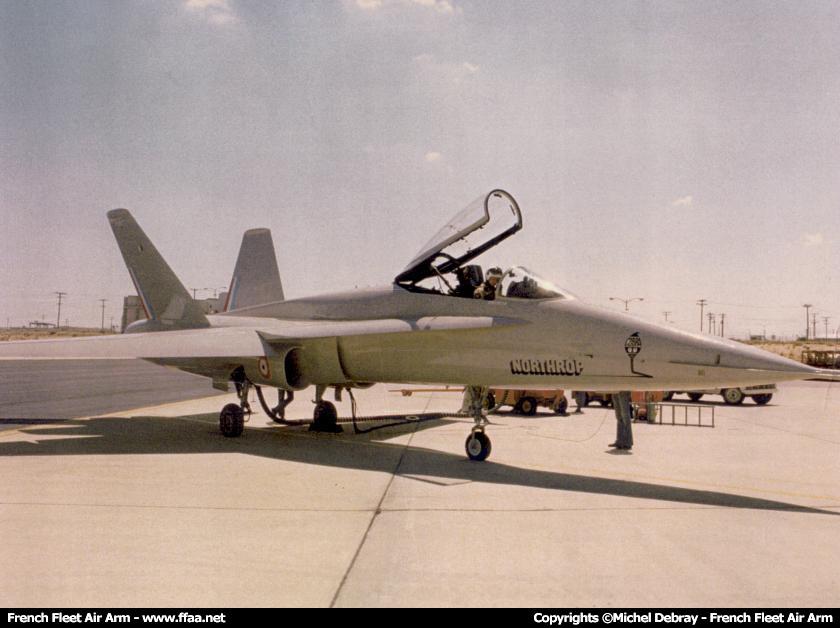
I never thought an F-18 could look that good !
Thats because its a YF-17.
More like using a minicab as a bus.
I’ve read that the F-18E is subsonic below 10,000 ft. I don’t know if that includes pylons or not, but it has to be even slower on the deck. Its top speed can’t be much different than an A-6 at sea level.
Speed
Is the F-18E faster than an A-6E at sea level?