 longshot
Hangar crossing…July 1970
The unions and BOAC hadn’t settled the crewing for their new 747s (Flight Engineers or not, was it?) so they were just used on crew training for several months… this sequence of a 28R landing and return to the hangar area was shot with a 135mm lens from the same spot as VeeOnes 707 pic
Over the Eastern boundary for 28R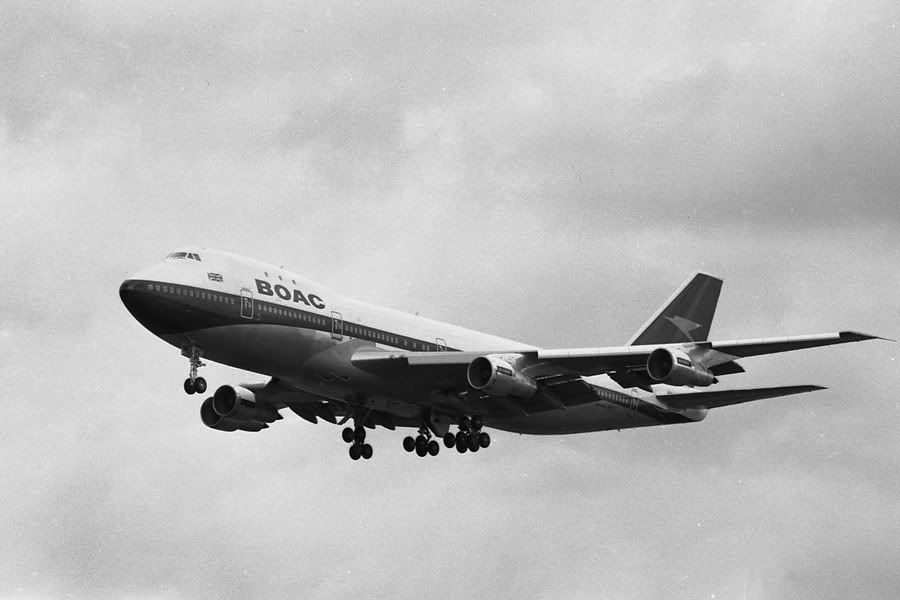
Over the threshold 28R, the Northside from Harlington corner westwards as it was in the 50s, BKS britannia parked bottom LH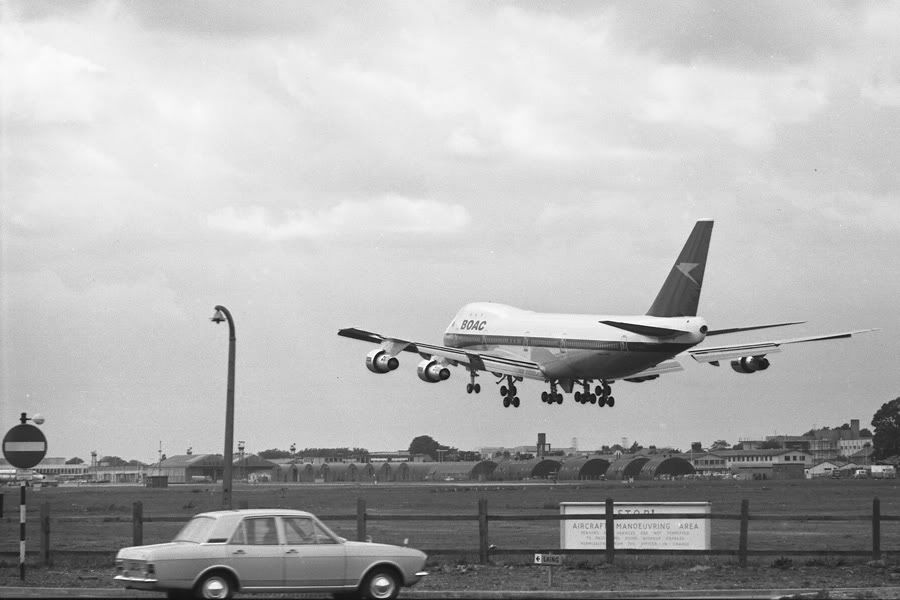
G-AWNC taxying back to hangars shot from the crossing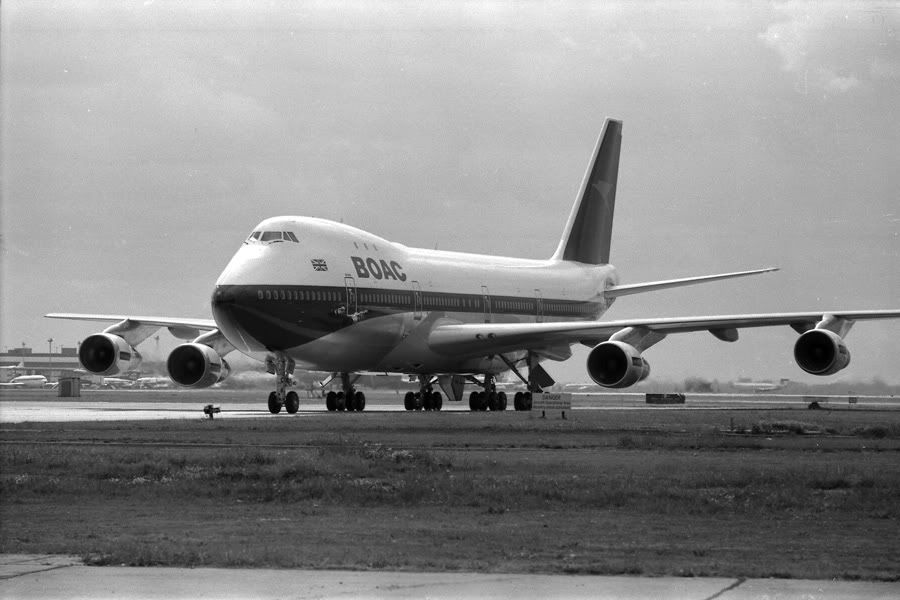
Looks like the first 3 delivered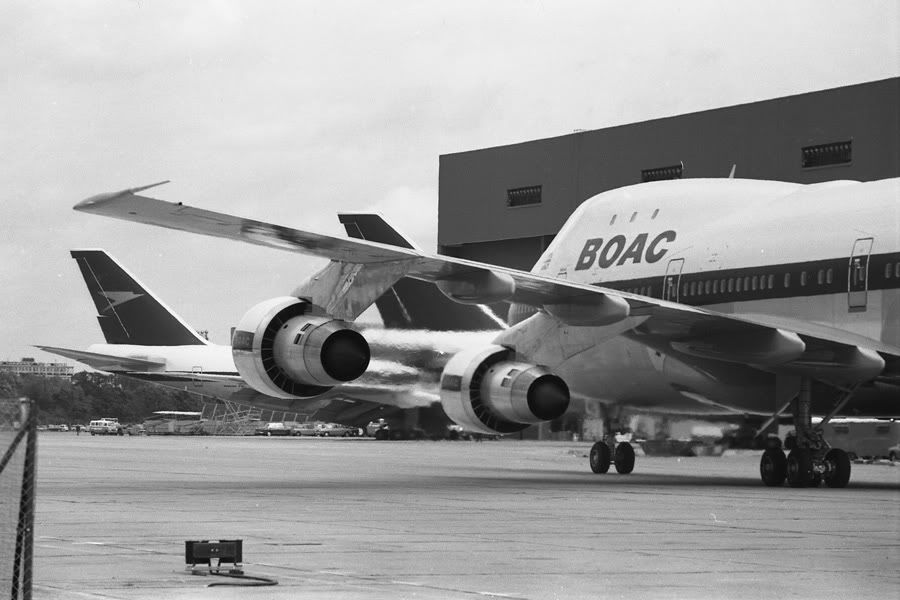
longshotT5 is OK
I agree about T3, T4 but you can sit in a nice cafe in the departure hall of T5 and watch the airliners take off or land …seem to recall you could see a little action in T1, maybe it’s changed….overall, though, the non-travelling public aren’t welcome
longshotVeeOne…I was wrong about LT red bus 140 using the Maintenance Area crossing …. the 90B did but between 7/52 to 11/54 it was diverted off airfield via Cranford reverting to crossing Hatton Cross to Harlington Corner in 11/54. The bus I’d forgotten about was your 285 which ran Wimbledon, Feltham ,Hatton Cross, Harlington Corner ,Heathrow Central from about 1962, I think. Your latest map sheds doubt on the actual route between Hatton Cross and Harlington around 1960….they were certainly using the crossing in your photo around 1970
http://www.busesatwork.co.uk/Routes/090b.htm
longshotI like the ScooterCaffe in Lwr Marsh St, Waterloo near the Ian Allan bookshop…not a pub and you might not like the funky counterculture vibe but the coffee and cake are excellent and they have bottled beer it seems
http://www.flickr.com/photos/74784995@N00/5155351105/
longshotI like the ScooterCaffe in Lwr Marsh St, Waterloo near the Ian Allan bookshop…not a pub and you might not like the funky counterculture vibe but the coffee and cake are excellent and they have bottled beer it seems
http://www.flickr.com/photos/74784995@N00/5155351105/
longshotFirst sign is spelling ageing as aging unless you’re American according to google :)….it used to worry me but I’m beginning not to care.
longshotFirst sign is spelling ageing as aging unless you’re American according to google :)….it used to worry me but I’m beginning not to care.
longshotInterflug62M….Sounds right to me.
Hanging on to the KC-135 has cost the US a fortune and the maintenance cost per hour is soaring. The ANG modified about 160 KC-135 starting 30 years ago using JT-3D (TF33) turbofans and pylons and tail planes from withdrawn US domestic 707-120B models making the resultant KC-135E a bit of a hybrid. (Separate from the much bigger project for Boeing to fit CFM56 turbofans, the KC-135R program) Apart from the fuselage width and alloy used I suppose the KC-135 is closest to the early 720s
VeeOne….that BOAC 707 on the crossing looks like G-AXXZ (a pax only variant, too!) which was the last 707 BOAC received (1970?).Did you ever pilot one? I like Travolta’s 707 coupe!
As I remember it, that road was not accessible to the public or their cars in the 40s and early 50s and the only way the public could get a look at the hangar area was on the bus-trips which ran from the public enclosures/Queens Building. When London Transport 90B started running on that road (ca.1955?) things loosened up and the arrival of the cargo village around 1969 made the use of the South Perimeter Road commonplace, but I suspect they were never designated as public roads.I think the crossing was closed in March 2006 and traffic routed to the East of the hangars
Interesting shot Sarah. The KC135 is fundamentally different from the 707 that we know and love. One major difference is the fuselage width, which is narrower. I’ve also read that the alloy used in their construction is different. The dimensions of the KC135 are broadly the same as those of the original design of the 707. The 707s revised fuselage width was in response to a request from Pan Am, for a wider cabin to match that of the DC8.
Never known you to be out of your depth yet Sarah:) None of us here ever know everything. longshot, do u know of any other differences between the 135 and 707? Other than the 135s fewer cabin windows!:)
Neil.
longshotThey should do it more often!….I liked the newsreel snippet of Hounslow Heath Airport
longshotSarah, I am pretty sure that all of the BOAC Conway powered 707s were new from the Boeing Co. I understand that the modified (taller) tail fin and ventral fin, were required by our CAA, before the variants airworthiness certificate was granted by them. These modifications were adopted for most variants by Boeing themselves. Later versions such as the 320 and 720B, had the ventral fin deleted, although the taller fin was retained. Ironically it was Lufthansa that operated the Conway powered 707 first, the variant was also operated by Varig. I could be wrong here, and I’m always very happy to be corrected. Back in the early 80s, I can remember ramping an early 720B operated by Danish charter airline, Conair, this was powered by the the old P&W engines, it was nicknamed the ‘coal burner’.
Interflug62M….Believe thats right about the CAA (might have been the ARB back then?:)). The Airliner Cafe 707 guide has chapter and verse on underfins, the 707-120/120B, 720/720B and 320/320B/C all got different sizes…the later 320B/C were built without the underfins as changes to the wing/high-lift devices made them redundant (AFAIK all the other models got them and kept them….must check the Braniff 707-200s)
http://www.airlinercafe.com/page.php?id=72
Conair had both ex Eastern 720-025 JT-3 non-fan and ex NorthWest 720-051B JT-3D turbofan models so its probably the former which were memorable (though I have a notion the 720 didn’t use water injection which produced the most smoke from the JT-3 🙂
longshotSarah…The ordering of 707s by BOAC was all tangled up in the tragedy of the Vickers VC7/V1000 project cancelled when 75% complete. The RR Conway engine was briefly the most powerful and economic engine on the 707 and DC-8 and went on the initial 707s for BOAC, Lufthansa, Air India, Varig, El Al, and Cunard-Eagle and on DC-8s for Air Canada, Canadian Pacific and Alitalia* but things were moving fast and by 1962 the 707-320B version with P&W JT-3Ds and much improved wing arrived able to operate US West Coast to Europe for Pan Am ( the Conway aircraft couldn’t do that with a commercial payload ). A 707-320C version with a cargo door followed , BOAC took 5 arguing no other cargo type was suitable, followed by 2 pax only707-336Bs …see
http://www.caa.co.uk/application.aspx?catid=60&pagetype=65&appid=1&mode=summary&aircrafttype=boeing%20707&dereg=true )
There’s a thread on pprune about BOACs 707s which has stuff about the crash of ‘RWE after an engine dropped off (it was an ex-Cunard Eagle model -465, some differences from the BOAC purchase and acquired 2nd hand)
http://www.pprune.org/archive/index.php/t-311275.html
The underfin was deleted from later 707-320B/C variants after a series of subtle flap and slat improvements made them unnecessary (see Airliner cafe’s Ultimate 707 guide
http://www.airlinercafe.com/page.php?id=72
You can see in your second photo how much the wing has been developed esp’ on the leading edge, not so visible is the increase in area closer to the fuselage on the rear edge…see in the airliner cafe page…….Mick
* Conway DC-8s went to some exotic operators including Cubana 2nd hand
http://www.airliners.net/search/photo.search?aircraft_genericsearch=&airlinesearch=&countrysearch=&specialsearch=&daterange=&keywords=DC-8-43&range=&sort_order=photo_id+desc&page_limit=60&thumbnails=
Well, I have discovered I am out of my depth against some of you very knowledgable guys. I am probably wrong about the first BOAC Boeings being second hand. I know the airline had a large fleet registered G-APF? and these seem to have had the old engines that I thought were Pratt & Whitney because of the odd jet outflow pipe shape. The later jets G-AX?? had what I thought WERE the rolls-Royce engines.
I just thought I’d read in a history of BOAC that they’d acquired a few used 707 jets in the early 1960s. But the G-APF? fleet are clearly pre-registered as though they were being built for the airline. I know the two state carriers held with this practice of pre-registering new fleets of airliners since the early post-war days.
longshotVeeOne….top photo is by Bill Sheridan. too, from August 1970….about the time I started working near the Fields Hangar… the TriStar hangar was built roof first which was jacked up hydraulically…completed in 1971 I believe….I wonder why so many T3 aircraft including the Zambia AW DC-8 are parked near the QB?
The fence in the 707 smoky shot was on the perimeter road which was inside the primary wire mesh airfield fence…I wonder if thats a go-around rather than a full take-off?
Here is a photo I like (origin unclear) showing part of the viewing area and the airport in 1970. It really brings out the interesting nature of the older airliners and the openness of the airport in back then. They seem to be building the BEA Tristar hanger and the BOAC car park. Some of the old British Eagle hangers are still present.
A lovey photo by Bill Sheridan that I really think brings out the easy going visual nature of the airport in the 1960s is his photo of a TWA 707 departing 28L. Taken from the far end of the runway it shows the lovely little two-bar wooden fence that surrounded the airport back then. Sweet! You can almost see the flock of sheep eating grass. 😉
longshotI think the terraces at Gatwick when they included both the North and South piers gave a more comprehensive coverage than the QB/T2 Roof Gardens but Heathrow was much larger
Some 60s shots from the QB by Paul Howard on http://www.abpic.co.uk
http://www.abpic.co.uk/photo/1012274/
http://www.abpic.co.uk/photo/1003601/
http://www.abpic.co.uk/photo/1057610/
http://www.abpic.co.uk/photo/1041273/
http://www.abpic.co.uk/photo/1034328/
http://www.abpic.co.uk/photo/1030383/
http://www.abpic.co.uk/photo/1012277/
http://www.abpic.co.uk/photo/1006397/
http://www.abpic.co.uk/photo/1057436/
longshotThere are some (rather stodgy) agency photos of the QB/T2 roof gardens in the mixed bag Google Life photo archive search
http://images.google.com/images?q=air+aero+1920&q=source%3Alife&biw=1440&bih=717
for example
http://images.google.com/hosted/life/l?imgurl=938dbd872deeaa84&q=air%20aero%201920%20source:life&prev=/images%3Fq%3Dair%2Baero%2B1920%2Bsource:life%26hl%3Den%26biw%3D1440%26bih%3D717%26tbm%3Disch
http://images.google.com/hosted/life/l?q=air+aero+1920+source:life&prev=/search%3Fq%3Dair%2Baero%2B1920%2Bsource:life%26hl%3Den%26biw%3D1440%26bih%3D717%26tbm%3Disch&imgurl=451ab825848b6f3d
http://images.google.com/hosted/life/l?q=air+aero+1920+source:life&prev=/search%3Fq%3Dair%2Baero%2B1920%2Bsource:life%26hl%3Den%26biw%3D1440%26bih%3D717%26tbm%3Disch&imgurl=cff1603ee773f4df
http://images.google.com/hosted/life/l?q=air+aero+1920+source:life&prev=/search%3Fq%3Dair%2Baero%2B1920%2Bsource:life%26hl%3Den%26biw%3D1440%26bih%3D717%26tbm%3Disch&imgurl=ea857783db7e14c9
http://images.google.com/hosted/life/l?q=air+aero+1920+source:life&prev=/search%3Fq%3Dair%2Baero%2B1920%2Bsource:life%26hl%3Den%26biw%3D1440%26bih%3D717%26tbm%3Disch&imgurl=eaa7f63410cfebde
http://images.google.com/hosted/life/l?q=air+aero+1920+source:life&prev=/search%3Fq%3Dair%2Baero%2B1920%2Bsource:life%26hl%3Den%26biw%3D1440%26bih%3D717%26tbm%3Disch&imgurl=5f8bef8b0dd301fc
http://images.google.com/hosted/life/l?q=air+aero+1920+source:life&prev=/search%3Fq%3Dair%2Baero%2B1920%2Bsource:life%26hl%3Den%26biw%3D1440%26bih%3D717%26tbm%3Disch&imgurl=e6852551d04d0300
longshot[QUOTE=VeeOne;1773200]Here is photo I just scanned. It was taken in 1971. . I say it was 1971 but it might actually have been 1970 as there are no BOAC jumbos around or we would have probably photographed those too, as they were so new and amazing to see.
What is amazing is the zero level of security at London Airport at that time.
VeeOne, It was on an LT bus route at that time! Here’s a BOAC 747 from that spot in summer 1970
http://www.airliners.net/photo/BOAC/Boeing-747-136/0775455/M/
and actually from the crossing in 1973
http://www.airliners.net/photo/BOAC/Boeing-747-136/0814283/M/


 Sign In







