pfcem
pfcemAgreed. LM didn’t coin the concept, they only defined parameters for 5th gen fitting the F-22 parameters. [So far so good]. Unfortunately, at that time they probably expected all their future designs (F-35) to supercruise because they included SC as one of the main requirements.
Now, F-35 doesn’t supercruise. Therefore it’s not rocket science, it cannot be called 5th gen. But F-35 fanclub and LM don’t want to hear that, so they silently skip this requirement. And that makes Euro-fans fed up, would you blame them?
According to what is being written these days, F-35’s RCS is hardly VLO (of course it depends on what you compare it to)..
It’s the VLO what is a pure speculation. Those “in the know” have always said that the RCS of the F-35 is not the same level as F-22 (which is generally referred to as VLO).
I don’t think that L-M or any other company should have any right to define something which then shall be generally applicable to whole industry. If a company is allowed to define that then it inevitably leads to artificial terms set up in order to highlight own designs at the expense of the competition. Which is already happening, as we can see.
For me, both definition of SC and requirements for aircraft generations defined by Lockheed Martin are completely invalid, for good reasons. Especially after both were re-adjusted at least once in order to favor F-35.
Sure jackjack i agree, but that wasn’t my point..
My point was that LM supercruise definition are purly for advertizing reasons.
Stop seeing everything from LM and other aviation manufactors in purly black and white.. its allowed to use common sense here.
yes, i think you are right, there are 2 definitions, science and LM
science says all the plane breaking the sound barrier
LM says 1.5+
Wrong. The USAF/DOD defined parameters for 5th generation, NOT LM. LM is just the lead manufacturer building airfraft to those parameters.
Supercruise NEVER HAS BEEN & never will be a 5th generation fighter requirement. Not to mention that the F-35 most likely CAN cruise supersonically, just in the leage of the Eurofighter Typhoon & Rafale rather than the true SUPERCRUISE of the F-22.
APA is NOT the authority on what is VLO & what is not VLO. The F-22 is not the upper threshold for VLO.
And prior to ‘defining’ supercruise as >Mach 1.5 the term was scarcely used much less known to any but a relative few.
***
Don’t worry about it. Some people get a bit touchy when one questions their super toy in a negative way, not that your comments were negative of course.
People like YOU get MORE than a bit touchy when you point out that their favorite fighter is not longer top-of-the-line & that someone else has something so superior as to be game changing.
Anyway, on the supercruise bit. Call it what you want, but if an aeroplane can break the sound barrier and hold a particular speed above that without useing its reheat with or without weapons, drop tanks etc then its more than worthy enough to be called supercruise in my book. As for LM’s definition of supercruise, its nothing more than a marketing gimmick. Its just like getting on old series 3 Land Rover, stripping it down & calling it a Formula 1 car…Doesn’t make sense. I bet if the F-35 makes it to the speed of say, Mach 1.2 without reheat, I bet LM say: “LOOK! The F-35 can supercruise”.
No, LM will NOT say the F-35 can supercruise even though it quike likley CAN cruise at ~Mach 1.2 without afterburner. THE ‘marketing gimmick’ is everyone else suddenly touting ‘supercruise’ for their fighter because they can cruise at >Mach 1.0 without afterburner AFTER the USAF/DOD used/redefined the very little known/used term for the ATFs truly transformational ability to cruise at >Mach 1.5 without afterburner.
***
Despite some claims from LM or some “interpretors” even that is not for free, when it comes to range or endurance. Just the smaller part of the mission envelope of the F-22A is at “supercruise” and the F-22A has to reach and stay above 40.000 feet by that.
Typical Sens strawman BS. Neither LM nor ANYBODY else EVER claimed that the F-22 supercruise (thats >Mach 1.5) is free when it comes to range or endurance – quite the opposite in fact.
***
What about the wavelength of the radar your facing?
Lengthen that radar wave, and pretty shortly you’ll find those decibels rising, and rising damn sharply!
There are reasons why certain wavelengths are used. Just TRY to track, much less target, an aircraft with your mythical low frequency radar.
***
The problem is, there is not a constant transonic regime for all aircraft in a similar way. We can agree that most of the super-cruise claims are still in the transonic regime past Mach 1 peak. All that in mind none serious aircraft-producer does claim supercruise for his design as a constant feature and a temporary option only.
Even for the F-22A and it is proven transonic capability it is a considerable trade-off in range or endurance.
More Sens BS. Supercruise (that’s >Mach 1.5) IS a constant feature of the F-22 & it has proves that capability with nearly ever flight it takes.
***
For F-16, drag peak at ~M1.05, and it exit the transonic region at ~M1.15, Delta wings and even F-22 has higher critical mach value by higher wing sweep
and thus exit transonic zone earlier.http://history.nasa.gov/SP-367/chapt5.htm
http://history.nasa.gov/SP-367/f91.htmF-16 have a wingsweep of 40*
F-22 42*
Rafale 48*
YF-22 48*
Typhoon 53*
Mirage 2000 58*
Su-27 42*
MiG-29 40*
F-35 is 33*
Gripen is 43*
F-15 is 45*F-35 stand out as a fighter with a really poor wing sweep, it’ll drag badly.
It’ll get the poorest rating in thickness ratio as well.
1. The wing sweep of the F-35 is 35 degrees not 33 degrees.
2. The drag curve difference between the F-35’s 35 degree wing sweep & the F-22’s 42 degree wing sweep is not THAT much.
3. Drag is significantly more complicated that simple wing sweep.
***
Sullivan need to get his facts straight.
The development schedule has been extended 13 months not 30 months. The 30 month number is JET II worst case scenario of what COULD happen.
While as of last December only 4 test aircraft had been delivered ALL 13 are on track to be delivered by the end of 2010. And total labor hours has in fact DECREASED with each & every lot. The FACTS have been posted here before so there should be no need to post them again. And despite all the BS unfounded cost increase estimates the truth is that production costs are tracking BELOW projections – so much so that LM estimates that with the existing procurements budget 90 ADDITIONAL aircraft could be procured by the end of the program.
***
Well, if the delays on F-35 increase any further.. couldn’t the US MOD just order more SH’s and newer F-15(SE) versions.
First, the program is NOT actually delayed all that much. It is currently months behind schedule (not 2+ years). This 30 month crap is a PROJECTION OF POSSIBILITY & not even based on the status of the actual program. If we bought F/A-18E/F &/or F-15s in the FY2011 budget in place of F-35s we would not get then any sooner than we will get the F-35s.
Beeing a a 4th gen teens doesn’t mean their are that inferior fighters.
Yes as a matter of fact it does.
If they are equiped with the very latest systems, radar, engines they would still do good filling the shortage in USAF/Navy/Marines/ANG these days.
Then they end up cost as much as the F-35 & STILL inferior due to the F-35 characterstics they can not possibly possess.
All this 5th gen fighter procurment confuses me a bit, its better to have fighters operational now instead waiting for a delayed new fighter and just watch the shortage increase by the month/years..
We have fighters operational now. Buying 4th generation fighters now will not get them any sooner than buying F-35s now.
***
How are things going with the SE, its been nothing but silence since it was unveiled?
Nobody have ordered it yet so how can it be late and overbudget?
Actually there HAS been news since it was unveiled. You can find it in the thread about it here.
The point is that being late & overbudget is THE NORM rather than the exception. Anyone you actually belives that any major weapons system program is not going to ultimately be late & overbudget is only fooling themselves (not that it CAN’T happen, just that it is unlikely).
***
You have to order them first. Nobody wants them.
Wrong, a number of nations HAVE expressed interest. They will (likely) order F-15SE on THEIR schedule, not yours.
***
SE is a very tough sale. It addresses only X-band and ignores L, S, and C-bands where many SAM acquisition radars operate. SE has yet to implement dozens of design details that were addressed on the F/A-18E/F. Those details are not trivial nor inexpensive to design, build and qualify. Boeing needs a benefactor with deep pockets to complete the SE design. Anybody that rich would weigh the cost of completing SE design against the cost of off-the-shelf F-35s and would probably choose F-35.
Boeing’s only hope is to find a country whose primary concern is to build their own airplanes as a way to prop up their indigenous aerospace industry (e.g. Japan).
THE intent of the F-15SE is to offer a ‘near 5th generation’ fighter to those who are not yet cleared (& unlikely to for some years) to recieve F-35s. Just because the F-35 is offered to some does not mean that it is offered to all. There is also the question of production slots for any potential additional F-35 customers. If a buyer is not already in the process of procuring F-35s NOW, then it will be ~FY2018 before they can expect to have production (for 2020 delivery) of their order begin.
***
I think the real alternative to the F-35 on the arms market is the Gripen NG.
It’ll do 90% (maybe more) of the work at what… 50% (?) of the cost (perhaps much less when overall operating costs are factored in).
I know you can talk about quality and force multipliers. But bottom line, (hypothetically) if you can only afford 15 F-35s versus 30 Gripen, which is the more credible force in real world terms?
But of course, thats just an opinion.
Norway has come to quite a different conclusion…
***
to me, the most “stupid idea” using your words, was to go after a design not unlike what mcnamara wanted the f-111 to be… a common design for everything but, what’s more, a most modern and cheap at the same time…
Do you you have any idea how costly it would be to have gone with three completely different designes?
the US are a bit like a poker player who got too comitted on the turn to step back and the other guy goes all in after the river… by betting on a single design to do everything for the next 40 years, there was a very big risk to be stuck with it even if it doesn’t deliver, be it on performance, or on price, or on schedule (even if the last one is the least inconvenient of the three potential problems). today, saying “ok, that’s enough” is quite difficult, and saying “we keep on doing it” isn’t easy either… any way you take it, for the ones to decide, it’s not a good position to be in
But the F-35 IS delivering on performance, in REALITY (not BS projections not based on the actual status of the program itself) not that far off from schedule & for cost despite all the projections being made we won’t know what the ACTUAL cost is/will be until a year or two into full rate production but mark my words the unit total production cost will likely be nearer (likely even LOWER) the Pentagon’s most recent lower $80 million (FY2002 dollars or ~$96.36 million in FY2010 dollars using the Bureau of Labor Statistics Consumer Price Index Inflation Calculator) than the higher $95 million (FY2002 dollars or ~$114.43 million in FY2010 dollars using the Bureau of Labor Statistics Consumer Price Index Inflation Calculator). From the FY 2010 budget the F/A-18E/F average unit total production cost of the 389 thru FY2007 is $81.267 million with the 69 added FY2008-2010 increasing the average to $81.5 million. That puts the Pentagon’s most recent projections for the F-35 (all three models I add – A would be lower while B & C would be higher) at ~18.2-40.4% higher than the F/A-18E/F. Does not sound that bad when you put the numbers into perspective now does it… Note that for the F-35 the unit flyaway cost projections have been ~85% average unit total production cost – so the Pentagon’s most recent projections of $80-95 million (FY2002 dollars or ~$96.36-114.43 million in FY2010 dollars using the Bureau of Labor Statistics Consumer Price Index Inflation Calculator) average unit total production cost translates to an average unit flyaway cost of ~$68-80.75 million (FY2002 dollars or ~$81.91-97.27 million in FY2010 dollars using the Bureau of Labor Statistics Consumer Price Index Inflation Calculator).
***
http://www.janes.com/news/defence/jdi/jdi100317_1_n.shtml
The US military’s top acquisition official is planning to switch to a fixed-price contract for the F-35 Lightning II Joint Strike Fighter programme in place of the current ‘cost-plus’ arrangement, amid growing concerns about ballooning costs.
Ashton Carter, Under Secretary of Defense for Acquisition, Technology and Logistics, said on 12 March that the Pentagon plans to switch to the fixed-price scheme in order to get a handle on F-35 costs, which have escalated under the current cost-plus arrangement with prime contractor Lockheed Martin.
The cost-plus system reimburses companies for their expenses in addition to providing additional money to guarantee them a profit.
Under the fixed-price structure, Lockheed Martin would propose costs for the F-35 based on specific government requirements for the aircraft, which would be laid out ahead of time. The company would then receive the fixed-price amount, regardless of the unanticipated time and resources spent completing the project.
I think this would be a good thing, I suspect that this “cost-plus” system is actually one of the reasons why things have been sliding so much. Perhaps LM and subcontractors have not had strong enough incentive to keep costs down, why should they when people are throwing money at them after each delay?
If they switch to fixed price the price estimate certainly will go up again — but this time we will get a realistic price estimate. If not LM will find itself in deep manure.
Given that LRIP costs have been BELOW projections, going to a ‘fixed price’ structure would likely INCREASE LM profits…
***
I don’t believe the F-35 will be about 80m. I think as I have thought from the time when it was promised to be ~58m that it will be 100m+.
My prediction of ~100m was made over a year ago. I know very little about these things but I’m not so bad at recognising misleading BS from PR departments. So far independent predictions (non-LM PR BS) have been moving closer to my estimate.
The $58.7 million was F-35A flyaway cost, not total program (all three models) average unit production cost.
When you ‘predicted’ ~$100 million, did you mean average until flyaway cost or did you mean average unit total production cost or something else?
Note that the latest Pentagon projection of $80-95 million (FY2002 dollars) average unit total production cost calculates to a average unit flyaway cost of ~$81.91-97.27 million (FY2010 dollars).
***
if LM can deliver by that timeframe… if my memory serves well, someone posted links to statements that the testing wouldn’t be finished by then… unless you want the RAAF to end the testing on its “production” models, they may need to be postponed
The (13 month) testing & evaluation extention DOES NOT effect deliveries.
***
Oh yes, the USAF has cut their numbers already. Current budget plans are more than 400 units short of what they initially planned to order. If the current budgets aren’t beefed up significantly there will only be about 1300 up until the year 2038. And this is still considering the low price LM advertised for the last few years. The cost increase of 50-90% isn’t included in these plans.
As it looks right now there will be less than 1000 units for USAF. I expect there to be abut 1500 for the US all together. World wide we’ll not see more than 2000 during the next 30 years.
1996 ‘initial’: 2978 (2036 USAF + 942 DON [642 USMC + 300 USN])
1997 QDR: 2852 (1763 USAF + 1089 DON [609 USMC + 480 USN])
2002 QDR: 2443 (1763 USAF + 680 DON [350 USMC + 330 USN]) note the ‘big loser’ being the USMC – reductions due to integration of USN & USMC TACAIR
There has been no official US order change since, NOT EVEN IN THE 2010 QDR.
And don’t be such a fool to assume that today’s economic wows (&/or anti-defense administation) will be the norm for the next 3 decades.
Even the 3173 total is ONLY FOR THE 9 INITIAL PARTNER NATIONS, there will no doubt be MORE customers over the next 3 decade that will INCREASE that number. A total production number of ~4000 IS NOT unlikely!
***
I’m a bit of a worrier over F35. Will it do what its supposed to? Will it be cheap to buy? Will it be cheap to maintain? Will the spiral in development costs result in aquisition costs spiraling? And many others.
Yes the F-35 will do what it is supposed to do.
The F-35 was never going to be ‘cheap’ to buy or maintain but rather cost effective (aka not that much more expensive than legacy fighters but MUCH more effective).
There is no spirtal in development costs.
***
Lack of “stealth” is no issue if you have performance,
Dream on.
the question is if “stealth” will allow for lack of performance,
in the case of F-117, it didn’t.
Yes it did.
pfcemDoes anyone know why it’s so delayed? Is it the software, the airframe, or what?
Because when the schedule was created, the program & the government projected it would take x time to get the initial airframe production up & running. It has actually taken ~6 months longer than projected.
***
I see that you are from Australia. I find it peculiar that you simply say “so what” because someone will have to pay the cost breach. And that someone is customers – that also includes your government, which will source the money from you..
What cost breach? DEVELOPEMENT costs are exceeding projections (nothing new, unexpected or out of the ordinary), PRODUCTION cost (the cost CUSTOMERS pay) is thus far right in line (slightly below in fact) projections.
***
its a LRIP cost breach, not a long term cost breach, as far as i understand it
No, there is no LRIP cost breach. In fact LRIP thus far has been BELOW projections.
The “breach” is a POSSIBLE/PROJECTED TOTAL PROGRAM COST breach & not even based on the ACTUAL state of the program.
***
the 0.5 stands for 5th gen avionics and weapons, who can argue that rafales and typhoons have reached this point yet, i can see shortfalls in both
No, the “0.5” is simply an acknoledgement that there is such a gap between 4th generation & 5th generation fighter capabilites/characteristics that there is room for 4.5 generation fighter in between. About the only ‘common’ capability/characteristic of 4.5 generation fighter is reduced RCS, beyond that there are certian capabilites/characteristics (at least a 1/2 generation beyond normally attributed to 4th generation) that some have & others not.
***
I’m scared.
Kind of.
If that programme should come apart the forces are in deep ****.
So what are you scared? The ‘signs’ are that the program is coming together quite nicely.
Gosh! Said it before and say it again: Time to dump that B version and concentrate on a single merged and re-prioritized A/C version, plus a twin-seater. Time!!!
That makes no sense whatsoever. Not only would it end up costing MORE than the current program (and that does not include the fact that you would then have to start over with something else to replace the Harrier which would result is even MORE cost) but also end up with a sinle airframe even LESS that what the USAF &/or USN want – your single ‘A/C version’ either compromises FURTHER from what the USAF would want/get if it were developing its own unique aircraft for the sake of making it MORE compatable with the USN or vice versa OR even worse BOTH.
***
There were some reassuring on-target figures but others that looked really, really bad. Worst of all, the getting things done on time and overspending trends appear to be downwards.
Some quite interesting handwritten comments on the report. Page 19 shows a chart with target and actual data covering Feb-Oct 09. The chart concerns “Verification of the F-35’s physical configuration to the design requirements by performing PCA’s (physical configuration audits)”. The target is 95% and is met or exceeded in all 2009 months shown in the chart.
I like the handwritten comment next to the chart: “ergo a/c are built 5% wrong and that’s OK?”
Name a new fighter program that at this stage in the program was any better.
You need to read the report again. Or to save time simply look at the Report Scope chart on page 5 – note how MOST categories are GREEN and how high (tight) the threshold is for it to be yellow &/or red. FAR from the doom & gloom the naysayers make the program out to be.
***
No need to complaint — the real news is worse than you would expect:
http://www.aviationweek.com/aw/blogs…entId=blogDest
IOC delayed to 2015… pcfem and Spudmanwp where are you?
Sweetman says: “naysayers 1 JSF program 0”. Irritating, isn’t it?
LOL.
Delivery dates have not changed. The only ‘change’ is that the USAF (leadership) has decided to wait to declare IOC until testing is complete. If the F-35A needs to got to war in 2013 or 2014 it will do so…
***
There is a difference between late, over-budget programs and the biggest, most expensive military aviation program ever being late, over-budget and out of control. If that isn’t newsworthy, I don’t know what military aviation story is.
There is a difference between a late & over budget program (the NORM these days) & an out of control program.
***
I agree that there is no need to post the same story again and again. However where the F-35 is concerned there are multiple delays and multiple increases in cost. Each one merits reporting IMO. The management of the program has been deficient when performance is measured against targets and continues to be so. Each failure merits reporting IMO.
The problem is not so much that each & every delay is reported but rather HOW each & every delay is reported. ONE delay most often leads to all but certain delays to EVERYTHING related to it. What one has to look at is the delay for each even compared to the previous – is the delay increasing, decreasing or remaining mostly constant. JUST as important is to put things into perspective, delays are much more the rule rather than the exception.
***
Just till you start believing it, the bad news hasn’t ended just yet.
Bill will of course report it when its under control, just as he would report Unicorns stampeding through the whitehouse, Bill didn’t get the JSF in trouble, so don’t shoot the messenger.
The reason why some here keep ‘banging on’ about it is because people like you refuse to see whats blooming obvious.
The JSF program is in trouble, it has been shown to be in trouble, $600m in withheld funds, sackings, delays and huge budget blowouts, its like ENRON with wings.
The good news thats being peddled at the moment is its not technical problems with the JSF, this is quite humourous if you look at underlying reasons why.
Technical issues tend to be ‘revealed’ in testing, little testing = little problems. perhaps if they cancelled all testing they could go straight to IOC with zero problems, viola! a successfully completed program.The JSF is going to have a bad year, just accept it, we all know it is unlikely to be killed as there is no plan B, but I see little evidence at this stage of the program is any different to the F-22.
Just sit back watch the show and wincelaugh (depending on your persuasion) at the bad bits to come.
No, the JSF is NOT in trouble [aside from that we currently have a very anti-defense administation & Congress ATM]. It is in fact progressing as well or better than many other new fighter programs. It is just that the other fighter programs do/did not have an army of naysayers hell bent on putting them in the worst light possible.
***
In other news, not reported at Ares, flight testing continues at Patuxent River.
They don’t (or hardly ever) report the PROGRESS being made unless they can spin it in a negative light like it did not happen on THE day it was scheduled. I also especially love how NORMAL scheduled maintenance is reported as a problem.
***
I don’t know what your problem is. Most news is predominantly negative as counterbalance to marketing which is 99.9% positive. I don’t see anything wrong in that. If you want to read about how the F-35 is so fantastic, just visit the website of Lockheed Martin.
No, most news is negative because it makes others ‘feel good’ to see how horrible everything is for everybody else.
BTW, I don’t remember Sweetman to have skipped a single important milestone of the F-35 program just because it was positive news. It seems that you want to deny the troubles with F-35 by ridiculing anyone who brings such news.
It is not that Sweetman ‘selects’ what to report & not report based on if it is positive or negative it is that no matter what the news is, if he reorts it, he reports it in a negative light.
***
Well, you said nothing, so there’s nothing to paraphrase, neither…
No, as others were intelligent enough to figure out & he repeated for clearification, he bets that the RAF will go with the F-35A ~2020-2025 as it primary (day 1) fighter asset with its Eurofighter Typhoons being religated to secondary roles.
You still don’t have the faintest clue of what you’re talking about, do you?…and yet your “witty” one-liners are supposed to have what effect?
Jackjack, this isn’t a pub, but a (more/less) serious aviation forum, so try to act accordingly.
You should not project YOUR faults onto others.
Another issue you’ll just have to deal with is; Australia doesn’t have an interceptor, period.
That’s right, it does not have a dedicated interceptor. INSTEAD it has multi-role fighters (F/A-18 ATM to be replaced by the F-35A) to perform not ONLY as an ‘interceptor’ but many other roles/missions as well. Yes that DOES mean that the aircraft it uses as an ‘interceptor’ is compromised vs a ‘comparable’ dedicated interceptor BUT a dedicated interceptor would compromise other important roles/missions.
With F35 in service, RAAF will just barely (if) be able to fulfill a fundamental role of protecting Australia’s aerospace.
The only aircraft that could do the job of protecting Australia’s aerospace better than the F-35A is the F-22 (the PAK-FA possibly will when it reaches maturity) & NOBODY is getting any F-22s (Gates won’t even allow the USAF to get HALF as many as it needs).
You can’t seem to understand that to intercept the target you need to be able to catch it in the first place, in which case the “stealth” doesn’t count for much and is in fact counterproductive, due obstructing and interfering with airflow, increasing drag.
YOU can’t seem to understand that in COMBAT CONFIGURATION the F-35A is PLANTY fast. AND with its MUCH reduced detectability can get closer to the target before the target knows it is being intercepted (which INCREASES the chances of a sucessful intercept) AND the deterrence effect of stealth (who is going to want to attack a nation when your 1st warning that your attack is being/has been intercepted could be AMRAAMs already heading towards your flight).
Denmark can forsake interceptor, because they have ~180 EFs and ~200 Gripens within 200km or so, range. Australia doesn’t and JSF program is purely politically/economically motivated.
Politics & economics no doubt factor in but that does not change the fact that the F-35A IS the best fighter available to Australia.
I mean if you don’t see that, then you’re a helpless case…
You have once again just domonstrated that YOU are hopeless.
***
Jackjack do you actually understand this? Why do you think IOC’s etc. are spilling? Do you truly believe it is because everything is just peachy with the F35 program?
http://www.aviationweek.com/aw/blogs…entId=blogDest
Air Force Secretary Michael Donley said yesterday that the initial operational capability (IOC) of the Joint Strike Fighter (JSF) has slipped for the U.S. Air Force to late CY 2015.
It is YOU who does not understand. The program is MONTHS behind schedule, not YEARS. The causes of the delays have & continue to be addressed with a trend toward SIGNIFICANT improvement.
IOC is simply a declaration. In reality whether the USAF stayed with the 2013 IOC or delays it until 2015/2016, the number of F-35s ‘in service’ & the state of said service is the same. If the F-35 is needed to go to war in 2014, whether IOC is/was 2013 or 2015/2016 makes no differrence.
***
More doom and gloom from Bill
Comparison 2: A long time ago in a galaxy far, far away – towards the end of 1995 – the Eurofighter EF2000, as some Pollyanna had named it, had notched up 81 flights in 18 months of testing, about the same rate as JSF today.
It will be interresting to see if Bill joins reality & changes his tune once all test airframes have been delivered & flight testing ramps up…
***
There’s intercepting something faster than yourself and intercepting something MUCH faster than yourself. Big difference.
And when intercepting something going Mach 5+, whether you can go ‘just’ Mach 1.6(+) or Mach 2 makes little difference.
***
Yeah, he’s starting to sound more than a tad obssessed. Definitely wadding into Kopp territory. Then again, he did say he thinks that if the F-35 succeeds European fighter developement would end.
Starting to sound more than a tad obssessed? Most informed ‘folk’ said that quite some time ago.
***
The F-35 is ~ Mach 1,6 limited by design.
Mach 1.6 is a LOWER limit, not an upper limit. It MUST demonstrate AT LEAST Mach 1.6 with a full load of weapons & fuel.
***
The max allowed speed for the canopy is Mach 1,6 by specification set to start with. That was revealed, when a contractor did run into problems by that and the Mach 1,5 demanded for service use met, but the test program had to open up the flight envelope of the F-35.
Where DO you make this crap up?
***
this has been done several times but it doesnt stop the nonsense by them
the 1.6 was a min requirement which has been exceeded to 1.67 so far
Under testing a F-35 “prototype” was flown to the red-line temporary like a F-4 prototype to Mach 2.62. None serious will claim that an ordinary front-line aircraft will reach that speed under regular conditions or will even come close to that.
Not even that speed was achieved on a computer with a non production representative configuration (240-3).
No F-35 has flown anywhere near ‘red-line’. I have yet to hear of any flying much greater than Mach 1.05 at this point. BUT the FACT remains that Mach 1.6 is a LOWER LIMIT that the F-35 MUST reach/exceed in full combat configuration. To that end it has been disclosed that the earlier 240-3 configuration had a predicted top speed of Mach 1.67 (that is MORE than Mach 1.6 not less than Mach 1.6).
Take any ‘comparable’ medium-weight 4th or 4.5 generation fighter, load it up with two AMRAAM + two ‘2000 lb’ JDAM (or equivalent weapons) + enough fuel for a 625nm combat radius & it ain’t going to approach its clean top speed.
***
1) The issue with the problems the program is currently experiencing is not that it is having problems; as many have stated that is pretty normal for complex programs, it is that LM and various other parties with vested interests claimed that this program would not suffer from such issues due to blah blah blah and offered this “fact” as a major reason for the final product being affordable.
Typical naysayer BS. NOBODY EVER said that the program would not suffer. Quite obviuosly it is, just not as much as the naysayers want everyone to believe & not out of line with other fighter programs have suffered & come out just fine.
***
The F-35 is not a 5th gen design, when supercruise is demanded for that. By that the F-35 is 4.5 design or supercruise is not crucial. LM and some others are trapped by the own advertisement claims and they are not eager to discuss that for obvious reasons.
Sorry, APA has no say in what makes a 5th generaton fighter. Supercruise IS NOT & HAS NEVER BEEN a requirement for 5th generartion fighters.
***
Well, jackjack EADS does claim EF a stealthy plane, so what are we going to do about that??
I mean, how can you ignore manufacturer’s claims?
LM’s 5th gen is also “more stealthy” compared to legacy fighters, isnt it??
Well, if SC isn’t a KPP for 5th gen, the F117 is a 5th gen FIGHTER too (has F in nomenclature).
There IS a difference from being ‘stealthy’ & being ‘all aspect stealth’.
Check the characteristcs of 5th generation fighters, the F-117 does not meen a number of them – being ‘all aspect stealt’ (VLO) alone DOES NOT make a 5th generation fighter.
***
LM closely defined the must have capabilities of a 5th generation fighter around the F-22 back in the 1990s and the USAF works with that. Main features stealth, supercruise, integrated avionics, NCW, AESA radar and even supermanoeuverability. That’s the problem if people start to define something to close around something very specific. Now where the F-35 is on the table supercruise and supermanoeuverability are suddenly not important anymore to earn the label 5th generation. That’s something I have pointed out for years now, but fanboys ignored it or tried to find lame excuses.
And jackjack to your info AFs etc might not use the term 5th generation with regards to the Typhoon, but they aren’t using 4th generation with regards to the teens/teenskis either.
Wrong. The USAF/DOD defined the capabilities of a 5th generation fighter & LM designed the F-22 to meet those (& other) capabilities. Neither supercruise nor supermanueverability (aka CONTROLLED post-stall flight) are 5th generation fighter requirements.
***
it will be interesting to compare the f-35/22 manoeverability, i havent done it yet
i havent seen anyone creditable say the phoon isnt 4.5, though i would like aesa included in the 4.5 definition, as its suppose to mean 4 gen platform with 5th gen systems afaik
fwiw i dont give LM a gods right to set definitions, here is a LM link claiming 5gen for both f22/35
http://www.lockheedmartin.com/capabi…gen/index.html
if they originally claimed planes had to have SC for 5th gen, it does muddy the water
The reason there is even a ‘4.5 generation’ is because there is such a gap between 4th generation & 5th generation that ‘allows’ it.
LM didn’t set the ‘definition’/criteria/requirements for 5th generation fighters, the USAF/DOD did – LM is simply the lead manufacturer of the USAF/DOD’s 5th generation fighters.
pfcemThe price quotes on the F-35 are ranging between 50 million and 100 million with loads of uncertainty. Very understandable as this is a very new plane, not even fully developed.
The eurocanards seem to cost all between 50 and 80 million.
The F-22 is costing according to public sources, around 170 million a piece. For F-22, all parameters to determine the price are fully known as it is in full production.
So what is really justifying that the F-22 sooo expensive??
Is the taxpayer paying for exclusivity [like buying a Ferrari] and has the price nothing to do with production cost + a reasonable profit?
Or are there real world technical explanations for this price tag? if so, what are these?
The only ‘price quote’ given for the F-35 is the $58.7 million F-35A flyaway for the multi-nation partner LRIP contract which has failed & those specific ‘quotes’ given to each, everything else is just someone’s (often unsubstantiated) PROJECTION.
The flyaway cost of the ‘eurocanards’ (Rafale & Typhoon) is (depending on what games you want to play with exchange rate & such) $80-120 million.
The flyaway cost of the 60 lot 7-9 F-22s was $140 million. The flyaway cost was projected to CONTINUE to decrease to ~$120 million had production continued. The ~$170 million is the projected cost of the 1st lot after production is/was restarted. The F-22 was to have reached a full rate production rate of 48 per year, it never exceeded 24 in any given year.
Not to mention the realities of things simply costing different to build & buy in different nations.
pfcemI would say “less than the RCS of a golf ball” because it’s not made of metal.:confused:
Just to clear up this misconception…The fronatl RCS of the F-35 is not equal to the RCS of a golf ball, the RCS of the F-35 (expressed as a 2D sectional area) is the SIZE OF a golf ball.
pfcemIf they don’t have a product, why are they asking for an extension?
So they can submit a non-existent product?
They clearly have something they want to submit, but just need more time to get a bid together since NG pulled the rug out from under them.
The truth is that EADS does have a product but it does not meet the requirements. It was relying heavily on NG expertise & reputation to turn the A330 MRTT into something that did. Just as the Italian/Japanese KC-767 are not exactly the Boieng KC-X offer, the Australian & other A330 MRTT/KC-30 are not exactly the NG/EADS KC-X offer. Where do you think that supposed ~58% US content for the NG/EADS KC-X comes from (and no US engines & final assembly are not all of it).
After all the delays the program has been through, I don’t think waiting another, say 5 months, would hurt anything, especially if it forced Boeing to submit a more competitive bid.
Boeing’s bid is MORE than competative & won’t change (except perhaps a greater possibility of GEnX engines) with any further delays WITH OR WITHOUT a competing bid.
***
Af for tanker. EADS needs to “get it” and pull out. Even if they offered a “magical” tankers that fly on pixie dust and produced gold dust from its exaust… it would still lose to also non existent boeing tanker.
No it is EADS/KC-30 Kool-Aid drinkers who need to “get it” & join reality. That the KC-30 is an Airbus/EADS product rather than a Boeing producxt IS NOT what is/was ‘destined’ it to lose (just look at all the BS the KC-X Source Selection Team pulled during the last ‘competition’ in order to ‘select’ the KC-30). The fact that KC-X is & has always been a KC-135E/R replacement but the KC-30 is BIGGER & HEAVIER than the KC-10 is.
***
EADS North America can legitimately submit a bid and be in compliance with US law. In fact, EADS North America did so to win the UH-72 Lakota light utility helicopter contract. The trick will be getting NG to agree to being a subcontractor for those items NG provides, or finding a credible replacement capability for those technologies for the proposal.
Yes, EADS NA could ‘legitimately’ bid but it does not have the expertise or reputation of NG in order for the bid to seriously considered an acceptable risk.
NG does not want anything to do with KC-X (as prime or sub). It has look at the ‘business case’ & determined that it is not a likley profitable undertaking for them.
***
“Based on their concern for American forces”??? This was the company which tried to take the American forces to the cleaners but got caught.
How many times does this lie have to be debunked before EADS/KC-30 Kool-Aid drinkers stop repeating it?
Boeing did not try to take the ANYBODY to the cleaners. The tanker lease contract price was found to be fair by independent review & the corruption you are so obviously referring to was TWO PEOPLE – one in the USAF/DOD (Druyun) & one at Boeing (Sears).
I know of no big deals done where the customer gets a better value product/service from only having 1 possible supplier. It seems to me that if Boeing has suddenly become concerned for American forces, the company should be lobbying for at least one other product to be considered. Best way to do that would for Boeing to threaten to withdraw from consideration for the contract unless an alternative product was evaluated as well
ANOTHER PRODUCT HAS BEEN CONSIDERED!
***
If an airline had already decided to buy the 737 it would be pretty stupid not to ask Airbus for a quote for the A320, wouldn’t it? Why? It would be likely to end up getting a better deal on the 737’s it was going to buy anyway.
Nonsense, prices for the 737 & A320 are well established (just as they are for the 767 & A330). Asking for a price quote from Airbus is NOT going to change Boeing’s price.
***
Even if you think the KC-767 is the better choice, you should still want an EADS bid just to keep Boeing honest.
Having no competition does the taxpayer no favors
Whether there ultimately is another bid from EADS of not is not going to change Boeing’s bid in the slightest.
Having ANOTHER competiion now when everything that the decision makers need to know to make the correct choice is known is a waste of the taxpayers money.
***
The amusing thing is…our A-330 tankers will be flying and will have supplied fuel to USAF aircraft during exercises, while Boeing is still trying to bolt their 767 together. And of course, the costs will have gone through the roof.
But then of course, USAF flyers might be banned from taking fuel from a “Frenchie” aircraft.
767 tankers are already operational & HAVE supplied fuel to USAF aircraft during exercises…
And there is PLENTY of time allocated for KC-X SDD for Boeing to have the KC-767NG flying well before it is expected to deliver the 1st operational tanker.
***
Boeing have already changed their design from the 2nd RFP to the 3rd…
Have they now…Oh that’s right they changed to the newer 787 cockpit displays & revised its 6th generation boom for greater fuel offload (since that requirements has been increased). Yes MAJOR design changes there [not].
***
You are obviously unaware of the wing flutter problems that have plagued the Japanese/Italian KC-767s then…
You mean the same flutter problems that have plagued the Australian KC-30…
Or the changes that Boeing have made between RFPs because they realised their original proposal would have screwed up?
What changes would those be? New cosckpit displays & a revised (due to INCREASED requirement) boom are hardly major changes…
Seriously? Against having the two large OEMs build aircraft on US soil?
Pardon my french, but are you f**king nuts?!?!
The A330 wasn’t going to be BUILT on US soil, only ASSEMBLED on US soil from parts MANUFACTURED outside the US. And in case you hadn’t noticed Airbus/EADS has stated that the US A330 ASSEMBLY line is off the table without the KC-X contract…
***
For me it is a simple question. either the US is serious about buying from allied nations or it is not. If it is not serious, than they should give the contract to Boeing, if they are serious then the money that owuld have been used to built the factory in Mobile (and all the state money that will go to NG/EADS for building it) could be better used on purchasing planes the USAF needs.
The US has already shown it is serious about buying from allied nations. We buy plenty from allied nations AND if we were not serious about buying from allied nations we would not even allow them to bid for ANY us defense contract.
Did anybody believe that it a commercialy viable option to have a factory building soley A330F after the tankers were built? I don´t. And I am sure building them on the exisiting line would be cheaper as well.
It was suggested that eventually all A330 production would be moved to the new factory, as A350 production took over Toulouse.
Commercial A330 production will end long before KC-X production does.
pfcemBetter performance than the F-16? In what measurable parameters?
Sustained turn performance? Nope.
Pitch response? Nope.
Pitch rate? Nope.
Roll response? Nope.
Roll rate? Nope.
NONE of those parameters have been made public for the F-35A so you have no clue what you are talking about.
What we DO have is public statments from pilots who have flown the F-35A & the USAF/DOD/F-35 Program Office. From that it is known the acceleration & turning performance of a COMBAT LOADED F-35A “almost exactly match a clean Block 50 F-16”.
Having a larger controllable ultimate AoA means virtually nothing as you have no energy left to even try and avoid a missile after stalling for a few seconds.
A F-16 will stall at a lower AoA than a F-35A.
The comparison with the F-105 is quite obvious. An attack aircraft which had a secondary consideration for A2A combat. The heavy use of electronics was required to compensate for a poor airframe.
BS. The F-35A was designed to replace the F-16, not the F-105.
None of which are an inherent capability of the airframe. Exact same as the F/A-18. Use brilliant, mind-bogglingly good electronics to hide an absolute sh*tbox of an airframe.
I challenge you to find ANYONE who has flown (or flown against) the F/A-18 who would dare desribe it as a “sh*tbox of an airframe”.
***
It is known a development freeze of the F-35 does not match the F-16 in sustained turn rate.
In fact, it cannot match the F-4E.
Unsurprisingly, Lockheed lie and people believe them.
http://www.military.com/features/0,15240,186349,00.html
http://www.aviationweek.com/aw/gener…F35-030509.xml
maximum speed of Mach 1.67; acceleration from Mach 0.8 to Mach 1.2 at 30,000 ft. in 61 sec.; a top turning speed of 370 kt. at 9g and 15,000 ft.; and a sustained turn capability of 4.95g at Mach 0.8 and 15,000 ft.
An F-16 will go from 0.8 to 1.2 in under 30 seconds at 30,000ft!
Nice try. But 240-3 is a PRE WEIGHT REDUCTION standard AND those numbers are for a COMBAT LOADED F-35A – thats ~23,000 lbs of weapons & fuel. And just were do you get that a F-16 can accelerate from Mach 0.8 to Mach 1.2 @ 30,000′ in 30 secs?
Comments from those who have actually flown the F-35 state that it OUT ACCELERATES the F-16.
***
considering these “performance claims”, I guess we’ll still be here arguing for years.. until some F-35’s finally come to their units and (some time later again) they start facing other aircraft.. then we’ll have a clearer picture of what they can or can’t do.
No we do not have to wait that long. PLENT of pilots will have flow the F-35 & commented on how WELL it flys before then, in fact some ALREADY HAVE.
thing is, even LM’s aim was, they admitted, to match F-16’s performance, not get better.. and for a strike aircraft (which it is, even if some politicians/airforces believe they buy an “all rounder” ) it’s not bad.
No it is a muti-role FIGHTER. Just like the F-16, the F/A-18, the Mirage 2000, The Rafale, the Eurorighter Typhoon, the Fuclrum, the Flanker… It IS in fact intended (& will be) THE primary air-to-air platform for MANY services around the world.
Now, believing it will outperform fighters built with agility in mind, well, sorry, I don’t buy it… it has a powerful engine, but it’s also very heavy… put that engine in an f-16 and you’ll get fabulous performance. put it in a 30000lbs aircraft and you get a good flying brick, not unlike the f-105 or the F-4 at its time. Good striker but not a dogfighter
The F-35A OEW is 26,664 lbs. That is ‘just” ~2400 lbs heavier than the Eurofighter Typhoon. Remarkable consider all that is ‘crammed’ INSIDE an airframe similar size.
The F135 won’t fit in an F-16. In fact the F135 has almost as much DRY thrust as a F100-PW-229 &/or F110-GE-110 in FULL AFTERBURNER!
***
I suggesting you folks should pick up a few books on Aviation history.
I suggest you join the 21st century. The F-22 was designed to do things differently.
This is a typical every day mission for F-22A who operates out from Alaska.
Do you really think the F-22 do supercruise in any duration of this mission?
That is a typical PEACETIME mission.
Its carrying those DT for a very good reason, to stand a chance of identify/intercept/shaddow bombers like Tu-95/160..
It will be the same with the F-35, it will have to carry DT in a numbers of missions, so who’s talking giberish here..LM
Wrong. THe F-22s out of Alaska carry drops tanks to hide their true radar signature. The combat radius/range of a F-22 with ‘just’ internal fuel is comparable to that of a F-15C with two drop tanks. The combat radius/range of a F-35 with ‘just’ internal fuel is GREATER than that of a F-16 with two drop tanks.
***
but mind you F-22A uses of full millitary power will drain fuel tanks fast!
It isn’t very helpfull to reach something fast if you’re gonna have to hit the silk on the way home.So again like Dynamo pointed out, ‘Supercruise speed’ will not be used very often.
F-22’s don’t supercruise at full military power, they do it at 80% military power. Yes that is still a lot of fuel being burned every minute but A LOT less than any prefious fighter flying at the same speed/altitude.
F-22 supercruise VERY OFTEN & for significant periods of time.
***
The detection range is enough.
No it is not.
pfcemI’ve never understood why the USAF prefers PW so much when GE clearly beats them so badly (witness the F-16 program). WRT the tanker, if you’re going to buy an engine from 1990, why not buy the best engine from 1990: the CF6-80C2? Better yet, why not buy a modern engine (GEnx) for your old airframe?
Sorry but your reference to the F-16 DOES NOT support you BS claim of GE beating P&W. What is DOES do, however, is demonstrate how ill-informed you are.
And the reason why you don’t buy the GEnx for KC-X is because the USAF/DOD has made in clear it wants low cost/risk. The GEnx is neither. Note that I have staited previously that the GEnx (or P&W GTF) SHOULD be selected reguardless of what airframe is selected despite the higher risk & up front cost due to the long term benifits. Specifically to the KC-767, when the draft RFP was released I noted that the KC-767 just misses the B (6 to 8 point threshold) line [does at some ranges but not all] & the improved fuel efficiency of the GEnx (or P&W GTF) would be enough to put it solidly into 8 point territory (thus would only ‘lose’ 2 points to the KC-30).
***
Just because they make one engine that is better in an aircraft (your example of the F-16) doesn’t mean ALL their engines will be better in ALL aircraft.
You should not be accepting the premis that the F110 is a better engine for the F-16 than the F100.
***
It’s more complex than that. F110s when they first came into service had more thrust than F100s, even in “big mouth” F-16s. GE started out at a higher thrust level because they wanted to grow the engine easier and they were also looking at what everyone expected to be a 527 F-14B/D market, and 27K was the thrust for which the F-14 was designed. The F100, finally faced with competition improved its performance and reliability (F100s prior to the arrival of the F110 didn’t meet the thrust for which the original requirement was). At this point, P&W also started offering versions that matched the F110 in overall thrust
Competition had little to do with it! P&W had ALREADY proposed performance & reliability improvements with NEW VERSIONS of the F100. But it did not get done because the government wanted P&W to improve the EXISTING (in service) F100. The ‘original’ F100 provided enough thrust – it was only with later, heavier F-15 & F-16 variants that greater thrust was asked for (& the resulting F100s provide similar thrust to their equivalent F110 but at lower weight).
***
Way to contradict yourself
The second statement is exactly what I said. They are doing what they can to get new a/c into service by 1) putting the needs of the acquistion team ahead of the needs of the warfighter and 2) selecting a tanker that Congress will allow them to have
LOL.
The requirements are essentially the same as the last round & it is CONGRESS which demanded another competition in the 1st place.
Absolutely false. There were going to be the same number of booms (179) regardless of which tanker was selected. And as the IFARA score showed, the KC-30 mopped up the KC-767 in real-world operational effectiveness.
Wrong. It is not how many booms you have in inventory, it is how many booms you gat get in the air (& on the ground) in theater. The IFARA showed that with the KC-30 you CAN”T get enough booms to meet the demand of all the receivers so the model data HAD to be altered to ‘allow’ more KC-30s to be operated from each airfield & from more airfields than it can in reality (without tens of billions of dollars of infrastructure improvement).
As far as the more fields, that isn’t clear at all. Compared to the base 767, the A330 can operate from more fields because of its shorter balanced field length. With this variant of the Frankentanker and its longer wings, they may have improved their takeoff performance enough to take the lead, but if they have, it’s not by much.
YES it is VERY CLEAR. The smaller & lighter KC-767 can operate from MORE airfields & in greater number from each than the larger & heavier (larger & heavier the KC-10 in fact). The KC-767 can operate from ANY runway length the KC-30 can operate from & what you EADS/KC-30 Kool-Aid drinker DELIBERATE ignor/dismiss is that as the length of runway shortens the payload/capacity advantage of the KC-30 shrinks & in fact at a runway PCN of ~50 the KC-767 can operate with a GREATER payload/capacity than the KC-30.
The winglets add 11′ to the 767 wingspan.
Regardless, it doesn’t matter much because tankers don’t operate out of austere FOBs for the simple reason they don’t have enough fuel available. A perfect example is how the tankers for Afghanistan operate out of Manas in Kyrgyzstan. Having to operate from a base a long way from the action is becoming typical and really shows off the advantage of the longer-ranged KC-30
YES IT DOES MATTER! One of the STATED PURPOSES of KC-X is to operate from smaller airfields closer to the refueling points (that IS after all the reason for the 7,000′ runway requirement). NOBODY (except fro EADS/KC-30 Kool-Aid drinker like you with their typical strawman arguments) ever said anything about operating from airfileds that are not ALREADY tanker capable.
***
When it became apparent that you could park more 767s than 330s, AF simply reduced the required distance between wingtips in calculating how many 330s could be parked on a ramp of specified size to get the numbers up. They didn’t do this in the RFP, they did it after the proposals were received, during the evaluation. .
Tarmacks (runways & taxiways) were strengthened and taxiway & parking areas were increased as well.
***
I think we know how this one goes. I point out that the GAO found no issue with the IFARA score and ask you to prove your assertion without relying on a Boeing press release.
Read the ruling again…
But once again, for the benifit of others (I KNOW YOU WILL NEVER GET IT). Boeing did not protest the validity of the IFARA changes (it COULDN’T as it agreed to them) – what it DID protest is that the KC-X Sources Selection Team did not take into account ‘insights & observations’ meant to bring a dose of reality to the no longer reality representative model data. The KC-X Source Selection Team was able to convince the GAO that it did.
***
Familiar from where? When did you raise an IFARA issue with me? When did I ever talk abut IFARA before this? No matter. My phrase that apparently has caused you so much heartburn is solely concerned with the issue of wingtip distance and how it affects the calculation of how many a/c can be operated from a ramp. I used it to illustrate some of the things USAF did that made the award collapse.
After proposals done to USAF requirements were accepted, during evaluation USAF decided to change the wingtip safety distance from what they said they would use in the evaluation. This had the net effect of fitting more A330s onto a ramp. USAF later tried to defend this by saying that recent data from the field indicated that a/c were being parked closer to each other than what they told the bidders they’d be evaluating on. This may well have been true. However, what was in the RFP is what the respondents had to base their submissions on. Changing the rules after the fact isn’t valid. Otherwise, no one would know what to propose and there would be no integrity to the process. If you want confirmation of this particular wrinkle, you can find it in coverage by Aviation Week and Flight International of the time, as well as elsewhere.
Ramp utilization is only one factor in determining IFARA score. GAO did not have a problem with the IFARA score because that factor only had a minor impact on the score and EADS/NG still did better on IFARA. In other words, yes, this was done wrong, but if it had been done right it wouldn’t have changed anything, so that part of Boeing’s protest was denied. It did, though, have a significant impact on MILCON costs and here GAO did agree with Boeing.
The USAF did not change the wing spacing AFTER the bidders were told standard operational procedural distances would be used. The CMARPS model (used for the IFARA evaluation) was run using the standard REAL WORLD model data (including wingtip spacing) & the KC-30 failed to complete the missions because of insufficient number of tankers able to operate in theater to meet the demands of all the receivers. But you can’t have a competition if your computer model used to determine how good the bidding tankers are if one of the two can’t get the job done so various alterations were done to the model data in order to increase the number of KC-30s which could operate in theater so that it could obtain a score. To assure Boeing that this now obviously flawed/inaccurate CMARPS model was not the sole determiner for IFARA, the KC-X Source Selection Team promissed to include “insights & observations” to give additional REAL WORLD depth & detail to the IFARA evaluation.
Boeing’s protest was NOT concerning the validity of the altered CMARPS model (it had agreed to the alterations so had no grounds to do so) but rather that the KC-X Source Selection Team did not did not do the required “insights & observations”. The KC-X Source Selection Team was able to convince the GOA that it had.
***
The distinctive blended winglets are also a new feature, expected to save over 4% in fuel consumption.
The KC-767AT had blended winglets so they are not new to Boeing’s KC-X offering…
***
[QUOTE=Amiga500;1549590
That 24% figure leaps off the page at me!
Bull-f**king-s**t Boeing.
A PW4060 engined 767 will use anything between 4.5 and 5.5 tonnes per hour (per aircraft) in cruise.
A 330-200 will use between 5 and 6 tonnes/hr (per aircraft) in cruise.
(Of course, the variation is due to aircraft weight and flight level)
Thus, manipulate the figures, and you are looking at 30%+ increases. Taking the average, you are looking at 10% difference.
OK, after some googling I found this:
http://www.boeing.com/ids/globaltank…ConsReport.pdf
Reading it, you know what the c**ts done? I can do no better than quote direct:
This analysis assumed that both fly similar commercial mission profiles, both fly 750 hours per year and both are operated at their maximum take-off gross weight at the start of each mission profile and/or their maximum landing weight at the conclusion of each mission
profile.
So, the rocket scientists conclude that the aircraft that carries 28% more payload burns more fuel…
Even better, I’ve seen their average fuel burn rates – and they are more bull****. They’ve used averages of 5.1 tonnes/hr and 6.4 tonnes/hr for the B767 and A330 respectively. I know for a fact a 330 will burn between 5 and 6 tonnes/hr cruising, and take-off/climb is such a short portion of flight that it doesn’t make a big difference to the average. So the bstarts at Boeing have shortened the “similar commerical mission profiles” so the take-off/climb portions are proportionally much greater. After all, it takes more energy to get more weight to 30,000 ft doesn’t it.
Oh, and in addition, they used the more fuel efficient GE engined 767 rather than the proposed PW engined 767 in this comparison “study”.
Bottom line – do not believe one single word that falls from the mouth of Boeing.
[/QUOTE]
Of course the KC-X (A330 or 767) won’t fly commercial mission profiles nor will they fly at maximum take-off gross weight very often. The analysis was perfectly clear where its data came from & what it represented.
The FACT is that the data used is PUBLIC DATA from operators and the difference between the CF6-80C2 & the PW4062 is negligible at best.
No matter how you try to spin it the reality IS that a ~265,000 lbs OEW, 193′ 7″ long, 197′ 10″ wingspan aircraft IS going to burn more fuel than a ~185,000 lbs OEW, 159′ 2″ long, 156′ 1″ (167′ with winglets) wingspan aircraft. The only question is how much & I bet that the difference for USAF tankers is GREATER than it is for commercial airliners.
***
Spot on.The blended winglets are another risk factor. Afaik they have no been tested in tanker configuration so far. Even I must admit that the new RFP and the withdrawl from NG/EADS is becoming to look like a bad thing.
Utter nonsense. Just like every other airframe component of the KC-767AT &/or NewGen tanker the winglets are flying today on one or more 767 variant with INTIMATE understanding of how they ALL work.
***
well, the good thing would be for the USAF to take boeing’s word for it:
if the USAF average consumption isn’t 24% less than RAAF one (using A330 based tankers) for the same mission types, boeing pay (refund at “per plane basis”) the difference…
in two years no more boeing…
In your EADS/KC-30 Kool-Aid induced hallucinations. The way tankers operate vs commerial arliners, the fuel burn difference is likely to be HIGHER.
Should the US government pay Boeing the diffierence when it is higher?
***
If they wanted the blended winglets then maybe they should buy out defunct U.S. airlines using 767’s already. They would save a bundle converting the 767’s already flying into tankers using non-Boeing involved contractors. I’m sure Boeing would pull a coup de grace on this strategy, but it sure would save taxpayers a fortune to buy lightly used airframes like that.
Buying used airframes is not cost effective. Sure it saves money in the short run but ends up costing MORE in the long run.
pfcemFor those of you concerned about the American taxpayer, don’t worry, Boeing will be under a microscope of this deal.
If Boeing ever wants another big contract…to say nothing of the follow-on orders…the planes will have to be perfect and delivered on time and on cost.
Which has been true since 2002.
***
Smart business move by Northrop. With the recent A400M news, EADS probably is not in a position to sell heavy weight A330s at a cut-rate price to compete with Boeing’s medium weight B767s.
Not JUST the A400 but the A350, A380 & most of all the WTO ruling on its illegal substitles.
Too bad from a technical point of view. Northrop had a superior design for the communications node.
Technically everyone who has bother to keep up with the KC-X & is intellectually honest already knows enough to know that the KC-30 is the wrong tanker for KC-X. The only thing to possibly be gained technically from another destined to be protested “competition” was the true market price of the KC-30 since it is doubtful Airbus/EADS could offer the A330 airframe at below market price anymore.
How is the NG/EADS a superior design for the communications node? And don’t give us that “bigger is better” BS.
***
Until the next big contract comes along and everyone starts screaming about keeping money at home.
Boeing doesn’t HAVE to do squat because the US has so few options they can’t afford to kick Boeing to the curb.
Kind of like a battered wife in some ways. “I know Boeing truly is a good company. Sometimes things just get a little out of control, but he can’t help it. I still love him and he loves me and that’s all that matters.”
BS. The next ‘big contract’ will go through the same process as KC-X has & is still going through. That is unless the politicions get out of the way & let the USAF/DOD get what is wants withough all the hassle of the process (& we ALL know that is not going to happen).
Sure Boeing could decide that it does not care to remain one of the US top defense contractors and screw everything up, have its KC-X contract cancelled & it be ‘black balled’ from any further defense contracts with the US.
***
I totally understand why our European friends aren’t going to believe this, but this really isn’t a case of dishonesty to insure the US candidate wins. What follows makes no judgment on the relative merit of the two aircraft.
In the first solicitation to replace the KC-135 (which is what KC-X is about) USAF told what the requirements were, what they expected from respondents what the must-meet minimum specs were, what enhancements they’d evaluate and what they were worth, and how the proposals would be evaluated. EADS/NG bid a version of the A330 (although if they won they said they reserved the right to supply a different version) and Boeing had a choice of the 777 or 767. They chose the latter because based on what USAF said it wanted, they could quote a cheaper price, even though this would be a best value instead of pure price award. Looking at the two proposals, USAF decided it wanted what EADS/NG offered more. However, based on what USAF had said they wanted, the EADS plane probably was unreachable. The proper thing to do at that point would be to cancel the solicitation and go out again with what they wanted now, and evaluate what came in. Of course, the vendors would be pissed because preparing these bids are expensive. Boeing would probably have come back, based on teh new criteria, with a KC-777. Instead, what USAF did was “cheat” and ignored their own rules so that they could select the Airbus. Boeing protested not that the KC-767 could do all that the KC-30 could do, but that the KC-767 better matched what USAF asked for than the KC-30, and more importantly that the evaluation was skewed to get to the KC-30. They said that if USAF had solicited for the capabilities on which they actually awarded, they would have bid a KC-777 (no guarantee, of course, that they wold have won). That’s a key: Boeing had an alternative aircraft they could have bid if USAF had asked for what they actually wanted. If they hadn’t, their protest may not have carried as much weight. Again, even bidding the 777 wouldn’t mean Boeing would win. The GAO sustained the protest. They didn’t say one plane was better than the other or that the “wrong” plane won They said that based on what USAF asked for and by their own rules , they couldn’t justify the award, and also they didn’t run a honest and legal evaluation.
USAF tried again, and this time wrote the requirement in a way that was blatantly set up so that only EADS could possibly win. That was quickly shot down and it never even made it to the formal solicitation phase.
After bungling it so badly USAF is now, for KC-X, taking a very conservative approach. At this point, they’re going for whatever can get new aircraft the fastest and has the best chance of avoiding a protest. If USAF has come out with a requirement for more fuel and passengers and not needing to operate in an austere environment, Boeing would have bid the 777. If they wanted more booms and in a more austere environment, they’d bid the 767. That was the basis for their “7A7” marketing pitch. No matter what USAF came out with EADS/NG was going to bid the 330.
As it turned out, USAF emphasized a KC-135 replacement, they said they needed tanker capability soonest and said they would decide on price. Awards on price are usually unprotestable, and that no doubt was a big factor in deciding to go this way. . Boeing bid the 767. EADS made the business decision that bidding the 330 in a competition with the emphasis on price would not result in a program that would be sufficiently profitable , so they withdrew–probably right decision, given the fact that they didn’t have two different sized tankers to bid.
This fiasco so far is not as simple as “we just want Boeing. Politics on both sides played a part, but politics is not to bl;ame (this time) for what happened. The whole thing could have been avoided if USAF had either known what it wanted up front, or had just followed its own rules.
Now, KC-Y has been described as looking for a tanker/cargo aircraft, so it could turn out differently.
The 1st solicitiaion was in 2002, the 2006-2008 solicitation was the 2nd. Boeing chose the 767 over the 777 not ONLY becasue it was a MUCH better fit for the requirements but because when Boeing asked the USAF if wanted the 777, the USAF said no. The KC-X Source Selection Team WAS NOT THE USAF! IT was SUPPOSED to represent the USAF but clearly did not. THE USAF has NEVER wanted the A330, in fact it REJECTED it during the 1st solicitation & it is quite clear FROM ALL THREE SOLICITATION RFPs that a smaller tanker is preferred – THERE HAS NEVER BEEN A RFP THAT THE KC-30 WAS A BETTER FIT FOR!
YES POLITICS IS TO BLAIM!!! If it were not for politics the USAF would ALREADY HAVE the tankers it knew it wanted since before 9/11/01!
KC-Y is the KC-10 replacement.
***
Unlikely… unless they were to open another 777 line. As far as I am aware, there are nowhere near enough slots in the existing 777 line to fit the tankers in.
I also don’t know if there would have been enough in the tanker order to justify opening a completely new line either.
Boeing can EASILY increase the production rate of the 777 line – good God we are talking about a measly 1-1.25 airframe per month, the line is currently running at 2-3 airframes per month BELOW what it has run at in the past.
***
It does not matter. The USAF opted for the 767 to get a tanker at all. Boeing is in trouble with the 787 and in need of help. Nothing wrong about that as long neither Boeing nor Airbus blame the other side for hidden subsidies.
BS. The USAF hasn’t EVER “opted for the 767 to get a tanker at all”, the 767 is what it has always wanted!
Boeing IS NOT in trouble with the 787, it is breaking sales records even before it is ready for its 1st delivery & is in MUCH better ‘shape’ than the Airbus A350.
***
Boeing has a mild dig in at EADS in this “Rah-Rah” video: http://www.unitedstatestanker.com/vi…ngNewGenTanker.
At ~ 39 secs into the video, there’s an animation of the KC-767 refueling a V-22. The V-22 was one of the aircraft that the original RFP required be documented that it could be refueled by the KC-X. EADS/NG did not indicate that they could do that, but USAF simply ignored this when they selected them. Yes, Boeing did document that they could refuel the V-22. So, Boeing here is subtly tweaking their noses by showing this animation.
No
Refuelling the V-22 was never a requirement of the last RFP.
It was in the optional credit section.
You are BOTH wrong. The problem with the KC-30 was not that it could not refuel the V-22 SPECIFICALLY (that is just what some reporter guessed it was), it was that the KC-30 could not climb/fly fast enough to meet standard emergency tanker procedures. And OBJECTIVE ARE REQUIREMENTS! Just not ‘mandatory’…
The requirement that the GAO determined that the KC-X Source Selection Team had not reasonably supported its determination that the KC-30 met was 3.2.10.1.1.9, not 3.2.10.1.1.10
The V-22 is not mentioned AT ALL in the GAO ruling.
***
ST-21
You said in your long post:
“USAF tried again, and this time wrote the requirement in a way that was blatantly set up so that only EADS could possibly win. That was quickly shot down and it never even made it to the formal solicitation phase.”
Paraphrasing what you said in regard to the latest “contest” :”The USAF wrote the requirement so that only a Boeing product could win”
So why wasn’t that “shot down”
To a bemused observer of jingoistic, “it wasn’t invented here” behaviour, I find it hard to come to any other conclusion than…the fix was in.
And the A-330 based tankers are flying, with the first two expected to be in RAAF operation by mid-year (admittedly a little late)
And just how is this 3rd round RFP (the requirements are essentially the same as those from round 2) written so that only a Boeing product could win?
There are SIX new build KC-767 flying with FOUR IN SERVICE, the 5th & 6th likely to enter service around the same time the 1ST Australian KC-30 and the 7th & 8th in 2011.
***
Not quite. In the 2nd RFP, USAF basically took the things that GAO said they did improperly in the award to EADS/NGand rewrote the spec to make it match what the EADS plane did. They might have gotten away with it had they not put in one other wrinkle or “fix”. They also specified that the new tanker proposal had to be designed, the bid put together, all claims validated and all the risk reduction addressed–in 45 days. This effectively precluded Boeing from bidding a KC-777 because going to detailed design and putting together a bid on a new aircraft couldn’t be done in 45 days. Even if it could have, there’s no way you can realistically demonstrate your new design’s (remember that Boeing had not gone to detailed final design on the KC-777 once they decided to go with the 767–it would have been to expensive to do so for a plane they weren’t going to bid anyway) risk was covered when you only have 45 days. All EADS/NG had to do was say, “see my previous bid”. It was the way the specifications were rewritten, and especially the incredibly short timeframe that sank that RFP.
I have dealt with your incorrect 1st, 2nd, 3rd RFP already.
But the RFP you refer to as the ‘2nd’ was written by John Young, not the USAF & was never publicly released so you have no clue whatsoever what it was like OTHER than it was significantly different enough for Boeing to ask for more time to study it in order to determine the best tanker to offer & the comments made by Young at the time. This latest RFP appears to be quite similar to what Young had said about his…
In the case of what’s happening now, they’re going for an unprotestable rapid development of a KC-135 replacement. They just want a tanker that can operate from the most unmodified fields. All the other stuff they’re going to go after in the next phase. Boeing does have a plane that can do that. So does EADS/NG, but they’d have to sell it at a price that wouldn’t be very profitable, so they made the wise decision to bow out. Now, if Boeing didn’t have the 767, they’d have to bid the 777 and under the requirements in this RFP, EADS would probably win.
Err… The requirements this round are essentially the same as the previous round.
pfcemOne question- are these Super Hornets the standard USN version with 7.5G limiters ? Or are these 9G fighters as promised in the Indian MRCA competition ?
Standard USN Hornets & Super Hornets are perfectly capable of utilizing their 9g flight envelope when needed. The 7.5G limit is a standard practice ‘artificial’/soft limit meant to reduce the stresses of high g flight so as to reduce maintenance & extend service life.
***
What will RAAF do with the old C/D Hornets when the Superbug enters full service? Just scrap them, or try to sell them second hand on the market? If there still are some flight hours left in those hulls they schouldnt be too hard to sell..
The F/A-18Fs are an interim ‘stop-gap’ to replace Australia’s F-111s (due to their early retirement) until its acquires sufficient F-35s. They have NOTHING to do with replacing its F/A-18A/Bs.
***
I would keep them for strike – although nothing can meet the legs of the ‘pig’, I reckon you will get a better comparable combat radius out of the F/A-18F compared to the F-35.
Only if the F/A-18F is carrying 2+ drop tanks & the F-35A is not…
pfcemStill they tried to become part of the Eurofighter consortium. That didn’t work out of course, but they did try I believe.
More like they tried to take over the Eurofighter consortium & force the others to go with the aircraft FRANCE wanted.
***
Not really, because a given volume for weapons and fuel is not for free.
No body ever said it was. BUT internal weapons & fuel is more aerodynamically efficient than external.
We can agree with a few semi-attached solutions only.
? ‘semi-attached solutions’ ?
The designers of Su-27 till Su-35BM did not evaluate an internal carriage of AAMs for a good reason.
Yes it called NOWHERE TO PUT THEM. If you don’t design internal carriage before hand the only way to ‘add’ it is to either take something else out (to make room) or add conformal structures (note how conformal fuel tanke have become somewhat popular do to their advantages over external drop tanks).
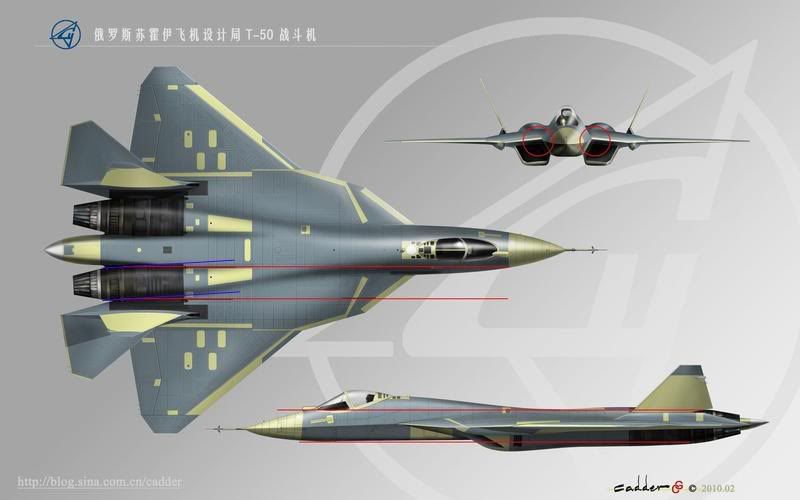
The F-22A and F-35s do suffer from that despite contrary claims and the PAK-FA is not an exception.
Nobody ever said they do not ‘suffer’ BUT the reality is they do not suffer near as much as the naysayers want everyone to believe.
***
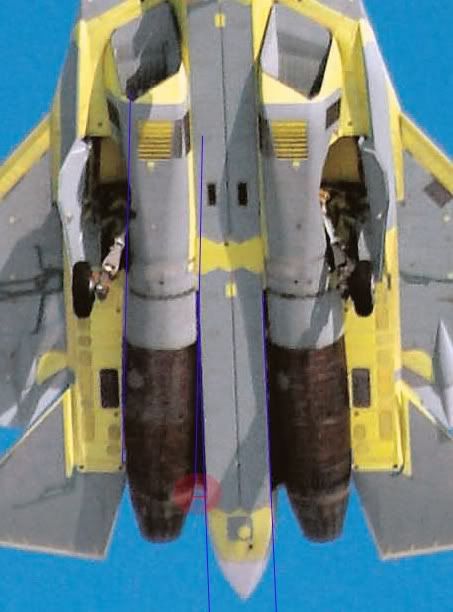
You mean something like this
I have the same impression.
http://img.photobucket.com/albums/v297/wsoul/intakes2.jpg
http://img.photobucket.com/albums/v297/wsoul/Intake1.jpgYes, thats my impression. Based on that. I would speculate that the intake ducts curve upward and inwards. The intakes are lower than the engines and the ducts have to curve inwards to meet the toed in engines. They might pass above the weapon bays too.
Despite the appearant ‘cant’ of the engines, closer examination reveals that the front of the engines are directly in line with the intakes.
And in the picture of the T-50 on the ground being used the nose is pointed DOWN, not reprisentative of level flight…
pfcemwhat a friggin disappointment
I agree
***
I did think the Chinook was a bit big for a combat SAR aircraft.
Aircrews aren’t that big and Special Ops have their own assets, so I (like the USAF Chief oif staff at the time) was a bit surprised with the Chinook selection.I’d like to see an S-92 get the job. A nice size between the Blackhawk and now-retired USAF HH-53s
The Chinook isn’t that big. And as you yourself stated, the HH-53 (significantly bigger than the Chinook) have been retired. Does it no make sense to replace THAT lost capability.
I too wood like to see an S-92 get the job of replacing the HH-60 BUT there is still a need for something MORE (range, capacity et cetera) to replace the HH-53.
pfcemI don’t see why more Supers aren’t simply bought and cancel the F-35C?
Then you are ignorant &/or blind.
It seems the least important of the 3x F-35 models to me, particularly with USN already focused on X-47 UCAV programs for LO penetrating and long-ranged strike capability.
Just what pray tell makes the F-35C the least important model?
The USN UCAV program is not expected to reach IOC until 2025 & even then it is only to equip ONE CAW squadron to SUPPLIMENT/COMPLIMENT the FOUR squadrons (2 each) of F/A-18E/F & F-35C squadrons.
I would add that cancelling the F-35C will allow for greater engineering effort, free up project management capabilities and development funding to then be utilised on the more challenging -B variant and allow the production facilities to streamline onto only 2 models and build these quicker than they could have built 3x separate models and replace legacy aircraft sooner, saving a bundle of cash in the process?
USN can get some -B models to fly off their carriers to provide a less than optimal but better than nothing VLO fighter capability and maintain complete commonality with USMC.
USN would then operate larger numbers of Supers and Growlers, with a defined upgrade path to keep them relevant in future years. In times of financial strife, the USN could easily make do with a bit less range and a bit less ordnance (though still plenty of each) from it’s new fighter. All the other capabilities will be the same…
You have no clue what you are talking about.
That is the same kind of nonsense that would have had the USN cancelling the F-4 Phantom just as it was entering production & waiting for the F-14 & F-/A18 or cancelling the F-14 & F-/A18 just as it was entering production & waiting for the NATF & JSF.
***
How many years from service is the F-35C, vs how many years from service is the UCAV?
F-35C IOC: ~5 years
UCAV IOC: ~15 years (planned but it too is likely to see delays but let us hope it happens before 2030)
Note that as currently planned the USN is projected to order its LAST F-35C in 2026 for delivery in 2028…
pfcemI’m going to say it again despite getting frankly bored of pointing it out:
“There is no such thing as fighter GENERATIONS – nobody agrees what it actually means and it is all frankly marketing BS”!
The European airforces who operate the Gripen, Rafale and Typhoon all say that they are 5th generation fighters in their opinion more then capable of meeting their air defence needs for the next thirty to forty years!
Nuff said!
Complete & utter BS. Fighter generations have been used by most all nations/designers/manufactures/writers since the 1950s.
pfcemApologies if this has been posted before, but it seems to make a clear case that the KC-30 is the better aircraft under every heading:
Seems being the key work there. But it is in fact EADS/KC-30 Kool-Aid. It ‘looks/appears’ good to the ignorant but in reality it is not.
So lets take a look at these 11 ‘capabilities’.
Fleet Effectiveness Value
This is the IFARA ‘score’. In the final evaluation they were 1.9 vs 1.79 vs 1.0. In reality without billions of dollars of infrastructure improvement the KC-30 scores LOWER than the KC-135R (in fact it could not even complete the evaluation missions to even obtain a score). The KC-X Source Selection Team had to alter the model data in order to get enough KC-30 in the air to refuel all receivers.
Aerial Refueling Mission Effectiveness
Another bogus ‘mission effectiveness’ evaluation based on inaccurate/made up data. This one from RAND which also ‘concluded’ that there was little cost-effectiveness difference for a airliner-based tanker from 300,000 lbs (767) all the way up to 1,000,000 lbs (747). For those who have bothered to look much of RAND’s work appears to be tanted towards a specific conclusion rather than an honest assesment…
The Maximum Fuel Load
Being able to carry more fuel DOES NOT mean that you WILL offload more fuel…
Fuel Offload At 1,000nm
Bogus nonsence.
According to an earlier (2005) study done by CAS Inc [the same source as THIS chart] at the runway length where the KC-135R offloads ~100,000 lbs of fuel [~9120′] the KC-767 offloads ~132,000 lbs of fuel & the KC-330 (KC-30) offloads ~145,000 lbs of fuel.
According to an earlier (2005) study done by CAS Inc [the same source as THIS chart] at the runway length where the KC-767 offloads ~117,000 lbs of fuel [~7860′] the KC-330 (KC-30) offloads ~134,000 lbs of fuel & the KC-135R offloads ~55,000 lbs of fuel.
According to an earlier (2005) study done by CAS Inc [the same source as THIS chart] at the runway length where the KC-330 (KC-30) offloads ~153,000 lbs of fuel [~10,000′] the KC-767 offloads ~132,000 lbs of fuel & the KC-135R offloads ~120,000 lbs of fuel.
Note that the KC-767AT would be slightly better than the KC-767 due to its superior runway performance…
Fuel Load From 7,000′ Runway
According to an earlier (2005) study done by CAS Inc [the same source as THIS chart] the KC-767 reaching its full fuel capacity from a 9,000′ runway & the KC-330 (KC-30) reaching its full fuel capacity from a 11,000′ runway. It shows the fuel offload from a 7,000′ runway to be ~101,000 lbs for the KC-767 & ~119,000 lbs for the KC-330 (KC-30).
Note that the KC-767AT would be slightly better than the KC-767 due to its superior runway performance…
Aircraft Fuel Efficiency
Again, being able to carry more fuel DOES NOT mean that you WILL offload more fuel…
The reality is that a commercial 767-200ER on a’typical’ airliner’ flight at near MTOW burns an average of 1722 gal (11,537 lbs) per hour while a commercial A330-200 on a ‘typical’ airliner’ flight at near MTOW burns an average of 2139 gal (14,331 lbs) per hour. Yes, as I have pointed out before a commercial airliner & a ‘typical’ airliner’ flight are NOT the same as a tanker. It is important to note however that a KC-767 with a load of 202,000 lbs of fuel is ~11,000 lbs (a KC-767AT would be ~25,000 lbs) BELOW its MTOW where as a KC-30 with a load of 246,000 lbs of fuel is just ~2,000 lbs below its MTOW AND tankers don’t fly the most efficient speed/altitude…
Aircraft Mission Capability Rate
You are delusional if you actually think that the KC-30 would have a higher mission capability rate than the KC-767.
Global Airfield Availability
Completely ignors most everything that actually determins IF an aicraft can actually operate from a given airfield OR that a KC-30 with a load of ~200,000 lbs of fuel can not offload as much of it as a KC-767 with a load of ~200,000 lbs. All they did it take the runway length each could take-off from with ~200,000 lbs of fuel & add up the number of airfileds from some unknown list of airfields. Nevermind that a KC-30 with a load of ~200,000 lbs of fuel has a take-off weight of ~465,000 lbs (ACN F: 55.5-59.9-69.4-93.3, ACN R: 47.7-54.9-64.8-74.8) vs 382,000 lbs for a KC-767 (ACN F: 48.0-53.0-64.9-84.6, ACN R: 43.3-51.9-61.6-70.2) OR whether or not there is sufficient parking &/or taxyway space for a 193′ 7″ long, 197′ 10″ wingspan aircraft.
Payload, Pallet & Passenger Capacity
KC-X is a TANKER with a secondary airlift capability not an airlifter with a secondary tanker capability. Nevermind that the KC-767s pallet capacity is one more than the C-17 ( & 3 times the KC-135) &/or that is pasenger capacity is ~double that of the C-17 (& 2.5 times the KC-135). I would like to see you get 52 tons of payload into a KC-30 without a proper frieghter floor.
Again please excuse my ignorance, but aren’t both these tankers already in service with other Air Forces? Why is there a need for expensive development?
No. Japan has 4 KC-767J in service. Italy has ordered 4 similar (but not identical – the Japanese tankers have no drogue pods for example) KC-767A with 2 set to enter service as soon as all certifications are completed & the last 2 to follow next year. There are no KC-30/A330 MRTT in service with any nation. The closest to doing so is Australia which is ~18 months behind schedule (experiencing center of gravity & wing pod flutter issues BUT had recently FINALLY passed fuel via boom to Portuguese F-16s) & expected to enter service ‘around mid-2010’ [likely around the same time as the Italian KC-767As].
The expensive development is needed because NEITHER the Italian/Japanese KC-767 NOR the Australian KC-30 meet all the KC-X requirements. The USAF requires specific systems for its tankers that none of the others have.
***
I 100% agree with your statement here. What I was reacting to was,
“The issue is that the USA says it’s holding competitions, but either writes the requirements to fit the politically preferred candidate & appoints an evaluation team which is openly biased in favour of that candidate, thus negating the whole point of holding a competition, or runs the competition then rejects the decision when the ‘wrong’ (in political terms) candidate wins”.
This is discussed in more depth in another area, but in a nutshell what happened the first time was USAF set out certain criteria, then changed its mind on what it wanted in the middle of the competition without informing both competitors, and evaluated on other criteria. The reason the award was overturned was not because one plane was better than the other (GAO made a big point of saying that it was not indicating the other plane should have been chosen) or because the “wrong” candidate won, but because USAF could not justify the selection they made under the criteria they themselves set out.
The second try collapsed because it became obvious that this time USAF was writing the criteria around a particular aircraft.
This is why, instead of doing it right this time, it looks like they’re going the “safe” route and awarding on price.
You are a little confused.
Round 1 was the tanker lease.
Round 2 was the 2006-2008 debacle.
Round 3 is this new RFP.
There was a ill-fated attempt at round 3 in late 2008 (shortly after round 2 was cancelled) but Gates called it off for a “cooling-off period” & to “allow the next administration to view objectively the military requirements and craft a new acquisition strategy for the KC-X as it sees fit.” THAT RFP was written by Young & from what was released about it seem quite similar to this latest RFP.
Round 1 was hardly ‘open’ having actually begun in 1996 with the USAF/DOD having all but decided on the KC-767 even before 9/11/01 (at which time the tanker recapitalization roadmap did not have the USAF getting its 1st new tanker until 2012). Shortly after 9/11/01 a new tanker recapitalization roadmap where by leasing 100 KC-767 similar to the Italian KC-767A was to ‘jump-start” the process such that the USAF would get its 1st new (leased) tankers in 2006. EADS/KC-30 supporters of course argue that the USAF having already decided on the KC-767 prior to releasing the RFP hardly made it fair either.
***
One side argues that being more capable is a good thing.
Another side argues that being more capable is a BAD thing.
Tell me which side is drinking the kool-aid?
No, one side confuses additional/extra CAPACITY with greater capability. The other side recognizes the difference between the two & how bigger/more is NOT better AND that the realities of tanker operations is more complicated than a simple 1-vs-1 comparision.
The side side confusing additional/extra CAPACITY with greater capability is drinking the Kool-Aid.
***
My position is that the 330 is a more capable tanker, and a bigger airframe. That being said……it is and will continue to be seen in America as a European/French airplane. Thats just the way it is, and no rational argument is going to sway that appearence from the US public and (more importantly) the congress. People can deny that till their blue in the face, but it simply will not change. While the 767 is not as good(?) a tanker (they are 2 completely different a/c) as the 330, it is the more politicaly and publicly acceptable of the two. It is a HUGE improvement over the 135s, and it is, for want of a better way to put it, “good enough” for the job. The Air Force needs a new tanker YESTERDAY, so the US needs to get this contract going!
Just what do you base your position that the A330 is a more capable tanker? I bet it is based on EADS/KC-30 “bigger is better” Kool-Aid.
The A330 IS a European airplane. Final assembly in AL doesn’t change that fact.
The KC-767 is the better tanker for the USAF.
***
Actually the KC-30 and KC-767 are VERY close in lifecycle costs, which is what makes the KC-30 a no-brainer (more capability for free)
The KC-777 would be significantly more, so while the KC-777 would perform better, we couldn’t afford enough of them.
If the KC-777 were in the same range as the KC-30 and KC-767, I would be all over that.
But it’s not.
No they are not and you know it. Even using a BS 25 year service life when the KC-X is supposed to be in service for 40 the KC-767AT’s (& other inaccuracies) lower operational costs was able to overcome its higher developement cost (& Airbus/EADS’ deliberate underbid).
***
Been lurking for a long time following the thread with some interest, as I am a former -135 aircrew. Most of the the debate on this topic is focused on a limited number of attributes of each aircraft and is completely missing the point of what does the end user ultimately want? Which is in and off itself a good question because you have two schools among us blue suiters, the pointy nose crowd and the gas passer/transport types. Each have a different view.
As stated earlier, I flew for a while in the -135 and flew with plenty of guys who had green ink dating back to GW #1. One of the chief constraints they mentioned was there were never enough booms in the air, but almost every mission they flew they brought lots of gas home. Part of the not enough booms problem is that the little pointy nose types are limited on their on load rate.
Now, back to the two cultures thing, the pointy nose types want a -135 replacement, that focuses on passing gas first. Why? the current tankers aren’t using all of their capacity so why pay for extra capacity that we won’t use and why pay for extra operating cost that will keep us from buying and flying more important airplanes (pointy noses). For them, smaller, cheaper and as much capability as the -135 is good enough.
The second crowd would like to augment the airlift side of the house and favors larger with more cargo and pax. In particular, they see the pax capability into defended fields as a big benefit taking a lot of load off of the C-17. They would argue using this cargo excess capability will offset the larger size and operating costs of a larger aircraft.
Now, this in now way reflects any official view of my employer, just some random discussions amongst the crew dogs. So, I would argue the culture aspect plays a bigger role than the jingoistic protectionism if the RFP favors a smaller aircraft. Why? most Air Force general officers are fighter pilots and they won’t buy an aircraft that will take money away from the more important priorities of buying and operating fighters.
Cheers
Pretty much my experience talking with tanker crews & commanders. Those who recognize THE need of a tanker 1st & an airlift asset 2nd (AND that we are to be getting a ‘large’ tanker later) would rather have the 767 (if not something smaller). Those who, for what ever reasons, consider the need of an airlift asset 1st & a tanker 2nd would rather have the A330 (or 777).
***
There’s a solution to that – get the USN and USMC hierarchy to convince the USAF to go probe and drogue on their fighter assets. Yes, the individual transfer will be slower, but you can do two at a time.:D
I suspect it’d be fifty years too late though!:)
On a serious point though, it’s better to have the luxury of being able take gas back home off the area, than to find you haven’t got enough of it. You very rarely here of a KC-10 with a negative frag, but I’ve heard it from -135s (and other “smaller” coalition tanker aircraft). With the number of tankers being procured, with the basing options available (certainly in the near and middle distance future) I suspect wouldn’t be a big push factor either way.:)
Have you not been paying ANY attention? The KC-135s return to base with ‘extra’ fuel in the tanks almost all the time.
AND what you so conveniently forget/neglect is the number of types of tankers. We are NOT replacing all KC-135s & KC-10 with just ONE tanker.
***
You’ll get the same number of booms in the air with both.:)
major problem is that the number of airframes are the same, so, the number of booms is identical.
The difference is that the “bigger guy” will be able to feed more “little guys” in a row (bigger load), which can be also considered as an equivalent of “more booms in the air”
the price argument works the other way too (maybe even better)
Classic example of EADS/KC-30 Kool-Aid. Just because the number of tankers to be procured is the same DOES NOT mean that the number of tankers that you can get in the air is the same. You can operate MORE KC-767 from MORE airfields (& MORE from each) than you can the KC-30 even IF you spend the tens of billions of dollars to rebuild the current infrastructure to accomodate the KC-30.
AND just because you can carry more fuel DOES NOT mean that you will unload more fuel. Reality is quite different from EADS/KC-30 Kool-Aid fantasy world.
***
The one advantage size will give you is loiter time. Say for example the transit time into and out of theatre is 2 hours each way (not unrealistic). Whereas the smaller tanker may then only give you 2 or 3 hours “on task”, with the larger tanker you may get close to doubling that (or better depending on the flow of receivers). When you’re conducting ops 24/7, that is where the larger tankers give you a slight advantage, in that to have same amount of gas available in theatre, you need fewer sorties (fewer cycles on the airframe, fewer servicing man hours). The number of tankers in theatre at one time is always going to have a reasonably finite limit as well, due to airspace demands (borders, terrain/geographical limitations, civil airways etc).
More EADS/KC-30 Kool-Aid fantasy world. In the REAL WORLD flight operations are not a constant – it occurs in surges (LOTS of aircraft needing refueled in a comparatively short period of time) & lulls (comparatively longer periods of time with MANY fewer aircraft to refuel).
AND with the ability to operate more KC-767 from more airfileds than the KC-30, the average fleet/theater wide transit (time/distance) per tanker is SHORTER.
That is not to say that having a smaller number of larger tankers to compliment a larger number of smaller tankers is not good but this EADS/KC-30 Kool-Aid that replacing KC-135s with a tanker LARGER & HEAVIER than the KC-10 NOT good.
***
The argument about who gives you the most really revolves around how USAF specs the project and what they consider the most important. The previous go-round, Boeing gave more booms per dollar because its plane cost less and could operate from more airfields. EADS could deliver more fuel more economically at the refueling point because you could transfer more fuel per aircraft. The price for that was fewer booms because if you put the same number of planes up there as the Boeing design, it cost you more up front and that would defeat the purpose of Airbus’ greater per plane load-carrying capability (could project the same way with a KC-777).
No the argument about who gives you the most revolves around REAL WORLD tanker operations. Just because you can carry more fuel DOES NOT mean that you will transfer more fuel. In fact in reality the KC-X will not transfer anywhere near its full fuel capacity the VAST majority of the time AND for those few situations when you DO need ‘a lot’ of fuel THAT is what the KC-10/KC-Y are for.
This time, USAF seems to be focused on price. This is why EADS is objecting, because they don’t get much credit for their larger capacity, given that they exceed the requirement (Boeing is objecting for different reasons). In this case, for EADS to put up the same number of booms would mean their bid would cost substantially more (again, the KC-777projects out the same way).
Neither of the previous two rounds’ RFP gave any credit for greater capacity (over the other bid). The KC-767 exceeds the requirement. There is no possible way for you to put as many KC-30 booms in the air as KC-767 booms. The KC-767 can operate from more aifields & operate in greater numbers from each airfield.
***
Not true. The KC-30 burns more fuel per hour and had higher infrastructure costs, but even accounting for those, the lifecycle costs between the two was practically identical.
This means the acquisition cost of the KC-30 was LESS than the KC-767
Yeah, by making a number of inaccurate/incorrect cost evaluations – not the least of which was evaluating cost over just 25 years when the KC-X is expected to stay in service for 40…
To put it into perspective, the developement & procurment cost were ~$35 billion but total life-cycle costs were over $100 billion.
And just wait, IF NG/EADS bids this time it is (unfortunately for them) likely to be closer to real market price rather than the DEEPLY discounted price that all those illegal subsidies from EU governments ‘allowed’ them to get away with in the past.
I ESPECIALLY love how THIS TIME, when lower cost is a more important factor, that NG/EADS & its supporters complain that it can’t compete on cost…How can that be IF the KC-30 is in fact less costly?
***
well, considering that boeing proposal is very different from tankers they proposed to other nations (japan, for instance), it’s an entirely new aircraft they need to make fly, composed of various parts coming from various models (fuselage 767-200, wings 767-300 and cockpit 767-400), which is what earned it the nickname “frankentaker”. once they made the airframe fly (and tested and all that stuff), they need to integrate all military specific hardware they intend to put in it
EADS, proposes, on the other hand, pretty much the same airframe they sold already to australia (among others), in which they need to integrate specific USAF hardware (that’s nothrop-grumman’s job).
basically, the difference is that the airframe is ready in EADS/NG case and not in boeing’s
But the A330 MRTT has already been modified for military operations. The question is, not what development is needed for military operations, but what development is needed for the USAF that is different from what has been done for the RAAF, RAF, & Saudi & UAE air forces?
The 767 is another matter, as Boeing is offering a model significantly different from existing KC-767s.
ALL of the airframe components of the 767-200LRF/KC-767AT/KC-767NG are currently flying on one or more existing 767 varients and Boeing has proven time & time again that it is more than capable of integrating new airframe components onto existing designs – the P-8 being the most recent example. The amount of systems developement needed for KC-X is MUCH more significant than the minor airframe changes.
***
Agreed re the A330 – that’s what puzzles me about this – and as for the KC-767, why don’t Boeing offer the same plane they built for Italy and Japan, especially as it was developed for the USAF in the first place?
No the KC-767s for Italy & Japan were not developed for the USAF. Although IF the round 1 tanker lease had gone through a US specific KC-767 similar to the Italian/Japanese KC-767s WOULD have been developed & (assuming no major delays) been in service for almost 4 years now.
Neither the Itialian or Japanes KC-767 NOR the Australian KC-30 meet all KC-X requirements…
If the answer is that further development of either or both aircraft is required by the details of the USAF specifications, then in the interests of the US taxpayer, someone should bang a few heads together in the Air Force and get them to rewrite their specs. Paying out more billions of dollars to get 100% of the specs doesn’t make sense these days, especially if what’s already available meets 99% of the requirement.
Again, the KC-X has some rather specific requirements (see the RFP) that need new systems to be developed & integtrated into what ever airframe it ends up being. There is nothing out there today that meets anywhere near 99% the USAF requirements.
Note that the tanker lease was much as you ‘prescribe’. Taking an ‘existing’ tanker (in the case of the tanker lease it was the KC-767 already in the works for Italy & Japan) with minimal developement (time & money) to meet the most critical/basic requirements. Of course the tanker lease was just meant to ‘jump start’ the prosess, a full spec/capability KC-767 to meet ALL USAF requirements was to be developed during the time of the lease for later procurement batches/lots (with possible/likely/hopeful procurement & upgrading of the lease tankers to as near full spec/capability as possible).
***
But remember that in this case, it’s a flying fuel tanker…. It’s not cutting-edge technology.
Which begs the question: why replace the KC-135s at all? Most of them have enough airframe life left to soldier on for another 25 years.
Because, aside from the current fleet already overly expensive to operate due to their age (projected to reach $6 billion a year by 2018), since Congress is so unwilling to provide the necessary funds for more than 12-15 new tankers per year it is going to take 30-40 years (from when we get the 1st new tanker) to recapitalize the entire fleet. By the time we are done the 1st KC-X will be due for retirement/replacement & we will have to start all over again…
pfcemI thought the 2013 date was basically a misunderstanding, and therefore 2015 is not a delay?
You miss the point. Mearly the PERCEPTION of a delay (real or not) is enough to cause F-35 naysayers to go shouting from the mountain tops that it is further proof of all the bad things they want people to believe about the F-35.
***
Honestly this topic is long covered and cleared, no need for another thread.
Read post #5. A few of your were so ‘quick on the draw’ that you responded to the start post WHILE I was generating it.
***
pfcem, looking for intellectual honesty and integrity from that crowd is as pointless as trying to find a crock of gold at the end of a rainbow. You’d probably have better luck trying to find the gold.
Yes, I know. THE point of the thread is that if they had even a semblance of intellectual honesty then they SHOULD have went off on a tirade about the T-50/PAK-FA similar to what I posted.
***
Deliveries for 2015 were stated as the target for last 4-5 years… so how can this be a “delay”??? In fact if they manage to introduce it to service ONLY 5 years after first flight it would be a major coup for Sukhoi… especially as f35 has not a chance in hell of entering production before 2015 😀
You miss the point. Mearly the PERCEPTION of a delay (real or not) is enough to cause F-35 naysayers to go shouting from the mountain tops that it is further proof of all the bad things they want people to believe about the F-35.
The F-35 has been in production since FY2007. In 2015 it is to be in FULL RATE PRODUCTION of ~230 airframes per year.
***
Is this like the de facto ‘Anti-PAK-FA Thread’? Should I leave?
No, the thread isn’t even about the T-50/PAK-FA. I mearly used a ‘bad news’ report about it as a lead in….


 Sign In