 esp 49129
The Cold War lasted a long time… :confused:
If you look at rough time periods, here’s my ranking:
1950s: Mig-19??? I’m not enough of an expert…
1960s: F-8 Crusader
Clearly more maneuverable than F-4, Mig-21, Mirage III, BAE Lightning, while still retaining good (only slightly inferior) acceleration/climb performance.
1970s: Mirage F-1
The most maneuverable non-fly-by-wire supersonic fighter in the West (beat only by the Mig-29 in the East). Achieved this without sacrificing acceleration/climb performance and while incorporating a credible BVR capability, which allowed it to compete with “non-dogfighters” such as the F-4 & Mig-23.
1980s: F-16 / Mirage 2000 (tie)
Both fighters were extremely maneuverable thanks to fly-by-wire. In particular, a delta wing dogfighter became possible for the first time. I would rate the Mig-29 & F-18 slightly below. The Mig-29 was simply too limited (fuel, electronics, service life) to justify its possibly marginally better dogfighting capability. The F-18 was competitive at low speeds but outclassed in many possible scenarios (initial merge, interception etc).
esp 49129What country is this Etendard? Irak?
Yes, that’s an Iraqi Super Etendard according to a previous thread on this forum:
http://forum.keypublishing.co.uk/showthread.php?t=23837
Notice that some of the French markings remain. There are no Iraqi markings because the planes were only on loan.
esp 49129A transport with two TP400-D6 would compete head-on with the C-130J, not the G.222.
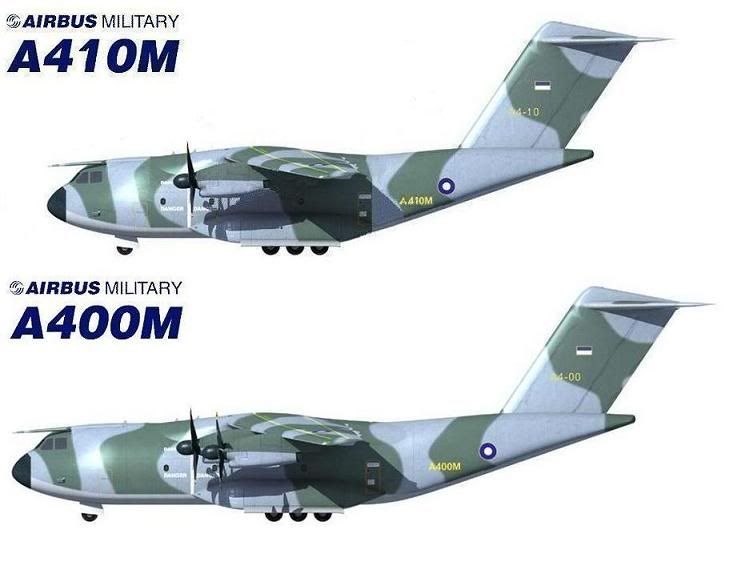
It’s called the A410M, actually. 😉
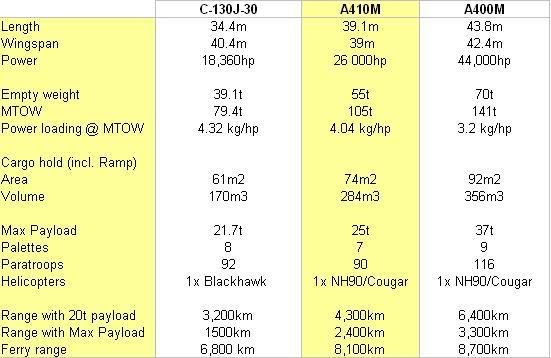
I dreamed this baby up 3 years ago – a more “tactical” variant of the A400M, with common engines (but uprated to 13,000hp from 11,000hp), avionics, cockpit, fuselage (shortened by 5 meters), cross-section etc. Only the wing would be entirely new and some of the structural arrangements changed because of the lighter take-off weight.
Compared to the C130J, the main improvements would be in the improved internal cross-section and higher payload, allowing for 25t armored vehicles or larger helicopters, for example. The swept wing would also improve cruise characteristics and range.
Here are the notional specs I came up with:
esp 49129Too bad the MKIs won’t be anywhere near full potential. 🙁
Still, it makes for an interesting line-up, with both Su-30s and Rafales already announced as Red Flag participants in August. Given this opportunity to check-out two potential rivals for the first time, I can’t see how the F-22 won’t be making the trip.
Let’s dream on: Su-30s, Rafales, F-22s, who knows perhaps even Typhoons from one of the Eurofighter countries?
Now that would be an interesting photo op.:D
esp 49129Confused
Super Hornet Block II+/Rafale F3, license built in India, with 50% offsets, full technology transfer, radar codes and the right to integrate competitors’ weapons and systems, all probably for an impossibly low price…
Am I the only person who thinks the Indians are dreaming?:confused:
They may get one or two of the above concessions, but I don’t see how in the world any of the bidders is going to just hand over their hard-earned, bleeding-edge technology for a bargain basement price. MRCA may be a (potentially) lucrative competition, but none of them are stupid. Or are they? :confused:
esp 49129More breaking news
According to the French defense magazine Raids, 3 French Tigre HAPs are to deploy to Afghanistan in the second half of 2008. 😀
Given that the Aussie Tigers are closer to being ready for an operational deployment, this appears to confirm that Aussie Tigers to Afghanistan in spring/summer 2008 is technically feasible. 😉 Still waiting for official confirmation.
Nice to finally see that the best alternative to the Apache’s monopoly is finally shaping up… (Cobra, Mangusta, Rooivalk, Hokum and Havoc fans please excuse me :p )
esp 49129the tiger is better for the ARH role leaving apaches/cobra’s to do cas/escort & attack roles.
Although the Apache Longbow is clearly the king of all gunships in the attack role, the Tiger could stake a strong claim to being the best CAS/escort helicopter out there. 😉
Keep in mind that while the Aussies nominally bought the Tiger for the ARH role, the Tigre HAP’s original role as designed is CAS/escort of ground troops and transport helicopters in a Cold War scenario. This can be seen in the Tiger’s specs:
– The Tiger’s M781 gun is a much newer and more capable design than the Apache’s M230 chaingun. Muzzle velocity is 29% higher (1025 m/s vs. 792 m/s), leading to greater destructive power and higher accuracy. Rate of fire is 20% higher (750 rpm vs. 625 rpm), also improving the accuracy of each salvo.
– The Tiger’s is the most maneuverable gunship out there, which comes in handy for CAS/escort, when you’re dodging small arms fire and covering troops on the ground.
– The Tiger is the only Western gunship built from the ground-up for the air-to-air role. The maneuverability is great for air-to-air, as is the gun’s unique (as far as I know) air-to-air mode. Stingers/Mistrals are also a common loadout (IIRC only Japanese Apaches are equipped with Stingers).
– Just like the Zulu Cobra and AH-64D, the Tiger’s gun is slaved to the pilot’s helmet for near instantaneous targeting, which IMHO is key for the CAS/escort role. For details, you can check out this rather cheesy video from Eurocopter: http://www.youtube.com/watch?v=ECHwsiKdsos
esp 49129marage1,
The Tiger’s ammunition load is 450 x 30mm rounds.
By comparison, the Apache typically operates with 300 x 30mm rounds plus a 100 gallon internal auxiliary fuel tank, though it has a maximum capacity of 1200 rounds if you delete the fuel tank. Based on experiences in Afghanistan, it appears that 300 rounds often aren’t enough and there’s talk of future modifications to increase the ammunition load at the expense of some of the auxiliary fuel.
Given all that, hopefully the Tiger’s load of 450 rounds is just right…
esp 49129That is just pitiful.
With only 9 airframes at the moment, Australia is the second biggest user for the Eurocopter Tiger?
The Tiger is a pan-European RAH-66 Commanche, to put it bluntly.
Some would take that as a compliment… :p
Seriously, though, Comanche only flew about 630 hours, while Tiger has already logged over 8000 hours. If the numbers in service seem so low, keep in mind that there are a lot more Tigers actually flying but not yet delivered. At least 41 Tigers have been spotted, and the only thing we can be sure of is that the actual number flying is higher and steadily increasing as more and more helicopters finish their ground tests and make their maiden flights.
Tigers spotted:
France: 12 (serial numbers 2001-2016, missing 2005, 2007, 2008 and 2014 delivered to Spain?)
Australia: 13 (serial numbers 4001-4013)
Germany: 10 (serial numbers 1001-1010)
Spain: 6 (serial numbers 701-706)
And here’s a nice picture for the road::D
esp 491291, CVF is NOT INTENDED to be a sea control platform. Its role is Carrier Strike.
Okay then… Too bad the RN won’t be getting the fixed-wing, overland-capable AEW coverage it needs to perform said Carrier Strike role. Or are you claiming that the future MASC will be able to support strike packages the way E-2 Hawkeyes regularly do in Iraq or Afghanistan? :p
2, STOVL CVF is going to be capable of generating strike sorties against first-day-of-war targets 450nm distant with freefall ordnance and circa 600nm distant with CASOM. It will be capable of generating 100 plus sorties in the first 24hr surge of combat operations and will be able to, comfortably, sustain 72 sorties a day for a further 10 days.
I recall a certain 40,000 ton CTOL carrier whose design specifications call for surge operations of 100 sorties per day for 7 days (Charles de Gaulle) So I’m sorry but I don’t see the supposed advantage of STOVL for sortie rates. I’ll admit that if you specify a short enough time span, then eventually you do reach a point where STOVL will generate more sorties than CTOL. But IMHO, the difference might be operationallysignificant over no more than a couple of hours, if ever.
In addition, regardless of which type is better at surging and what length of time you use to define such a “surge”, this surge capability is only a very small part of the overall picture. After all, it becomes a moot issue once you’ve entered the sustained phase of operations, because maintenance and stores then become more important. For sustained operations, STOVL and CTOL are both equal, all other factors being the same. Thus, the French PA2 will have a higher sustained sortie rate than the original CVF STOVL design (75 per day beyond the first 7 days) due to the Marine Nationale’s requirement that jet fuel capacity be increased from 3 to 5 million liters.
Finally, the only conceivable cases where you’d need this (still-to-be-proven) superior surge capability would be against precisely those regional powers that have the weapons to exercise sea control and against which the lack of fixed-wing AEW and long-range strike is going to be sorely missed… :diablo:
esp 49129@ Edlaw
The whole point of the reverse angle deck is to minimise overhangs, which reduces the deck pitching a lot.
Got it. Don’t know if we’re saying the same thing, but I’m also thinking that the reverse angle deck allows the arrestor wires to be set closer to the ship’s center, where there’s less pitching movement, since the landing area extends all the way to the bow. This gives pilots an easier target to hit.
@ Jonesy
I know I’m not going to change your mind, but I’m still hoping Edlaw and I can win this “Battle of the Atlantic”. :p
On the surface a CVL with 10 S-2’s, however many of those left with shot/traps left on their airframe lives by the 80s!
Well… dozens of S-2s are still operational in 2007. And firefighting operations aren’t exactly easy on airframes. The aircraft that went through the Turbo Tracker upgrades in the early 1990s were also stated as being good for 25years. So I think it might be no more of a nightmare than keeping the F-14 in service…
10 Hornets may seem to be of value, BUT, in reality what could they achieve?.
BARCAP….with 10 aircraft?. 2 aircraft on a CAP slot plus 2 on DLI ‘Alert5’ and 1 set-up with an emergency buddy pack and there’s half your airgoup gone…for the provision of a single CAP pair!!!. Even if you cycle pilots through the Alert birds you have 2 cabs struck below under maintenance, 2 up on station, 2 on deck and the buddy tanker…that leaves a whole three aircraft…be still my wildly beating heart!
I’m going to assume that you’re a fan of the Invincibles. 😉 So how is 10 F-18s worse than 8 Sea Harriers on an Invincible? I understand it’s not enough for a 24h sustained BARCAP, but it’ll still provide you with more air defense capability than any carrier at the time bar the U.S. supercarriers.
Given that a 20k ton CVL is going to seriously pitch and roll in a standard-issue Atlantic seaway, and catobar ops are going to be an interesting proposition, a 20k ton CVS with 10 SHAR FRS1, 12 HAS.Mk5 and a few AEW.Mk2’s is going to be, operationally, the far better proposition.
HMCS Bonaventure seems to have conducted North Atlantic operations just fine for more than a decade. So I’m to take a giant leap of faith and assume that a modern carrier with stabilization systems should be able to replicate the performance of a 19,000t WWII design… 😀
esp 49129Jonesy,
Aha! If the real threat is indeed from Soviet SSNs, then would you rather take a helo-only capable carrier, or a CTOL carrier that could operate S-2 Trackers – the closest thing to an S-3 Viking – in addition to helos? :p
A CTOL carrier has the inherent flexibility to fall back on operating only ASW helos if needed. But it can also carry, say, 10 ASW Trackers, 10 F-18 Hornets, and a gaggle of helos. This would have been perfect for the U.S., Canadians and Australians, which were all operators of these aircraft…
The S-2 Tracker could easily have been upgraded into an effective ASW platform in the early 70s-80s, with digital processing equipment similar to that on the S-3 Viking. The only reason it didn’t happen was because the USN didn’t operate Trackers anymore. However, such an upgrade was later privately funded by various companies as part of Turbo Tracker upgrades, and was put into service on Taiwanese Trackers.
Sure the Tracker might be slower than a Viking, and only carries half as many sonobuoys, but it would have been highly valuable. An AEW variant could even have been developed, and fitted with Searchwater radar…
Anyway, I just though your argument highlights the need for a CTOL carrier! :diablo:
esp 49129x07,
According to my Google searches, 25 de Mayo never actually operated Super Etendards, because she was determined after trials to be too small to do so effectively.
Same thing for the Rafale on Clemenceau. The Rafale landed during trials without any stores, and both the Rafale and F-18 were determined after technical evaluations to be capable of operating off the Clemenceau in the air-defense role. But the French Navy was desperate for a Crusader replacement, so we don’t know how compromised these operations would have been. For example, could the Rafales/F-18 bring back more than a couple hundred kilos? And could the Clemenceau’s shorter wires stop a 14-16t Rafale/F-18 doing a hard landing in rough seas without breaking anything?
I’ll compromise and concede you a couple of meters: the PROVEN minimum length to land a Hornet-sized aircraft without significant operational constraints is 195m. That’s the design length of the Charles de Gaulle’s angled deck back when it was intended to operate only Rafales. The French then decided to buy Hawkeyes after construction had started, and everyone knows the consequences… 😉
esp 49129(@ Jonesy: definitely impressed at how managed to “spin” my argument. Is that skill part of your line of work? :diablo:)
Seriously though, if anyone wants to defend themselves against Soviet massed anti-shipping strikes with subsonic 😮 , short-legged 😮 , WVR-only capable 😮 STOVL fighters, then be my guest.
However, if you would prefer not to finish swimming in the cold Atlantic waters :p , then you probably will want a supersonic 😎 , BVR-capable 😎 fighter capable of providing 24h BARCAP coverage outside of enemy bombers’ launch envelope, with long-range AEW support. In the later case, the CTOL option is suddenly very attractive, even if you need to plan your launch & recovery cycles more carefully… 😉
(Apologies for all the emoticons, I overdid it somewhat)
esp 49129The rationale for reverse angled decks IMHO is that they are the only way you can fit the required ~200m (650ft) angled deck needed to operate F-18 sized aircraft on a postage stamp sized 20,000-25,000t carrier. 😉 (200m is the size of Charles de Gaulle’s angled deck – likely the smallest F-18 capable carrier)
A normal angled deck will run only say ~3/4 of the length of a carrier, which is fine on a large carrier. It also works (barely) on small carriers as long as you limit yourself to operating aircraft the size of A4 Skyhawks. Clemenceau’s angled deck was 165m (540ft) and I would imagine that the angled decks of HMAS Melbourne or 25 de Mayo were even smaller, though I wasn’t able to find any data. 🙁
The overlap between the angled deck and the catapults is a non-issue. First, it would probably be inevitable even with a normal angled deck, assuming you want 50m+ length catapults (Clemenceau didn’t have an overlap with 50m long catapults, but was also significantly – about 40m – longer). Second, a small carrier only has about 20 aircraft, so efficient air operations are much less of an issue than on a supercarrier with 80 aircraft (4x as many aircraft to recover, 2x as many aircraft to launch per catapult on a Nimitz 😮 ).


 Sign In







