 esp 49129
Shiplover
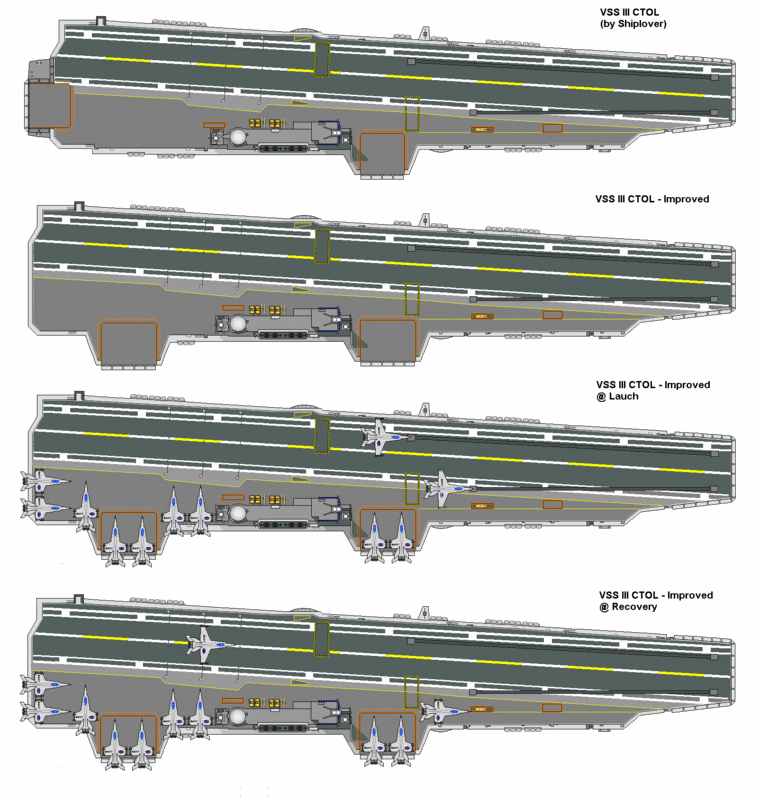
I’m not sure that the location of the deck edge lifts on your drawings is possible. They appear to be too close to the centerline, thereby intruding on the hull “box”, which would create structural problems.
Usually deck edge lifts are attached to the outside of the hull, so the entire lift overhangs over water. Of course this overhang may be undesirable for Atlantic Ops, but it’s unavoidable IMHO.
Given the advantages of deck edge lifts (improved hangar flow, more deck area, less likely to prevent flight operations), it’s much better to accept the weather-related constraints and compensate by fitting a proper stabilization system. Another option would be to locate the island further forward, in front of both lifts, a la Charles de Gaulle, which might help protect the lifts from weather.
Also, its likely that the kinds of seas that would prevent the use of a deck edge lift would also rule out landing operations anyway…
esp 49129Shiplover,
Lovely drawings! I felt inspired and took the liberty of designing an “Improved” CTOL VSS based on your drawings. 😎
The objective of my mods is to speed up air operations and enlarge the airgroup while sticking to the same overall dimensions. The resulting notional airgroup would be ~20 fixed wing aircraft + 4-6 helos. Pretty damn impressive for such a small platform (30,000t, 717ft). :diablo: A perfect Colossus/Majestic class replacement as well, and similar in capability to the larger Clemenceau class.
Here’s what I changed:
– I enlarged both lifts to carry 2 Hornets. Benefits: faster flow to/from hangar, 2 additional deck parking spots
– I moved the stern deck edge lift to the starboard deck edge. Benefits: lift no longer interferes with recovery operations, and better flow within the hangar.
– I enlarged the deck all the way to the stern. Benefits: More deck space and longer landing area, allowing for easier recoveries in bad seas
Comments?
esp 491293rd BPC for French Navy?
Great idea for a thread. Here’s some news fresh off the press.
The French Navy is considering buying a 3rd 21,000t BPC type LHD as a replacement for the Jeanne d’Arc training ship to be retired in 2010. Key arguments in favor of the BPC design for this role are:
– Accomodation for 450 troops is more than enough for the expected number of cadets (130 cadets per training cruise)
– Helicopter capability can also be used to train army aviators
– Large payload, landing craft and on-board hospital can be put to use for quick-reaction humanitarian operations while on training cruises around the world
– Capable of real mission taskings in case of need
– Excellent availability of 210 days/5000 hours per year, which can be extended to 350 days (again useful for secondary mission taskings)
– Low operating costs compared to its predecessor Jeanne d’Arc (160 vs. 600 crew)
– Extremely low acquisition costs of 150-200MM euros (:eek: ), about 20% more than a comparable commercial ferry apparently and less than a frigate
IMHO, a great idea, though maybe one of the smaller BPC variants (14,000t BPC 140 anyone? 😉 ) might shave off an additional couple dozen million euros…
BPC Mistral & Tonnerre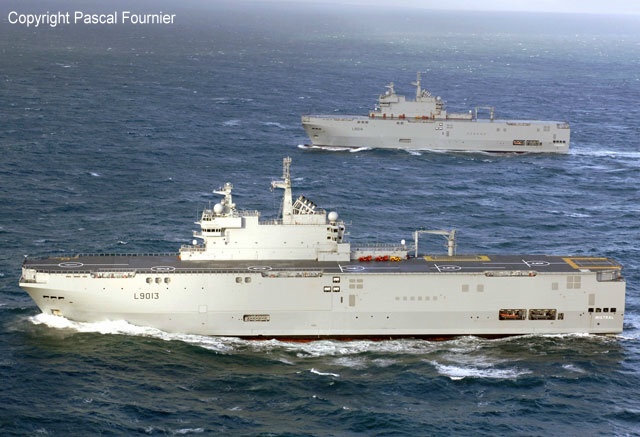
BPC 140
Here’s the original info:
http://www.meretmarine.com/article.cfm?id=105252
(Sorry, non-French speakers will need to rely on the awful babbling of Babelfish or some other translation website)
esp 491293 full-size, full-spec LHDs is almost certainly unrealistic for a country like South Africa. However, I think 2 smaller, downgraded derivatives of an existing LHD design would be much cheaper, and probably achievable.
The key is that the SAN needs to be realistic about the LHDs’ intended mission. South Africa needs regional power projection ships tailored for humanitarian and logistical operations in low-threat waters. That’s very different from a 20,000+ ton BPE/Mistral-style design capable of global power projection and amphibious combat operations in medium-to-high threat waters. Specs that the SAN could easily downgrade include the combat system, weapons, HQ facilities, helicopter facilities, endurance etc.
The ideal starting point IMHO would be the BPC 160 design, a smaller variant of the French Mistral class proposed by DCN, for cost and technical reasons. Here’s what I think the SAN’s “Modified BPC 160” should look like:
Modified BPC 160
Displacement: 17,000t
Troops : 500, in higher density accommodation
Helos: 8-10 helos, 5 landing spots, 1 lift
Vehicles : 100
Landing Craft : 4 LCMs, no LCAC capability
HQ: Small 50 man HQ
Hospital: 70 beds
Combat system: Downgraded Senit, ~500 tracks
Communications: Inmarsat, Fleetsatcom
Weapons: 2x 30mm gun (rely on portable SAMs or escort in case of real air threat)
Regional endurance
Compare to Mistral:
Displacement: 21,000t (25% larger)
Troops : 450
Helos: 16 helos, 6 landing spots, 2 lifts
Vehicles : same
Landing Craft : same # of LCMs, but also LCAC-compatible (requires high-powered ventilation equipment)
HQ: Large 150 man, NATO compatible HQ
Hospital: same
Combat system: Senit 9 (~2000 tracks?)
Communications: Syracuse (French satellite comms), Fleetsatcom & Inmarsat
Weapons: 2x 30mm, 2x Simbad SAM
Global endurance
Basically, it would be as capable as the Mistral class for humanitarian & logistic operations (for which you need troops, vehicles and hospitals), but less capable for combat operations (for which you need a large HQ, powerful combat system & communications, more helos and self-defense weapons). By leveraging an existing design, reducing the specs and displacement, and building more blocks in Polish shipyards (as was already partially done with Mistral), I’m sure you could cut the ships’ cost by another 40%.
The Mistrals were already cheap at 650MM euros for 2 ships, so the SAN could get 2 17,000t LHDs for ~400MM euros (US$500MM). That would be excellent value for money. 😎
esp 49129Rafale M pics from Indian Ocean
Found these recent pictures of Rafale M operations on Charles de Gaulle, during missions over Afghanistan. Apologies for the small size.
Bombed up & ready to go.jpg)
Launch at dawn%20(web).jpg)
Launch.jpg)
Back from last mission in Afghanistan.jpg)
And finally… 12 Rafale on deck.jpg)
.jpg)
Edit: And sorry – I forgot credits for the photos. pacdg.free.fr
esp 49129other good sources give 10,300 kg as the empty weight
AdlA sources have also given empty weights in line with the 10,300 kg figure for Rafale C (10,650 for the B, for example)
Jackonicko,
What are your sources? I have never seen those figures on paper, or on the internet.
Unwittingly, Pilot THX gave some credence to this kind of weight figure when he posted that:
“There was a nice report from a french journalist flying in the backseat of Rafale B302. He claimed the takeoffweight was 16,4t with a 1250 l tank and 4 MICAs.
So let’s subtract 16,4 t minus 1,4 t (should be the weight of tank and for MICAs). So you have 15 t.
Oh it’s becoming interesting let’s subtract 4,3 t of internal fuel and we have at least 10,7 t empty weight for a Rafale B.”
His numbers are slightly off: the 1250l tank, 4 MICAs and 2 pilots (which he forgot) will weigh in closer to 1700kg. And internal fuel will be 4500kg. So by that math empty weight is closer to 10,1t.
Also, unfortunately this kind of math doesn’t work well… with any aircraft. Trust me, I’ve tried it. For example, take the Typhoon IPA3 two-seater, which flew with with 4xPaveway IIs, 3x1000l fuel tanks, 4x AMRAAM, 2 IRIS-T and 2 pilots at a maximum take-off weight of “almost 24 metric tons”.
MTO (24,000kg) – internal fuel (4840 kg) – 4x Paveway II (4x520kg) – 3x 1000l tanks (3x800kg fuel + 3x~100kg empty weight) – 4x AMRAAM (4x 160kg) – 2 IRIS-T (2x 90kg) – 2 pilots (2x 100kg) = 13,350kg!!!
Being generous, even with a MTO of 23,5 tons the internal weight would come out to be 12,850kg empty. Of course, it’s an instrumented aircraft, but that’s still over 1,100 kg above what you’d expect.
Basically, there are a lot of things that go into the maximum take-off weight than aren’t counted in the empty weight (pylons, for example). Since you surely know this and purport to be objective, it’s disappointing to see you misuse Pilot THX’s numbers… 🙁
esp 49129Loaded weight (internal fuel + 6 AAM) :
Rafale C : 331 kg/m2 (TWR 1,01/0,67)
Rafale B : 334 kg/m2 (TWR 1/0,67)
Typhoon F2 : 331 kg/m2 (TWR 1,11/0,74)
Typhoon T1 : 346 kg/m2 (TWR 1,06/0,71)Combat weight (half internal fuel + 6 AAM) :
Rafale C : 281 kg/m2 (TWR 1,19/0,79)
Rafale B : 286 kg/m2 (TWR 1,17/0,78)
Typhoon F2 : 286 kg/m2 (TWR 1,28/0,86)
Typhoon T1 : 301 kg/m2 (TWR 1,22/0,81)Both using the empty weights you specified earlier (that I don’t agree with, but that’s another story).
Not much change when using the official French weights:
Loaded weight (internal fuel + 6 AAM) :
Rafale C : 330 kg/m2 (TWR 1.01/0.68)
Rafale B : 330 kg/m2 (TWR 1.01/0.68)
Typhoon F2 : 337 kg/m2 (TWR 1.09/0.73)
Typhoon T1 : 348 kg/m2 (TWR 1.05/0.70)
Combat weight (half internal fuel + 6 AAM) :
Rafale C : 278 kg/m2 (TWR 1.20/0.8)
Rafale B : 281 kg/m2 (TWR 1.19/0.79)
Typhoon F2 : 287 kg/m2 (TWR 1.28/0.85)
Typhoon T1 : 300 kg/m2 (TWR 1.22/0.82)
Overall, Rafale C has 6% worse TWR and 3% better wing loading than Typhoon F2. Rafale B has ~3% worse TWR and 6% better wing loading than Typhoon T1.
IMHO, anyone who seriously thinks these differences are significant and worth arguing about needs to get off this forum and down a couple of pints of cool guinness (or any other beer of your liking). :diablo:
Can we go back to a Rafale-only thread? :p
esp 49129@ TMor,
Oops, my mistake. The article mentioned “an enhanced variant of the Rafale” with AESA, improved OSF, and MAWS for 2012. I assumed this meant Rafale F4 because the last F3 deliveries are in early 2012, but the article didn’t explicitely use the word “Rafale F4”. So you may be right and these improvements might be rolled out on the last Rafale F3s. 😉
esp 49129Update from Janes
I just finished reading the latest Janes International Defence Review, which had separate updates on the Rafale and Typhoon programs… 😎
For the Rafale, nothing new was said about the Afghanistan mission, which was very disappointing. The usual praise was given for the RBE-2 radar (specifically compared to mechanical arrays), manoeuvrability, acceleration, climb rate, range and payload. Some of this directly contradicts Rafale’s detractors, but in the absence of specific head-to-head comparisons or data, there’s nothing new to bring to the raging arguments on this forum… 🙁
What WAS interesting about the article, though, was the very complete roadmap that was given of future developments. Nice to see such detail, with some new information (at least to me), about the schedule for Exocet trials, GBU-24 2000lb bomb integration etc. Here goes:
– May 2006 to early 2008: Qualification of Rafale F3 standard – 400 test flights planned
– June 2007: First Exocet firing trial from Rafale (will be launched from Charles de Gaulle aircraft carrier)
– Mid-2007: First production AASM GPS-guided bombs available (already cleared on Rafale F2)
– Mid-2008: Entry into service of Rafale F3. New stores include: RECO-NG reconnaissance pod, Exocet anti-ship missile, ASMP-A nuclear missile. Avionics updates include: improved terrain-following radar modes and Spectra self-defense suite
– Late 2008/early 2009: qualification of Damocles laser designation pod
– Early 2009: clearance for GBU-24 Paveway III 2000lb bomb
– 2009: Start of deliveries of Rafale F3 standard aircraft for Navy
– End of 2009: all Rafale F2 upgraded to F3 standard
– 2010: First ASMP-A equipped, nuclear deterrance squadron operational
– 2012: First delivery of Rafale F4 standard with AESA radar, improved OSF optronics system and missile approach warning system
The biggest surprise to me was the ASMP-A schedule. I’m not sure why nuclear strike is such a high priority that the second Rafale squadron should be dedicated to it (as opposed to conventional strike, air-defense, reconnaissance etc.). The Mirage 2000N should be fine until 2015 (is it even needed?), while the Mirage 2000C RDI and Mirage F1 CT and CR need replacements today…
esp 49129I still like the idea of the F-14D. At what point does the F/A-18F actually become cheaper/better than the F-14D? I don’t think the Super Hornet will come in cheaper, or more capable. Here’s why:
Assuming that newer F-14Ds require 4x as much maintenance hours per flight hour as the F/A-18E/F (40 hours instead of 10 hours), and that they will fly 2500 hours (a third of their service life) over the next 10 years before they are eventually replaced by the F-35, they will need an extra 75,000 maintenance hours per plane. At US$100 per hour, that’s US$7.5M. At US$1000 per hour, that’s still only US75M.
Another way to look at it is that a mechanic can work 40 hours a week or about 1800-2000 hours a year, for maybe US$100000 a year in fully loaded costs. So you need an extra 40 or so mechanics-years, or an extra 4 mechanics per plane. That’s US$4M over 10 years.
To summarize:
F-14D:
Upfront costs – zilch. Uncle Sam should be able to give these out for free.
Maintenance: 40-60 hours per flight hour in USN service. My best guess is 40 hours or better in RAAF service (no carrier ops, so less corrosion, which is an issue for old designs like the F-14; don’t need to maintain certain systems – IRST, tailhook).
Capability advantages: Twice the payload/range of the Super Hornet.
F/A-18E/F:
Upfront costs: US$90M
Maintenance: 10-20 hours per flight hour in USN service. Would be similar in RAAF service.
Capability advantages: superior air defense (AMRAAM, AIM-9X capable), more survivable (stealthier, advanced electronics)
esp 49129F-14D
If this is just supposed to be a 10yr stop-gap deal until the JSF is available, why not lease 24 F-14Ds from the USN?
The Tomcat would be a superior long-range strike platform and F-111 replacement than the Superbug, and would have cheaper up-front acquisition costs. Maintenance should be OK, as the D-model has modern engines and probably still some airframe life left in it, especially for land operations.
Overall, my ranking:
1) F-14D: Good strike platform, cheapest stop-gap option. Available immediately.
2) F-15E: Best strike platform, but most expensive (no lease option available). Available fairly soon.
3) F/A-18F: Not enough range to be a suitable F-111 replacement. Fairly expensive. Airframes maybe could be diverted from USN production slots for immediate availability.
esp 49129I don’t have any data on the 2000’s payload/range, but I would assume it to be very similar or even slightly better than the F-16’s (excluding CFTs), both clean and with many typical payloads.
The 2000 has the advantage in terms of lower drag, lower weight, and a smaller engine, all while having an identical internal fuel capacity and slightly larger external tanks. The F-16 has the advantage in terms of having a more efficient engine with lower specific fuel consumption, and in some very specific payload configurations where the 2000 can only carry one external tank.
I think the 2000 earned its poor reputation for payload/range due to the fact that the 2000C versions were short legged because they could only carry one tank with 2 BVR missiles and the 2000D/N typically only used one pylon for A/G payloads. Both issues were fixed in the 2000-5, since the 4 underfuselage pylons were wired for BVR missiles and LGBs. IIRC, these underfuselage pylons are also being wired for GPS guided bombs on the 2000D.
So in terms of air-to-ground payload the 2000-5 has the advantage in close air support (up to 6 LGBs with 2x2000L tanks, or 4 LGBs with 3x2000L tanks) while the F-16 has the advantage with heavy weapons (2 heavy pylons with 2 tanks vs. only 1 heavy pylon with 2 tanks).
In terms of air-to-air payloads, the 2000-5 again has the advantage because it carries more BVR missiles (all 6 Mica are BVR capable) than the F-16 (max 4 AMRAAM?) while still being able to carry 6000L in 3 drop tanks.
esp 49129Sens,
What’s your data for the “high” carrier approach speed of the Rafale? The data I’ve seen online doesn’t seem to corroborate this.
I’ve seen anywhere from 120kts to 140kts for the Rafale (the first number sometimes referred to as the “touchdown” speed or perhaps at very empty weights). By comparison, the F-14’s approach speed is 125kts, the F/A-18 135kts and F-4 145kts, so the Rafale seems to be in line with the Hornet and better than the Phantom – definitely not “high” in my book.
esp 49129I’ll confirm what phaze2black said. Same thing happened to me: had to login in order to see the Military forums.
esp 49129I’ll confirm what phaze2black said. Same thing happened to me: had to login in order to see the Military forums.


 Sign In







