 Richard gray
maybe it happened like this.
Ok. Here with the help of Bryant & May and a camera that take fuzzy pics my theory of how dents appeared top, middle and bottom of the wing.
Did the stumps break? Yes and No.
Stumps were hit Approx dead centre.

and then,
snapped, but did not break right through and shut on the wing like a pair if scissors.

PS. pp. It was a Honey hoops box, not sugar puffs.
Richard grayThank you Mark12 Finally a pic where I can see how it happened.
So the picture from San Diego must have had the damage to the edge and bottom of the wing filled in.
Going to wait now to see who else can see how damage to bottom and top accured.
Richard grayPP. The experiment I tried was not to break the nails/stumps, but to see what damage they did to the cardboard. (I will type slowly so that you can understand.) I pressed the cardboard hard against the nails as if the wing was in level flight this produced three indentations similar to the picture taken at Halton. Then I experimented on trying to produce the same indents as shown on the pic from San Diego. I then found that this could only be achieved by tilting the cardboard by approx. 25 degrees as if the plane was nose diving into the ground.
Unfortunately with the camera I have, I have been unable to produce good clear shots of the damage on the cardboard.
I then asked this question.
When the leading edge hit the stumps, what happens, are the stumps pushed over and out of the ground, if so there would be no damage to the top of the leading edge. Or did they break in two, if so would the top half of the stumps damage the top of the leading edge as much as shown in the pic in post 9.
Up to now I have not had a satisfactory answer to that question.
So until I can see, or have explained to me, that the damage to the top of the leading edge was caused by the stumps. Then I have to believe that something else has happened to the wing since the original incident.
It seems to me that you are the one being, an unbeliever, as you seem to think that nothing else could have happened to that wing in the prevailing years.
Richard graySo Pobjoy pete, did you try an experiment with nails as stumps and a piece of cardboard folded as a wing? I suspect not, I would say you see something and make up your mind what it is, and stick to that thought, without questioning whether it is right or not.
So so to save a lot of argument in about 30 to 40 years. I will tell you that they are not B & Q nails but Godfrey nails and the cardboard was cut from a sugar puffs box purchased from Morrisons.
Richard grayNot got a lot for you, Yak 11 Fan.
As Pimpernel says the man to see is Bob, Robert J Collis as he is the man who has assisted Neil Storey with the book Norfolk in the Second world war from which I am getting the information from. It is a great book full of information about the people of Norfolk ,what they did and went through etc. Including who got bombed and when.
In Fact the same day as the plane we are talking about.
Bombs fell on Banham 5 incendries IB, Bircham 4 High explosive. HE, Carlton Rode 2 IB, Catton 7 HE, Cranwich 2 HE, Horning 2 HE, Hoveton 2 HE, Matlaske 10 HE, Pulham ST Mary 17 HE, St Faiths 2 HE, Snetterton 4 IB, Sprowston 2 IB, Thorpe 12 HE, Watton 13 HE, West Caister 3 IB and Wickmere 9 HE.
21st Aug 1940 Do. 17Z-3 From 2/KG2 was shot down by blue section of no.242 sqd (Flt .Lt G Powell-sheddon, sub –Lieut R E Gardner and Pilot Officer J B Latta) during a sortie over Norfol. Attempted a forced landing but overshot and ploughed into a wood and exploded at Conifer hill Starston at 11.52 pm. approx.
Crew: 1 Killed, 2 wounded.
Lieut H. Ermecke was killed, Uffz. G-D Wulf, H Herman and war correspondent Sonderfuhrer Lt Kurst Rashe (of Lw. Kr. Ber. Komp. Mot.3) bailed out and were captured severely wounded. Aircraft U5+FK was a write off. This was the only German aircraft shot down on land in Norfolk during the battle of Britain.
Richard gray9th May 1942 Do 217E-4 (5375) from 1/KG2 Hit a balloon cable at 3,500ft over Lakenham. Norwich. Dived to low altitude and was Shot down by LAA at Stoke holy cross, situated at chain home radar site, crashing on a field at West Green farm , West Poringland at 1.20 am. Aircraft U5+EH disintegrated.
All crew Killed. Oberlt. W. Bollert, Oberfw. R. Bucksch, Uffz. M. Speuser, Uffz. A Otterbach.
All crew share communal grave, Earlham cemetery.
A memorial service was held at the crew grave in 1986 at the request of the widow of the pilot, and the CWGC subsequently added more details to the headstone, which up to until then had carried only the initials and surnames of the four crew.
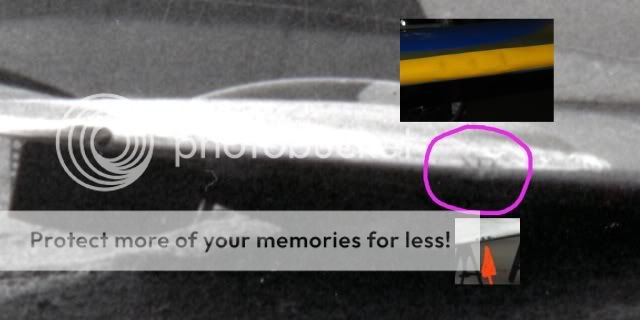
Richard grayInset pic with orange arrow taken 1987, shows head on damage consistant with cricket stumps. No damage on top of leading edge.
Inset pic with yellow leading edge (present day) shows damage on top of leading edge, no impact marks on edge.
Mark12’s recent image shows damage on edge, consistant with stumps.
So how did the marks get onto the top of the leading edge?
When the leading edge hit the stumps, what happens, are the stumps pushed over and out of the ground, if so there would be no damage to the top of the leading edge. Or did they break in two, if so would the top half of the stumps damage the top of the leading edge as much as shown in the pic in post 9.
Identical damage can be replicated by a simple model.
but I cannot replicate the two examples of the damage at the same time.
Damage to the leading edge is consistant with the leading edge hitting the stumps head on. But the damage to the top of the leading edge can only be achieved by hitting the stumps with the wing at 45 degrees. so my conclusion is that the damage has been tampered with to make it worse then it was.

Richard grayI have never doubted that there were impressions on the leading edge where the stumps were hit. However those on the image in post 9 are completely false. Beside being too wide for cricket stumps the spits nose would have to have been buried well into the ground to achieve dents at that angle.
Richard grayCan only find 3 Do17s which crashed in Norfolk none close to Norwich, several 217s though.
Dornier crashes in Norfolk 1939 – 45.
From, Norfolk in the second world war by Neil R Storey.
21st Aug 1940 Do. 17Z-3 From 2/KG2. Conifer hill Starston approx. 15mls from Norwich.
21st Aug 1940 Do. 17Z – 3 6/KG3 crashed in sea off Scolt Head Brancaster. Approx. 40 mls.
7th March 1941 Do. 17Z -2 of 2/KG3 ditched into sea off Gorleston approx. 20 miles.
24th Feb 1941 Do 217E – 4 from Stab111/KG2 crashed into sea off Cromer. Approx. 21 miles
9th May 1942 Do 217E-4 from 1/KG2 Hit balloon cable over Lakenham. Norwich. Shot down by LAA at Stoke holy cross Norwich crashed at West Poringland 5 miles.
15th May 1942 Do 217E – 4 from 4/KG40 in sea off Happisburg. Approx. 40mls
16th May 1942 Two Do217s from 3KG2 believed shot down by Spitfires of 412 sqd off Gt Yarmouth . Approx. 30mls.
30th July 1942 Do217E – 4 from 6/KG2 Crashed Salthouse Marsh. . Approx. 26mls
23rd Aug 1942 Do217E-4 2/KG2 Crashed East Walton. . Approx. 40mls
17th Sept 1942 Do217E-4 7/KG2 crashed at Church farm, Fring. . Approx. 40mls
18th March 1943 Do217 shot down 2mls N of Kings Lynn crashed into River Ouse. Nothing ever found to Identify aircraft. . Approx. 45mls
6/7th Nov 1943. Do217K-1 KG2. AA direct hit over Beccles crashed Winston hall farm, Gillingham. . Approx. 16mls
Richard grayHero all the way RIP.
The son of a member of the Royal Canadian Mounted Police of Danish heritage and a Welsh mother, he grew up in the Northwest Territories and in Edmonton, Alberta, where he graduated from high school. Jean Hersholt, the Danish-born actor and humanitarian, was an uncle.
Mr. Nielsen enlisted in the Royal Canadian Air Force before his 18th birthday and trained as an aerial gunner during World War II, but he was never sent overseas.
Richard grayHero all the way RIP.
The son of a member of the Royal Canadian Mounted Police of Danish heritage and a Welsh mother, he grew up in the Northwest Territories and in Edmonton, Alberta, where he graduated from high school. Jean Hersholt, the Danish-born actor and humanitarian, was an uncle.
Mr. Nielsen enlisted in the Royal Canadian Air Force before his 18th birthday and trained as an aerial gunner during World War II, but he was never sent overseas.
Richard grayRocketeer. Don’t know if this is helpful, but your wheel could be off, the last one in this list.
Ju88s crashed in sea off Norfolk coast.
30th July 1940 Ju88 2(F) /122 30mls of Happisburgh.
10th March 1941 Ju88A-5 (8180) of 1/KG30 ditched off shore at Sparrow Gap Weybourne. Aircraft Captured.
22/23rd March 1941 JU88 of 7/KG6 in sea off Norfolk/Suffolk coast.
26th May 1941 Ju88A-4 (0738) of 1/KG 506 crashed into sea off Norfolk coast.
14th June 1941 Ju88C-4 from 4/NJG2 Crashed on the mud flats 2 miles out from the sea bank at Wingland marsh Kings Lynn.
15th Sept 1941 Ju88A-5 (5247) from 2/KG 606 crashed into sea off Happisburgh.
26th Dec 1941 Ju88 (1442) 3/KG 506 crashed into sea off Winterton.
4th March 1942 Ju88A-4 (1384) from Erpro/KG30 crashed off Mundesley.
30th July 1942 Ju88A-4 (3810) from 9/KG26 into sea 1 mile off Hemsby.
19th Oct 1942 Ju88D-1 (1342) from 3/(F)/33 into the sea 20mls of Cromer.
From, Norfolk in the second world war by Neil R Storey.
Richard grayHi Bob, I’m a bit too young to have served at Foulsham. But have a book which has a lot of data concerning 180 sqd and the Mitchells they flew. Any specific information you require I may be able to look it up for you.
880Squadron.
31st Aug 43 Mid air collision over Foulsham between B17 Fortress 422sqd USAAF and Beaufighter V8715 96sqd RAF Fortress crashed on to church farm cattle sheds Pilot LT Trueshall & 7 crew killed, Beau crashed nearby 2 crew killed.
Found this information in previous mentioned book.
Excellent thread and pics of Foulsham here
http://www.airfieldinformationexchange.org/community/showthread.php?245-Foulsham
Richard grayBy your judgement on the current leading edge image what would you say the pitch dimension was of those three depressions?
Mark
I know photos can be quite deceptive so I could be completley wrong, by looking at the leading edge depressions I would guess they are approx 5 to 6ins apart.
As a cricket ball is 2 3/4ins wide then the gap between the stumps must be less than that so the ball does not go straight through.
The pitch is a rectangular area of the ground 22 yards (20 m) long and 10 ft (3.0 m) wide.
Richard grayTo me the dents look too far apart to be stumps.
The wicket consists of three wooden stumps that are 28 inches (71.1 cm) tall. The stumps are placed along the batting crease with equal distances between each stump. They are positioned so they are 9 inches (22.86 cm) wide. Two wooden bails are placed on top of the stumps. The bails must not project more than 0.5 inches (1.27 cm) above the stumps, and must, for men’s cricket, be 4 5/16 inches (10.95 cm) long. There are also specified lengths for the barrel and spigots of the bail. There are different specifications for the wickets and bails for junior cricket. The umpires may dispense with the bails if conditions are unfit (ie it is windy so they might fall off by themselves).


 Sign In







