 TooCool_12f
When I speak about “marvel”, I don’t specifically aim at the safety record, but rather at the mantra that, in pretty much every aspect, its fans describe it as the “fabulously magnificent example of perfection leaving everything else in stone age..” more or less
From memory, losses of the Rafale:
– one crash in Afghanistan operations, when over sea with fuel management problem
– one pilot crashed in night fight training due to disorientation or G-Loc (dove from high altitude into the ground)
– two aircraft lost in probable midair collision (both disappeared simultaneously)
TooCool_12f“with 125000 hours clocked” it still hasn’t even ended its initial development, had one aircraft lost due to engine fire (Rafale lost 4 aircraft due to human error, not one for a technical problem), was grounded and then flight envelope reduced for months because of engine overheating (from memory, engine used to bend too much for the tolerances applied). Is it the worse aircraft in history? no, far from that, is it the marvel some want us to believe it is? I have my doubts… in any case, what I (or you for that matter) think about it won’t change a single thing anyway 😉
TooCool_12fTooCool just reminds the fact that the Canadians themselves have said more than once, and the fact that a twin engine is safer than a single one if anything, because it can afford to loose one engine
And, once more, this whole discussion about twin vs single engine aircraft started because someone asked how Canada could prevent the F-35 to compete.. and I gave an answer that is obvious: all they have to do is ask for a twin engine aircraft. You can argue about how marvelously safe the F-135 is (it was already grounded a couple of times, but hey, let’s imagine it is safe), the fact remains, if they want to eliminate the F-35, they can easily, and perfectly legally do so .. end of story
TooCool_12fI don’t put the blame on the F404, I already said it was a proven design at the time. Anyway, we’re turning around the point: if the official data say they had to shut down one engine in midflight over 200 times in a 24 year period that shows one thing that pretty much anybody at least a little honest would have admitted by now: engines are not perfect. they do have issues, sometimes minor, other times more serious.. pretending that having more than one is useless (pretty much the argument of those claiming that “Canada doesn’t need a twin” just because their pet plane has only one) is denying reality.
How many pilots and planes they’ll loose if the opt for a single engine? only time will tell… but for those who will get killed and their families because of troubles that a multi engine aircraft could spare them, it will not be much of a consolation to hear “yeah, but it was a reliable engine…”
TooCool_12fReally? How many F-16 or any other modern one engine fighter were lost due to engine problems compared to twin engine fighter? Please dont ever again suggest Canada can lose 200 planes if they flow single engine airplanes…
I merely cited what they say: government recordings show that they had to shut down 200 times one engine in midflight.. why? “safety reasons” they don’t say anything more precise. but have you ever seen a pilot in a twin engine aircraft shut down an engine just for fun? now, the class A mishaps stats about the F-104 are very nice, but I have only one question: if they HAD to shut down an engine, on an F-18 which is by far a more modern aircraft, what would’ve happened if they had only that one onboard? Can you just answer that simple question?
TooCool_12f30 years old, but the engines use the same basic technology.. more refined, but also more complex and with more strain on the elements… the F-135 is a brand new one, and it still has to prove its reliability (and until now, there were several moments where that reliability was somewhat questioned.. only time will tell how well they worked on it to correct what was not working as expected) while the F404s of these Hornets were already a proven and quite reliable design overall between 1990 and 2010 .
As for the reason, the precise one isn’t listed for every occurrence, but all are regrouped in “for safety reasons”.. they, obviously, did not shut them down for fun.. it can mean a birdstrike, starting fire, oil leak (oil pressure down), and so on.. it can be anything.. the only thing that is certain is that it was considered sufficiently serious (dangerous) to consider it to be safer to shut the engine down. In a single engine fighter, such occurrence leaves no choice, either you shut it down, and eject, or you don’t shut it down… and you face the consequences you considered more dangerous than shutting it down when you were in a twin
TooCool_12fagainst what? the Su-57? J-20? we can turn around it for ages… 😉
one link about reliability:
http://o.canada.com/news/0919-jet-engines
it starts with:
“Government records show Canadian CF-18 pilots shut down one of their aircraft’s two engines in midflight more than 200 times since 1988 because of safety concerns”
now, if one puts into perspective that they don’t shut down an engine for fun, and that they had to do it, it means that, had they have single engine type with the same result, they’d have lost 200 aircraft over 24 years (the article dates from 2012)… that’s an average of 8 engine shutdowns in midflight per year. now imagine if they take the F-35 and hope to keep it for 40 years.. how many would they have to buy to keep up shutting down 8 engines in midflight per year?
TooCool_12fer, from the examples you give, Sweden and Norway are a lot smaller (long but narrow), meaning they are always in relative vicinity to an airbase, they are literally dwarfed by the size of canadian territory up north. Japan is much smaller as well (same thing) and also much further from the arctic circle definitely not having the same conditions and, what’s more, they do operate twin engine fighters as well (F-15), which allows them to modulate depending on their priorities… and, what’s more, their next gen fighter they want to develop is also a twin engine one, if I’m not mistaken. For the USA, a comparable territory would be Alaska where operational missions are performed by F-15s and F-22s… twins. Other countries close to the arctic circle are Finland (operates F-18s – twin engines) and Russia (all fighters developed for long range over Siberia for a number of decades by now are twin engine fighters with no exception).
US Navy will opperate the F-35C.. yes, but if you look at it, it was shoved down their throat without asking them about it and they do whatever they can to reduce its introduction, retaining the F/A-18E/F as much as possible and looking for their next platform which, incidentally, will be a twin engine one (again)
Australia… Hum, yes, however, there has been a lot of criticism about the acquisition process by the politicians and, from what I remember, it wasn’t good for your career to disagree with it
About the statistics.. yes, engines became much more reliable than they used to be 50 years ago (as one would expect them to be), but again, unless you can guarantee a perfectly reliable engine (meaning one that will absolutely never fail), whic nobody can, two are safer than one… the only question is, how much do you value the life of the guy (or girl) inside and what odds you are willing to accept to risk wasting it.
Now, about the start of this (once more repeated discussion): the question was “how would Canada fight the commercial war”, and some have suggested that they should ask for some details that they believe the USA would refuse.. I merely suggested a more “reliable” solution to exclude the F-35 which is to ask for a twin engine fighter.. by design, it would exclude the F-35 without the risk of the vendor eventually saying “ok, we accept these conditions”..
TooCool_12f@ eagle
twin engine fighters have usually engines shielded from each other, especially because they are to be used in proximity of little guys who do their best to destroy them…
for example:
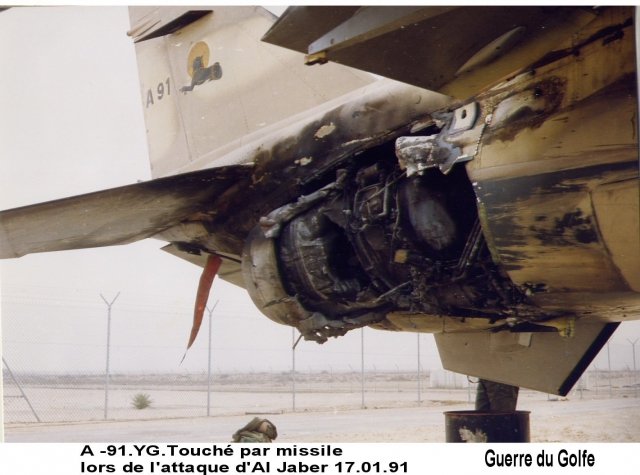
this jaguar was hit by a missile over Iraq back in 1991, and you can be sure that the hit was violent.. but it went back home.. and it’s not the only one.. basically, if you have an engine destroyed by a hit, in a single engine fighter, you’re down.. in a twin, you still have a chance
but here, we’re discussing about canadian procurement process, and the argument is much more about engine reliability than being shot at.. as up north, there isn’t much of a threat of being targeted by any sort of weapon. And again, even the most modern engines (see the A380) do have failures… be it due to weather conditions, birds, maintenance (a tool forgotten in air duct for example) or god only know what other reason, having only one means that in case of a fail, you will fly your MB if you’re lucky enough to have the time to eject, and if not… too bad. In a multi engine you still have a chance to remain airborne and get back down safely with your aircraft
TooCool_12fexchanging ideas, yes, but on this very subject, I’m not speaking about “my” ideas… I simply state what one’s being taught whenever he learns to fly, and why there is redundancy in everything critical in an aircraft.
For some parts, you can make them failsafe, meaning, you build them in a way that they can’t and won’t brake unless you destroy the aircraft… possible for parts like wing spars and other structural components.. an example of that principle pushed to the extreme is the DC-3 that had lots of parts made with that principle, and that’s why you can still see a number of them flying today, many in countries and conditions where you’d expect them to just rot on the ground… but the problem is that you can’t do it for everything as the aircraft would be too heavy.. and then, there is complexity of some parts that brings the increased possibility to malfunction, even without breaking. Computers can crash, engines can malfunction, and so on… for that, you use redundancy, so that in case of a malfunction of a given part of the aircraft, your spare takes over and allow you to get back on the ground in one piece
At first, when regulations have been standardized, for flights over oceans, the liners used 4 engines, three eventually, but never 2, as the flight on one engine was considered insufficiently safe to allow flights far from alternate airports. Then, as engines reliability and power increased, new regulations have been made, the ETOPS was born:
https://en.wikipedia.org/wiki/ETOPS
from there on, twin engined aircraft could fly over oceans and hostile areas for as long as they remained inside reach of an alternate airport in a given lapse of time (first 90 minutes, then 120,, then it was extended to 180.. the 3 or 4 engined aircraft never had that limitation and could (and can today) cross the oceans in all directions regardless of the distance to the closest alternate airport.. they are considered sufficiently safe for long flights with one engine dead
TooCool_12fok, there’s TomcatViP and then, there’s reality…
Engine broke off because of higher probability? no. first of all it failed simply because things tend to fail, especially when you push for high performance and complexity.. the more you try to get out of it, the more chances you get to have a failure… that’s what redundancy is all about: limit the importance of failures of individual components. Every aircraft has redundant systems for everything important… and it has to prove that in case of failure of a given component, the safety of the whole aircraft is not compromised. Engines do fail, hydraulics do fail, electronics do fail, and so on.. what makes the aircraft safe to fly is the fact that there’s redundancy that makes the failure of a single system safely manageable, thus acceptable.
TooCool_12fDon’t worry, I understand perfectly what the loss of one engine means.. and that’s exactly why redundancy is there.. to have more than one to rely upon. Why do you think, there are no single engine airliners? Because they can fail.. and if they do, having more than one is your best chance to survive. The A380 engine broke… and it is one of the latest and most modern engines around (made by GE/P&W alliance) … showing, if need be, that there’s no such thing as “a failsafe engine”. The aircraft and the people onboard are still in one piece only because there were other engines that kept running to have it fly to the diversion airport (for them, it was about 700nm flight from Groenland to Goose Bay)
TooCool_12fwhat A380 incident did show above anything else was that with more than one engine, you keep flying, while if you had only one, you’d have 550 dead people. With one engine type that has, for example, 1 chance out of 1000 to fail, you have 1 chance out of 1.000 to loose the aircraft and potentially the crew due to it. With two engines, you have 2 chances out of 1.000 to have one engine that fails, but as you can get back on the second one, the one engine failure is something you can afford… to loose the aircraft and the crew, you’d need to have both engines out at the same time, which, in this situation has 1 chance out of 1.000.000 to happen
TooCool_12fno need to ask for complicated stuff like source code, just ask for a twin engine aircraft for safety reasons (which, btw would be pure logic, considering you operate over hostile territory up north a lot) and the F-35 is out of the game
others don’t seem to bother a lot about it being too obvious that they decided before even making the competition.. Belgium, for example, seems to have copy-pasted parts of F-35 brochure for its RFP, so much that Boeing, Saab and Dassault didn’t even bother to reply to that masquerade
TooCool_12f@ Vnomad:
it is not boeing but US Commerce Department who decided to impose a tax on Bombardiers jets.. so, if an official US government body starts to do so, LM as a US company may just as well have to pay the bill.. that is, if Canada maintains its stand
as for “repaying subsidies”,
https://leehamnews.com/2017/07/20/boeing-787-payback-gap-widens/#more-24180
looks like Boeing sells its Dreamliner too cheap?
and let’s not speak about the F-35… the development paid for by the US government, is it a subsidy? If it’s not included in the aircarft price paid by foreign buyers, it looks like it…


 Sign In







