 uss novice
From the article above:
Dassault, Snecma and Thales will submit a best and final offer for Brazil’s initially 36-aircraft FX-2 requirement on 8 June, facing competition from the Boeing F/A-18E/F Super Hornet and the Gripen NG. “We are the only ones offering [to transfer] all equipment, including source codes,” says Jean-Noël Stock, Thales’s head of the Rafale programme.
Thales also names Greece, Kuwait, Libya, Qatar and the United Arab Emirates as other possible customers for the Rafale.
No mention of India 🙁 😮 Dammit! This bird should be the top MRCA contender. The writing seems to be on the wall – “rafale is not interested, rafale is out” 😡
What a beast it would have made with Snecma/GTRE kaveri, CFTs, Meteors, Mica IIRs, OSF GenX, AASM, Scalp, you name it! THE complete aircraft imho, sorry but nothing comes close!
Sucks! I hate politics.
USS.
uss noviceCompare the two images
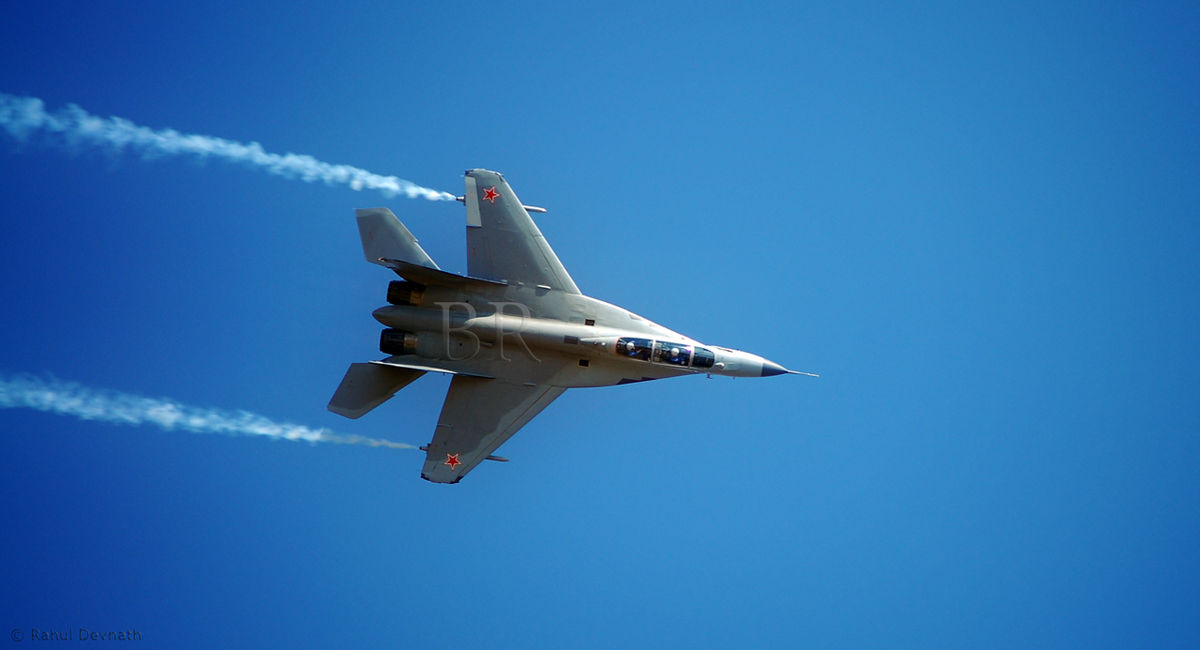

Some observations:
1) Does the nose cone for the 35 @ Aero India 09 look ridiculously small or what? I guess, the production variant of the Zhuk-AE on the final 35 would be closer to the cockpit and therefore distinctly bigger – more TRMs? Based on one particular visitor at AI09, the mig guys categorically stated that the radar could be moved further up to accomodate bigger antenna and range.
2) Is the crank in the 35 model posted by MM11 in another thread the same as the appearance of the crank in the naval fulcrum, thanks to the flaperons? or is it something different. One thing is for sure the production version of the K has lot bigger wing area than the 35 (old M airframe).
Or are my eyes just playing games?
USS.
uss noviceCompare the two images
Some observations:
1) Does the nose cone for the 35 @ Aero India 09 look ridiculously small or what? I guess, the production variant of the Zhuk-AE on the final 35 would be closer to the cockpit and therefore distinctly bigger – more TRMs? Based on one particular visitor at AI09, the mig guys categorically stated that the radar could be moved further up to accomodate bigger antenna and range.
2) Is the crank in the 35 model posted by MM11 in another thread the same as the appearance of the crank in the naval fulcrum, thanks to the flaperons? or is it something different. One thing is for sure the production version of the K has lot bigger wing area than the 35 (old M airframe).
Or are my eyes just playing games?
USS.
uss noviceWith the increase in wing area, I wonder if there is an even greater increase in internal fuel. The MiG-29K/M carries about 5500kg internally? Can the 35 do more on fuel as well as payload? If they can keep the internal weight below 12000kg, it would seem possible.
A super fulcrum with 6000kg fuel internal capacity and 7000kg payload would be around 26 tons – in the realm of possibility. The thrust would still remain better than the original fulcrum with similar loads albeit marginally. Definitely multirole though.
Yup supercruise seems unlikely. Perhaps for an MLU with the VK (10 ton) engines?
USS.
uss noviceWith the increase in wing area, I wonder if there is an even greater increase in internal fuel. The MiG-29K/M carries about 5500kg internally? Can the 35 do more on fuel as well as payload? If they can keep the internal weight below 12000kg, it would seem possible.
A super fulcrum with 6000kg fuel internal capacity and 7000kg payload would be around 26 tons – in the realm of possibility. The thrust would still remain better than the original fulcrum with similar loads albeit marginally. Definitely multirole though.
Yup supercruise seems unlikely. Perhaps for an MLU with the VK (10 ton) engines?
USS.
uss noviceotherwise they’d just stick an AESA on the ’29K, right?
I thought that was precisely the idea, what with the mig goons touting the K, M and 35 as a “unified family” with tremendous commonality. The only difference between the M and the 35 were supposed to be avionics related (ols, aesa etc); and the M/35 vs K was the extra carrier op related stuff, hook, strengthening etc.
Still the Maks 07 photo of the 35 with the cranked wing and 11 hps is intriguing. Eagerly look forward to May and then August.
USS.
uss noviceYou are both right. RAC MiG initially proposed the MiG-29SMT to Austria, but Austria didn’t granted participation in the competition. In 2002 when Eurofighter was already selected, the flood catastrophe caused delays and many manufacturers tried their luck again. RAC MiG offered the new MiG-29M1/M2 now. The MiG-29M2 demonstrated is the former 4th MiG-29M prototype and now the aircraft which is called MiG-35, though it’s nothing else than a testbed, not a representive prototype.
BTW I looked up in my materials and found the content of the austrian website. It’s in german.
Thanks for the clarification MM11, that last bit in german was exactly what I was trying to dig up. Gracias.
Btw, did people get a gander at the above pic for the MiG-35? Simply amazing. If the mtow, empty, payload specs are true, mig just pulled its ace outta the hole.
USS.
uss noviceErr, the figures on that image seem ridiculous. MTOW 29000kgs? :eek:empty weight ~ 11000kg 😮 If they achieved this, you are looking at payload (fuel + armament) of about 17000kgs! Unbelievable. incredible, impossible? Again, wing area was to be more iirc. Anyone notice payload increase to “upto 7000kgs”? This bird is coming along, if these specs are true, the MRCA bid could be in the bag.
Is this just uneducated media garbage or is the source worthwhile? Anybody find anything at Aero India to corroborate the same?
USS.
uss noviceAustrians were offered MiG-29SMT-2 (that was the name for a Zhuk-M equipped version at that times), not MiG-29M. The demonstrator flying in Austria was MiG-29SMT-2 No.917 (painted in grey/green livery).
.
Flex, I’m not so sure. I thought the one shown to Austria was the 9.15 variety, No 154 if i’m not mistaken. Check out G. Mader’s article at ACIG. There was also a poster around 2002 who had posted the MiG-29M’s brochure for the swiss competition. IIRC, mtow was 23500, payload ~ 5500.
I’ll see if I can dig up the dirt.
USS.
uss noviceThough OT, you mention the engines here, is there anything “new” about the AL-31FP? Or what are you talking about here?
All I’ll say is that things are not what they seem. It is said that the airframe of the MKI “necessitated” extra power for the engines and that the older Ks simply could not be upgraded to MKI standards. Similar to what GeorgeJ used to say ages ago, dunno if he is still around.
Remember that, I think I have saved the contends of that website somewhere on my HD.Empty weights weren’t given if I recall right. The old MiG-29Ms empty weight was given with 11.5 t, that of the MiG-29K with 12.7 t. So ~12 t is not unrealistic for the MiG-35.
A report of Pibu puts the K’s weight at around 800kgs more than the 35’s. Btw, what makes you think the newer M/K/35 are heavier than the older ones? If anything they ought to be lighter thanks to the extra composite usage (15% iirc). Personally, I belive that the weight of the 35 may be around 11500, certainly no more than ~ 12 tons.
USS.
uss noviceuss novice, your figures coincide with the ones I gave earlier.
Not exactly, the F-15E weighs around 17000 tons empty and 36450 ton Mtow. The MKI weighs about 18400 empty and 39000 mtow. Btw, internal fuel carriage is a massive advantage in that it frees all the hardpoints, not to mention reduces drag.
See, MiG-35 weighs approximately 12 tons empty, which is equal to F-15. But as it carries weight less than single-engine F-16, so we may not go further into it’s cost-effectiveness and per hour cost of operation.
What model F-15 are you comparing the 35 to? The F-15C weighs well over 14000kgs, the MiG-35 will weigh no more than 12000 and probably even 11500kg. As far as cost effectiveness goes, the upfront costs of the 35/K are ridiculously low compared to the F-16/15/18, Rafale, Typhoon. I doubt the huge upfront cost difference can be easily offset by lifecycle costs. The MiG-35/K’s per hour costs are not that different from any of the other western birds.
Hence, MRCA is needless as far as ToT is concerned also.
I know what you mean and sort of agree. Increasingly it seems as though the MRCA is just to get some politico/babus coffers filled.
USS.
uss noviceOk, stupid question, but here it is: Why is the 35 so much hevier than the original Fulcrum? (And the F-16A/B vs Block 60 etc)? Surely it cant only be due to those conformal fuel cells, or?
I dunno if you misunderstood my previous post, but the 35 is hardly that much heavier than the original. 10.9 tons versus 11.5-12 tons empty is hardly much of an increase for a twin engined beast. Compare the Shornet for example. Or even the blk 60 vs the F-16 A. Empty, you will find the fulcrum has added the least weight.
MTOW, is another story – the fulcrum adds a solid 5.5-6 tons to the original 18 ton mtow. Why? because they were able to squeeze in 50% extra fuel (5500kg) and increase the payload by another 50% – 6500kg. A super job really. At the same time marginally increasing the TWR (20% more engine thrust) and wing area.
Imho, no other aircraft has had such an effective upgrade so far with the possible exception of the su-35.
USS.
uss noviceThe normal take-off weight should include the fighter’s internal fuel, and for the members of Fulcrum family, the amount of internal fuel they can carry is from 4,540 L / 3,632 kg (MIG-29C) to 6,250 L / 5,000 kg (MIG-29M) .
Hot dog, Toan does a good job on what normal (and sometimes empty equipped constitutes). Some sites put (at least used to) the empty weight of the earlier fulcrums at 16tons. But thats not what is truly empty, which is 10900kgs. It includes fuel etc.
Last I checked, both the K and 35 carry about 5500kg internal fuel. In conclusion, the super-fulcrum is distinctly lighter than the Super Hornet and comes nowhere close to the size/weight of the F-15.
USS.
uss noviceThey are as per comparisons from widely read internet sites like Army Technology, FAS.org, wikipedia, etc. You may run a comparison yourself.
I have done waay too much research on this and believe me your sources are ridiculously generic or old to have anything worthwhile. Fas.org! for heavens sake man. That section of the site has not been updated for eons. Just remember this (as per the ACM Krishnaswami the MKI flew with loads of up to 39000kg!) Empty weight ~ 18400 (including TVC). Now do the math. Also engines are not what is available on open source, phil camp/simon watson’s latest book on the MKI is a good read to pick up on this.
The above is inaccurate. 11,500 kg is F-18’s empty weight. MiG-35’s “clean” weight i.e. with internal fuel is 17,700 kgs (per wikipedia). Thus, empty weight must be of the order of 12,500-13,000 kgs. This is the empty weight of F-15 Eagle.
Boss, wrong again! And wikipedia! The 17ton figure is empty equipped (i.e. is with fuel). PUrely empty the mig-29A weighed at 10.9 tons with mtow of 18tons. The latest version is 30% heavier mtow. Again, do the math. MTOW of 35 comes to 23500-24000kg. Now deduct the 50% additional fuel (5500kg), now deduct the payload (6500kg). These were the same figures given for the MiG-29M (on which the 35 is based) during the austrian competition, remember that one anybody?
Despite this, it carries only excess of 6 tons on just 9 hardpoints — only 1 more than Tejas. We may assume 6.5 tons, as CommanderJB suggested. Yet, this is only 0.5 tons more than the single-engined Gripen.
Thus, MiG-35 is likely to be an inefficient, costly, addition to the IAF, besides being totally needless.
[/QUOTE]
Needless to say, your conclusions on both the flanker (MKI) and fulcrum (35) are wrong.
USS.
uss noviceTom,
MiG-29 empty weight may be roughly accurate, but my sources put MiG-35 closer to 15,000kg and other MiG variants around 13,000
Could you please elaborate on your sources (if you can that is)?. The mig-35/M/K weighs 23500kg (MTOW), carries 5500kg fuel internally and is capable of 5500kg (K) – 6500kg (35). When you reduce the fuel+payload (12000kg), you get 11500 kg empty.
I can understand an increase even upto 12500 empty, but 15000 sounds ridiculously high.
USS.


 Sign In







