 phylo_roadking
LOL you buy the 3-DVD set from the IWM, tho’ I think parts of them can be tracked down on YouTube. I was sent the screengrabs.
Yes, I assumed that was why the gunner’s left hand was being used…given that the camera is looking over his right shoulder, using the right hand would have obscured the view.
But surely the gunner would switch the ‘pilot-off-gunner’ selector switch well before looking down and to the right, away from his gunsight, would have been an issue
Yes, to switch from “off” to gunner”….could have been done at leisure, I would assume after the guns were unlocked from straight ahead” for takeoff.
But from “gunner” to “pilot”? Remember…when this was to be done –
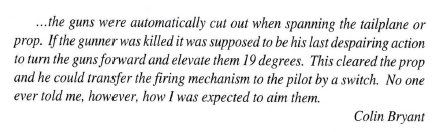
…the gunner MIGHT have been somewhat preoccuopied! 😮
phylo_roadkingYou mean this one? Margam…

Lots more detail here – http://www.subbrit.org.uk/sb-sites/sites/m/margam/index.shtml
phylo_roadkingThe bulb was to warn the gunner that the turret would turn if he moved the joystick…..
Ah, I see that now, my big red line is obscuring the line referring to the “main switch”
Interestingly (for Scalectrix fans :D) not JUST if he moved the joystick –

the gunner can see which way the ‘pilot-off-gunner’ selector is switched just by looking at it.
I wonder…it means him intentionally looking down and to the right, away from his gunsight…
Although here he’s switching it with his left hand, remember from James’ pics in the other thread where it is…
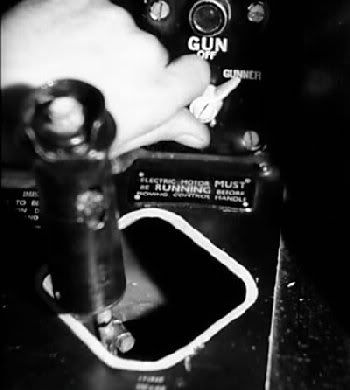
…down at the bottom of the right side of his controls, in front of the joystick.
phylo_roadkingDo you have a similar passage for the firing circuit?
Yes I do…from the Defiant MkI Manual again –
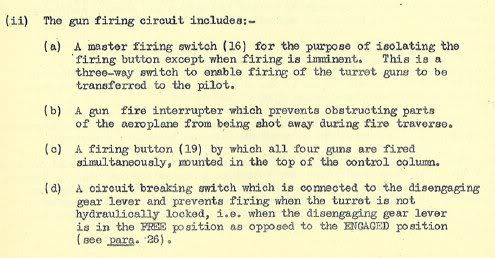
…and as I said at the top of the thread, see how it pokes a finger in Clarke’s eye??? 😮 And yet if it’s so wrong – we are supposed to believe it simply wasn’t amended between September 1939 and October 1942? :rolleyes:
phylo_roadkingNo, you’ve lost me there.
In BOTH pics you can see that the switch is “on”, turned to the “gunner” position….
AND THE LAMP IS *NOT* LIT! :eek::p
(I wonder if this was one of the light reduction steps taken to dull the illumination in the turret when nightfighting?)
Isn’t the bulb designed to indicate that the electric motor that runs the hydraulic pump is running? My knowledge of the turret systems is letting me down here but I’d assumed the traverse and elevation were hydraulically powered (and that the motor was remote from the turret so the gunner couldn’t hear or feel it working).
Would the guns fire without hydraulic power? I’d say probably yes.
Yes, to both….the gunner had a crank handle to turn the turret with one hand in the absence of hydraulics for any reason…but according to that section of the manual the lamp should be on when the master switch is “on”. And you can see that it isn’t…
phylo_roadkingBy the way – is it that impossible for Sgt Loftig to have rested his arms up on the cockpit sills??? Doesn’t look out of the bounds of possibility to me…
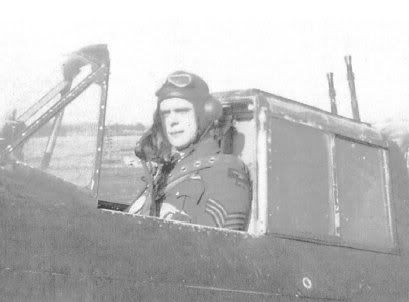
phylo_roadkingYou might also notice is that there’s something else buried in there that might have some bearing on a “human/mechanical error” issue causing the Irish Sea incident…

If that bulb had popped…then the gunner wouldn’t have that little glowing reminder out of the corner of his eye that the master switch was still “on” and energised…whether at “pilot” OR “gunner”…;)
HERE you can see the actual position of the bulb in a screen capture from “The Royal Air Force at War: The Unseen Films” from The Imperial War Museum Official Collection – does this count as a primary source?…right above the word “GUN” –
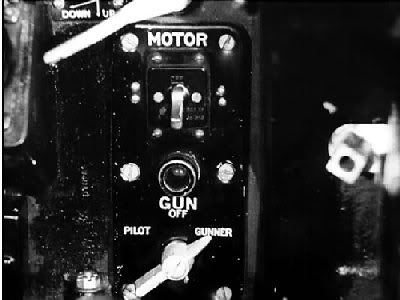
NOTICE ANYTHING??? I just have….
Here’s another capture for emphasis –
😮
phylo_roadkingCreaking_Door, I’ve had another look through some of the material I was first sent by Hendon regarding this. And a page that was previously of little use in the debate here and elsewhere has some answers to the issue of the part played by the Condensers…
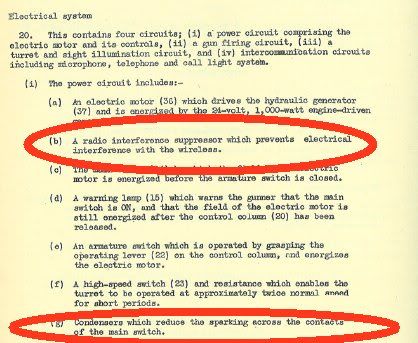
As you can see, the Operating manual for the Defiant MkI specifically says the condensers were to stop arcing acros the switch contacts….ad that there was a separate and additional suppressor fitted to the circuit to prevent interference with the radio 😉
phylo_roadkingJames –
Ah, so despite saying so you aren’t interested in the veracity of the anecdote. Sorry, I thought what you said was what you meant.
I’m interested in the veracity of the anecdote insomuch as how it bears on the Clarke issue. Obviously a pilot’s firing button that isn’t physically connected to the wiring circuit as per Clarke can’t cause a misfire…
I don’t know (or care) if Clarke made a mistake in his book. As a publisher, I’m well aware the error-free book probably does not exist (rather like APs). As you also have signally failed to grasp, I’m not interested in AP reliability, and at no point have I entered that part of the discussion, beyond your touching believe that need = result.
Then can I ask why on earth you chipped in in such detail on an issue that from the very beginning involved both a discussion of Clarke…
(And I’m perfectly aware no book is perfect, including Air Publications; but I find it rather unrealistic to believe that the SAME mistake could appear in effect in FIVE Air publications – all with a separate document-controlled Amendement process – and that it would be permitted to remain there in total for at least five years that *I* can see – AND at the same time they should all agree so closely with the features of the aircraft as descibed in an anecdote from Mark’s book that you edited?)
I’m not interested in AP debate or switchery detail at this level, and I’m comfortable that the flaws the the story and the route for resolution are available to the interested reader.
…AND involved from the beginning a discussion at that level? 😮
It’d be nice if you were to state if you were going to contact Alec or not, but it’s not important, obviously. If I get time I may ask Mark to take a look at the thread – I think you’ll understand that I won’t be definite about it as I can’t personally recommend joining the discussion, and I’d like to give him the opportunity to decline.
Actually, Mark has replied to my PM AND I’ve also emailed Crowood since you first suggested it. I didn’t realise you were keeping a checklist of replies.
I note you’ve failed to ‘pursue’ acknowledging the even more basic physical and structural issues I’ve raised or respond with a page reference to the anecdote as requested. Even a ‘yes but’ might have helped.
1/ I’m tracking down some material on all that myself before commenting – I wasn’t aware I was against a time limit?
2/ Alec’s anecdote is of course on Pages 35 and 36, in Chapter Two “Specification F.9/35“
On a more constructive level, with someone who has expressed an interest in the detail we’re discussing…
phylo_roadkingJames – sorry to pursue this…but obviously “get it” you don’t.
I’ve suggested that paperwork – such as APs – are not primary data in checking how the thing works, rather than an official statement of how its supposed to be used.
…except it has to work the way the “instructions” say – whether in practice the crews ever used them that way or not. Or else ALL the manuals/Notes would be amended, or even just one of them….to reflect the new reality – and that did not happen.
In other words – that’s why I’m trying to find out ALSO what the normal training/regime was for Defiant conversion…as in – was what Colin Bryant says they were TOLD to do ever practiced for real???
I’m afraid that APs, including revisions, are not a 100% reliable guide to actual use of equipment – it’s naive to believe otherwise.
1/ I’m quite aware of that – note my empahsis; for instance, whole sections such as the gun control transfer COULD in practice have been completely ignored. But the use or not is certainly no guarantee that an aircraft type was set up/functioned differently than the manuals/Notes say!
2/ Remember the Amendment process – if something changed, then they changed too, sooner or later. Are you aware of the example of the instructions on not exceeding a particular airspeed when climbing to
operational altitude in a MkII fitted with Marston radiators? SOMEONE somewhere had to work out there was a problem, THEN the Pilot’s Notes for the MkII were amended.
3/ there’s the reality check of it saying the same thing in THREE AP streams –
A/ the Manual/Pilot’s Notes for the MkI
B/ The Manual/Pilot’s Notes for the MkII
C/ AP1659C for BP Turrets.
I’ll be quite happy to find out that noone ever DID what the manual said intentionally I.E. never intentionally transferred the control of the guns to the Pilot…
But not doing it is 100% different from the facility to do do it being physically removed as Clarke says! 😮
Can you see that that’s two completely different aspects?
So finally, I’m interested in Alec’s input, mildly interested in a page ref to the story, but otherwise IMHO an obvious line-shoot for minor amusement is being subjected to analysis beyond its merit.
I don’t think you’ve grasped that I’m interested in far more than just Alec’s anecdote; that just kickstarted my interest in several different areas of the whole issue. Whether or not it happened, whether ot not it was pilot error, gunner error, electrical fault or mechanical fault…discussion of it on several occasions has brought up the question of the veracity of Clarke’s statement.
And that statement and how it differs from the apparent historical reality of what the APs say is a separate issue from the Irish Sea anecdote.
phylo_roadkingThe interrupter mechanism on the Defiant was a contact pad on the turret and a ring of contacts on the outer ring it revolved in; for the bits they DIDN’T want to fire at….there was simply a break, a cutaway, in the ring of contact pads. Thus as the gunner traversed – the contact pad on the turret body would hit the blank spot and the ciruit would break, the guns stop firing… then resume again on the other side of the cutaway as he traversed on round!
According to Alec Brew, the cutaway was so precise that the pair of guns that moved over it first stopped firing – then both sets – then the first pair OUT of the blank spot would begin firing again! 😮
As for the sound aspect…”period” aero engines with vestigial silencing were bloody loud anyway (many pilots were later amazed about the whisper-quiet jets ;)..yet WE who have grown up with them would hardly call them “whisper-quiet”!) and in front of the pilot, bringing the sound back to him, while the aircraft was basically flying the pilot away from the noise of the Brownings. It might not have been as loud for the pilot as you anticipate.
But that still leaves my two questions unanswered; the safety bezel on the firing button would need to be set to fire and the guns would need to be deliberately cocked…..all while the crew are relaxing over the Irish Sea
I would assume…on a combat patrol…that the guns would have been cocked and tested very soon after takeoff anyway, traverse/elevation tested etc.. Just because the pilot was relaxing and bored doesn’t necessarily mean the gunner was 😉
Looking through the 307 Sqn. diary, something has struck me; though it’s never often remarked on, the Defiant would indeed STILL have been an excellent fighter for long-range maritime patrolling there, and off Scotland and Cornwall etc….anywhere where German intruders were beyond the range of fighter escort 😉
phylo_roadking…to prevent serious arcing…..or to avoid interference with the radio (wireless) on-board?
For condensers on the switch, hardly the latter – for there would only be radio interference from the switch (if there was any) for a split second each of the (handful of) times the switch was used during a flight 😉 Each time it clicked from one pole to another.
phylo_roadkingPersonally I think that the firing circuits have been carefully designed with safety in mind; four switches (pilot’s, pilot-off-gunner, free-engaged and interrupter) all have to be positioned correctly to operate the ‘relay solenoids’; if any one of them isn’t closed the guns will not fire. Also when these four switches are closed the primary circuit activates a second circuit to operate the gun firing solenoids. This tells me (and electrical theory isn’t my strong point) that the primary circuit is relatively low-powered so that would tend to reduce the risk (to zero) of ‘arcing’ over any of the switches.
There is always the remote possibility of a short-circuit from another positive wire activating one of the solenoids (and firing the guns without anybody pressing anything) but that would have to happen exactly at the moment the guns supposedly fired in the anecdote. A much more likely earth short would simply blow the fuse (when the firing button was pressed).
Well, logically the fact that condensers HAD to be fitted would indicate there was a need for them…
On the issue of the power in the circuit – I’m not sure it was that low-powered; one of the frequently attested-to issues with the A MkIID turret was that the gunner’s special quick-rotate function could only be used for around 15 seconds, or the ring of contacts in the turret would burn out….so there were some heavy-duty currents in the mix. Also – solenoids, even period ones, handle some pretty heavy wattage.
But I’m going to request a copy of the three chapters of AP1659C regarding the A MkIID in full from Hendon, as opposed to the couple of page excerpts I have now; this should contain all the servicing data and short-circuit (sic) this issue….
(couldn’t resist that! :p)
phylo_roadkingWell there’s your problem. APs (rarely) do contain data that was wrong and never corrected; believing otherwise is simply naieve. There are examples out there, and I suspect more chats with crew air and ground might be illuminating.
You are trying too hard to show something unlikely is true – rather than tackling it head on (with Alec) or accepting it’s probably just a good line and moving on. Without wanting to be rude, your mis-measure of dates and dimensions, plus a determination to rely on secondary data, indicates to me that you are pushing too hard with a pre-decided conclusion.
From what I know (and have shared) the only bit of interest is if Alec cares to add any detail to the background. I’m pretty sure I know the answer there. The switchology is of vague interest, but is not decisive in the story.
James, I think you’re not getting what I’m writing – but then I do write with a Northern Ireland “accent” and syntax.
Well there’s your problem. APs (rarely) do contain data that was wrong and never corrected; believing otherwise is simply naieve.
I addressed this. ONE pair of manuals/Notes could be wrong or simply not reflect reality…but after four years September 1939 to October 1942 (in the case of the Defiant MkI pairing) there’s NO attempt to amend them if they were.
But carrying on the error into a SECOND manual/Notes pairing would be stretching the chance of there being a mistake in the APs. SOMEONE would have fed back up the system that there was a difference from the reality…IF Clarke is right and the pilot side of the switch was disconnected in practice.
And AP1659C for the turrets themselves confirms the three-way switch and pilot side of the firing circuit being connected and “live”.
A mistake replicated in TWO entirely separate manual streams? And uncorrected in both?
your mis-measure of dates
I’m working on the dates of issue and amendments (or not) that Hendon supplied.
plus a determination to rely on secondary data, indicates to me that you are pushing too hard with a pre-decided conclusion.
James, as far as I’m aware, material like manuals and Pilot’s Notes are primary source material; it’s Clarke that is the secondary source, and I’m not relying on him, I’m trying to find out if he’s right or not – I’m worried about other people relying on him! My opinion is he’s not – supported by the manuals/Notes and AP1659C agreeing with Bryant’s comments….
The switchology is of vague interest, but is not decisive in the story.
No it’s not. There are three separate issue on the Defiant’s firing system I’m looking at. The ability of the pilot to fire (or for his guns even to be live (Clarke)) is just one aspect of the whole. I’m interested in the anecdote for it’s own sake….as well as being interested in whether Defiant pilots weren’t just told about their ability to control the guns but also if they actually ever did this is training.
Why are you happy that it did happen? It could just be a tale; for the reasons I’ve explained, it fits the criteria for a good ‘line’ and none of the practical ones if you are familiar with the structure of the aircraft.
You can’t prove a dataless theory; you can only weigh the evidence. Saying it’s ‘true’ because there’s an (one!) anecdote isn’t good analysis, IMHO.
I have ONE important datum…to quote Alec…
A further strange feature of the Defiant was that the pilot was provided with with a normal gun button and could fire the guns, provided they were locked in the forwar position, although there was no synchronization gear to protect the propeller. On at least one recorded example during the war, a Defiant pilot on a non-operational flight over the Irish Sea slid back his canopy and rested his elbows on the canopy rail while the guns were pointed forward in this way…
…that there is a record of the incident somewhere in the original; it’s that I want to see.
phylo_roadkingMeanwhile – on the separate subject of how the gunner was expected to enter/exit the aircraft….
By the time the Defiant MkII’s Pilot Notes were issued in 1941, the rear sliding “doors” of the cupola were NOW referred to as his “normal exit”…with the fuselage hatch as his “alternative” 😉 But here’s where the diagram now shows an ADDITONAL hazard to negotiating that exit in a panic for whatever reason…an extra difficulty that is not mentioned in any of the perosnal anecdotes or literay sources I’ve read on this so far –
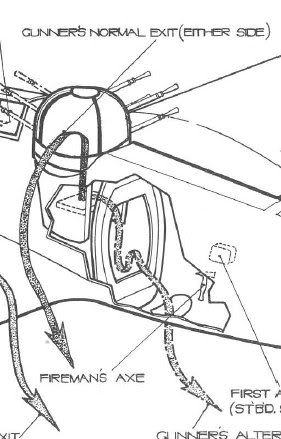
…not ONLY did he have to fold up the seat pad in the turret, wriggle down and out of rear of the turret mechanism – he ALSO had to squeeze through an inconvenient hole in a bulkhead! – before reaching the narrow compartment where the hatch was 😮 ALL in his bulky “parasuit”.
In an emergency…very possibly injured, the plane spinning, or burning, or both…that’s a VERY awkward trip for the gunner. EITHER he has to try and turn round in the turret – the “table” in front of him didn’t leave him too much room to do all of this! – then crouch down and crawl through the turret frame AND the bulkhead headfirst….OR try and do it all reversing backwards! :p


 Sign In







