 Pelagius
Car’s a Renault 12, if that’s any help. So France or Romania are likely locations.
RVT – Rendez Vous T…??
PelagiusAre the jack legs not attached to the hydraulic ram using those pins you were asking about the other day?
PelagiusBut this still maintains the ‘folklore’ view that Rolls-Royce, but not Ford, was some sort of cottage industry. The facts of the matter are that Rolls-Royce built more Merlin engines than Ford and Packard put together, and mostly in vast shadow factories at Crewe and Glasgow that were set-up pre-war by Rolls-Royce.
Of course, mass production is possible using both methods, but using process control over selective assembly enables greater efficiency, less operator workload and a more consistent product.
PelagiusInteresting; I hadn’t realised that the British, Canadian and US inch were ever different.
I’d supposed that warfare was one of the things that quickly drove standardisation. I think the US and Canada supplied Britain with a lot of rifle and field-gun ammunition during the First World War; I’d have thought that the tolerances on those would have been affected by the difference in the inches.
Standard calibre for American weapons (.30 / 7.62mm) was different to the British (.303 / 7.7mm).
PelagiusRather than being a workforce skill issue, is this not a process capability issue? Statistical process control of the machine tools will allow tighter tolerances to be used in production, allowing for better parts interchangeability. This is the system pioneered by Eli Whitney for the Springfield Armory during the civil war, to allow full parts interchangeability of musketry. When the machining is controlled by parts tolerance rather than process, a wider spread of variations is encountered, which requires a degree of selective assembly to get best fit.
I understand that he ‘craft’ ethos of British industry maintained this process, as evidenced by the Rolt quote, especially his ‘new and disturbing phenomenon’ phrase. The parts were maybe not produced ‘out of tolerance’ but the variation within tolerance was such that selective fitting – not bodging together – was necessary. Ford, however had embraced the idea of ‘putting the skill into the tool’ from the outset of his automotive production, and was using process-controlled machine tools from the beginning of Model A production in the mid ’20s. The lower workload required of his assembly workers required less initial training and had social benefits, allowing higher production rates to be maintained.
PelagiusEr…are you sure about that??? :confused:
Until standardised in 1959 to the Canadian Inch (25.4mm), Imperial inches were 25.3999, American Inches were 25.4005.
PelagiusI have always understood (I’m sure it’s in my apprentice notes somewhere) there are two aspects to using tulip valves…
As the hot exhaust valve is running closer to metallurgical limits, the reciprocating mass is critical – the tulip valve can maintain strength with reduced mass compared to ‘nailhead’ valves.
The gas flow effect allows a smoother, flowing exit for the exhaust gases, when compared with the potential rapid direction change of the flow around a ‘nailhead’; the smoother flow of the tulip valve prevents the localised hotspots on the stem of the nailhead.
There’s a video out there somewhere on the net of an exhaust valve in operation. I was amazed at the amount of hammering one gets.
How about a Merlin engined bike…
Or a rotary…
PelagiusThe owner of the ‘first Flea’, Mr. Carine, also owned a Luton Minor.
An inverted Luton Minor wing can be seen in one of the pictures of the ‘second Flea’.
As the Luton is obviously dismantled, perhaps that’s the source of the Flea’s Anzani…
Pelagiuslooks similar to an aircraft rigging inclinometer.
It is a rigging inclinometer. I used both these and their bulkier, more accurate (?) brethren regularly in conjunction with rigging boards since first encountering them at Halton. The ones used in training had similar dates IIRC! I daresay they were used to align weapons too, being a general purpose rigging tool.
The other type…

Pelagiusall I can say is that the ppl on here have some bloody nice bikes:D
chris
And some right horrors….

Pelagiusall I can say is that the ppl on here have some bloody nice bikes:D
chris
And some right horrors….
PelagiusIt may be a little trivial after some of the previous postings, but one of my ‘set trousers to brown’ moments was warbird-related. It was around ’78-’79 and I was living with my father in Coventry. It was the summer holidays, and I’d spent much of it, as ever, up at Baginton hangar-ratting and watching the preparations and arrivals for the big Coventry Air Day. Dad was a press photographer, and as always for the display had obtained ‘access all areas’ press passes for his team, which naturally included me.
Come the day of the display I was in ‘plane-mad-kid heaven, getting to sit into just about every cockpit (the Mosquito impressed me the most – and one of the team got a flight in it), asked to act as tip-walker on the Sopwith Tabloid, meeting Hans Van DerWerf, Starfighter display pilot and my hero at the time, and best of all, being allowed on the runway during the displays. One of the aircraft displaying that day was the B-17, piloted by Don Bullock, a name with which I am sure the majority of Forum members are familiar. The display was as spectacular as ever, with wingovers and low passes aplenty which made for some spectacular photography from the runway centreline. A line of photographers soon gathered across the runway, with me amongst them on the crowd-side fringe. Following one wingover, the pilot lined up on the runway centreline and brought the B-17 down low for a low, fast pass. Then a bit lower. Then impossibly low. My dad, with his long, rifle-stock-mounted lens, was the first to drop down, then each of the photographers in succession dropped flat onto the runway. With the confidence of youth I stood there, nicely lined up with the port outer, knowing that the pilot would pull up in plenty of time, which of course he didn’t, maintaining around 6ft tip clearance to the runway. By the time I had decided that I was surely going to die, there wasn’t much room between me and the whirling disc of Hamilton Standard. I dropped to the floor and as I did, I felt the propeller’s tip vortices flicking the hair across the top of my head.
I doubt it was really as low as it felt, but the following year’s display was photographed from well into the flight line.
PelagiusIt may be a little trivial after some of the previous postings, but one of my ‘set trousers to brown’ moments was warbird-related. It was around ’78-’79 and I was living with my father in Coventry. It was the summer holidays, and I’d spent much of it, as ever, up at Baginton hangar-ratting and watching the preparations and arrivals for the big Coventry Air Day. Dad was a press photographer, and as always for the display had obtained ‘access all areas’ press passes for his team, which naturally included me.
Come the day of the display I was in ‘plane-mad-kid heaven, getting to sit into just about every cockpit (the Mosquito impressed me the most – and one of the team got a flight in it), asked to act as tip-walker on the Sopwith Tabloid, meeting Hans Van DerWerf, Starfighter display pilot and my hero at the time, and best of all, being allowed on the runway during the displays. One of the aircraft displaying that day was the B-17, piloted by Don Bullock, a name with which I am sure the majority of Forum members are familiar. The display was as spectacular as ever, with wingovers and low passes aplenty which made for some spectacular photography from the runway centreline. A line of photographers soon gathered across the runway, with me amongst them on the crowd-side fringe. Following one wingover, the pilot lined up on the runway centreline and brought the B-17 down low for a low, fast pass. Then a bit lower. Then impossibly low. My dad, with his long, rifle-stock-mounted lens, was the first to drop down, then each of the photographers in succession dropped flat onto the runway. With the confidence of youth I stood there, nicely lined up with the port outer, knowing that the pilot would pull up in plenty of time, which of course he didn’t, maintaining around 6ft tip clearance to the runway. By the time I had decided that I was surely going to die, there wasn’t much room between me and the whirling disc of Hamilton Standard. I dropped to the floor and as I did, I felt the propeller’s tip vortices flicking the hair across the top of my head.
I doubt it was really as low as it felt, but the following year’s display was photographed from well into the flight line.
PelagiusI have a few, this is the oldest and the one most worthy of posting up. It’s my ’26 AJS G6 Big Port’. 350cc OHV, very light, handles superbly, goes very quickly indeed and has the most useless brakes I’ve ever come across 😮
It’s currently u/s with a rather slippy clutch following my trip to Shuttleworth on Saturday 🙁

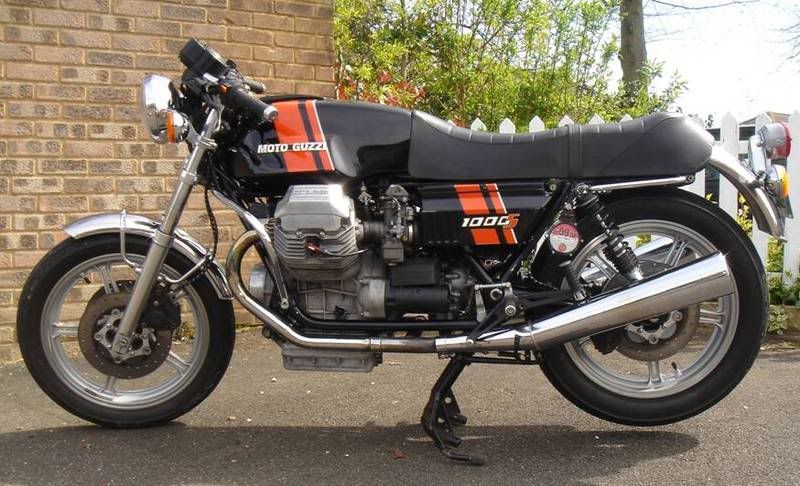
At the other end of the scale I have a 1990 Guzzi 1000s, which has the earlier big valve motor. Took me years to find the right one. Seen here with the M.O.T. silencers on, normal wear is shorter, louder and significantly less restrictive
It is truly an addiction….
PelagiusI have a few, this is the oldest and the one most worthy of posting up. It’s my ’26 AJS G6 Big Port’. 350cc OHV, very light, handles superbly, goes very quickly indeed and has the most useless brakes I’ve ever come across 😮
It’s currently u/s with a rather slippy clutch following my trip to Shuttleworth on Saturday 🙁
At the other end of the scale I have a 1990 Guzzi 1000s, which has the earlier big valve motor. Took me years to find the right one. Seen here with the M.O.T. silencers on, normal wear is shorter, louder and significantly less restrictive
It is truly an addiction….


 Sign In







