 Sundog
Boring looking
1) F-22. It looks like a MiG-25 or F-15 that melted.
2) Anything with a canard, except the Rafale since they sculpted the forward fuselage in a cool way. For the most part though, canards are like the new cliche’ of fighter design.
3) JSF. The inlets are kind of cool, but otherwise it’s the same freaking layout we saw on the F-15, F-18, MiG-29, Su-27 only with a single engine. It’s the old cliche’.
Cool looking
1) YF-23 – It looks like a dragon.
2) F-16XL – It looks fast and cool with it’s cranked arrow wing (Which it was).
3) Bird of Prey – The coolest wing design flown in the past 30 years. It just lives up to it’s name in the Klingon sense.
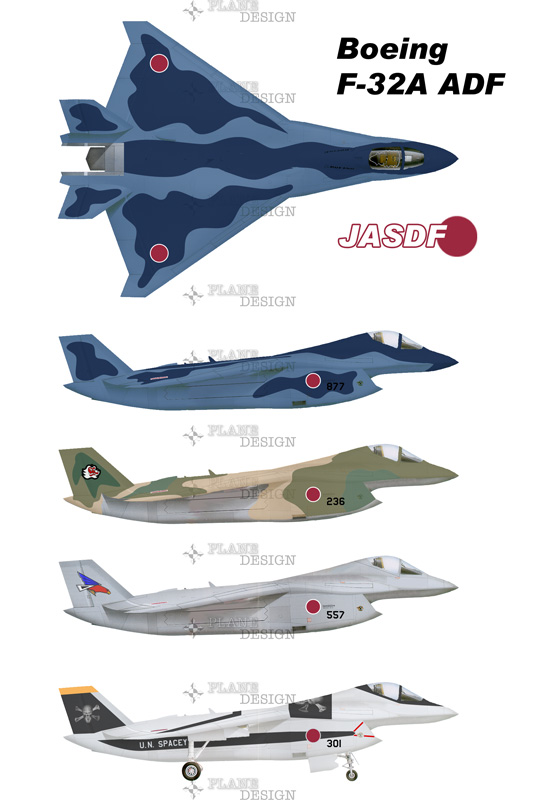
SundogI really liked the X-32, because l like delta and arrow wings, but due to where they put the cockpit, in what I would determine was done to minimize weight since they were marginal for the STOVL mission, the plane ended up looking like a flying Bullfrog.
So I thought, what if to minimize all costs by keeping every JSF version the exact same, Boeing built a production version of the X-32 as the F-32, and left the same components in from the STOVL version, but they would just be used for super STOL. This would mean it could be slightly redesigned to optimize the aerodynamics without the weight being as critical and there wouldn’t be the problems of hot gas reingestion that the prototype suffered from during vertical landing. Not to mention, this just looks a hell of a lot better than the X-32. I just moved the cockpit forward about 8 ft. to improve pilot visibility and increase the fineness ratio which is important for supersonic perfromance and would probably help the F-32 in supersonic cruise.
I have watermarks on it because it isn’t finished and there are other countries I still have to paint, including the U.S. I started with the JASDF because of all the different camo schemes available. Enjoy. BTW, the last paint scheme was meant as a JASDF celebration of anime’. I also intentionally turned the skull and crossbones 180 on the spine to what’s painted in the anime’ because I like it better that way 😉
SundogFYI, for those of you who don’t know, he is talking about the material that covers the hingeline, not where the side edges of the flight controls abut adjoining structure. They usually use the shallow diamond edges there.
As for the “ablation” seen on the interior of the starboard rudder, I can’t tell if that’s wear or something actually supposed to be there. However, I wouldn’t be shocked, if it is wear, that it’s caused by the nozzle heat, efflux and possibly sound, especially when you consider the effects of the nozzle efflux vectoring near there.
Of course, it could also be a maintenance guy had to get in there to “fix” something and since it was just a test or ferry flight they weren’t worried about fixing the gap sealer.
That’s a nice pic, BTW, of the flight controls in “Airbrake” mode.
Edit: I just turned off my ZA and noticed that other pic posted above, I don’t know if it’s a gap or the actual actuator we’re seeing there but it’s obviously normal, at least it appears to be. Great pics, none the less 🙂
SundogThere’s a book out on the A-12 program titled the The Billion Dollar Blunder.
It’s very good if you are interested in the program. The main culprit in the failure of the A-12 was the U.S. Navy itself. It was trying to get a stealthy attack plane on the cheap. The book shows the model that Northrop entered into the A-12 competition and it looked like a small B-2 with wingtips that would fold to the vertical position, like triangular winglets, when the gear was extended for added stability on approach. I should add that it was similar in planform to the the original B-2 design that was just intended for high altitude flight, not the version as built with the multiple serrated trailing edge and smaller overall chord. it had the outer swept wings like the B-2 and the centerbody trailing edge just has the single apex. Also, it would appear the cockpit would have been side side, but the model shown is “solid color,” but I would guess it would have been like the B-2’s but with completel clear canopies like on the A-6, but that’s just my guess.
Based on Northrop’s experience with the B-2 program they refused to work on the A-12 program on a fixed cost basis because they knew it couldn’t be done at the price the Navy was seeking. The only reason GD-McDD got the program was that they agreed to do the impossible then went on to find out the hard way why it’s called the impossible.
SundogAs for cost over runs with regard to Northrop aircraft, the B-2 was mainly as expensive as it was due to the cuts in numbers built. However, if that was one of the reasons they chose L-M over Northrop, they obviously screwed themselves on that deal since L-M didn’t do a very good job of contianing the cost over runs on the F-22.
As for the A-12, the biggest culprit in the failure of the A-12 wasn’t McDonnell Douglas or the actual prime in that contract, General Dynamics. Anyone who is familiar with the story knows the number one screw up in that program was the U.S. Navy itself followed by General Dynamics. If McDonnell Douglas’s failure on that program was a mark against Northrop, then General Dynamics failure should have been a bigger mark against Lockheed Martins performance since they were teamed with GD at the time, along with Boeing. So that dog don’t hunt as an argument.
Second, Northrop was ready to fly their ATF one year before Lockheed Martin because Lockheed Martin’s original design was so screwed up. Northrop was ordered not to fly until Lockheed Martin could catch up by redesigning their ATF prototype. So please don’t hand me this b.s. about cost over runs and competence when Northrop was basically punished for not screwing up royally to begin with. Also, as a result of Northrop’s experience with the B-2, I would be more inclined to give them the contract, because that means they should have the “bugs” worked out with large composite structures that were needed for the ATF. That’s one of the reasons L-M teamed with Boeing on the ATF, to take advantage of the experience they gained on the B-2 program. So once again, that argument is a non-starter.
I know what my friends on the inside told me and I stand by that assessment. Of course, if what you meant is that all the above were used as excuses, along with the facade of the NATF program, as a reason to hand L-M the ATF contract, I heartily agree.
SundogSorry Over G, I’m right. I ‘m an Aerospace engineer. I busted my ass getting my degree and it wasn’t just to be right on aerospace forums. The F-22 does not have a delta wing. Sorry dude. Delta wings have a straight trailing edge, no kinks, cut outs, etc. The trailing edge on the F-22 is tapered not straight with a dual angle sweep not including the cutout for the stabilators. You could make the argument that it is a “modified” delta, but a delta it isn’t.
BTW, with regard to the “F-18’s problems” the only two I really know about being limited range and the problem with the vortex off the strake impinging the vertical stabs, which is why the strake fences were added. My lab partner in college worked on those. Having said that, Trapezoidal wings are better in the transonic regime, at least that’s what all the data shows. But hey, I don’t know, I guess you’re right and all of those studies by the aerospace companies are wrong?
SundogJust to clear up some of the misconceptions here
1) The ATF was designed to be able to outfly anything in the sky in the foreseeable future. Both the YF-22 and the YF-23 met those requirements, including in terms of maneuverability. The YF-23 didn’t need thrust vectoring to meet the mission requirements, however, Lockheed used TV to make their design even more agile.
2) The YF-23 was vastly superior to the YF-22 in terms of speed and stealth. The P&W powered YF-22 needed AB to get through the transonic speed range and could only supercruise at M=1.4. The P&W powered YF-23 Supercruised at M=1.8 and reportedly flew at M=2.2 with AB. The GE powered YF-22 could get through the transonic drag rise with out burner and supercruised at M=1.6. The YF-23 with GE engines supercruised at M=2.2+ and had a top speed of Mach=2.8+ with AB, some even suggested it’s top speed with AB as M=3+, but that’s still classified so I can’t confirm it. I should note both YF-23’s could go supersonic without AB. One of the areas, however, where the YF-22 had an advantage was reportedly in supersonic turn rate. It is vastly superior to most aircraft in that area due to the control power offered by it’s thrust vectored engines in combination with the airframes supercruise ability.
I should note that these numbers were obviously improved on for the production F-22 with it’s M=1.7 supercruise capability. How much of that was due to aerodynamic refinement and how much of that was due to increased thrust in the P&W engine I don’t have the answers to, either.
3) The main reason the YF-22 was chosen over the YF-23 was political. The people I knew involved in the down select prefered the Lockheed Martin design because they said the Northrop people were very arrogant, because they knew they had the Sh*t Hot design. I actually prefered the YF-23 myself and if it had been built, it wouldn’t have required nearly as much modification to turn it into a FB-23 as the F-22 does to be turned into the FB-22. In fact, the main reason offered for choosing the YF-22 over the YF-23 was that the YF-22 would make a better NATF (The Naval version) than the YF-23 would. The NATF was cancelled less than one month after the down select. It was the excuse to choose the YF-22 over the YF-23, nothing more.
4) For those of you who think the F-22 could easily be brought down or targeted by IR and IR weapons, I have some bad news for you, good luck. Stealth means reducing all signatures, not just RADAR. As such, the F-22 circulates it’s fuel throughout it’s structure before it is sent to the engines and burned to control the F-22’s IR signature.
5) The part of the flight envelope I can think of where the MiG-31 is possibly better than an F-22 is high speed on the deck in a high q environment. The MiG-31 is designed to fly at 1000mph on the deck, to be able to intercept cruise missles. I doubt the F-22 was designed to such a high q value due to the amount of weight it would add. However, the F-22 with it’s excellent look down shoot down capability wouldn’t have any problem taking it out from 40K+ feet where it will be supercruising.
6) If the MiG-31 really had a chance against the F-22, Russia would be building MiG-31’s like hot cakes right now, not developing the PAK-FA. As we know, however, the opposite is true. That’s the reality of the situation right there.
SundogOMG,
A “QUALITY” aviation movie. Has anyone ever noticed that it’s the WWI films that are always the best, in terms of aerial sequences? I mean, Pearl Harbor was a comedy, based on what I saw in that movie.
Speilberg almost had an accurate sequence in the series Taken, except he had BoB era Bf-109E’s fighting against B-17Gs, two planes that weren’t operational at the same time. Hell the Bf-109E’s even had BoB era camo and a cannon firing through the prop hub at those B-17s.
But this sounds good. None of the Ben Affleck flying straight and level for 30 seconds yelling, “He’s on my six, he’s on my six!”. It was like, “Dude shut up, if he isn’t shooting at you it isn’t a problem, just use some shallow curves and extend without him hitting you, you’re in a P-40 for Christ sakes!”
SundogHi guys,
Just to clear up my references on the trapezoidal wing, it wasn’t an opinion, it’s a fact they are better in the transonic speed range then a delta. My back ground is in aerospace engineering and I’ve read enough papers on it to know that’s why planes like the F-18 have such a wing shape. It has much less to do with the critical mach number and everything to do with area ruling. A trapezoidal wing offers a much better area distribution, closer to a Sears-Haack ideal distribution then a delta wing does for most confiurations in the transonic range. That means a trapezoidal wing generates much less wave drag in the transonic range than a delta wing does. At higher Mach numbers, near Mach 2, a delta wing has clear advantages for supercruise. However, once one factors in the ability to maneuver throughout the speed range and all of the other design points that need to be considered, the delta wing looks less and less attractive and ends up being modified to look like the wing on the F-22 which is about half way between a trapezoidal wing and a delta wing, which makes sense, given it’s mission design parameters.
SundogFYI, Aviation Week a couple of months ago had some articles on the F-22. Regarding countries seeking information to possibly purchase some F-22’s were Japan, Australia, Israel, Great Britain and I think there were one or two others I’m forgetting.
Ragarding cost, a foreign F-22 most likely wouldn’t cost as much as the USAF version, since some of the technologies in it we reportedly wouldn’t sell to other nations.
SundogOne thing I haven’t seen discussed here, which goes a long way towards winning a fighter contract, is manufacturing offsets. All three aircraft would easily fill Singapores needs. What most likely happened is the EU wasn’t offering enough, economically, to make the deal. Yes, you practically have to bribe other nations to buy your aircraft these days.
As for supercruise, although the F-104 could technically supercruise it didn’t have enough fuel for it to mean much, outside of an outright intercept. One of the most important ratio’s, with regard to an aircraft with supercruise ability is the fuel weight fraction. Right now, the production F-22 is marginal in that regard due to weight growth. However, it is better than anything else out there in that regard.
Oh, I forgot to add, just to keep the thread on topic, my nation’s fighter aircraft has a bigger penis then your nation’s fighter aircraft. I know everyone here isn’t like that, but it seems 90% of the time, that’s what these threads turn into.
SundogActually, the F/A-22 shouldn’t have any problems taking the Worlds Time to Climb record due to it’s massive thrust to weight ratio. It should also be able to take best speed over a long distance due to it’s ability to supercruise in its weight class. Of course, those records are only really important if the aircraft is configured for an actual intercept. In that area, I think the F/A-22 would dominate even more, due to it’s internal weapons carriage.
As for top speeds, as has been noted, they are typically limited by inlet design and/or materials (Thermal limits at high speed and medium to high altitude and structural, mainly dynamic pressure, limits down low.) Of course, although fixed inlets can cause a performance penalty, aerodynamically, they somewhat make up for this with less weight and complexity. Of course, I should point out that the main limiting factor to top speed is the “Mission Requirements.” Over designing the mission requirement can add more weight/cost. Anyway, we already know the F/A-22 supercruises at Mach 1.7 and has a top speed of Mach 2+, but it is reportedly capable of Mach 2.5
As for the B-1B, part of the reason for it’s existence was the USAF was trying to get a stealth bomber on the “cheap.” It did lower the RADAR signature, over that of the B-1A, but not to anywhere near the levels the USAF was hoping for.
SundogI went to that site last night after seeing that drawing. It’s pretty good fan art, I agree. I think the plan view drawings are official, though or from a publication. The ones showing the plan views of the MFI, MiG1.42 and the production model. Do you know anything about the drawing comparison there, i.e., it’s source? Just curious.
SundogThanks Flogger. That’s the first time I have seen a picture/drawing of the production MiG-1.42 I had read that it would have a wedge shaped 2d inlet and I understood what they meant, but I like seeing pictures for exact positioning, etc. I think I had read about the updated cranked delta so it’s cool seeing that as well. I didn’t know about the updated radome though.
SundogI actually have three view drawings of the Fairchild design, but I can’t remember where they’re at right now. I need to hire a librarian to organize all of my books, magazines, and papers 😀 The picture that Aerospacetech posted, though is almost exactly like the Fairchild submissions. Based on what I remember of my three view drawings, it’s probably 80% accurate with minor details being the difference.
Here is a larger pic of the NAA F/X submission cutaway as shown above
Internal Cutaway


 Sign In








