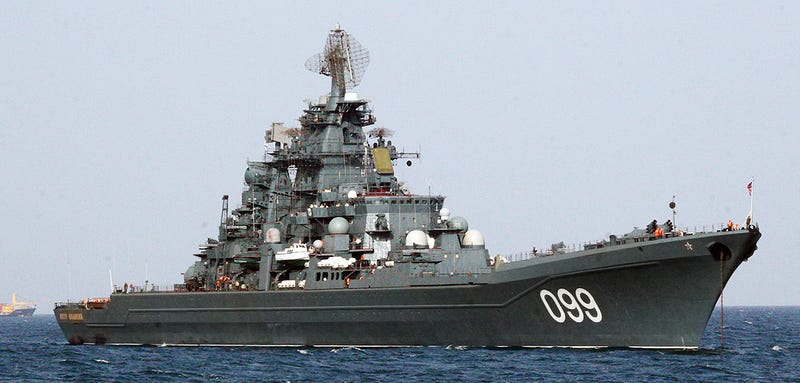
KGB
KGBThink the kiddies have been snorting the goofballs again. This thing is a shiny disco ball in comparison to the Arleigh Burke, let alone the…
[ATTACH=CONFIG]25097ATTACH]
Anyone can “reduce” RCS, but only a few teams are implementing actual “stealth” levels of RCS reduction.
If you were actually cognitively following the discussion, you’d know the reason why the picture of the Russian ship was posted and how it relates to the topic.
But since you brought it up.. http://www.thedrive.com/the-war-zone/5343/the-navys-new-stealth-destroyer-has-watered-down-capabilities-questionable-future
While details about the specific nature of Zumwalt’s various signatures are classified, it’s clear that when it comes to radar visibility, the ship has devolved considerably over the years. What was once a very stealthy design has been the victim of a never ending list of compromises. In recent years these compromises have become almost comically absurd, and now it seems that the Navy is willing to bolt anything onto the the class in order to save money.
First off, USS Lyndon B Johnson (DDG-1002), the final ship in the tiny class, will not feature the stealthy composite deckhouse that is such a key feature on the baseline DDG-1000 design. Instead it will be made out of steel.
Enjoy the Zumwalt’s clean lines now because they are about to change significantly. In a race to save money, the Navy has decided not to embed a bunch of sensors and communications infrastructure into the ship’s slab-sided deckhouse. Instead they will be bolted on as if they were an afterthought, making a $4B+ stealth ship, well, less stealthy to say the least.
KGB
KGBI was always curios what the FC 31 chassis looked like in the raw.
KGBSo you are equating theoretical research an mock-ups (none of which were fighters) to 30+ years of operational experience?
Like everything in US vs USSR, there was tons of overlap and ironies. Did they field a stealth jet ? No. They concentrated on water. But.. one of the major scientific breakthroughs on radar refraction, Pyotr Ufimtsev’s 1962 paper Method of Edge Waves in the Physical Theory of Diffraction was came from the Moscow Institute for Radio Engineering. This unclassified paper found its way into the US via the USAF’s System Command’s Foreign Technology Division in 1971. Ufimtsev’s paper helped Lockheed’s Skunk Works’ in its ECHO 1 computer program designed to predict radar cross sections (RCS).
Many of the designs tendered for the MFI (also sometimes called I-90 [fighter-90s]) program often incorporated low-observable features like canted tails and internal weapons’ bays. Yakolev’s MFI submission had canted intakes much like the F-22. Sukhoi also had a stealthy bomber program, the T-60S, of which very little credible information has surfaced.
The T 60S was first planned in 1984
KGBHow could it not? it’s got a 30 years headstart.
Nic
Russians were using stealth shaping and materials in F-117 era. They opted to experiment with it on the water. And some of the mathematics for it was done first by Russians but they ignored it. So no.

KGBThis debate is absolutely fruitless for many reasons, and the most important one is the fact that nobody on this forum and nobody outside the lockheed martin and sukhoi biro knows the exact RCS of the PAK FA and F-22.
They invest billions of dollars on R&D and test the RCS using the most complicated calculations and big anechoic chambers, and all over the net we have guys making “educated” points using just photos and some PC calculations.
Till recently we had “internet experts” claiming that only F-22 has smaller RCS than F-35 and they explained that with “this and that” as a rule of a thumb.
Now we know that more “roundish” F-35 has even smaler RCS than F-22 from certain aspects.Here is my rule of the thumb, If you don’t want to look stupid, don’t talk about RCS of VLO plane! I don’t!
And just one more thing regarding your comparison using photos:
[ATTACH=CONFIG]2509TTACH]
Even though they look similar from the front, PAK FA doesn’t have even close inlet curvature like YF-23 does.
Because of the much shorter front landing gear PAK FA is leaned forward when on the ground. That way much of the engine face is blocked and the engine itself looks like it is placed much higher in relation to the inlet. In the level flight that is not the case.[ATTACH=CONFIG]25096/ATTACH]
Anyway, if the ingenieurs from the Sukhoi claim that serial PAK FA will have similar frontal RCS to F-22, it is most certain that they have solved the engine face problem one way or another.
I just hope that they deliver what they promise.
I agree. But for most people, they believe its a foregone conclusion that the Raptor has better stealth than the Pak Fa. And it rarely gets challenged.
KGBYou remind me of a guy who keep insisting that Ye-8 is the same as F-16 because their intake is at the same position. Very cringe.
I said that the Pak fa and YF 23 intake and engine placement configuration was similar. And they are. Especially compared to the Raptor. Which is what I was talking about.
KGBYou should try different tactics, this one is too cringe

^ There is the under/offcenter intake/wing engine design of the Pak Fa and YF 23.
And then here is the Raptor. The Raptor is an entirely different design. Where the intake S veers into the center of the fuselage. And then goes into the engine. This is why the Raptor has a conventional look.
Not sure what you are cringing about…
KGBEither Sukhoi has planned to incorporate RCS reduction and hiding the compressor on a new IGV section, a separate section of variable vanes set in front of the fan (that we haven’t seen yet), or both.
The engine placement, under intake, blend and upper exhaust is listed as one of the main reasons that the YF 23 had better stealth than the Raptor.
http://www.globalsecurity.org/military/systems/aircraft/f-23.htm
Another RCS reducing feature is the engines. These are mounted in nacelles in the wing that blend gracefully into the wing on the top, and form an extension of the fueslage on the bottom. The intake duct starts on the lower edge of the wing and moves through it onto the top of the wing.
The Pak Fa and YF 23 share this similarity where the Raptor does not.
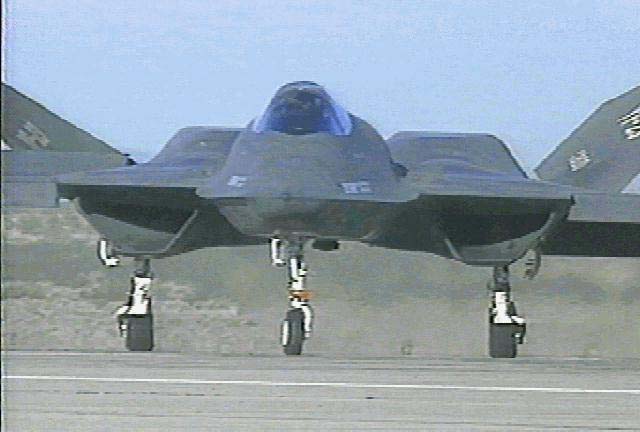
KGBRaptor huge vertical tail affect side aspect RCS mostly while PAK-FA inlet design affect front aspect RCS. For bow tie stealth design, frontal aspect are more important.
From one Raptor vs YF 23 report. http://www.globalsecurity.org/military/systems/aircraft/f-23.htm
The YF-23 was stealthier than the F-22 Raptor. The two ruddervators reduce the Radar Cross Signature of the YF-23 significantly.
One of the main reasons I believe the Pak Fa is stealthier than the Raptor.
KGBRaptor huge vertical tail affect side aspect RCS mostly while PAK-FA inlet design affect front aspect RCS. For bow tie stealth design, frontal aspect are more important.
From the front, the Pak Fa has a lower profile than the Raptor. So its not like it didn’t gain anything RCS wise with that design.
(the tone of the thread has always been that the Pak Fa has a higher RCS than the Raptor et al. I don’t believe it to be true )
KGBFirstly, a small corner reflector in the luneburg lens or a chaff clound can have RCS thoundsands times bigger than an F-22 eventhough physically they are alot smaller. In term of stealth attribute: shaping and material play much more important roles than physical size. If 2 object have the same shape and made from same material then yes the smaller object will have smaller RCS if we assuming both object are still in optical region in respect to radar wavelength. But J-20 and PAK-FA do not have similar shape, a slight different in size ( they are at most 20-25% different ) doesnot offset the advantage in shaping.
Secondly, i dont have to prove anything and certainly not to you. I said ” i think ” not ” iam sure ” ,and my post is the answer to the question Y-20 bacon asked me.If he wanted your opinion, he would have asked for it. Maybe if you stopped being immature and defensive every time someone talk about PAK-FA design trade off, people would have care about your opinion.
Firstly, a small corner reflector in the luneburg lens or a chaff clound can have RCS thoundsands times bigger than an F-22 eventhough physically they are alot smaller.
Over exaggeration. Stealth technology is not magic. And common sense would dictate that if it were true, no engineering team would handicap themselves like that.
In term of stealth attribute: shaping and material play much more important roles than physical size.
Is there a ratio or something ? Probably. What is it ? How do you know how much more important it is ? The shape and size are very much intertwined.
But J-20 and PAK-FA do not have similar shape, a slight different in size ( they are at most 20-25% different ) doesnot offset the advantage in shaping.
First. Just because you think that you’ve spotted something, does not mean that the Pak Fa has a “disadvantage in shaping”.
And 2nd,that is a ridiculous claim to make. The Sukhoi engineers would not get the shaping so wrong that it would be visible to the naked eye and would make an aircraft 25% larger in size, have a smaller RCS.
Secondly, i dont have to prove anything and certainly not to you. I said ” i think ” not ” iam sure ” ,and my post is the answer to the question Y-20 bacon asked me.If he wanted your opinion, he would have asked for it. Maybe if you stopped being immature and defensive every time someone talk about PAK-FA design trade off, people would have care about your opinion.
This is the Pak Fa thread. You cant expect to make claims out in the open for all to see, about the Pak Fa without them being challenged. PM him next time.
KGBDon’t be so quick to jump your horse, especially when you have not realized what are those lumps
I highlighted frontal. But even this.
Stealth features make the aircraft appear smaller than it otherwise is on radar. What seems to be lost on you is that making the aircraft smaller and low profile to begin with, is a stealth feature in itself. And we can clearly see that the J 20 has way more girth than the Pak Fa. Not only is the aircraft fatter. It is also longer and wider.
You are pointing to what you think is a more stealthy angle “less lumpy” or whatever. And maybe you are right. Maybe your RCS eye balling has detected an angle that is less stealthy on the Pak Fa than the J 20. But that does not mean that the J 20 is more stealthy period. Because the J 20 is way bigger and fatter.
So if you want to claim that the J 20 is stealthier than the Pak Fa, you have to prove that the angles you are seeing on the Pak Fa, are so un-stealthy that it makes up for the fact that the J 20 is longer, wider and taller.
There is no way the J 20 can be stealthier than the Pak Fa. The size difference is too big.
Russian stealth design philosophy was to make the jet as low profile as possible and not to sweat the details. China and the US designs made the jets bulkier but they sweat the details. So then we have people who look at the Pak Fa and notice a detail that the Raptor has and the Pak fa doesn’t and they say aha.. no stealth. But no. That is not how it works.
KGBIn term of shaping i think J-20 got a stealthier design than PAK-FA, at least from frontal
Sigh… Anyone who says this can’t expect to be taken seriously.

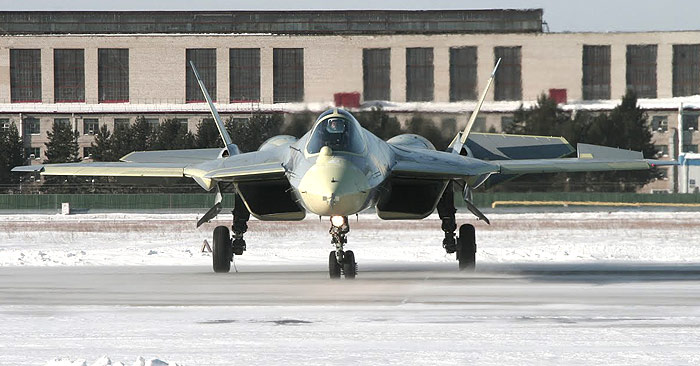
and I don’t think anyone has got close enough to the intake to confirm or deny what could be a possible engine face sighting. (if that’s where you are going)

KGBHow do you know that is the engine face and not the airflow modulator. (Jo Asakura claimed that due to the shape of the inlet it would have to have something like an airflow modulator to deliver an even pressure at the engine face). If that is an airflow modulator there is no way of knowing how much of the engine face would be visible behind it without it.
And the jet itself has to be identified. Which prototype it is and what was all changed since.


 Sign In