Chris, that is a much rarer Dragonfly, (only two flying in the world!) not a Rapide. Flown by Ryan Southam (DH90Dragonfly).
Yes, that is a genuine rotaty and a genuine propellor blade.
Sad news.
The Transavia Agtruk is positively pretty compared to the original design, the Bennett Airtruk however, which was designed and built by Bennetts Aviation at Palmerston North, NZ from old scrap Harvard parts. It was like the Transavia thing in layout (they bought the rights and tidied it up) but the Bennett’s design was radial engined. Sadly I don’t believe any exist today.
Gorgeous, I love it!
I am very much looking forward to next week, my first Wanaka airshow since 1993. Yay! I’m actually going.
Very nice photos Glenn, there are aircraft there I’d forgotten about and hope they’ll be there this time. I didn’t even know there was a Wessex operating in NZ too. Is it still here I wonder.
happy birthday Gary
Did you know this Bristol Freighter being discussed is a genuine Vietnam War veteran from it’s service with No. 41 Squadron, RNZAF? I hope it returns to it’s military colours once in preservation to reflect this rather than some dull civil scheme.
Or perhaps Sleaufighter… (ie slow)
I believe the director usually has a good hand in what the script writer does, and the producer (ie the one holding the purse strings) has an influence over everyone else in the crew. These twists happen in all such biographical films, very few escape merging of characters, or brushing over or making up of facts. I have studied a paper on this very thing at uni. Even the briliant Ghandi film had a few twists to make it more cinematically easy.
But in the case of The First of the Few, to me it seemed simply a case of they couldn’t be bothered researching the facts, and wanted instead to present some fictional romantic account of how the famous fighter came about. It’s probably good Mitchell never lived to see it.
I really like this Wade, yes it is unusual to see the aircraft flying out of the scene but it seems rather natural all the same, as your point of view is that of someone on the ground, watching them go off to war, so to speak. Great stuff.
It’s amazing how many hedges have apparently saved people from strafing. Most of the time we take them for granted.
Ian, for more on Arnold Ridley’s wartime exploits may I recommend my own article here
http://forum.planetalk.net/viewtopic.php?t=755&highlight=ridley
A further piece of trivia, Arnold Ridley was/is also famous for writing the West End production “The Ghost Train” and I believe he won the MM for his actions during the Great War.
That’s correct about The Ghost Train, one of many plays he wrote, many of which went on to be filmed. However I have never heard anything about him winning the Military Medal. He did get awarded the OBE for services to the theatre. Are you maybe thinking of his character of Godfrey, who held the MM? If you mean Arnold himself, I’m keen to hear details.
Dad’s Army actor Arnold Ridley was strafed in 1940 or early 1941 when he was walking along the road in his village of Caterham, on the way to the Savage Club. He had to throw himself into a ditch full of mud to avoid being hit. He later remarked that as it was a rare thing to be strafed at that time, when he arrived at the club no-one believed his story of how he got muddy.
In 1944 he was again a victim, this time of one of the first V1 flying bombs that exploded near him while he was in his garden, severely injuring him. After multiple wounds in WWI and WWII, plus these events it’s amazing he made it to 88 years old.
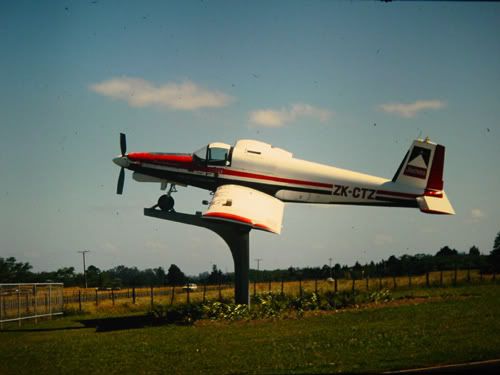
Here is a photo taken by my late Dad in the 1980’s of the Turbo Fletcher Prototype back in the days when it was gate guard to Hamilton Airport at Rukuhia.

For those who know little about this aircraft, it was one of two built to test the idea of fitting a turboprop engine to a Fletcher, which was converted by James Aviation, the pioneers of aerial topdressing. The other prototype crashed back in the testing days I believe. This however lead the way for the Cresco, a totally redesigned Fletcher concept with the turboprop and new, better structure. This in turn lead eventually to the enlarged version, the PAC750XL, a fairly new airliner/parachuting aircraft that’s becoming popular these days.
Well well, this is very interesting. The Turbo Fletcher prototype at Motat eh? The last I heard it was meant to be going to the Waikato Museum in Hamilton, which was after it was offered to the National Museum of Agriculture at Mystery Creek (a stone’s throw from Rukuhia where this was built) but they didn’t want it. Mystery Creek was totally appropriate for this aircraft, I don’t think Waikato Museum was. At least it’s not out of place at Motat as a third (?) choice.
I’m glad it is being looked after, but now I worry it will be stuck outside again (something Waikato Museum wouldn’t have done!) and once again deteriorate like before. James Aviation has done a nice job of restoration by the looks of it.
The bomber in the background is in fact an RB-34 Lexington, operated in New Zealand during the war by the RNZAF and called a Ventura in our service. The RB-34’s never operated in the Pacific campaign because they had the wrong radio gear and were not up to the standard of the later PV-1 Venturas used by the RNZAF in the campaign. These RB-34’s were used for training only, and some coastal patrol in NZ. This one spent most of its career at the Technical Training School in Nelson.