StevoJH
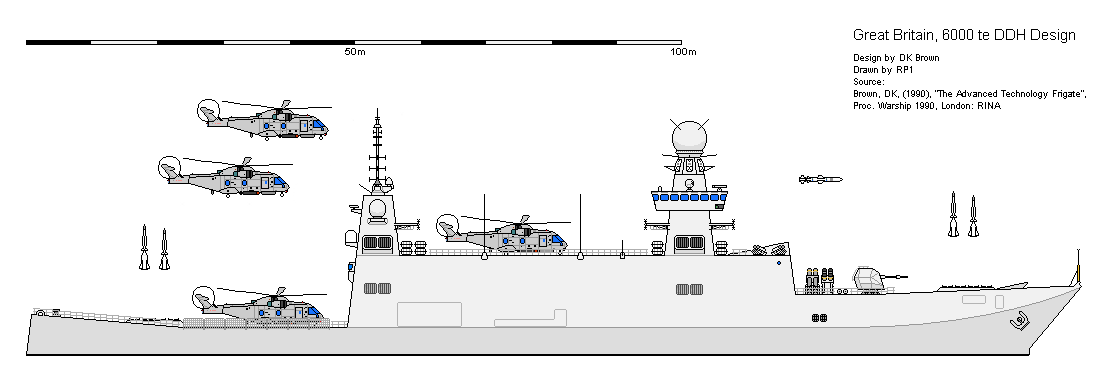
CIWS on the foredeck where you located it is a no go, they tried it on one of the T42B3’s but it got to wet (and that was back further between the gun and missile launcher). The Rear CIWS is surplus to requirements as it doesnt have the same arc of fire as the hanger mounted one. The VLS cells mounted there can go with the other ones on either side of the hanger, though personally i’d rather have a hanger capable of carrying two helicopters rather then one instead.
Also, gun in front of the VLS cells please.
StevoJH1. I) COMBO – ASTER 30 + CAAM with PAAMS or SAAM-ESD
2. C) ASTER 30 with PAAMS or SAAM-ESD
3. I) CAAM
Oh, and i’m sceptical about the numbers for SM2 and ESSM. Not to mention i’d rather stick with the system that the RN has already invested several billion pounds in its development.
StevoJHLook below it…..Nelson didnt have casemate guns
My guess, is that its either a Pennsylvania class, new mexico class or tennessee class battleship. The US had a habit of fitting its early battleships with very wet casemate mounted secondary batteries that were later either partly removed, or raised into the superstructure in later refits.
StevoJHThe short answer is “there isn’t one”. Harriers are long out of production (do the lines even exist anymore) and are woefully short on capability compared to the F-35. Frankly, I’m amazed at all the people getting their panties in a wad over things at this stage. This thing is going to be in service for 40 years. How ’bout we get it right instead of throwing in the towel in a massive panic at the first sign of everything not being a slam dunk for god’s sake? It’s almost nauseating the amount of terror a problem can invoke these days. Good thing many of these individuals weren’t working back in the fifties and sixties, they’d have all keeled over from heart-attack. (Soap box mode off. And this wasn’t directed at you Bgnewf 😉 ) If they were to throw the towel in now they’d just have to start over and the new costs would make these look like a bargain.
Maybe BAe have a production line of them sitting in the UK gathering dust somewhere from the last bunch they built in the mid to late 90’s if they didn’t build anything afterwards, but its unlikely.
If the F35B was cancelled the Royal Navy, USMC, Italian Navy and Spanish Navy would get very upset, especially considering they have invested money in the development of the aircraft. I’m fairly sure the RN has paid 5 or 10% of the development costs of the F35 program but i could be wrong (the figure of 3 billion pounds rings a bell for some reason).
StevoJHOne weight saving idea would be to use a lot of composites as per the Visby. Although it’s hard to calculate, it’s pretty obvious that the plastic Visby has a massive volume-to-displacement ration relative to steel 600t vessels?
Also, I found this interesting, inspirational even, sketch on Ship Bucket:
In order to gain the required structural strength for continuous ocean operations, a composite ships would be much heavier then a conventional ship. Remember that the Visby is designed for operations in the Littoral region.
As for that ship bucket image, its ugly, the forward VLS is in an impossible location, and i wouldn’t want to land on that top pad unless it was in perfectly calm seas with that radar platform right behind it.
StevoJHIt is not so clear, whether a GT powered carrier is a step backwards.
It offers some interesting possibilities for de-centralized installation on an all-electric ship.
I was being sarcastic, thats how the French Admirals apparrently considered a conventionally powered carrier, the French are unlikely to build another large carrier carrier to give a total of two, because they are supposedly building another pair of Mistral Class LHD’s.
StevoJHWell you never know, the French may find the cash somewhere down the line.
Yeah, but wasnt PA.2 the backup design after they realised they couldn’t afford their original plan? IIRC, they wanted a scaled up version of the De Gaule, including nuclear propulsion, after all, conventional propulsion is a backwards step:rolleyes:
StevoJHI think he was actually talking about the PA2 version of the CVF, i.e. the CTOL version, with the ability to operate anything the US currenty operates.
You mean the version that is likely to never see the light of day? :p
StevoJHScott
On those grounds definitely but I think the cost differential would be a bit more than an extra 4 hulls for the CVF-type design!. Especially if you put in whole-life costs!. Think more like, minimum, 22 or so.
When you get there you start looking at flexible response. Not all circumstances need the full weight of a CVN so sending a single US-PA2 (for want of better description) can be a much cheaper and more efficient response. Anywhere that needs a CVN is going to be better served by teaming two US-PA2s in concert. After all 1 CVW now is what 4 strikefighter sqdns plus an E-2 det and rotaries. A CVF can easily do 3 strikefighter sqdns plus the rest…maybe a few choppers light?.
You have:
1 x CVN – 4 fastjet sqdns and support plus 5000 crew or
2 x US-PA2 – 6 fastjet sqdns and 2 lots of support elements on circa 3000 crew.…plus you can cycle the conventional carriers to maintain a constant presence…or detach one and reallocate it in theatre to an alternate attack axis or whatever. Much greater operational flexibility. It doesnt work any smaller down than about PA2-size of course…you need the minimum deck and cats for the E-2’s but you dont need the CVN get comparable sortie rates and target effects.
True, plus in the case of the CVF, the only real weakness is the lack of an organic AEW aircraft along the lines of the E2 unless the RN develop one, probably using either the V-22 or the BA609.
The F-35B matches or almost matches both the current generation of Carrier aircraft and is almost a match for the F-35C, on paper at least. The CVF can probably also carry more aircraft then specified, just as the USN Carriers do not carry their full load. A CVF with an organic AEW capability and a FULL combat load would probably be a match for a USN CVN at the moment, though not if they increased their aircraft numbers to the maximum.
StevoJH1. C
2. B
3. N/A
StevoJHSingle choice, Tactom as it can fit into a Mk 41 strike length VLS, as can several other missiles, thus getting more bang from your buck.
Given deck space is going to be limited, you don’t want a pile of non-compatible missile systems each requiring its own unique launcher system.
Plus TacTom is in service with at least three navies that I am aware of, so it has a larger customer base and hence a larger industrial base.
Unicorn
I’m going to say, whichever one is most easily able to be fitted into a Sylver A70 VLS. With Sylver A70 you still have the option of firing Aster missiles. With Mk.41, the only RN deployed munition you can fire would be the Tactical Tomahawk. None of the new Generation RN warships will have the Illuminators to fire the SM family or ESSM, the main other missiles that Mk.41 can fire.
Edit:
1. A
2. C
3. D
StevoJHPlaneman
“Knock off them negative waves, Moriarty”!!!.
LOL!. No offense taken in the slightest. Spend a while fixing ships and twitchy guided weapons systems and that is what happens unfortunately. Struggling to try and make poorly designed bits of kit work when two minutes thought at the design stage wouldve made for efficient and simple operation gives you a hell of a perspective on getting things right from the kickoff.
Now there is a typical British solution at work!.
Design Authority: “The specs say full AAW capability”
Naval Architect: “Wont fit in the hull with all the other kit”
Design Authority: “What will fit that looks close enough?”😀
What your talking about is essentially dropping the Area AAW and ABM requirement in favour of a more modest, but quite adequate, self-defence fit. Which is every bit the right choice in the situation otherwise you cross over with the T45s and waste hull volume you need assigned to things that T45 cant do!. Namely – Carry LACM and as many choppers/UAV’s as possible.
Fully loaded T45 is close enough to 8000ton as makes academic difference. She could not do full Area AAW, carry significant numbers of LACMs and do ASW ops with multiple choppers. You would probably need a 12k ton trimaran for all that and it would be absolutely deadly – to the RN budget!. :diablo:
Nope if we’re stuck with trying to get all the missions specified on a T45-sized hull the only sensible way to do it is to start with a T45 hull, complete with PAAMS, ship a few angled box launchers for NSM somewhere and do the best job possible of expanding the hangar for a couple of Merlins.
In the case of the hanger, is there anywhere else on the ship where the boats can be stored? moving those would give enough room for your two merlins.
StevoJHAnd i think that would be adequate for most situations i’m not sure how many Royal marines there would be available for regular deployment because your not going to put a 100 troops on a ship just in case they are needed. 30-50 permanently embarked troops would be much more sensible and better use of resources.
30-50 is probably about the maximum you could realistically embark for any amount of time anyway, remember that it takes a specialized 30,000t ship (in the case of the future RAN Canberra) to carry 1,000 troops. Scaling that down, you could probably fit 150 embarked men on a 4,500t ship if you did not put any meaningful weaponry on it.
StevoJHYes i would agree that there should always be some capacity aboard a ship for soldiers. A 4000 tonne vessel could probably have accomodation for 140-150 quite easily but a total crew for a ship that size would not need to be any more than 80-100.
Erm, lets not get excited, probably a single platoon maximum.
StevoJHA VLS capable of fring VL Mica should be capable of firing CAMM.
Sure, but the VLS his image is showing looks like he has a VLS system hanging out under the roof of the hanger.


 Sign In