dark light

bri21

Forum Replies Created

Viewing 4 posts - 1 through 4 (of 4 total)
  • Author
    Posts
  • in reply to: Nuclear capable aircraft – what exactly do they need? #2352639
    bri21
    Participant

    I’ve heard that cooling systems and piping were sometimes required on nuclear capable aircraft.

    I think the Su-24M was an example of this (export models lacked this cooling system).

    Possibly. It depends entirely on the weapon design. Not heard of cooling on UK weapons tho’ where the opposite was sometimes the case. Red Beard for example had to be kept warm and within strict temperature limits, esp on the exposed deck of a carrier in Atlantic waters. Usually the problem related to the non-nuclear components, esp the HE implosion system. I believe an electric blanket was issued. Formula 1 cars keep their tyres warm in a similar manner.

    in reply to: Nuclear capable aircraft – what exactly do they need? #2353109
    bri21
    Participant

    In principle, all that’s needed to deliver a nuclear bomb is that it can be physically carried & released & the arming system on the bomb & the aircraft are compatible, i.e. exactly the same as for a conventional bomb.

    Yeah ……!

    Except that ordinary iron bombs don’t usually carry thermal batteries that have to be ignited, or ram-air generators that have to be unlocked, radar fuzes (for airburst at a precise height AGL) that (at one time) had to be warmed up prior to release, barometric fuzes, clockwork fuzes, (I know of one nuclear bomb that had all of these), thermionic valves that had to be warmed up before release, hydrostatic fuzes and impact/graze fuzes also.

    None of these features were needed to prevent unauthorised use, but only to ensure enemy countermeasures couldn’t prevent detonation. Not usually a concern with iron bombs.

    In addition, the electrical power needed to detonate a nuclear bomb is considerable. The capacitors that supply that power have to be charged up before release, and that cannot be done in a millisecond, and it usually comes from the aircraft power supply. So there are considerable differences. The safety items are additional.

    in reply to: Nuclear capable aircraft – what exactly do they need? #2353261
    bri21
    Participant

    SEF key

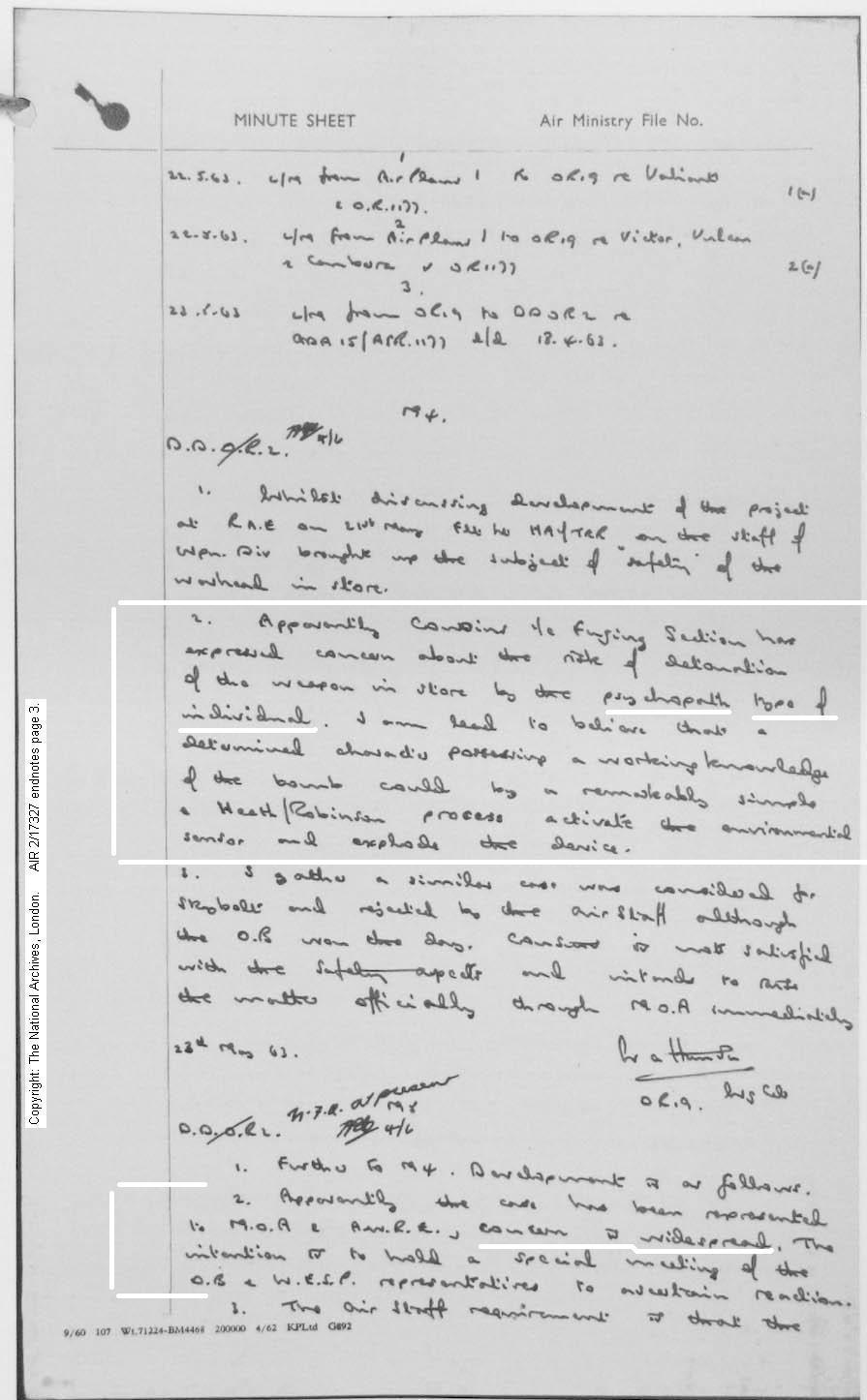
    Actually, the SEF key wasn’t included in the original specs or design. It was very much an afterthought after a guy named Cousins in RAE Weapons Dept spotted a flaw in the arming sequence.

    The two flip-out velocity sensors were included to prevent the arming sequence beginning if the bomb rolled of the back of a truck (or similar event). They triggered at approx 120 knots. So a prolonged fall was needed. However, Cousins spotted that they could be triggered by a

    PSYCHOPATH TYPE OF INDIVIDUAL

    and

    … a determined character possessing a working knowledge of the bomb could by a remarkably simple and Health Robinson process activate the environmental [speed] sensor and explode the device. …

    The speed sensors could be hot-wired.

    The actual original document is uploaded here http://www.nuclear-weapons.info/images/tna-air2-17327note_03-2.jpg signed off by a Squadron Leader Hampton of Operational Requirements 19. An individual not noted for pulling punches.

    Subsequent documents disclosed another related issue. Naval versions of WE.177 configured for use as depth bombs had the speed sensors disabled. They were triggered by hydrostatic pistols pre-set to a depth. Loaded on a heliocopter parked on a flight deck, should the weapon break loose, fall onto the deck, and then roll over the side, it could detonate at the preset depth. The Admiral (and all the little fishes) would be very unhappy.

    So the SEF key was the chosen solution. It placed a key-break in the circuit between the speed sensors and hydrostat pistols and the weapon’s thermal batteries.

    However, the reason it was chosen rather than a PALS system was because a PALS lock would take too long to develop and delay service entry, whereas the SEF lock (while acknowledged as almost worthless to stop a determined psycho) would keep the Whitehall bureaucrats and politicians happy that “something had been done”. When actually, the most effective safeguard was the two-man rule.


    in reply to: whats the difference between WE177 B and C #1809865
    bri21
    Participant

    Au Contraire

    The B model was deployed only in the UK, first with the V-force and later with the Tornado squadrons. NATO found the 450KT yield too high for a tactical nuclear weapon, that is why the C has ‘only’ 250KT…

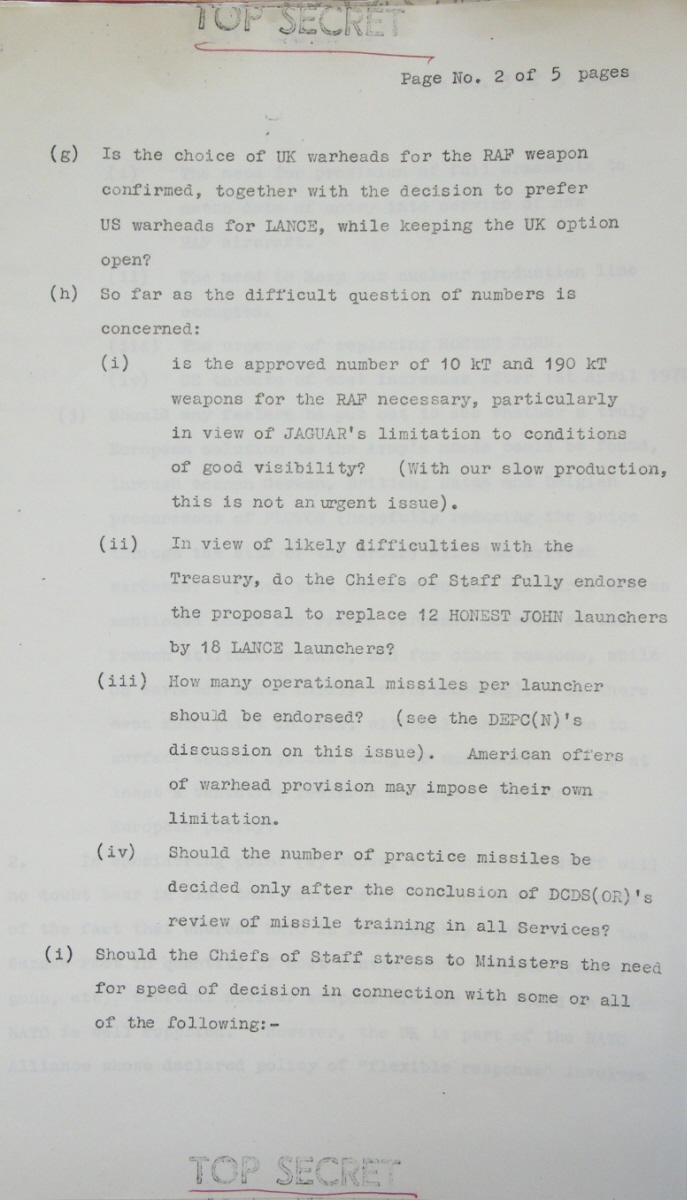
    The C Type was 190 kt not 250. This extract from the National Archives finally laid to rest that particular bit of the urban myths surrounding it.http://nuclear-weapons.info/images/tna-defe-11-470-e18-p3.jpg

    The C type was below 200 kt at 190 kt because NATO policy decreed a 200 kt upper limit for tactical weapons in Continental Europe.

    The use of the 450 kt Type B weapons was not confined to the UK either because they could be deployed elsewhere. Cyprus is one such place when the MEAF Canberras were replaced by Vulcans supporting the UK commitment to CENTO. See here http://nuclear-weapons.info/images/RAF-nuclear-frontline-Order-of-Battle-1966-94.PNG There’s also stuff in the archives at Kew that says they were deployed by VC.10 to Singapore by a westabout route for use by temporary detachments of Vulcans. Too laborious to dig it out just now and put on line. Trust me, it’s true.

    Seems incongruous now, but in those times Iraq and Iran fellow CENTO members were still friends with us, and we regularly overflew their turf with nuclear weapons positioning to FEAF

    For those wishing to look at the original archived source the ref is
    DEFE 11/470 E18 p3.

Viewing 4 posts - 1 through 4 (of 4 total)