 nazca_steve
Nice to hear from you on it Jim – check out the video link I posted – your memories on her are not far off. The legend appears to be a dayglo orange, and the overall shade of blue a deeper royal blue. Needless to say I have a soft spot for this scheme. If anyone out there was associated or worked with DH Motors during this development phase and remembers VN813/WH909, I’d love to hear from you.
nazca_steveThanks Fieldhawk. So the normal motion of the yoke on the elevators controlled the electric actuator then? Was this a pretty advanced feature for a 1940s era design?
I am a dedicated Canberra nut so you’ve no trouble convincing me she’s a beaut to look at! 🙂
nazca_steveThanks for that, Frank. Latest update is I just finished watching an old colour Farnborough DVD from Canada which showed a nice little sequence of her and so I have answered my own question.
That said, if anyone has any more info on it, such as specs, they would be much appreciated as I wouldn’t mind building a dedicated FS model of her one day.
Steve
Incidentally, I have the video clip here:
http://s12.photobucket.com/albums/a218/nazca_steve/?action=view¤t=VTS_01_1.flv
if anyone knows the serial of the chase Canberra flying with her – she is also painted in the same dark blue scheme as 813, implying she was on the De Havilland charge as well. Any input much appreciated
Steve
**UPDATE _ just sorted the mystery ‘chase plane’ – she was no chase plane but show stable mate really from DH Motors – WH909 fitted with a Gyron Junior in her port nacelle, and normal Avon in the right (!!??). Great detail here:
http://www.flightglobal.com/pdfarchive/view/1957/1957%20-%201302.html
read onto page 2 for some lovely detail about CCTV in the nav’s compartment in VN813! Not an everyday occurence but perhaps needed with a flipping great rocket in your belly!
nazca_steveSo does this mean the Decca Doppler was associated with the AS-30 firing systems? Excuse ignorance here, but I’m trying to understand what gave the B.15 the capability to launch this weapon over the 16. I’m guessing it needed some kind of look-down radar to target ships.
Can anyone help on this?
** UPDATE: done a bit of homework and realised the Decca Doppler was a radar nav aid, silly me 😉 But if anyone can shed some light on the AS.30 I’d love to hear it. All I know now is that it was optically guided via flares on the bum-end of the missile and adjustments were made via radio. Lovely stuff.
nazca_steveAnyone have any solid photos of the B(I).8 gun pack when fitted?
I’m also curious as to what types of bombs were fitted and how many could be carried in the two types of weapons bays (i.e. the full Brit bay without the gunpack and the B-57 bay).
I think a search on airliners.net for B(I).8s or a trip to Les B’s site will get you what you need for the gun pack. Bomb load wise, the full Brit bomb bay was 6x 1,000lb, or 10x 500lb. I believe the total armament weight on the Mark 8 was 10,000lb, that said, 6,000 internal stores, and 2,000lb underwings leaves you short of 2,000lb elsewhere. These are just the main bomb types though, as I think it could accomodate a range of target markers and larger amounts of practice bombs. B-57…hmm, I’m sure someone can do some digging on that.
**UPDATE, here’s a natty little view of the gunpack as fitted on a B(I).8 model kit which might help you:
http://www.ipmsusa2.org/reviews2/aircraft/details/qb_48/qb_48_canberra-gunpack.htm
nazca_steveIt is very interesting about the twin SNEBs I agree, honestly I don’t know why (if that was the case) Brit Canberras were not fitted for this, but I am in touch with a former B.15/16 navigator who was in the Akrotiri Strike Wing and I’ll ask him what he knows on it. You are right though – twin pods could not have been a weight problem.
I do have to agree with the earlier commets about the B(I) shortcoming on the lack of bang seat for the nav- on that one the B-57 clearly trumps the UK version. One other B-57 innovation I thought rather natty was the downwards firing guns in the bomb bay (I forget which variant that was, but I think it was Vietnam era).
Phantom, earlier you asked about the amount of space the B(I) gun pack took up- this was the just a little less than half the full bay, and special door were fitted forward of this to store 3x 1,000lb bombs or other stores. Les B confirmed these were a b***er to fit 🙂
nazca_steveAny idea what variety of munitions that were carried on the two underwing pylons in the Mk.8?
Some sources state that each pylon could take a 1,000-lb. bomb. Is that a misprint with each pylon capable of carrying a 500-lb. weapon thus being 1,000-lbs. total?
I’ve seen a picture of an Argentine Canberra with dual rocket pods on each pylon for a total of four. Could Brit Canberras carry four rocket pods?
This is a great topic, just stumbled across it. I have to echo Tim’s comments about it being hard to palette the idea of the US version being an improvement over the classic Brit design, but I have read many a comment to say this was true, simply from the tandem standpoint alone. That said, the offset angle of the B(I) canopy must have been nice for pilots.
One thing I think was a major improvement was the rotating bomb bay, reducing drag etc over target. Very natty idea, that. Interesting concept putting the MGs and later cannons in the wings too – from an interdictor standpoint, I wonder however if it was better to have massed firepower in a belly gun pack vs. spread in the wings? I guess having the bomb bay free though meant you could carry full internal bomb load over the 3x in the B(I).8 with gun pack.
Regarding Argentine Canberras with the twin Matras, I am not sure if the later B.15/16 Canberras could also carry this arrangement; it’s possible and perhaps someone can confirm. Even so, I doubt the earlier B(I) types could carry twin rockets like that. The Roland Beaumont book states 1x 1,000 bomb on each underwing plyon, or Sneb rocket launchers but not 2x on each station.
You Tube had a cracking documentary about the B-57 development a while ago which talked a lot about a lot of this discussion. Here is a small nice B-57 vid with some early colour footage of the RAF B.2 pattern model arriving in the US:
http://www.youtube.com/watch?v=JBsqy5MFFDY
nazca_steveNot just the RAAF, the Royal Navy used them too in Malta, and I think they did fairly well as drones, at least the one shot down by a Sea Slug did its part in blowing up well! This one looks uncannily similar in terms of colour scheme and markings to the RN drones.
nazca_steveGood point SpitfireMan, perhaps the reason the controller had the climb too steep.
nazca_steveYes, I can see all of this now 😮 It’s like the wool has been pulled from eyes! Port it is, and yes, the mangled metal does look bent back by a strong force. Must have been a very glancing blow not to damage further into the tip.
Sorry for dragging this debate out further than it should have been, it’s just from my angle (pun intended) it seemed to make perfect sense (doesn’t it always). I honestly have been trying to second guess myself but I just could only see starboard. I’m quite glad it’s over though, lol. 🙂
nazca_steveOK, I think I finally understand what you’re getting at now. You’re saying rotate the photo 90 degrees right…well if that is it, then I am well and truly wrong and I see the port wingtip. 😀
Honestly the whole time I’ve been losing my mind because of the way the photo was orientated and because of the angle the writing was written. If only I had seen this from early on! You all must have a lot more perceptive eyes than me!
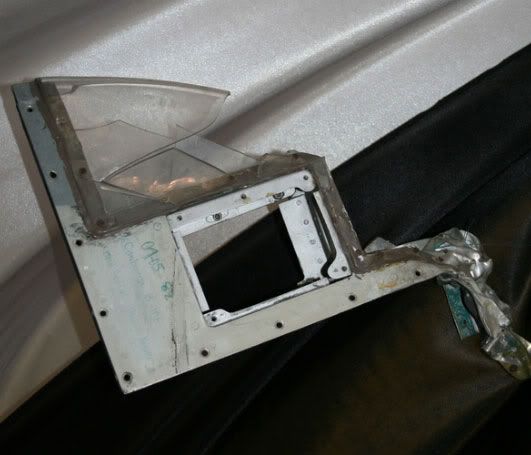
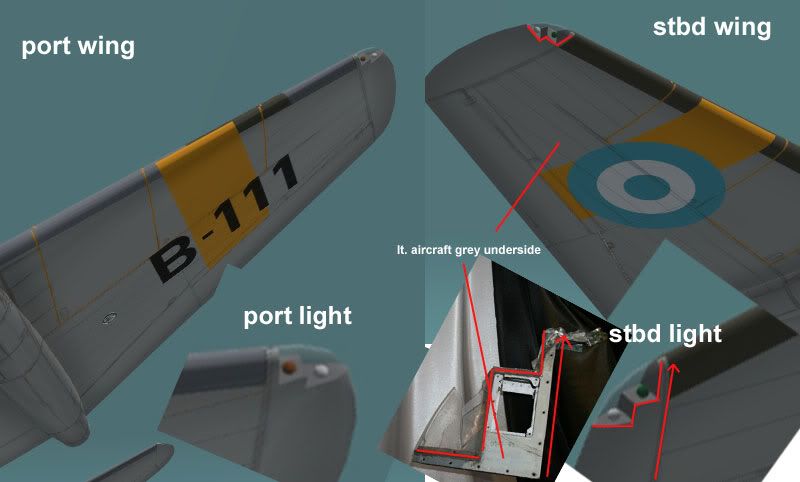
nazca_steve“Unlikely to have damaged the starboard wingtip in a turn to port, you see.”
Not unless the starboard wing was raised during in this port turn (as it surely would be?) and it was indeed damaged by a missile impact.
Whatever the case, I don’t know, I was not there. Take your pick of whether you believe the port or right wing was damaged – I guess the only way you could know for sure was to ask the chaps at Puerto Deseado that repaired it after its emergency landing.
I know the judge and jury have decided on the photo showing port side; fair enough, but I’ll leave this small mockup I did for my closing argument!
Cheers,
Steve
nazca_steveChaps, I think there has been some confusion. B-108 was part of the two flight group that went out on 1st May. It was damaged either by missile impact or clipping the sea on a low level turn. B-110 was shot down that day in the other flight group. B-108 was repaired on return to an emergency airfield, I forget the name, and presumably the torn wingtip ended up in the museum after that.
On the 13th June, B-108 was shot down by the Sea Dart and crashed into the sea. There was some discussion of whether any wreckage was found on land near where she went down, but no evidence has come up so far. There was also discussion regarding if she was severed in two, but accounts from Captain Pastran, the survivor (now decesased) show he was able to throttle back the engines and deploy airbrakes, implying the airframe was all in one piece still.
nazca_steveIf someone does go up there, see if there is any chance you can get in the cockpit – I’m going to be building the B.5 for FS2004 later this year, and it might be the only way to find out what the Mark 5 looks like inside. We know it was a target marker with radar but I’m not sure if there is nose cone access from inside…thing is it has a flat panel, so I’m at a loss where the radar went
I’d be very grateful if any pics can be taken 🙂
nazca_steveChaps, glad to see this is getting some coverage here. B-108 ended up in the sea but all reports do not indicate it severed in mid-air. Only two Canberras were shot down, which you have both mentioned as B-110 and B-108. B-108 was damaged, either by impact on the sea or a possible missile impact on 1st May, but the jury is still somewhat out on that one.
I have covered the loss of B-110 and 108 here:
http://www.nazcastudios.com/grupo2/malvinas-conflict-uk.html
and there was a superb thread on it starting here:
http://forum.keypublishing.co.uk/showthread.php?t=81971&page=15
and also over at Zona Militar, including much discussion on what happened to B-108 on the 1st.
http://zonamilitar.com.ar/foros/showthread.php?t=18569&page=10
Going back briefly to the possibility of a fake, again I doubt it, but who knows. Seems unlikely to me. That piece is from a photo taken from an Argentine museum.


 Sign In







