Vanshilar
Well, there is the Super Hornet.
*Slinks away from this thread.*
VanshilarCETC: UAV Swarm Prototype
I think the funniest part is the uplifting, inspirational music, followed by the explosion at the end.
VanshilarObviously the X-32! Huehuehue
(where’s that picture when you need it)
BTW depending on how you define it, the P-51 could be a contender as well. Though some might say that the underside intake is sufficiently far back that it doesn’t look like a chin, but…something else.
VanshilarThis is the “PAK-FA News, Pics & Debate Thread” not the “U.S. and Russian economy and politics” thread. If you want to engage in nationalistic chest-pumping there are other places for that purpose.
VanshilarI have never heard Rafale associated with a claimed Mach 1.4 supercruise. Mach 1.4 for Typhoon, yes. I do recall reading of Mach 1.2 for Rafale.
So this was apparently taken at the 2011 Bourget Air Show:
http://rafalefan.e-monsite.com/medias/files/fiche-rafale-le-bourget-2011.jpg
It basically says the Rafale can supercruise at an unspecified Mach for an unspecified distance with 4 missiles and a 1250 L belly drop tank, and that the Rafale M can supercruise at Mach 1.4 for an unspecified distance while carrying 6 air-to-air (MICA) missiles.
Vanshilarthey should’ve either went all in with the Sukhois or all in with the Rafales. not both. waste of money on logistics and training
Depends on how much tech they’re getting out of it.
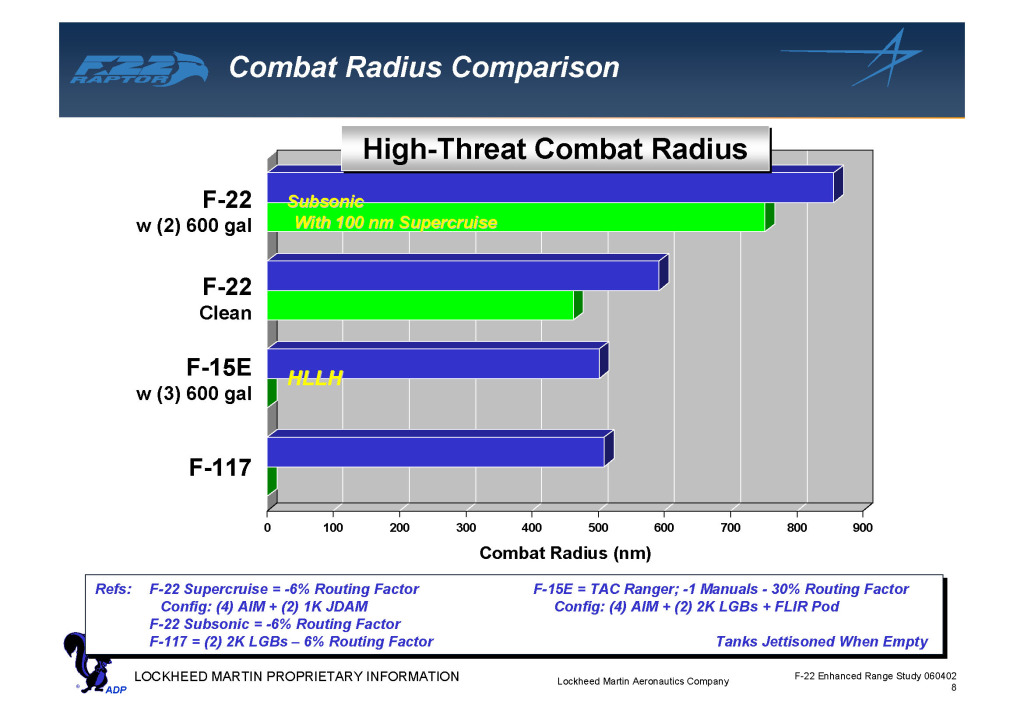
VanshilarAt the risk of re-railing this thread, it does seem interesting that the Rafale has significantly longer range than the F-35 (896 Nmi compared with 751 Nmi in air-to-air configuration).
On the other hand, that’s with the Rafale using 3 external fuel tanks. The source doesn’t actually say what type of fuel tank was used, but it’s likely either the 2000 L tank or the 1250 L supersonic tank. I’m guessing the former is more likely. You can see what they look like here. The link says that the three fuel tanks weigh an additional 14,700 lb, which seems kind of high to me since 3×524 gallons (at 6.8 lb per gallon) means 10,690 lb of fuel, so it’s saying there’s an additional 4000 lb of weight for the fuel tanks and their associated pylons. Not sure if that’s accurate, or if something’s wrong with my assumptions. The Rafale carries 10,300 lb of fuel internally according to the link. By comparison, the F-35 gets its 751 Nmi range from 18,250 lb of internal fuel.
However, nothing in life is free; assuming about 1500 lb of missiles (since it’s air-to-air config) and pilot, this means the Rafale weighs about 48,000 lb at takeoff, with a max thrust of 34,000 lb, for a thrust/weight ratio of 0.71, compared to the F-35 which would be at a weight of about 49,000 lb but a thrust of 43,000 lb so a higher thrust/weight ratio of 0.88. Their wing loadings would also be similar, the Rafale at 98 lb/ft^2 compared with the F-35 at 106 lb/ft^2. The Rafale also presumably won’t be supercruising or pulling 9 G’s with those fuel tanks.
And of course to give you an idea of the F-35’s range, the Typhoon with 3 fuel tanks (presumably 1000 L each) had pretty close to the same combat radius as the F-35 does on internal fuel: 747 Nmi versus 751 Nmi.
It would’ve been interesting to compare the Rafale using 2 fuel tanks instead, since that would probably give a range similar to the F-35’s on internal fuel, but of course Lockheed did the comparison so it was their choice.
VanshilarThis thread go on so much longer than i expected
Well I was originally going to bring up that a bigger example of Lockheed shooting themselves in the foot is calling F-35’s Mach 1.2 for 150 miles on mil thrust “technically not supercruising” given how that term is used by every manufacturer nowadays, but I had decided not to.
Vanshilarthey sell the thing. the further it goes the better. you claim their numbers include “hidden routing”.. up to you to prove it. If you can find a reliable source to support your claim, fine, if not, stop polluting this thread with your imaginary nonsense
Actually routing factor is a fairly common thing when they consider the combat radius, or at least for the USAF anyway. For example, the source for the F-22’s combat radius on wikipedia includes a -6% routing factor.
I guess since they didn’t explain the combat profile in detail for the F-35 in the SAR, it’s hard to know how much of a routing factor it includes. Looking at the JSM infographic, an additional factor is that the combat profile may include a leg at a non-optimal altitude for cruise, which is less fuel-efficient. I guess so the given range is really just a minimum range available, i.e. the actual max range may be somewhat farther if it is allowed to fly at optimal altitude or there are fewer SAM’s in the way (and thus less routing) or whatever.
VanshilarYes but that still seems like quite a big difference. I also assume (though may be wrong on this) that the mission profile assumes the bombs are dropped halfway through (i.e. on the target), so the Super Hornet is carrying them (and taking the weight and drag penalties) for only half the mission.
For the F-35, is its mission profile for the SAR also assuming some time at low altitude, or is it purely high altitude for the 625 Nmi? I *think* there was something about changing its mission profile a while back to meet the SAR requirements, I’m not sure if this was it.
VanshilarActually I’m surprised the Super Hornet can hit 816 Nmi in air-to-air, since in its SAR, with 3 fuel tanks, 4 1000-lb bombs and 2 Sidewinders, on an interdiction mission its combat radius was given as 489 Nmi. Those bombs must be pretty draggy.
(By comparison, F-35 carrying 2 2000-lb bombs and 2 AMRAAMs have a combat radius of 625 Nmi according to its latest SAR.)
VanshilarUSAF has recognized that one shortfall of Gen 5 jets is lack of deep magazines. Therefore, USAF is pushing to provide communications links between Gen 5 and Gen 4 jets to allow them to operate as a team against a near peer IADS. The idea is the Gen 5s would provide targeting to the Gen 4s and beat down the immediate threats to Gen 4s. The Gen 4s, with their “deep magazines”, would engage the targets ID’d by the Gen 5s using standoff weapons. This means there must be a greater emphasis on standoff weapons like JSOW, SDB and Spear (>50 miles), and less emphasis on JDAMs and LGBs because of short range, even if those weapons are tossed from high speed (<25 miles).
It’s worth noting that Gen 5 jets can carry external weapons as well. “Lack of deep magazines” is only when they’re in VLO configuration, in which case Gen 4 jets have a magazine of exactly 0. For example, using external hardpoints, the F-35 is given as having a payload of 18,000+ lb, compared with 17,750 lb for the Super Hornet and 17,000 lb for the F-16. It can fly much farther on internal fuel though, thus fewer hardpoints will need to be taken up by fuel tanks, which reduce the useful weapons load.
So it’s more likely that this is to keep the Gen 4 planes relevant while the Gen 5 planes are still entering service, in the “medium term” where the services are still using a mix of Gen 4 and Gen 5 planes. Once the Gen 4 airframes have reached their lifetimes and are retired, Gen 5 planes can take over the “deep magazine” role, and can get closer to their targets even with their deep magazines than Gen 4 planes ever could due to the platform’s stealth.
VanshilarOh I’ve missed this post:
Thanks. Yeah I knew that shockwaves (and thus drag) are caused by an increase in curvature, which is why supersonic aircraft tends to have bigger fineness ratios. As far as I can tell, the overall argument was that the plane’s overall lift was proportional to the plane’s overall planform area (total airplane area when viewed from the top, i.e. not just the wings), while the plane’s overall drag was proportional to the plane’s overall frontal area (area when viewed from front), and those proportions were roughly the same. I’m guessing the logic was that fighter planes cruise near the transonic regime, and thus wave drag dominates, and that you can use the ratio of areas as a proxy for the plane’s fineness ratio, which determines how much drag it has, and thus how efficiently it cruises at these speeds. Perhaps there’s also a confusion in translation of the terms fineness (ratio of length to maximum width) and finesse (glide ratio, which is also the lift/drag ratio).
This is me speculating on the logic, the guy never gave the logic when asked, just said that you could do this. It was used to claim that Russian planes (which tend to be long and flat) have very good lift/drag ratios and thus good range, while U.S. planes like the F-35 tend to be stubby and thus bad lift/drag ratios and thus bad range. (Their performance graphs have not been released so this is used as an estimate.) I would have thought that, since these planes cruise in the subsonic region, a long and flat plane actually has quite a bit of drag due to skin friction drag. IIRC the lift/drag ratio of PAK FA was claimed to be close to twice that of the F-35 on the basis of a plane planform area vs frontal area comparison. I asked you because I didn’t know if there was some branch of aeronautical theory that I didn’t know about that could allow someone to make this claim (ratio of areas as proxy for lift/drag ratio for determining cruise and thus range).
VanshilarYour generalisation may be true, but T/W is nothing without L/D. You brag about 10% wing loading, or 10% higher T/W all the while ignoring the fundementally low L/D of delta wings.
At the risk of sidetracking the thread a bit, can you say something about the legitimacy of using the ratio of a plane’s planform area (total area when viewed from the top) with the plane’s frontal area (total area when viewed from the front) as a proxy for its optimal lift/drag ratio (i.e. L/D or C_L/C_D) for use in estimating cruise conditions and range of the aircraft? Thanks.
VanshilarThe SR-71 certainly had design features intended to reduce its radar signature, including chines, canted tails, RAM at leading/trailing edges, and a number of others.
That radar systems could still detect it doesn’t mean it wasn’t stealthy — stealth just reduces the range at which you can be detected, tracked, shot at, etc. Given that the SR-71 was never shot down, I guess you can say the stealth was successful, although it’s more due to a combination of stealth, height, and speed, not stealth alone. It really depends on what you mean by “stealth aircraft”. You might call it first generation stealth if you want.


 Sign In